What to Show an Officer on Alberta Public Land
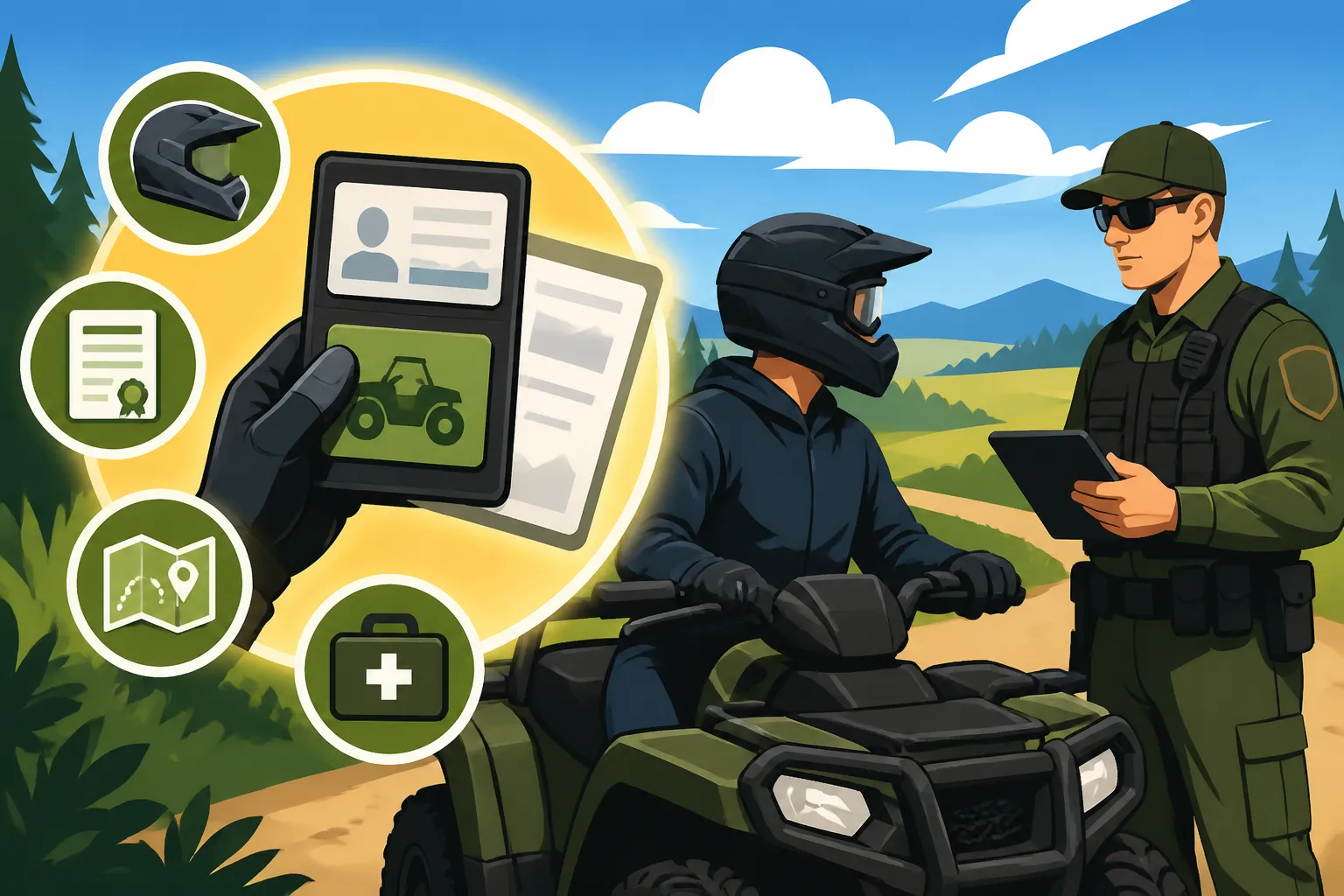
An encounter with an officer on Alberta public land is easier when your paperwork is ready and you know what it proves. The key items are usually your machine’s registration and insurance, along with required safety equipment. This guide explains what to carry, what an officer may check, and what to do if you ride as a visitor, camp, or have a document you cannot produce.
The documents to have ready
For an Alberta-registered ATV or side-by-side being ridden on public land, prepare to show the vehicle’s registration certificate and proof of insurance. Keep them accessible, not buried in a trailer or locked in a vehicle far from where you are riding.
Registration and insurance answer different questions. Registration identifies the machine and its registered owner; insurance provides evidence that the machine is insured for the use in question. Having one does not replace the other. Before heading out, check that the certificate matches the machine you are riding and that your insurance applies to the location and activity.
A useful way to prepare is to make a small document kit for each machine:
- The registration certificate for that machine
- Current proof of insurance
- A phone with enough battery to access any backup records
- Identification, especially if you may need to confirm your identity or age
- Any permit or confirmation that applies to a particular trip or activity
Keep the official documents in a waterproof pouch or another protected place. A clear sleeve from a local outdoor shop or Amazon can help prevent paper from getting soaked or torn, but it should not make the certificate difficult to remove and present. If you carry paper in a cargo box, secure it so it cannot blow away when the lid opens.
Registration certificate
The registration certificate is the document that connects the machine’s identifying information to its registration. Make sure the details correspond to the ATV or UTV you are operating. If you own several machines, do not assume that the certificate for one covers the others.
The machine also needs to display its plate as required. A certificate in your pocket does not make an incorrectly displayed or missing plate irrelevant. Check that the plate is present, securely mounted, and easy to see. Alberta no longer uses a registration sticker on the plate; the plate itself remains important. For background on the public-land requirement, see Alberta Registration Before Riding Crown Land and Alberta Plate Placement on a Machine.
Alberta registration documents may be issued or accessed electronically, but a phone image is not always a substitute for a paper certificate. Follow the document instructions and carry the printed certificate when required. If you need the practical details, see Alberta Digital Certificates Must Be Printed. Do not count on cell service, a working screen, or a charged phone as your only way to produce paperwork.
Insurance proof
Carry proof that lets an officer identify the insured machine and verify the policy information. The evidence may be a paper insurance document or another format accepted under the applicable rules, but do not assume that an insurer’s app will load at a remote staging area. Save or print the information in advance, and confirm with your insurer what form of proof you should carry.
Insurance must be appropriate for the machine and the activity. A policy that covers a machine at home or on private property may not necessarily answer every question about riding on public land. Ask your insurer whether the coverage applies to your planned use and location, and whether any exclusions matter. More detail is available in [Alberta Insurance Proof on Public Land].
Identification and age
There is not a general driver’s-licence requirement for every ATV rider on public land just because they are operating an off-highway vehicle. Still, having identification available can make it easier to establish who you are if an officer needs that information. It can also help if an age-related rule is relevant.
Treat identification as useful trip equipment, not as a substitute for registration or insurance. If you are riding with a child or youth, plan for an officer to ask questions about the rider’s age and who is supervising. The rules for younger riders are discussed in Alberta’s Minimum Age of 14 on Public Land and Alberta Rules for a Supervising Adult.
What an officer may inspect on the machine
An officer’s check can involve more than paperwork. The machine itself may be inspected for required equipment and compliance. The exact focus depends on the location and circumstances, but riders should be prepared to show that the vehicle is properly equipped and that safety components work.
Before leaving home, do a walk-around rather than waiting for a roadside check to reveal a problem. Test the lights, look at the exhaust system, check the plate, and make sure the machine is in safe operating condition. A part that worked last weekend may have been damaged during transport or riding.
| Item | What to check before the ride | Why it may matter during a check |
|---|---|---|
| Registration plate | Present, secure, and visible | Helps identify the registered machine |
| Headlight and tail light | Working and not obstructed | Required equipment may be checked on public land |
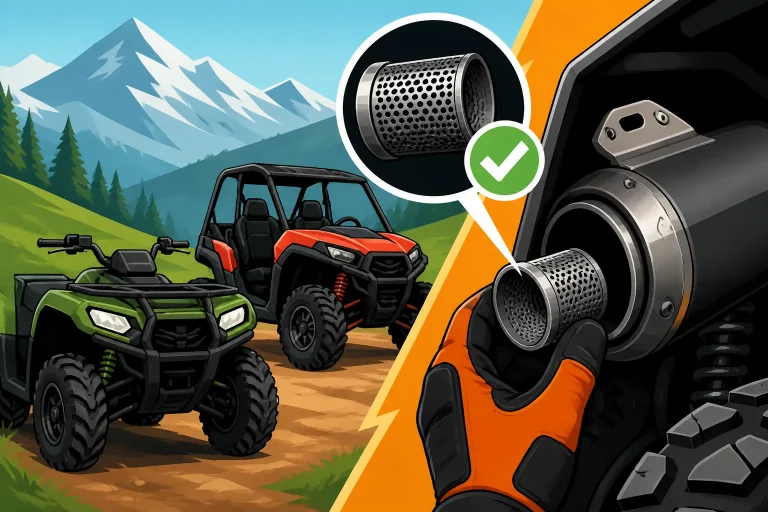
| Spark arrestor | Fitted and appropriate for the exhaust | Fire prevention and equipment compliance |
| Muffler and exhaust | Not modified in a way that violates applicable rules | Noise and exhaust requirements may apply |
| Helmet | Meets the applicable standard and fits the rider | Helmet rules apply to many public-land rides |
| Insurance evidence | Matches the machine and is easy to produce | Confirms coverage for the trip |
| Registration certificate | Matches the machine and is available in the required form | Confirms its registration |
Lights, exhaust, and spark arrestor
Do not assume that daylight means lights are unimportant. Check that the headlight and tail light work and remain visible from the angles an officer or another trail user might approach. Mud, a loose connection, a broken lens, or a failed bulb can turn a quick inspection into a problem. Review Alberta Requires Working Head and Tail Lights and Alberta Lighting Rules on Public Land for the equipment details.
The exhaust system is another item worth checking before every trip. A damaged or altered muffler can create noise problems and may put the machine out of compliance. Do not rely on “it sounds fine to me” as your test. Read Alberta Bans Modified Exhausts and Alberta Requires a Spark Arrestor if you are unsure whether a modification or replacement part is acceptable.
A spark arrestor should be present and in suitable working condition. A machine that has had exhaust work, a replacement muffler, or other modifications deserves an extra check. If you are not sure whether the part qualifies, ask a qualified repair shop or confirm the applicable requirements before riding.
Helmet and rider safety
On public land, helmet rules apply to many riders, with specific exemptions in some circumstances. A helmet should fit correctly and meet the required standard; a helmet that looks sturdy is not necessarily compliant. Check for the appropriate certification label and make sure it has not been damaged in a crash.
Carry a helmet for every rider who needs one, including passengers. Do not assume a passenger is covered by the operator’s equipment or that a side-by-side’s rollover protection automatically removes the helmet requirement. Rules can depend on the vehicle, the rider, and the circumstances. See Alberta Helmet Law on Public Land and Alberta CSA Helmet Standards for more detail.
What can be checked in practice
An officer may look at the plate, examine safety equipment, ask to see documents, or ask questions about where you are riding and who is operating the machine. A useful overview is Alberta Equipment Checks by Officers. Keep in mind that an inspection is not necessarily a sign that you have done something wrong; it may be part of routine enforcement or a response to conditions in a particular area.
If the officer points out a defect, listen carefully and ask a calm, specific question if you do not understand what needs attention. Do not try to resolve a technical dispute by arguing from memory on the trail. Note the requirement, the location, and any follow-up information you are given, then check the rule or seek qualified advice after the ride.
Rules that depend on where and how you ride
“Public land” does not mean every route, trail, road, or open area is available to every machine. Access may depend on land designation, closures, trail designation, local rules, and the type of vehicle. A registration certificate does not give permission to use a closed trail or a route that is not open to your machine.
Before a ride, check the current map and the rules for the area. Look for closures, designated routes, vehicle-size limits, seasonal restrictions, and any special instructions. If the route passes through a grazing lease, private property, or an active industrial area, separate access rules may apply. Permission to enter one portion of a route does not automatically authorize riding everywhere along it.
Keep a map or other reliable route information available, particularly where mobile service is unreliable. A downloaded map can help you confirm whether you are still on a designated route, but it does not replace current official closure information. If you use a phone for navigation, protect it from water and impact, and have a backup plan for when the battery runs low.
Public land is not the same as a public road
Riders sometimes assume that a ditch, road allowance, forestry road, cutline, or lease road is automatically open to OHVs. That is not a safe assumption. The legal status of a route and the rules that apply can differ, even when it appears to be an ordinary track. Check the route before riding rather than relying on tire marks left by other users.
Likewise, an officer may ask where you started, where you are going, or whether you have permission to use a particular route. A map, a landowner’s permission where relevant, or a record of an event permit can help explain your plan. Do not present a map as proof of access if the route is closed or permission is required and you do not have it.
Camping passes and other permissions
A public-land camping pass, where required for the area and type of camping, is not an ATV registration and does not authorize riding on a closed route. These are separate requirements. If you are camping, confirm whether the place you plan to stay is covered by a pass requirement and whether any other camping conditions apply. See Alberta Public Lands Camping Pass and [Alberta Random Camping Rules Explained].
A pass connected with camping should not be treated as a general OHV trail permit. Alberta does not have a blanket trail pass that replaces registration, insurance, or access rules. If an officer asks about your camping arrangements, be ready to show whatever proof applies to that particular trip, but do not assume a camping document settles a question about riding access.
There may also be special permissions for an organized event, commercial activity, filming, or other non-routine use. If your trip is more than ordinary recreational riding, check the specific permit requirements in advance. Keep the approval confirmation accessible and make sure its conditions match what your group is actually doing.
If you ride into Alberta from another province or country
Visitors should not assume that Alberta’s requirements are either identical to their home jurisdiction or completely separate from it. Recognition of out-of-province registration and insurance can depend on where the machine is registered, the rider’s status, how long the machine is in Alberta, and the trip circumstances.
If you are visiting, carry the registration and insurance documents from your home jurisdiction. Make sure they identify the machine you brought and that the insurance applies to riding in Alberta and on the type of land you plan to use. You may also need to show how long the machine has been in the province or confirm that you are a visitor rather than a new Alberta resident.
Start with Alberta Registration for Visiting Riders and Thirty Consecutive Days and the Clock. The time limit is not a detail to guess at based on the number of weekends you have ridden. If your stay is getting longer, or you have moved to Alberta, check whether you now need Alberta registration and what steps apply. A visitor’s exemption should not be treated as a permanent alternative to registering a machine here.
For visitors from a neighbouring province, a useful preparation checklist is:
- Carry the home-province registration certificate for the machine.
- Carry proof of insurance and confirm the policy covers the planned Alberta use.
- Be ready to explain when the machine entered Alberta if the length of stay matters.
- Check whether your status has changed because you have moved or settled in the province.
- Confirm that the route is open to your machine, regardless of where it is registered.
- Review local equipment and rider rules rather than assuming your home rules cover every issue.
An officer may ask for information that helps establish the machine’s registration status or whether a visitor rule applies. Keep answers factual. If you are unsure whether your situation qualifies, resolve that before riding rather than trying to interpret a time limit beside the trail.
Insurance is still a separate check
A home-province registration document is not proof of insurance. Carry both. Even if your home jurisdiction does not require the same insurance for every off-road use, Alberta’s public-land requirements may still affect your trip. Confirm coverage with your insurer before leaving home, and ask whether the policy has restrictions for public land, competition, commercial use, or particular types of machines.
If the machine is borrowed or rented, make sure you have the right documents for that arrangement. The owner’s assurance that the machine is insured is helpful but is not a replacement for checking what proof is available and whether the policy covers your use. A rental operator should explain what is covered and what you are expected to carry.
A calm, practical response during an officer check
If an officer signals you to stop, slow down safely and pull over where you will not block the trail or create a hazard. Turn off the machine when appropriate, keep your hands visible, and give the officer space to speak. If you are riding in a group, ask everyone to stay stopped and avoid surrounding the officer.
Answer questions directly and respectfully. If asked for a document, present the relevant certificate or proof rather than handing over an entire bag of unrelated papers. If you do not understand what is being requested, ask politely for clarification. A calm exchange is more useful than trying to win an argument while standing beside a running machine.
A practical sequence is:
- Stop in a safe place and make the machine secure.
- Listen to the officer’s request before reaching into a pocket or storage compartment.
- Present the registration or insurance proof that was requested.
- Answer factual questions about the machine, route, and trip as clearly as you can.
- If you do not understand a direction or alleged issue, ask for it to be explained.
- Record relevant details later, especially if you receive a warning, ticket, or instruction to correct a problem.
Do not rely on the idea that a weak cell signal excuses missing paperwork. An officer may not be able to wait while you search an insurer’s website or try to recover a password. That is why a printed certificate and offline insurance information are sensible backups.
At the same time, do not assume that every paper you carry is automatically required for every ride. The point is to have the documents most likely to matter and to understand which ones apply to your circumstances. An officer’s question about a specific pass or permission may relate to your location or activity, not to every OHV rider across the province.
If you disagree with an officer’s interpretation, stay courteous and ask how to follow up. Avoid making sudden movements, refusing to identify the document you are showing, or escalating the encounter. If you receive a ticket, read it carefully and use the stated process and deadlines to respond. The trail is rarely the right place to settle a complicated legal question.
Prepare your document kit before leaving home
A simple checklist is more reliable than trying to remember everything at the staging area. Keep one copy with your riding gear and another with your trip plan. If more than one machine is in the group, label each document set clearly so the wrong certificate does not end up with the wrong rider.
Before loading the machine
Check the machine identification and compare it with the registration certificate. Confirm that the plate is installed and readable. Verify that the insurance document matches the machine and is current for the trip. If you have recently bought, borrowed, or repaired the machine, pay particular attention to whether the paperwork and equipment are still in order.
Then check the route. Confirm that the area is open, that your vehicle class is allowed, and that you understand any seasonal closures or access conditions. If your ride involves camping, an event, guiding, or another special activity, check the separate requirements for that activity. Do not leave that research until you reach the trailhead.
Pack documents so they stay usable
Paper documents should be protected from rain, mud, and abrasion. A small waterproof pouch can work, as can a sealed compartment that remains accessible without tools. Amazon is one place riders look for inexpensive document sleeves, but the important features are legibility, a secure closure, and easy access—not the brand or appearance.
Do not put the only copy of a certificate somewhere that can be lost with a detached bag or damaged in a rollover. A second copy stored separately can be useful, but it does not necessarily replace the official document when a particular format is required. If you use digital backups, save them for offline access and keep the phone charged. A backup screenshot is useful for reference; it should not be mistaken for a document format that the rules require you to print.
A small laminated checklist can also help when several people share machines. If you make one for the group, keep it general and verify the current requirements before each trip. You can print or laminate one at home, or find document and gear organizers through retailers such as Amazon. Avoid putting sensitive personal information on a checklist that will be left in a staging area.
Do a last-minute equipment check
Before the first ride of the day, ask one person to walk around each machine and another to check the documents. That quick division of tasks catches common oversights: a dead tail light, a loose plate, insurance proof left in the truck, or the wrong registration certificate packed with the machine.
A final check should include:
- Registration certificate and plate
- Insurance proof
- Working headlight and tail light
- Required helmet for each rider
- Suitable exhaust and spark arrestor
- Route and closure information
- Camping or event documentation, if applicable
- Identification and emergency contact information
If you ride often, keep a dedicated document wallet with your gear rather than rebuilding the kit each weekend. A compact tether or organizer may keep your phone and paper records from disappearing into a cargo box; Amazon and outdoor retailers offer many versions, but choose something that is secure and practical for your machine. Whatever you use, make sure it does not interfere with safe riding or access to controls.
When the paperwork is missing or does not match
If you discover before the ride that the registration certificate is missing, the insurance proof is expired, or the machine details do not match, postpone the ride until you have resolved the issue. Do not assume that a purchase receipt, text message, or photo of an old document will fix a registration problem. If a recent sale or ownership change caused the mismatch, contact a registry agent or the insurer before taking the machine onto public land.
If you are already on a trip, stop riding the affected machine until you know what the applicable rules require. Call the registry agent or insurer when you have service and ask for clear instructions. A friend’s certificate, another machine’s plate, or a document for the same model is not a substitute for the correct paperwork.
Being prepared does not mean carrying every document imaginable. It means knowing which requirements apply to your machine, your rider, and your location—and being able to show the relevant proof without turning a routine check into a scramble. For related practical guidance, What an Officer Checks at a Staging Area explains the kinds of checks riders may encounter when they arrive to ride.
Disclaimer
This article is for general informational purposes only and does not constitute professional advice. Laws, prices and regulations vary by location and change over time. Consult a qualified professional for guidance on your specific situation.