Alberta’s Public Lands Camping Pass
A weekend ride can be planned down to the last fuel stop and still go sideways when you reach a public-land camping area without the right pass. Alberta’s Public Lands Camping Pass is easy to confuse with an OHV registration or trail permit, but it serves a different purpose. This guide explains when it applies, how to get ready, and what else to check before camping and riding.
What the Alberta Public Lands Camping Pass Covers
The pass is for camping, not for riding
The Alberta Public Lands Camping Pass is connected to camping on certain public lands. It is not a registration plate, proof of insurance, or general permit to ride an ATV or side-by-side. That distinction matters: having the camping pass does not make an unregistered machine legal to ride, and having valid OHV registration does not replace a camping pass where one is required.
Think of the trip as two separate checklists. One covers the people and machines: registration, insurance, equipment, and whether your planned route is open to OHVs. The other covers where and how you will camp. A pass can satisfy one part of the camping checklist without resolving any of the riding requirements.
Before you head out, review Alberta Has No OHV Trail Pass alongside the rules for your destination. A camping pass should never be treated as blanket permission to use every road, trail, cutline, or campsite in the area.
It applies only where the requirement is in effect
The pass is not a universal camping pass for every public land in Alberta. The requirement applies to designated public-land areas, including parts of the Eastern Slopes and Willmore Wilderness. Boundaries matter, and a destination name alone may not tell you whether the particular campsite or route is inside an area where the pass is required.
That can make a trip around the foothills feel confusing. A group may stage near one community, ride through a zone, and camp farther along without realizing that the land-management rules have changed. Check the applicable land map and camping information for the exact location rather than assuming that every nearby public campsite has the same requirements.
For regional context, see Alberta Passes Along the Eastern Slopes. If your plan takes you toward Grande Cache or Willmore Wilderness, check the pass requirement and current access information for that specific area before choosing a camp.
It is not the same as a campground booking or other pass
A Public Lands Camping Pass should not be confused with a reservation at a developed campground. A reservable campground may have its own booking process, fees, and conditions. The public-lands pass is associated with camping on the designated lands where the pass requirement applies; it does not reserve a site or guarantee that a particular location is available.
It is also separate from the Kananaskis Conservation Pass. That pass concerns vehicle access and parking at locations where it applies, while the Public Lands Camping Pass concerns camping on designated public lands. A trip that crosses different land-management areas may involve more than one set of rules.
If you are combining a ride and an overnight stay, confirm each requirement independently: land access, campsite rules, machine registration, insurance, and any applicable vehicle or camping pass. For a closer look at the other pass, use [Alberta Kananaskis Conservation Pass Rules].
Who Needs a Public Lands Camping Pass
Adults should check the requirement before camping
The pass rules are especially important for adults planning to camp on public land in a designated area. Do not assume that one person’s pass automatically covers everyone in a group, or that the person who booked the trip has completed every adult’s requirement. Confirm who needs a pass for the way your group will camp.
This is an easy detail to miss when several friends are travelling in separate trucks and arriving at different times. One person may have handled the campsite plan while another assumes the pass is included in a vehicle registration or trailer booking. Sort out the requirement before leaving home, and make sure each person who needs a pass has obtained the appropriate one.
The pass requirement is not a substitute for checking whether camping is allowed at the exact spot. A pass does not override a closure, authorize camping in a prohibited area, or guarantee access through private or restricted land.
Children and mixed-age groups need a separate check
Families often ask whether children need their own pass. The answer depends on the applicable rules and the child’s age, so check the official guidance before relying on an adult’s purchase to cover a family group. Do not infer the rule from the number of people in a vehicle or the number of tents at camp.
This is particularly worth checking when a family has teenagers who are travelling with friends, or when adults and children are arriving in separate vehicles. Write down who is camping, where they will sleep, and which pass requirement applies to each person. That small bit of planning can prevent a frustrating conversation at the staging area or campsite.
For the age-specific question, see Do Alberta Kids Need a Camping Pass?. Keep this separate from youth OHV rules: a child’s camping-pass status does not determine whether they may operate a machine or what supervision is required.
A pass does not grant land access
Possessing a pass does not mean you may camp anywhere you find a flat patch of ground. Land status, closures, designated camping locations, fire restrictions, and access permissions still matter. A route that looks open on a general road map may cross a restricted area or lead to land where camping is not allowed.
This distinction is important in working landscapes. A trail may pass near grazing land, industrial activity, or a private parcel, and the presence of other campers does not prove that overnight use is permitted. Check official maps and local notices, respect signs and gates, and do not treat a pass as permission to cross land that requires separate authorization.
When your route passes through a grazing lease or private property, check the rules for that land as well. Alberta Private Land Permission and Alberta Grazing Lease Access Rules can help clarify why access permission and a camping pass are separate questions.
Choosing and Getting the Right Pass
Compare the available pass options
The pass system offers different durations, so match the option to your actual trip rather than choosing based on a quick guess. A short stay may call for a shorter-duration option, while repeated trips may make an annual option more practical. The best choice depends on your dates, the areas you expect to visit, and the rules attached to each option.
| Planning question | What to check |
|---|---|
| How long are you camping? | Match the pass duration to the trip and confirm its start and expiry times |
| Will you return later? | Compare a short-duration pass with an annual option |
| Where will you camp? | Confirm the location is within an area where the pass is required |
| Who is in the group? | Check who needs a pass, including children and adults arriving separately |
| How will you show proof? | Confirm what proof is accepted and keep it accessible |
| What else does the trip involve? | Check OHV registration, insurance, access rules, and any separate pass |
Do not rely on an old screenshot or a friend’s memory for the current options. Pass details and purchase information can change. Check the official pass information before paying, especially if your trip begins late in the day or continues across several dates.
For a direct comparison of the duration choices, read Alberta Three-Day Pass vs Annual Pass and Alberta Camping Pass Cost. The important point is not simply which option looks cheaper; it is whether the option covers the trip you actually intend to take.
Get a WIN card if you need one
A Wildlife Identification Number, or WIN, is used within Alberta’s licensing and pass systems. If the purchase process asks for a WIN, take care of that step before you are standing in a parking lot with limited signal and a group waiting to leave. New users may need to create or locate their account details first.
Keep your WIN information somewhere secure and easy to retrieve. It is useful to distinguish the number itself from the pass confirmation: one identifies the account, while the other shows the camping-pass purchase or status. Having one does not automatically prove that the other has been completed.
If you are unsure whether you have a WIN or how to find it, see Alberta WIN Card Explained and Alberta WIN Card Lookup. Check the official purchasing steps for the accepted process and required information rather than trying several options at the trailhead.
Buy through the official process and check the details
Use the official Alberta pass-purchasing process and read the confirmation carefully. Check that the pass is associated with the right person, that the selected duration fits your dates, and that you understand when it becomes valid and when it expires. A small date or account-entry mistake can matter when a trip starts late or runs longer than planned.
If another person is buying passes for the group, ask them to share the confirmation or explain how each camper can show proof. Do not assume that a pass purchased on one account will automatically appear on another person’s phone. Confirm the arrangement before you leave.
The published cost and purchase steps are the best place to confirm current figures. Avoid planning around an old price listed in a saved note or a previous trip report. For the practical steps, use How to Buy an Alberta Camping Pass.
Planning a Camping and OHV Trip Together
Treat camping permission and OHV permission as separate checks
A camping pass does not register your ATV or UTV. Before using public land, make sure the machine meets Alberta’s registration and insurance requirements for the situation, and carry the necessary proof. Requirements may differ for residents, visitors, farm use, and machines that are staying on private land, so do not assume one rule covers every rider.
The route itself needs checking too. A public-land area can contain designated trails, closed routes, roads with restrictions, and places where motorized access is not allowed. An open camping area does not mean every path leading to it is open to your machine. Look for current route information and obey gates, signs, closures, and local restrictions.
If you are new to the paperwork, [Alberta Insurance Proof on Public Land] and Alberta Registration Before Riding Crown Land are useful companions to your camping plan. Keep the camping-pass question on its own checklist line so it does not get lost among machine documents.
Check separate passes and area-specific requirements
One trip can involve multiple rules because Alberta’s public lands are managed in different ways. Depending on where you travel, you may need to check camping-pass requirements, OHV registration and insurance, land-access rules, camping restrictions, and a separate conservation pass. Do not buy one pass and assume it covers all the others.
For example, a group riding near the foothills might have a valid camping pass for a designated public-land area but still need to check whether the staging location falls under a different vehicle-pass system. A family staying at a developed campground may need a reservation even if they also plan to visit nearby public land. The specific destination determines which requirements apply.
Build a simple trip sheet with the name of each area, the planned camp, the staging location, and the rules you have confirmed. This works better than trying to remember a collection of similar-sounding passes after a long drive.
Carry proof where you can reach it
A confirmation is not much help if it is buried in an email account you cannot open without cell service. Save the proof in a way you can access offline, and keep a second copy if practical. Follow the official instructions about what counts as acceptable proof; do not assume that a purchase receipt, account screen, or verbal confirmation is interchangeable.
A waterproof pouch or document sleeve can protect a printed confirmation and other paperwork from mud and rain. Some riders use a small folder in the truck and a separate copy in their riding gear. If you order accessories through Amazon, check the dimensions and closure style so the item fits your papers and stays usable in the conditions you expect.
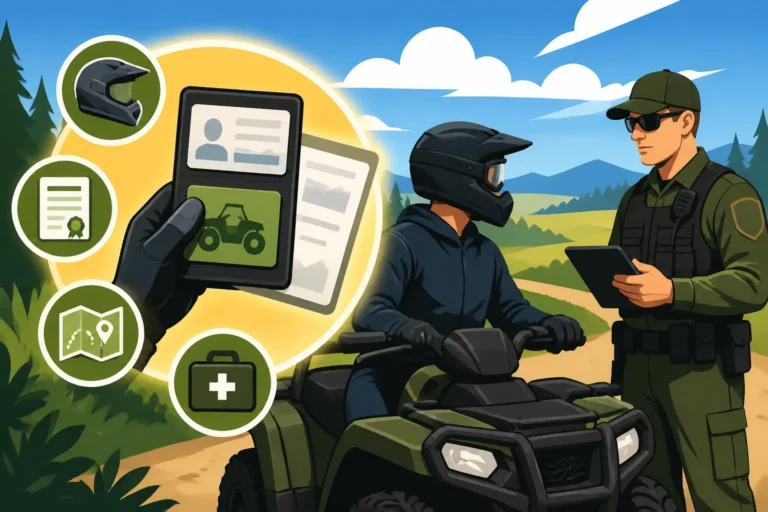
Do a final document check before leaving home: camping-pass proof, registration, insurance, identification, and any maps or route information you need. A tidy document kit will not replace legal requirements, but it makes it much easier to respond calmly if someone asks to see your paperwork.
Camping Rules Still Apply After You Buy the Pass
Confirm where camping is allowed
The pass does not identify a campsite for you. Check the land-use information for the area and confirm where camping is permitted, whether sites are designated, and whether temporary closures or restrictions apply. A broad regional map can help with orientation, but it may not answer the detailed question of whether a specific clearing is an acceptable place to camp.
This matters in busy areas where campers and OHV riders use the same staging corridors. A spot that looks convenient beside a trail may be too close to a facility, outside a permitted camping area, or part of a restricted site. When in doubt, choose a clearly authorized location and verify the rules instead of relying on tire tracks or other people’s tents.
For related planning, review [Alberta Camping Away From Recreation Areas] and Alberta Camping Distance From Facilities. These details are easy to overlook when the group is focused on finding a level place to park trailers and unload machines.
Respect duration limits and relocation rules
A camping pass does not erase limits on how long you may stay in one place. Check the applicable time limit and any relocation requirements for the land you are using. If your plan involves staying several nights, moving camp, or returning to the same area, make sure the arrangement complies with the rules rather than assuming that changing a tent’s position counts as relocating.
The practical version is simple: note your arrival date, the location, and the deadline to move if a limit applies. Groups can lose track of this when they take separate vehicles, add an extra night, or shift camp only a short distance. Keeping a written note prevents a casual extension from becoming an avoidable problem.
See Alberta’s 14-Day Camping Limit for the broader duration question. Confirm how the applicable rule works for your specific place and circumstances, because a general limit should not be treated as permission to camp in an otherwise restricted location.
Leave a low-impact campsite
Good campsite habits protect the area and make it easier for other visitors to enjoy it. Use durable ground, keep vehicles and machines where they are allowed, and avoid damaging vegetation or creating new tracks around the site. Do not leave garbage, food scraps, or broken gear behind, even if the area already looks rough.
Fire rules can change with conditions, and a camping pass does not authorize a campfire when a restriction or ban is in effect. Check the current fire information before you travel, and follow local requirements for fire use and extinguishing it. If a restriction is announced during the trip, adapt the plan rather than assuming it does not apply to an established camp.
Pack out what you bring, keep noise considerate, and leave gates and shared facilities as you found them. When you are riding in a group, make sure everyone understands the campsite plan. A clean, quiet departure is one of the most practical ways to keep public land usable for the next group.
Common Trip Scenarios and What to Check
A weekend trip to the Eastern Slopes
Suppose your group is driving from Calgary toward the foothills for a weekend of riding and camping. Start by identifying the exact land area and campsite, then confirm whether the Public Lands Camping Pass applies there. Do not assume that every place west of the city uses the same rules or that the name of a nearby staging area defines the boundary.
Next, check the selected pass duration against your arrival and departure times. Confirm which adults need a pass, how children are treated under the rules, and what proof each person should carry. Then handle the machine side of the trip separately: registration, insurance, equipment, and which routes are open to OHVs.
The evening before departure, save maps and confirmations for offline access. A remote staging area may have weak or no cell service, and downloading the map at home is more reliable than trying to do it beside a trailer with everyone waiting. If you use Amazon to find a waterproof phone case or document pouch, test it before the trip rather than discovering at the trailhead that it is awkward to open with gloves on.
A multi-night stay near Willmore Wilderness
For a longer trip near Willmore Wilderness, begin with the area’s current land-use information and confirm both camping and riding access. The public-land camping pass requirement is only one part of the plan. Longer stays also make duration rules, route conditions, weather, fuel planning, and emergency communication more important.
Decide where the group will camp each night and how far each day’s ride will take you. Avoid assuming that you can camp wherever the riding day ends. A route may pass through areas with different access conditions, and a remote-looking spot is not automatically an authorized campsite. Check maps and local information before you commit to a route.
If the group splits between machines or vehicles, assign one person to keep the key details: campsite locations, pass proof, emergency contacts, and the expected return time. Store an offline map and printed backup where they will stay dry. A dry bag purchased through Amazon or a local outdoor shop can help protect papers and electronics, but it is still worth carrying a paper map for a trip where signal may be unreliable.
Visiting Alberta from another province
Visitors should not assume that an out-of-province plate or camping permit replaces Alberta requirements. Check the rules that apply to your residency, the length of your stay, the machine, and the land where you plan to ride or camp. Registration, insurance, and camping permission are related trip-planning tasks, but they are not interchangeable.
If you are bringing a machine from British Columbia, Saskatchewan, or elsewhere, confirm what documents you need before crossing into Alberta. Make sure your group understands where the camping-pass requirement applies and how to show proof. A visitor who is prepared with the right documents is less likely to lose time sorting out paperwork at a remote staging lot.
For the camping side, start with the designated-area map and the official pass information. For the machine side, review the appropriate visitor rules, such as [Alberta Reciprocity for Visiting Riders]. Check each issue on its own; a valid home-province registration does not answer every Alberta access question.
A Practical Pre-Trip Checklist
Before you leave home
Work through the following list while you still have reliable internet access:
- Identify the exact camping location and confirm whether the Public Lands Camping Pass applies.
- Check whether the planned campsite is allowed and whether any closures or restrictions are in effect.
- Choose the pass option that covers your intended dates and verify the start and expiry details.
- Confirm who in the group needs a pass, including adults and children.
- Obtain or locate any required WIN information.
- Save the pass confirmation and relevant maps for offline access.
- Check OHV registration, insurance, required equipment, and route access separately.
- Identify any additional vehicle or area-specific pass that may apply.
- Review fire restrictions, camping duration rules, and any local notices.
- Share the plan and document responsibilities with everyone travelling in a separate vehicle.
This list is deliberately repetitive about separating the requirements. Many avoidable problems happen because a rider has “the pass” but means a different pass from the one the situation calls for. Naming each item—camping pass, OHV registration, insurance, route permission, and any vehicle pass—makes it easier for the whole group to confirm what is actually done.
At the staging area and campsite
Before unloading machines, take a moment to confirm that you are at the intended location and that access is open. Check signs, gates, and notices rather than following the vehicle ahead of you. If a closure or restriction conflicts with your plan, stop and choose a legal alternative.
Keep your documents accessible, but protect them from water and dirt. A second copy of important information can be useful when phones lose power or a person in the group has the only working device. If you keep a printed map in a document folder or pouch, make sure it is readable and not so tightly packed that you cannot use it quickly.
At camp, stay within the permitted area, follow fire and waste rules, and keep vehicles from damaging the ground. Before leaving, check that everyone has collected food, trash, gear, and personal items. A quick walk-through of the site is faster than returning later to retrieve something or leaving a mess for the next visitors.
Questions Riders Commonly Ask
Does the camping pass let me ride my ATV or UTV?
No. The camping pass concerns camping where the requirement applies. It does not register a machine, provide insurance, or authorize you to ride a particular trail. You still need to meet the applicable OHV requirements and confirm that the route is open to your type of machine.
It also does not grant access across private land, a closed road, or a restricted area. Treat the camping pass as one item in a larger trip plan, not as a general licence for all public-land activity. If you are unsure whether a trail is open, confirm it using current land-management information before riding it.
Do I need a pass for every public-land campsite in Alberta?
No single assumption works for every public-land campsite. The pass requirement applies to designated areas, not automatically to all public land throughout Alberta. The exact location and type of camping matter, so check the applicable map and rules for your destination.
A developed campground may have a separate reservation or fee system, while a public-land camping location may fall under different requirements. Confirm the details for the place where you intend to sleep rather than relying on the name of a nearby town, trail, or staging area.
Does one pass cover the whole group?
Do not assume that one person’s purchase covers everyone. Check the official rules for who needs a pass and how the pass is associated with the camper. This is particularly important if adults arrive in separate vehicles, children are travelling with different adults, or the group plans to split during the stay.
Before departure, make a list of the people who are camping and confirm their status. If one person is organizing the purchase, have them explain how each camper can show proof and what to do if someone arrives later.
Can I rely on a phone to show my pass?
Use the official instructions to determine what proof is accepted, and prepare for weak service. Save the confirmation or other proof in a form you can access offline. If you plan to use a phone, charge it before leaving and consider a backup battery, but do not assume that a live login will work at a remote site.
A printed backup can be helpful when a phone is damaged, dead, or unavailable to the person who needs to show the information. Protect paper documents from rain and mud, and keep the backup with the relevant person rather than leaving everything in one vehicle.
What should I do if my trip plans change?
Recheck the pass details and land rules if you change dates, add nights, move to another camping area, or take a different route. A pass chosen for one duration or location may not resolve the requirement for a changed plan. Also review any updated closures, fire restrictions, or access notices before proceeding.
If you are uncertain whether the existing pass still fits the revised trip, use the official pass information or contact the appropriate authority before leaving. It is much easier to confirm the rule while you have a connection than to discover a mismatch after setting up camp.
The simplest reliable approach is to confirm the land, people, dates, and proof separately. That way the camping pass does the job it is meant to do without being mistaken for an OHV permit, a campsite reservation, or permission to ride anywhere.
Disclaimer
This article is for general informational purposes only and does not constitute professional advice. Laws, prices and regulations vary by location and change over time. Consult a qualified professional for guidance on your specific situation.