Alberta Kananaskis Pass Exemptions
If you’re taking an ATV or side-by-side into Kananaskis, it’s easy to mix up the Kananaskis Conservation Pass with OHV registration, trail access rules and camping permits. The key distinction is that the pass applies to certain highway vehicles parked at designated locations—not to every person or machine on a ride. Here’s how to tell what applies to your trip.
What the Kananaskis Conservation Pass covers
The Kananaskis Conservation Pass is associated with eligible highway vehicles parked at designated provincial parks and public land recreation areas in Kananaskis Country and the Bow Valley corridor. It is not an all-purpose permit for anyone entering the region, and it does not replace registration, insurance or permission to ride an OHV.
For ATV and UTV riders, the practical question is usually not whether the quad needs a pass. It is whether the truck, SUV or other highway vehicle used to reach the staging area needs one. An OHV is treated differently from the highway vehicle carrying it.
| Item or person | Is a Kananaskis Conservation Pass generally the relevant requirement? | What to check instead |
|---|---|---|
| ATV or side-by-side being ridden off highway | No separate Conservation Pass is generally required for the OHV itself | OHV registration, insurance and local riding rules |
| Truck or SUV towing an OHV | It may need a pass when parked at a designated location | Current pass requirements for that parking area |
| Passengers in the towing vehicle | Passes are not bought separately for each passenger | Whether the vehicle is covered by a valid pass |
| A group arriving in several highway vehicles | Each vehicle’s coverage matters | Which vehicles are registered to the pass or passes |
| Camping during the ride | The Conservation Pass does not by itself authorize camping | Applicable public-land camping rules and any required camping pass |
The distinction is important because being exempt from the Conservation Pass does not mean an OHV is exempt from Alberta’s other rules. Riders may still need registration and insurance, and must follow restrictions on where and how they can ride. For an overview of the vehicle-specific point, see Why a Quad Does Not Need the Conservation Pass.
The pass also does not give a rider permission to use every road, trail or staging area. Access depends on the land designation, the route and any current closure or local rule. Start with Alberta Kananaskis Conservation Pass Rules and check the rules for the place where you plan to park and unload.
Which parts of an ATV trip may be exempt
The clearest exemption for an OHV trip is that the ATV or side-by-side itself is not the highway vehicle for which the Conservation Pass is generally collected. That does not automatically exempt the tow vehicle. If you drive a pickup to a designated parking area and leave it there while riding, the pickup’s pass requirement must be considered separately.
The OHV being ridden
An ATV or UTV used on an authorized off-highway route does not generally need its own Kananaskis Conservation Pass. That answer concerns only this pass. It does not answer whether the machine is registered, insured, equipped correctly or allowed on a specific route.
Before leaving, confirm the machine’s registration and insurance are in order. Riders should also check whether the route is open to their vehicle type and whether a local rule limits access to designated trails. The broader distinction between registration and land access is covered in Alberta OHV Trails: Riding Public Land.
The tow vehicle and other highway vehicles
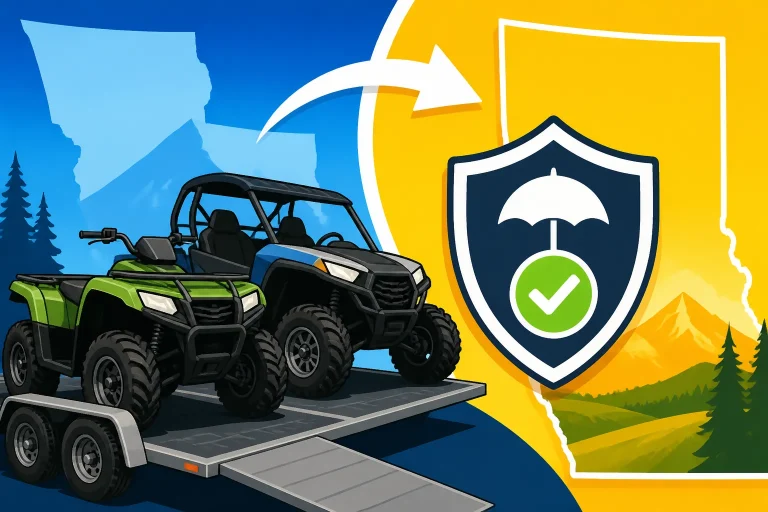
A truck towing an ATV remains a separate vehicle for pass purposes. So does a second truck driven by another member of the group. The fact that both vehicles are carrying exempt OHVs does not make the highway vehicles exempt.
Check the pass coverage against the specific vehicles you plan to bring. Do not assume that buying or displaying a pass for one vehicle automatically covers every vehicle in a convoy. Pass coverage can depend on the program’s current terms and how the vehicles are registered to it. If the group is travelling in more than one vehicle, sort this out before reaching the parking area.
Passengers are not separate pass purchasers
The Conservation Pass is tied to vehicle parking, rather than being a ticket for each person in the vehicle. A passenger riding along in a covered truck does not ordinarily need to buy a separate pass just to be a passenger.
That does not mean a passenger is exempt from every other rule. For example, helmet and passenger requirements for the OHV apply to the people riding the machine, not to the pass status of the truck. Check the rules relevant to your passengers and vehicle before the ride.
Other exemptions and special circumstances
Do not rely on a general claim that a particular vehicle, driver or trip is exempt unless the current program rules clearly say so. Exemptions can be narrow and depend on details such as the vehicle’s type, use, registration or the location where it is parked. A vehicle that qualifies for a special exemption at one site may not qualify under the same conditions elsewhere.
If you believe a disability-related or other formal exemption applies, confirm the required documentation and eligibility conditions with the official pass program before travelling. Having a placard or a particular kind of vehicle does not make it safe to assume that no pass is required. Keep any required proof available, and check whether the exemption applies to the actual vehicle and parking location in your plan.
Common trip situations and what to verify
A quick review of your itinerary can prevent the most common mistake: applying the OHV exemption to the truck as well.
You tow an ATV to a staging area
Identify the exact staging area and check whether it is a location where the Conservation Pass applies. Then check the pass status of the tow vehicle. The ATV may not need its own Conservation Pass, but the truck parked at the lot may.
Do not rely only on a sign or pass check you remember from a previous trip. Parking rules, access arrangements and closures can differ by location and may change. Where a Kananaskis Pass Actually Gets Checked explains why the parking location matters.
Your group brings several trucks
Make a vehicle list before the trip. For each truck or SUV, record its licence plate and confirm how it will be covered. If vehicles are arriving separately, each driver should know whether their vehicle is covered and what proof to have available.
This is especially useful when friends share a staging area but travel in separate vehicles. A pass associated with one vehicle should not be treated as a group pass unless the current terms explicitly provide that coverage.
You unload, then leave the tow vehicle parked
Unloading the OHV does not change the status of the truck. It remains a highway vehicle parked at the site, so check whether the pass requirement applies there. The fact that the truck is not being driven on the OHV trail does not, by itself, settle the parking requirement.
You camp as well as ride
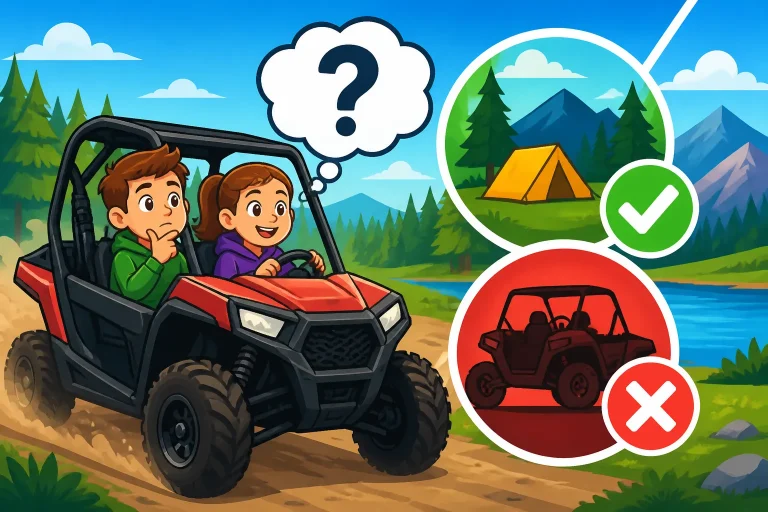
A Kananaskis Conservation Pass is not a camping permit. Depending on where you camp, separate rules may apply, including restrictions on the type of site, length of stay or whether a camping pass is required. Read Alberta’s Public Lands Camping Pass before assuming that a Conservation Pass covers an overnight stay.
Riding access and camping access can also be governed by different rules. A trail being open does not necessarily mean camping is allowed beside it, and a lawful campsite does not automatically make every nearby route open to OHVs.
You are unsure whether a spot is in the pass area
Check the named parking site and its location rather than relying on a broad description such as “Kananaskis.” The region includes different kinds of land and facilities, and the pass applies at designated locations, not simply because a trip is somewhere in the mountains.
If the site is unclear, confirm it through current official information before leaving home. Also check for closures and local access restrictions, especially when your route includes public land, a recreation area or a staging lot.
How to check before you ride
Use this short process to separate the pass question from the OHV rules:
- Name the parking location. Identify where the tow vehicle will be parked, not just the trail or riding area you hope to visit.
- Check whether that location is covered by the Conservation Pass program. Use current official information for the specific site.
- List every highway vehicle in your group. Confirm pass coverage for each one rather than assuming the group shares a single vehicle’s status.
- Treat the OHV as a separate compliance check. Verify registration, insurance, equipment and route access. The Conservation Pass exemption does not replace these requirements.
- Check camping separately. If you are staying overnight, confirm the rules and any pass requirements for the exact campsite.
- Keep proof available. Follow the current program instructions for displaying or presenting pass information, and carry the documents needed for your OHV.
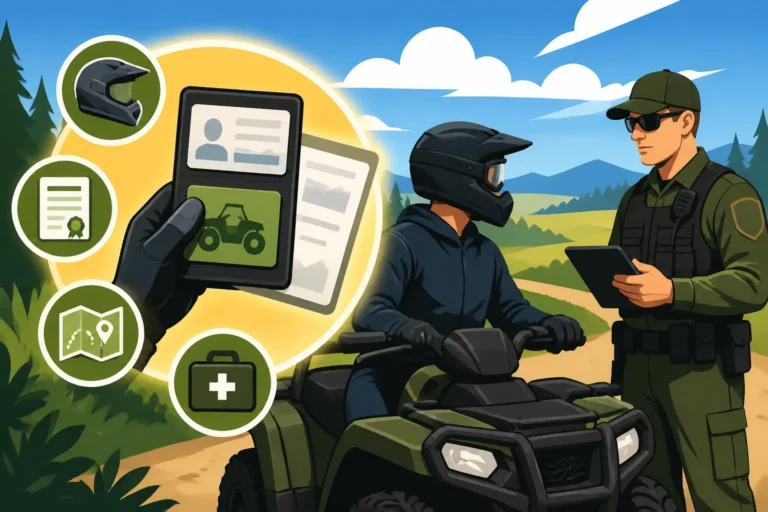
If an officer or site attendant checks a vehicle, the relevant issue may be the parked highway vehicle rather than the ATV being unloaded. For a broader look at documentation during a public-land ride, see What to Show an Officer on Alberta Public Land.
The useful rule of thumb is simple: do not buy a Kananaskis Conservation Pass for the ATV just because you are riding it, but do check the pass rules for the truck or other highway vehicle you park at a designated site. Then handle OHV registration, insurance, route access and camping as separate questions. That separation is what keeps a pass exemption from being mistaken for permission to ride anywhere.
Disclaimer
This article is for general informational purposes only and does not constitute professional advice. Laws, prices and regulations vary by location and change over time. Consult a qualified professional for guidance on your specific situation.