Alberta Spark Arrestor Checks
A spark arrestor is easy to overlook until an officer checks your machine or a fire restriction changes where you can ride. Alberta riders need to know what the equipment does, what to inspect before leaving home, and what an on-trail check may involve. This article explains how to prepare your ATV or UTV and what to verify when the rules for a riding area are unclear.
Why spark arrestors matter in Alberta
A spark arrestor helps stop hot particles from leaving an engine’s exhaust and potentially starting a fire. It is not a substitute for careful riding, and it does not make a machine safe to use during every fire restriction. But a missing, damaged, or blocked arrestor can create a compliance problem and a practical fire risk.
Alberta’s off-highway vehicle equipment rules include spark-arrestor requirements. Riders should check the current provincial requirements and any additional restrictions that apply to the land they plan to use. The equipment rule and a temporary fire order are separate things: having an arrestor does not automatically mean riding is allowed during a closure or restriction.
For an overview of the equipment requirement itself, see Alberta Requires a Spark Arrestor and Alberta Spark Arrestor Rules. These are useful starting points, but always confirm what applies to your specific machine and destination. Rules for public land are not necessarily the same as rules for private property, and a local closure can further limit access.
A spark arrestor is also different from a muffler. The muffler reduces exhaust noise; the arrestor is designed to reduce the chance that sparks or hot particles exit the exhaust. Some exhaust components combine both functions, while other setups use separate parts. A quiet-sounding machine is not proof that it has an arrestor, and a spark arrestor does not automatically make a loud or modified exhaust acceptable. For noise-related requirements, see Alberta Muffler Noise Rules.
The key takeaway is simple: check for a suitable, intact arrestor before riding, keep it in working condition, and check fire restrictions separately. Treating these as two separate checks helps avoid assuming that one piece of equipment answers every question.
What an officer may look for during a check
An equipment check may begin with a visual look at the exhaust system. The officer may want to establish that the machine has a spark arrestor fitted and that the exhaust appears complete and secure. What an officer checks can vary with the machine, the circumstances, and the applicable rules. A roadside or staging-area check does not necessarily mean the exhaust will be taken apart.
A rider should not assume that a part is compliant just because it is sold as an exhaust accessory, installed by a previous owner, or described as a spark arrestor in an online listing. The relevant question is whether the part is appropriate for the machine and satisfies the applicable requirement. Keep product and installation information if you have it, but paperwork does not replace the equipment itself being present and functional.
| Check | What to look for | Why it matters |
|---|---|---|
| Presence | An arrestor is fitted in the exhaust system | A missing part can leave the machine without required equipment |
| Condition | No obvious cracks, loose sections, or damage | A damaged setup may not work as intended |
| Attachment | The exhaust and its components are secure | Vibration can loosen hardware during a ride |
| Blockage | The outlet or screen is not clogged with carbon or debris | A blockage can affect exhaust flow and machine operation |
| Modification | The exhaust has not been altered in a way that removes or bypasses the arrestor | A part may be present but no longer serve its intended purpose |
| Fire conditions | Current restrictions and closures have been checked separately | An arrestor does not override an order limiting access or activity |
The table is a practical pre-ride checklist, not a substitute for the exact legal standard. If you are uncertain whether a particular exhaust meets the requirement, check the applicable regulation or ask a qualified mechanic or the relevant land manager before riding.
A check can also reveal issues beyond the arrestor, including a loose exhaust or a modified muffler. Officers may assess equipment under the rules that apply to the location and type of machine. For a broader overview of field checks, read Alberta Equipment Checks by Officers. It is also sensible to know what documents may be requested while riding public land; What to Show an Officer on Alberta Public Land covers that separate part of being prepared.
Do not rely on being able to explain an absent part after a check. If the arrestor is missing, damaged, or of uncertain fitment, repair the machine before riding in a place where it is required. A spare part in a storage box is not the same as a properly installed and working part.
How to inspect your ATV or UTV before riding
You do not need to dismantle the exhaust for every pre-ride check. A careful visual inspection can catch common problems, while unusual noises, reduced performance, or visible damage may call for a closer look by someone qualified to work on the machine.
Use this routine before a ride, especially after exhaust work, a repair, or a long period in storage:
- Let the exhaust cool completely. Exhaust components can remain hot after the engine is shut off. Do not touch or remove parts until the machine is cool.
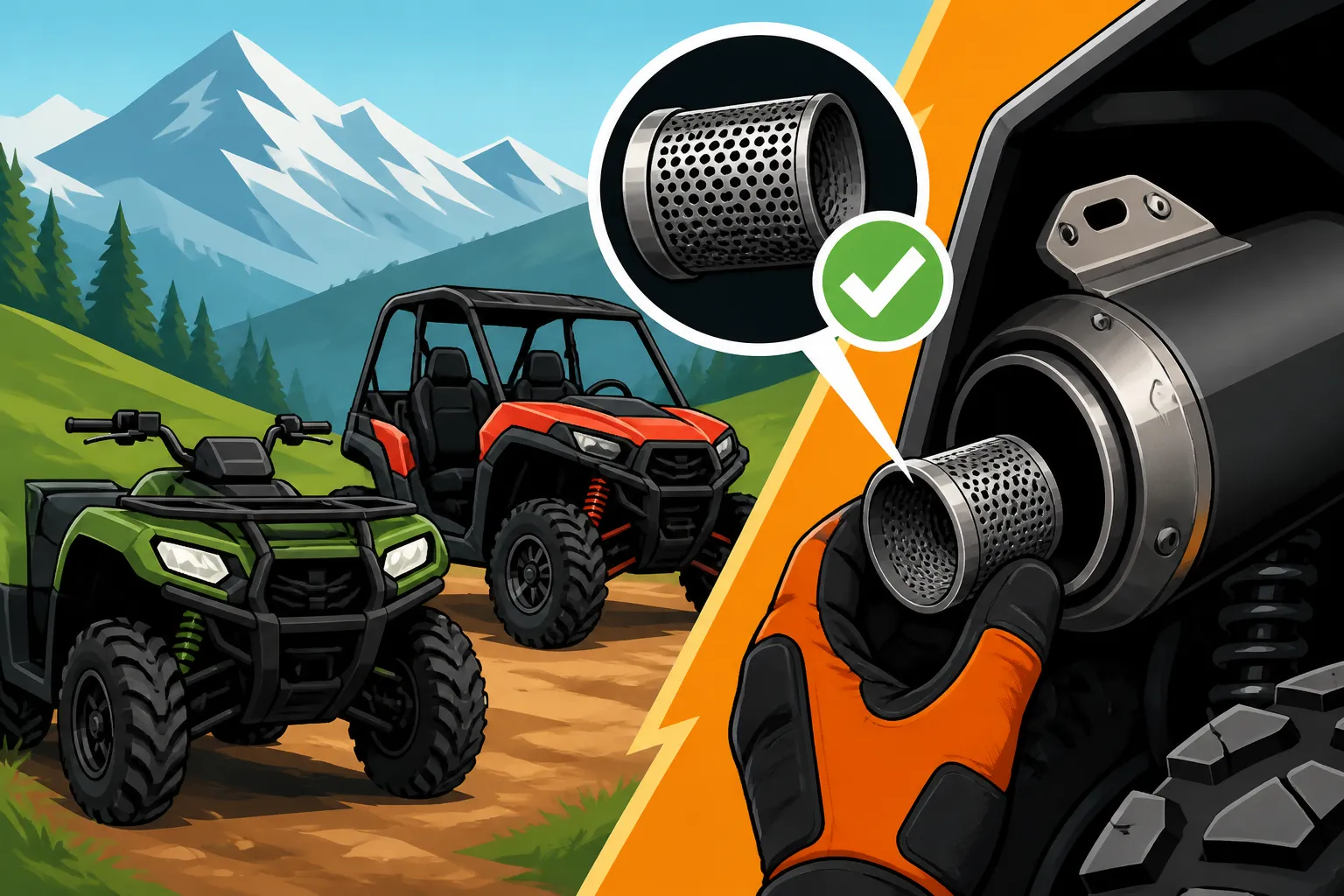
- Locate the exhaust outlet and arrestor assembly. Check the owner’s manual or service information if you are not sure where the arrestor sits on your model. Its position and design vary.
- Look for missing or altered parts. Check for an empty outlet, an absent screen where one belongs, or a component that appears to have been removed, cut, or bypassed.
- Check visible hardware and joints. Look for loose fasteners, a separating joint, cracks, or a component that shifts when gently checked. Do not force or handle hot parts.
- Look for heavy soot or blockage. Carbon buildup can reduce exhaust flow. Follow the manufacturer’s service instructions for cleaning; do not assume that scraping or drilling a component is safe.
- Listen after starting the machine. A new rattle, unusual exhaust note, or sudden change in performance may point to a loose or damaged part. Shut the machine down and investigate rather than riding on and hoping it settles.
- Recheck after repairs or modifications. If you replace an exhaust, have a mechanic confirm that the required arrestor remains installed and that the setup is suitable for the machine.
- Check the riding area’s current conditions. Look for fire restrictions, closures, and other access notices before loading up.
If the arrestor is removable for cleaning, follow the manufacturer’s instructions for removal, inspection, and reinstallation. Use the correct replacement parts and hardware. An incorrectly seated screen or a loose assembly can create problems even if the right component was purchased.
Replacement shopping needs care. Some riders use a dealer or repair shop to identify the correct part; others compare manufacturer details and fitment information online. If you search Amazon or another retailer, confirm the exact machine model, year, exhaust configuration, and part compatibility before ordering. A generic screen or a part that merely resembles the original is not proof that it meets the applicable requirement. When the listing is vague, ask the manufacturer or a qualified shop instead of guessing.
Avoid modifying an arrestor to improve sound or performance. Removing a screen, opening up a component, or installing an exhaust without confirming its arrestor can undermine both compliance and fire protection. Exhaust changes can also raise separate noise issues; Alberta Bans Modified Exhausts and Why a Modified Muffler Can Cost You a Ticket explain why a seemingly small change can have consequences.
If you bought a used ATV or UTV, inspect the exhaust rather than assuming the previous owner kept it original. Ask what work has been done and request any available receipts or product details. If the machine has no clear documentation and the part is difficult to identify, have a qualified mechanic inspect it before taking it to public land.
Check fire restrictions and riding access separately
A spark arrestor is one part of being ready to ride. It does not grant access to a trail, prove that a route is open, or cancel a fire restriction. Before heading out, check the status of the area and any current orders. Conditions may change, and restrictions can apply to particular locations or activities rather than to the whole province.
For public-land riding, plan around the rules for the specific zone or route, not just the equipment on your machine. Alberta OHV Trails: Riding Public Land provides broader context on riding areas, while Alberta Fire Ban Lookups can help you understand the need to check restrictions before travelling. If a notice is unclear, contact the land manager or the office responsible for the area rather than relying on an old screenshot, a forum post, or what was allowed on a previous visit.
A practical pre-trip sequence is:
- Identify the exact riding area and confirm that OHV use is allowed there.
- Check current access notices, closures, and fire restrictions close to departure.
- Inspect the arrestor and the rest of the exhaust while the machine is cool.
- Carry the documents required for your ride and keep them accessible.
- Recheck conditions if weather, fire activity, or local notices change before you arrive.
Registration and insurance are separate from equipment compliance. A correctly registered machine can still have an equipment issue, and an arrestor does not replace required paperwork. For riding on Crown land, see Alberta Registration Before Riding Crown Land. Keep the checks distinct: confirm access, confirm documents, inspect the machine, and follow any current restrictions.
If an officer asks about your exhaust, stay calm and answer plainly. Do not claim that a part is compliant if you do not know. If you have manufacturer information or service documentation, provide it if useful, but do not treat it as a guarantee that the equipment satisfies every applicable rule. If there is a concern about the machine, the safest response is to stop riding until the issue is resolved.
The most reliable habit is a quick visual inspection before each trip, with a more thorough check after exhaust work or a change in machine performance. Confirm that the arrestor is present, secure, and in suitable condition; then check the fire and access rules for your destination. Those are separate steps, and both matter.
Disclaimer
This article is for general informational purposes only and does not constitute professional advice. Laws, prices and regulations vary by location and change over time. Consult a qualified professional for guidance on your specific situation.