Alberta’s 72-Hour Pass Window
Alberta’s 72-hour Public Lands Camping Pass can be easy to misread as “three days” on a calendar. It is a continuous time window, so the start and expiry times matter if your trip crosses several dates. Here’s how to plan around that window, who needs a pass, and what to check before heading out.
What Alberta’s 72-hour pass window means
The three-day Public Lands Camping Pass is intended to cover a continuous 72-hour period, not three separate calendar days. If your pass begins at 2 p.m. on Friday, for example, the 72-hour window runs to 2 p.m. on Monday. The key is the expiry time shown for your pass, rather than how many dates appear on the calendar during your trip.
Alberta’s pass system uses a 2 p.m. start point for the short-term pass. That can make a difference if you arrive in the morning: buying a pass for the right date does not necessarily mean the coverage begins the moment you complete the purchase. Check the start and end times shown during purchase and on your confirmation before relying on it.
The basic distinction is:
| What you’re looking at | How to think about it |
|---|---|
| Three-day pass | One continuous 72-hour window, with a specific start and expiry time |
| Calendar dates | A pass may touch parts of four dates while still covering only 72 hours |
| Annual pass | A longer-duration option for people who camp on covered public lands more than once |
| OHV registration | Separate from the camping pass; it deals with the machine, not the camping period |
| Day ride without camping | The camping pass is not a general OHV trail or day-use pass |
For example, a pass that begins Friday afternoon can remain valid through Saturday, Sunday and part of Monday. That is not four days of coverage; it is 72 hours crossing four calendar dates. Likewise, arriving early on the first day does not extend the pass beyond its stated expiry.
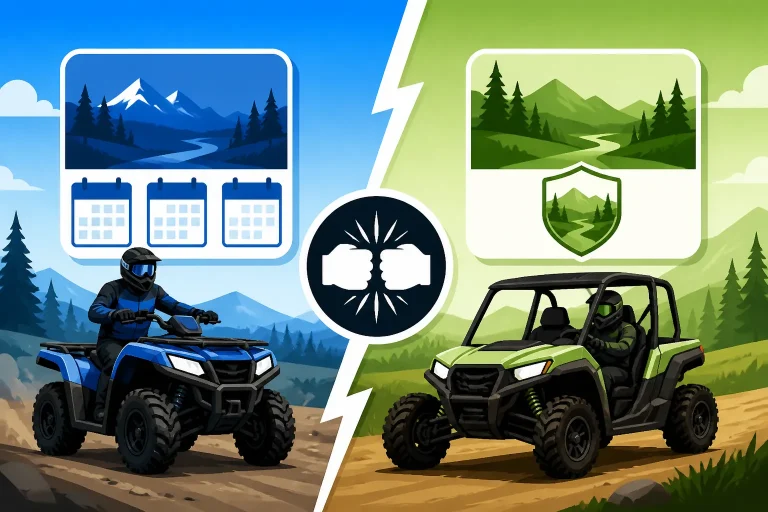
This matters most when you are combining a ride with an overnight stay. The pass is connected to camping on covered public land, not simply to having an ATV or side-by-side in the area. If you plan to ride during the day and camp overnight, check the camping-pass requirement separately from the machine’s registration and insurance requirements. Alberta Has No OHV Trail Pass explains that distinction, while Alberta’s Public Lands Camping Pass covers the pass’s role in more detail.
A useful habit is to save the purchase confirmation and look at the exact valid-from and valid-until times before leaving home. Don’t assume that “Friday” means midnight Friday, or that a pass lasts until the end of the third calendar day. If the displayed times do not fit your itinerary, adjust the selected start date or consider whether a different pass option is more practical.
Who needs the pass and when
The Public Lands Camping Pass applies to overnight camping on the public lands covered by Alberta’s program. It does not apply everywhere in the province, and it does not replace local access rules. Before planning around a pass, confirm that your intended camping area is one where the pass is required and that camping is permitted there.
The pass is generally a camping requirement, not an OHV permission slip. It does not authorize you to ride a closed trail, enter land where access is restricted, or ignore a local closure. Nor does buying one automatically make a campsite available. You still need to follow the rules for the particular public land area and use any designated or permitted camping locations as required.
The practical questions to ask are:
- Will I camp overnight on public land? If you are only riding for the day and staying elsewhere, the camping pass may not be relevant to that ride.
- Is this area covered by the pass requirement? Check the current official information for the specific zone or land you intend to use.
- Is camping allowed at the location I have in mind? A pass does not turn a prohibited site into an allowed one.
- Who in the group needs a pass? Check the current rules for adult and youth requirements rather than assuming one pass covers everyone.
- What other requirements apply? Depending on the trip, those can include a Wildlife Identification Number, machine registration, insurance, fire restrictions and local trail rules.
The pass is not the same as a Kananaskis Conservation Pass. These programs cover different things and apply in different circumstances. If your ride involves a specific recreation area, verify which access or camping requirements apply there rather than buying a pass based only on a place name or a general map.
A camping pass also does not replace an OHV’s registration. If you will take a machine onto public land, review Alberta Registration Before Riding Crown Land and Alberta Requires Insurance on Public Land. Visitors bringing a machine from another province should check the rules for their situation, including Alberta Reciprocity for Visiting Riders. Staying in Alberta for an extended period can raise different questions from a short visit, so do not assume that a camping pass settles the machine’s registration status.
For camping rules themselves, [Alberta Random Camping Rules Explained] is a useful companion. It helps separate the question “Do I need a pass?” from the question “Can I camp here, and what limits apply?” Those are related questions, but the answers are not interchangeable.
Choosing a start time that fits your trip
The simplest way to use a 72-hour pass is to plan backward from your first night of camping. Decide when you expect to begin the covered camping period, then compare that plan with the start time the pass system offers. If you arrive before the pass becomes valid, you may need to change your travel plan or select a start date that matches the trip.
A Friday-to-Monday example
Suppose your group plans to reach the area Friday afternoon, camp Friday and Saturday nights, then leave Monday morning. If the pass starts at 2 p.m. Friday, it could cover the period through 2 p.m. Monday. That can work for a morning departure on Monday, provided your camping and travel plans fit within the displayed expiry.
Now change the plan: you arrive Friday morning, set up camp, and expect to stay until late Monday afternoon. The same 72-hour window may not cover the whole stay. You would be starting before the pass is valid and leaving after it expires. In that case, consider changing the trip timing, selecting a later start if appropriate, or checking whether a longer-duration option makes more sense.
The exact calculation should come from the pass confirmation, not from mental arithmetic alone. Keep the confirmation accessible and check that the selected dates and times match what you intended. For questions about validity beyond the initial purchase, see Alberta Camping Pass Expiry.
When the annual option may be simpler
A short-term pass can be convenient for one trip, but it can be awkward when your plans are flexible or you expect multiple camping trips during its period. If you regularly camp on land covered by the program, compare the annual option with buying several short-term passes. The right choice depends on your plans and the current program terms; check the official system for current costs and validity details. Alberta Camping Pass Cost provides a focused overview of how to think about the cost.
An annual pass does not mean every public land activity is permitted, and it does not override location-specific rules. It simply avoids having to fit each covered camping stay into a separate 72-hour window. You still need to check where the pass applies and follow any site, access or fire restrictions.
Leave room for delays
A trip plan can shift for ordinary reasons: a trailer problem, a late departure, muddy roads, a crowded staging area or a sudden weather change. Build a little flexibility into your itinerary rather than planning to use every last minute of the pass.
If you may arrive later than planned, decide in advance whether you can safely shorten the trip or need a different pass start. If you expect to leave close to the expiry, remember that packing up and departing may take longer than expected. Do not treat the expiry time as a grace period.
If your plans change after purchase, look for the current rules on editing, cancelling or replacing a pass before assuming that a change is allowed. Is an Alberta Public Lands Camping Pass Refundable? addresses the related refund question. The safest approach is to resolve changes through the official purchase channel and keep any updated confirmation.
Buying, saving and showing proof
Buy the pass through the official purchasing route and review the details before submitting the order. The official process is the place to confirm current options, dates, validity and requirements. How to Buy an Alberta Camping Pass walks through the purchase process.
Before you finish, check these details carefully:
- The selected pass type matches the length and nature of your trip.
- The start date is the one you intended.
- The stated start and expiry times fit your itinerary.
- The pass is associated with the right person or account, if required.
- You understand which adults or other members of the group need their own pass.
- You know how to access proof if your phone has no service.
Save the confirmation in a place you can reach without a strong cellular connection. A screenshot may help, but do not rely on a screenshot if the official rules require another form of proof. If the system offers a printable certificate or confirmation, follow its instructions. Alberta Digital Certificates Must Be Printed and What to Show an Officer on Alberta Public Land explain practical proof questions that can matter on a remote trip.
A paper copy can be useful when a phone battery dies or the screen becomes difficult to read. Keep it protected from rain and mud. If you need a simple way to keep documents dry, a waterproof sleeve from an outdoor retailer or Amazon can be a practical option. Check the size before ordering so it can hold the confirmation without folding or obscuring important details.
For a long ride, keep your phone charged and download any maps or documents you will need before leaving coverage. A compact power bank from Amazon can help if you use your phone for navigation and to access pass proof, though it is not a substitute for carrying a backup plan. If you prefer paper navigation, a map or map case available through Amazon may be useful; confirm that the map covers the area you intend to visit and is current enough for your purpose.
These are conveniences, not legal requirements. Buying gear does not solve a pass mismatch, and a phone accessory cannot make an expired pass valid. The important part is to know the pass dates and times, keep proof available, and have a way to check your route and rules when signal disappears.
It is also sensible to keep separate records for separate obligations. A camping-pass confirmation is not proof of OHV registration or insurance. Store those documents together if that makes them easier to find, but label or organize them so you do not mistake one for another. For registration and insurance paperwork, see Alberta Registration Paperwork Checklist and Alberta Proof of Insurance on Demand.
Common planning mistakes to avoid
The most frequent mistake is reading “three-day pass” as three calendar days. A continuous 72-hour period can cross four dates, and its expiry is tied to the time shown in the pass details. Always check the actual start and end rather than counting dates.
Another mistake is assuming the pass begins at the moment of purchase. The program’s 2 p.m. start point is important. If the pass begins at 2 p.m. on the selected date, buying it earlier does not necessarily cover camping before that time. Confirm the validity shown by the system and plan your arrival accordingly.
People also sometimes buy a camping pass when what they actually need is to understand whether they may ride in an area. A pass does not grant OHV access. You still need to follow the rules for public land, designated trails, closures and private or leased land. Read Alberta Registration Before Riding a Ditch if your route includes a ditch, and check Alberta Bylaw Lookups Before You Ride when a municipal road or community is involved.
A related error is thinking that one pass covers every person in a group. Requirements may depend on who is camping and the program’s current terms. Check the official instructions for each adult and for children before purchase. Do Alberta Kids Need a Camping Pass? deals with the youth question. A group organizer should not assume that buying one pass on behalf of everyone settles the requirements for the whole group.
Finally, do not confuse the pass with a WIN card. The WIN card is a separate identifier used for certain Alberta services and purchases. If you are unsure whether you need one for the pass process, check the current instructions and Alberta’s WIN Card Explained. Keep the two records distinct.
A quick pre-departure check can prevent most problems:
- Confirm the camping location is covered by the pass requirement and that camping is allowed there.
- Confirm the pass start and expiry times against your actual arrival and departure.
- Check that each person who needs a pass has the required proof.
- Save or print the confirmation in the format the official instructions require.
- Check machine registration, insurance, trail access, weather, closures and fire restrictions separately.
- Keep the confirmation available for the entire trip, including when you are offline.
The 72-hour pass is straightforward once you treat it as a timed window rather than a set of calendar dates. Plan around the displayed expiry, verify the area and camping rules, and keep the confirmation accessible. That leaves fewer surprises when you reach the staging area or set up camp.
Disclaimer
This article is for general informational purposes only and does not constitute professional advice. Laws, prices and regulations vary by location and change over time. Consult a qualified professional for guidance on your specific situation.