Alberta Proof of Insurance on Demand
There's nothing quite like the rush of tearing down a winding trail on your ATV or side-by-side, the engine humming beneath you, the Alberta wilderness unfurling all around. But that feeling can vanish in an instant if a conservation officer or RCMP member signals you to stop and asks for your proof of insurance. Many riders feel a knot of anxiety in their stomach at that moment, wondering if they have the right paperwork, or if what they do have will actually count. This guide will walk you through everything you need to know about providing proof of insurance on demand for your off-highway vehicle (OHV) in Alberta, ensuring you can ride with confidence, knowing you're prepared for any roadside check.
Why Proof of Insurance is Non-Negotiable on Alberta's Public Lands
Riding an OHV in Alberta is an incredible privilege, offering access to some of the most stunning landscapes in the world. However, with that privilege comes a significant responsibility, particularly when it comes to insurance. It’s not just a suggestion; it’s a legal mandate designed to protect both you and other trail users. Ignoring this requirement can lead to far more than just a minor inconvenience – it can result in substantial financial penalties and even the loss of your machine.
The Law Behind the Demand
Let's be clear: in Alberta, if you're riding your OHV on any public land, you absolutely must have valid third-party liability insurance. This isn't some arbitrary rule dreamt up by local park rangers; it's enshrined in provincial legislation, specifically the Traffic Safety Act and the Off-Highway Vehicle Regulation (Regulation 319/2002). These laws define what constitutes an OHV and outline the mandatory equipment and operational requirements, with insurance being a critical component.
When we talk about "public land," it's easy to picture a designated OHV park like McLean Creek or the Ghost PLUZ. And yes, you absolutely need insurance there. But the definition extends far beyond that. Public land includes Crown land, undeveloped public land, and even the often-overlooked highway right-of-way, which includes ditches, shoulders, and sometimes even alleys within a town's limits, depending on local bylaws. Many riders don't realize that simply crossing a highway ditch to get to a field or a trail head can put them on a "highway" in the eyes of the law, triggering all the associated requirements, including insurance. The provincial rules around [What the Traffic Safety Act Requires of Alberta OHVs] are quite extensive, and understanding them is crucial for every rider. It’s a common misconception that if you’re not on a paved road, you’re off-limits for these rules, but that’s simply not the case. The intent is broad protection, regardless of the terrain. For a deeper dive into these requirements, you can refer to [Alberta Requires Insurance on Public Land].
The Risks of Riding Uninsured
Riding without insurance on public land is a gamble with incredibly high stakes. The immediate consequence, if caught by an enforcement officer, is a significant fine. These aren't just slap-on-the-wrist tickets; they can run into the hundreds, if not thousands, of dollars. Imagine being out for a fun day with friends, only to return home with a massive financial burden because you neglected a basic legal requirement. It's a frustrating, preventable situation that many riders unfortunately experience. [Alberta Penalties for Riding Unregistered] outlines the financial repercussions for various OHV-related infractions, and riding uninsured is certainly among the more costly ones.
Beyond the fines, enforcement officers have the authority to seize your machine if it's found operating on public land without valid insurance. Yes, you read that right – seize. Your pride and joy, the machine you saved up for, might be impounded, leaving you stranded and facing even more expenses to retrieve it, if you can even manage to do so. This is not a theoretical threat; it happens regularly. The hassle, the storage fees, the potential impoundment costs – it's a nightmare scenario that can quickly eclipse any perceived savings from skipping insurance. For more details on this drastic measure, check out [Alberta Vehicle Seizure for No Insurance].
And then there's the truly serious aspect: personal liability. If you're involved in an accident with another rider, a pedestrian, or damage someone else's property while uninsured, you are personally on the hook for all damages and medical costs. A simple collision could bankrupt you. Third-party liability insurance isn't just about avoiding a ticket; it's about safeguarding your financial future. It covers costs if you're deemed at fault in an incident, protecting you from potentially devastating lawsuits. Without it, you're exposed to unlimited financial risk.
What Counts as Valid Proof of Insurance in Alberta
So, you understand why you need insurance. The next logical question is, what exactly do you need to show an officer? It's not enough to simply have insurance; you need to be able to prove it on demand. This often causes confusion, as people are used to the small pink cards for their car. While those are familiar, OHV insurance proof has some specific nuances.
Physical Documents You Can Carry
The most traditional and often safest way to prove your OHV insurance is with a physical document. This typically comes in the form of an insurance liability card, often referred to as a "pink card" even if it's not actually pink for OHVs. This card is issued by your insurance provider and should contain essential information: your name, the name of your insurance company, the policy number, the effective dates of the policy, and, crucially, the specific details of your off-highway vehicle, including its make, model, and Vehicle Identification Number (VIN). It's vital that the VIN on your card matches the VIN on your machine exactly.
Another acceptable form of physical proof is the policy declarations page. This is a more comprehensive document that outlines all the coverage details, deductibles, and other policy specifics. While larger than a card, a copy of this page, especially the section detailing your third-party liability and the specific OHV covered, serves as undeniable proof. Always ensure that whatever document you carry, it is current and has not expired. An expired card is, legally speaking, no proof at all. It's often a good idea to keep the physical card with your registration certificate, as they are both typically requested together.
Digital Proof: A Modern Convenience (with Caveats)
Alberta, like many jurisdictions, has embraced technology to make our lives easier, and that includes allowing digital proof of insurance. This means you can display your insurance card on your smartphone or another electronic device. For many riders, this is incredibly convenient – one less piece of paper to worry about, and it's usually always with you. Your insurance company will likely have an app or a digital portal where you can access and display your policy information.
However, while digital proof is accepted, it comes with important caveats that every rider should consider. What happens if your phone battery dies while you're deep in the backcountry? What if you drop your phone and crack the screen, making it impossible to read? Or, perhaps most commonly in remote riding areas, what if you simply have no cell signal to load the document? Any of these scenarios could render your digital proof inaccessible, putting you in the same predicament as having no proof at all. Imagine being miles from the nearest road, phone dead, and an officer asking for your documents.
Because of these potential issues, many experienced riders and even law enforcement officers recommend having a backup. This could mean having a fully charged phone with the document screenshot, or even better, having a printed physical copy of your insurance card or declarations page tucked away in a waterproof bag. While the province allows digital proof, practical considerations often make a physical backup a wise choice. It's a bit like having a spare tire – you hope you don't need it, but you'll be incredibly glad you have it if you do. For similar reasons of accessibility and reliability, printing your [Alberta Digital Certificates Must Be Printed] for registration is also a good habit.
Practical Tips for Carrying Your Proof on the Trail
Having your proof of insurance is one thing; making sure it's accessible and protected when you're out on the trails is another. The Alberta wilderness can be tough on gear, and the last thing you want is a soggy, unreadable document or a dead phone when an officer asks for your papers. A little preparation goes a long way in avoiding frustration.
Protecting Your Physical Documents
If you opt for physical copies, protection is paramount. Your insurance card and registration certificate are thin pieces of paper that can quickly become a pulpy mess when exposed to rain, mud, or sweat. Invest in a good quality waterproof pouch or a heavy-duty zip-lock bag. These are inexpensive and can save you a lot of grief. Place your documents inside, ensuring they're sealed tight.
Next, consider where to store them on your machine. The ideal spot is easily accessible but also secure. A glove box, if your machine has one, is a common choice. However, some riders prefer to keep critical documents on their person, perhaps in a secure, waterproof pocket of their riding jacket or pants. This ensures that even if you're separated from your machine in an emergency, your identification and proof of insurance remain with you. Avoid keeping them in an open compartment where they could easily fall out or get caked in mud. Think about how you would retrieve them quickly and safely if pulled over. For example, if you keep them in a rear storage box, make sure it’s not buried under a pile of gear.
Ensuring Digital Access
For those relying on digital proof, the main concerns are power and connectivity. Before you head out, make sure your smartphone is fully charged. And we mean fully charged. Riding apps, navigation, and even just checking the time can drain a battery faster than you'd expect, especially in cold weather. Many riders carry a small, rugged power bank specifically for their phone. These portable chargers can be a lifesaver, not just for proof of insurance but also for emergency communication.
Connectivity can be a major challenge in Alberta's remote OHV areas. Signal drop-outs are common. To counter this, always screenshot your digital insurance card before you lose service. A screenshot is stored locally on your device and doesn't require an active internet connection to display. This simple step can prevent a lot of headaches. Consider sharing a digital copy (via text or email) with your riding partners. In an emergency, or if your phone becomes unusable, they might be able to access it on their device. While not official proof for you, it can sometimes help an officer verify details or assist in an emergency situation.
Remember that while a digital document is convenient, the officer needs to be able to read it. A cracked screen, a low-light situation, or a dirty phone could all impede readability. Keep your screen clean and free of damage. While you might not need a physical print-out of your [Alberta Digital Certificates Must Be Printed], having an accessible, readable version is absolutely non-negotiable for any type of digital document.
What Happens When an Officer Asks for Your Proof
The moment an officer asks for your documents can be a little intimidating, no matter how prepared you are. It’s important to understand what to expect and how to respond to ensure the interaction goes smoothly and respectfully. Knowing the drill can save you a lot of stress.
The Interaction: Stay Calm and Cooperative
If an officer signals you to stop, pull over safely and turn off your machine's engine. Remain calm and cooperative. They are simply doing their job, ensuring that riders are following the law and contributing to a safer environment for everyone on public lands. When they ask for your registration and proof of insurance, clearly state where your documents are and retrieve them carefully. For example, "Officer, my insurance card is in this waterproof pouch in my jacket pocket, and my registration is with it." This open communication shows you are prepared and have nothing to hide.
The officer will typically examine your documents to verify several key pieces of information. They'll look for your name, the insurance company, the policy number, the effective dates of coverage, and critically, that the Vehicle Identification Number (VIN) on the insurance card matches the VIN on your OHV. They want to ensure that the insurance you're presenting is indeed for the machine you are operating and that it is current. They might also ask for your driver's license or other identification to confirm you are the insured party. [What an Alberta Officer Can Ask to See] includes a comprehensive list of documents and checks they might perform during a stop. They are trained to quickly assess the validity of your documents. Officers are also likely to perform [Alberta Equipment Checks by Officers] to ensure your machine meets other safety requirements, so be prepared for a thorough inspection.
Consequences of Not Having Proof On Hand
There's a crucial distinction between not having insurance and not having proof of insurance on hand. If you have a valid insurance policy but simply forgot your card or your phone died, it's still an offense to not produce it on demand. The officer might issue a ticket for failing to produce proof of insurance, which is a significant fine. While not as severe as being completely uninsured, it's still a preventable penalty.
In such a situation, the officer might give you a grace period (e.g., 24-48 hours) to present valid proof at a local RCMP detachment or registry office. However, this is at the officer's discretion, and you should not assume it will happen. If they do not offer this, or if you fail to present the proof within the given timeframe, the ticket stands. It's often a hassle to have to take time out of your day to go to a detachment, and it requires you to be able to access that proof. This is why immediate, on-demand proof is so important. [Producing Insurance on Demand] further elaborates on the expectations and processes involved in these interactions.
If you genuinely don't have insurance, the consequences are far more severe, as discussed earlier. This is not a situation you want to find yourself in. Always, always ensure your OHV is properly insured before you even think about putting a wheel on public land.
Special Scenarios and Common Questions
The world of OHV insurance isn't always black and white, and various situations can lead to confusion. Whether you've just bought a machine, are renting one, or are visiting from out of province, understanding the specific insurance requirements can help you avoid unexpected issues.
New Purchases, Rentals, and Visiting Riders
When you've just purchased a new or used OHV, there's often a short window where you might not yet have your physical insurance card. Most insurance companies can provide a temporary digital proof or a "binder" document immediately upon activation of your policy. It's crucial to have this temporary proof on hand before you take your new ride out on public land. Don't assume you're covered simply because you've applied for insurance; you need the policy to be active and verifiable. If you're buying privately, ensuring you have your own insurance lined up before the transaction is complete is a smart move. When putting together paperwork for a private sale, resources like LawDepot can provide useful bill of sale templates to ensure you have all the necessary details documented for your insurance company.
For riders who rent ATVs or side-by-sides, the good news is that reputable rental companies will include the mandatory third-party liability insurance as part of your rental package. However, it's always wise to confirm this directly with the rental operator and ask to see the proof of insurance that covers the machine you're renting. They should be able to provide you with the necessary documentation or a copy of their fleet's insurance. Make sure you understand what you're covered for, and what your liability might be in case of damage to the rental machine itself. Check out [Alberta ATV Rentals: What They Cost] for a deeper understanding of rental considerations, including insurance.
Visiting Alberta from another province or country? Your existing insurance policy might cover you, but there are important time limits. Generally, Alberta allows out-of-province machines to operate for up to 30 consecutive days with their home province's or state's registration and insurance. After this [Alberta's 30-Day Rule for Out-of-Province Machines] expires, you are expected to register and insure your OHV in Alberta. Always carry your home province's insurance documentation, and be prepared to show proof of your residency outside Alberta if asked. [Alberta Registration for Visiting Riders] provides more context on the requirements for non-residents.
Farm Quads and Private Land
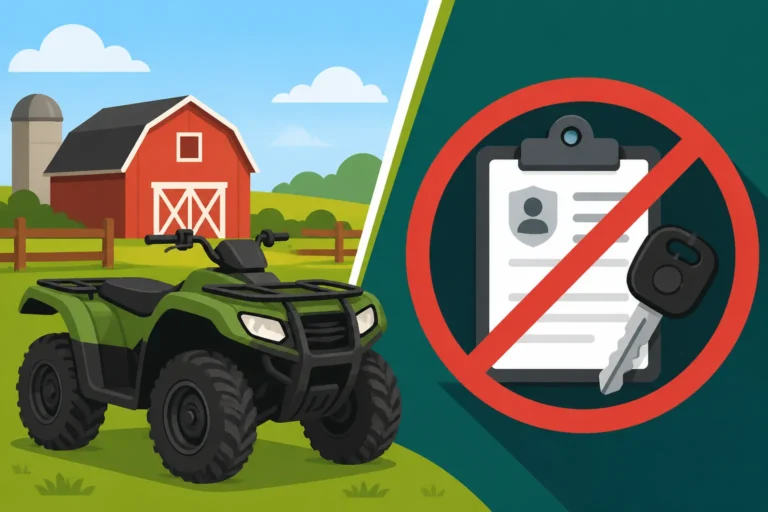
Farm quads are a bit of a special case in Alberta. If your OHV is used exclusively for agricultural purposes on private land, you generally don't need to register or insure it in the same way you would a recreational machine on public land. However, this exemption evaporates the moment that farm quad touches a public road, even a municipal road, highway ditch, or Crown land. Many farmers frequently cross public roads or ride along ditches to access different parcels of land or move between fields. In these instances, the OHV must be registered and insured. A common pitfall is assuming that because it's a "farm vehicle," it's always exempt, which isn't true for public thoroughfares. You can find more specific details about this in [Alberta Farmer-Owned Machines on Private Land] and [Does a Farm Quad That Never Leaves Need Registration?].
On purely private land, such as your own property or land you have explicit permission to ride on, while insurance isn't legally mandated by the province, it is still incredibly advisable. What if a guest on your property gets injured while riding your machine? Or what if you accidentally damage a neighbour's fence? Your homeowner's insurance might offer some limited liability, but a specific OHV policy provides more comprehensive protection. If you frequently have guests ride on your private land, consider having them sign a liability waiver. Legal document services like LawDepot can be a useful resource for drafting such waivers, ensuring you have some protection against unforeseen incidents.
Furthermore, if you're riding on private land that is part of a grazing lease or other Crown land lease, you need to be very careful. While it's private land for the leaseholder, accessing it might involve crossing public lands, or the terms of the lease might still impose certain public access rules. Always seek explicit permission from the leaseholder before riding, and be aware that crossing public access routes or rights-of-way will still trigger provincial OHV requirements. [Alberta Grazing Lease Access Rules] can help clarify some of the complexities around these types of properties.
| Feature | Physical Insurance Card | Digital Insurance Card |
|---|---|---|
| Accessibility | Requires carrying a physical item | Requires a charged device and potential signal |
| Durability | Susceptible to water, mud, tearing if not protected | Susceptible to device damage, battery drain, no signal |
| Verification | Easily readable by officers without device interaction | Requires officer to view your device, potential for glare/damage |
| Backup | Can be easily replaced with a printout or new card | Can be screenshot for offline access, but device is still a single point of failure |
| Convenience | Easy to hand over, no tech issues | Always with you (if you carry your phone), reduces paper clutter |
| Recommendation | Highly recommended, especially as a backup | Convenient, but always back up with a screenshot or physical copy |
Disclaimer
This article is for general informational purposes only and does not constitute professional advice. Laws, prices and regulations vary by location and change over time. Consult a qualified professional for guidance on your specific situation.