Alberta Visitors Under 30 Days
Visitors bringing an ATV or side-by-side to Alberta often want to know whether their home-province plate is enough. For a short stay, reciprocal recognition may let a properly registered machine operate without Alberta registration, but the 30-day limit is only one part of the answer. Your residency, insurance, riding location and local rules all matter.
How the Under-30-Day Visitor Rule Works
Alberta generally allows a visitor to use an off-highway vehicle that is properly registered in another jurisdiction for a temporary stay, subject to reciprocal recognition and the applicable requirements. The commonly referenced limit is 30 consecutive days in Alberta. It is not a general exemption from registration, insurance or riding rules.
The practical starting point is the machine’s home registration. Check that it is current, belongs to the machine you are bringing, and is valid for off-highway use under the rules where it was registered. Carry its registration documents and display the required plate or identifying mark from that jurisdiction. A visitor should not assume that an expired registration, a bill of sale, or a plate from another vehicle will qualify.
The 30-day allowance is best understood as temporary recognition for a visitor, not a way to postpone Alberta registration indefinitely. It also does not mean you can ride anywhere in the province. Alberta’s rules for public land and municipal roads still apply, and the land manager or local authority may impose additional restrictions.
For an overview of the general visitor arrangement, see Alberta Reciprocity for Visiting Riders and Alberta Registration for Visiting Riders. If your question is specifically about keeping a home-province plate during a short visit, Riding on Your Home Province’s Plate as a Visitor covers that issue.
Count the stay in consecutive days
A consecutive-day limit is not the same as a count of riding days. If the rule applies to your situation, taking a day off, leaving the machine parked at camp, or riding only on weekends should not be treated as automatically stopping the clock. Nor should a quick trip outside Alberta be assumed to restart it.
The dates that matter can depend on your circumstances, including when the machine enters the province and whether you remain a visitor. Keep a record of when you and the machine arrived, especially if the stay is close to the limit. If you are unsure how the period is counted, confirm the answer with an Alberta registry agent or the official provincial source before you ride.
For a more focused explanation of the timing issue, see Alberta’s 30-Day Rule for Out-of-Province Machines and Thirty Consecutive Days and the Clock.
A visitor’s status matters as much as the plate
The short-stay treatment is intended for visitors, not necessarily for someone who has moved to Alberta or is keeping a machine there on a continuing basis. If you take up residence, establish a long-term home, or your circumstances change while the machine remains in Alberta, do not assume that the original visitor arrangement continues unchanged.
A person can also be in Alberta temporarily while bringing a machine for work, a seasonal stay, or an extended visit. Those situations can raise questions that are not settled simply by counting days. If you are close to the limit or your residency is changing, ask how the rules apply to your particular circumstances rather than relying on a general visitor summary. Alberta Proof of Residency for Visitors may help you understand what evidence is relevant.
What to Check Before Bringing Your Machine
Before loading up, confirm the status of the machine and the rider separately. Registration attaches to the vehicle; permission to operate, insurance, and access requirements can involve the rider, the machine, and the place where you plan to travel.
| Check | What to confirm | Why it matters |
|---|---|---|
| Visitor status | You are visiting rather than relying on a temporary rule after moving to Alberta | A change in residency can affect whether the visitor arrangement applies |
| Home registration | The registration is current and valid for the machine and its use | Reciprocal recognition does not make an invalid registration valid |
| Plate or identifier | The machine displays what its home jurisdiction requires | A document alone may not satisfy display requirements |
| Insurance | Coverage applies to the machine and use in Alberta, including public land where required | Registration and insurance are separate obligations |
| Riding area | Machines are allowed on the specific road, trail or land | A valid plate does not grant access |
| Operator and equipment | The rider meets applicable age, helmet and equipment rules | Visitor status does not automatically exempt riders from Alberta operating rules |
| Length of stay | You know when the relevant consecutive-day period begins and ends | A short visit can extend beyond the temporary allowance |
Keep proof with the machine
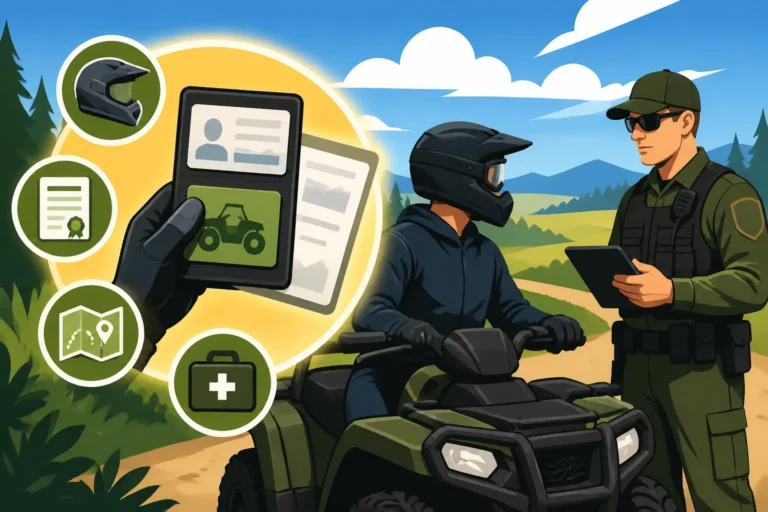
Carry the registration certificate or other official proof of registration, and be prepared to show it if asked. Keep your insurance details accessible as well. A photo on a phone can be useful as a backup, but do not assume a digital image will be accepted wherever an original or printed document is required. Check what proof is acceptable for your documents and riding situation.
A useful approach is to keep the machine’s paperwork together in a waterproof pouch or another secure place. If two people are travelling separately from the machine, make sure the operator can still access the documents. The goal is not to carry a stack of unrelated paperwork; it is to have clear proof that the machine is properly registered and insured.
For broader registration questions, Alberta Registration Paperwork Checklist can help you identify the documents commonly involved. If you plan to stay long enough that Alberta registration may become necessary, review Alberta Registration for a Machine From BC or the relevant page for your home jurisdiction.
Check insurance separately
A plate does not prove that the machine is insured. Confirm with your insurer that the policy remains valid while the ATV or UTV is being operated in Alberta, and ask whether it covers the type of riding you intend to do. Off-highway use, travel across public land and operation on roads may be treated differently under a policy.
Alberta requires insurance for OHVs on public land. Visitors should not assume that a policy written elsewhere automatically meets every Alberta requirement, or that a home-jurisdiction registration includes insurance. Ask the insurer what proof to carry and whether any restrictions apply to the machine, operator, passengers or location. More detail is available in [Alberta Insurance Rules for an Out-of-Province Machine] and Alberta Proof of Insurance on Demand.
If your machine is not insured for the planned use, sort that out before unloading it at a staging area. A short holiday does not remove the risk of an accident, and an insurance gap can create serious financial consequences.
Registration does not equal permission to ride
A machine can be correctly registered and still be prohibited from a particular route. Public land, designated trails, private property, provincial parks, municipal roads and highway ditches do not all have the same access rules. A route shown on a general map may cross land where OHV use is restricted or may be open only under particular conditions.
Before heading out, identify who manages the area and check the current rules for the actual route. On public land, look for closures, designated-trail requirements and seasonal restrictions. On private land, get permission from the landowner. In a municipality, check the local bylaw rather than assuming that a road or ditch is open because it looks suitable for riding.
The broader issues are covered in Alberta’s Public Land Use Zones Explained, Alberta Bylaw Lookups Before You Ride and Alberta Rules for Riding a Ditch. If you will camp while travelling, remember that camping requirements are separate from the rules for operating an OHV. A camping pass is not an ATV registration or a trail-access permit.
Other Alberta Rules Still Apply to Visiting Riders
The under-30-day arrangement is about temporary recognition of an out-of-province machine. It does not replace Alberta’s operating rules. A visitor should plan for the same basic safety and access checks as a resident, while also confirming that the home registration and insurance are recognized.
Helmets, age and passengers
Alberta has helmet requirements for many OHV riders on public land, with specific exemptions. Do not assume that a helmet rule from your home province is enough to determine what is required in Alberta. Check that the helmet meets the applicable standard and that each rider who must wear one has a properly fitted helmet. See Alberta ATV Helmet Law Explained and Alberta CSA Helmet Standards.
Age and supervision rules can also matter, particularly when a young rider is travelling with family. Confirm who may operate the machine, whether adult supervision is required and what “close supervision” means in the circumstances. A parent’s permission does not override the rules.
For passengers, follow the manufacturer’s seating capacity and instructions. A machine with one seat should not be treated as a two-person vehicle simply because a passenger can hold on. Side-by-sides also have occupant and restraint requirements that differ from a quad’s seating arrangement. See Alberta Rules for Passengers on a Quad or Manufacturer Passenger Limits on a Side-by-Side for related details.
Equipment and machine condition
Public-land riding can involve equipment requirements as well as ordinary safe-riding practices. Before leaving home, check the machine’s lights, exhaust and spark-arresting equipment, and make sure the plate or identifier is visible and secure. A machine that is lawful in one jurisdiction may need attention before it is operated in Alberta.
A simple pre-trip inspection should include:
- Confirm that the plate or required identifier is attached where it can be seen.
- Test the headlight and tail light, including any controls needed to turn them on.
- Check that the exhaust system is not modified in a way that violates applicable rules.
- Confirm that the spark arrestor is fitted and working where required.
- Inspect tires, brakes, steering, throttle and protective components.
- Pack the registration and insurance proof where the operator can reach them.
The details of the rules are explained in Alberta Equipment Required on Public Land, Alberta Requires a Spark Arrestor and Alberta Requires Working Head and Tail Lights. These checks also help identify a problem before it turns into a breakdown far from the staging area.
Road access is a separate question
A registration plate does not make an ATV or UTV street-legal on every road. In Alberta, road access can depend on the legal classification of the route, provincial rules, municipal bylaws and any specific permission that applies. A county road, town street, highway ditch and forestry road may each have different restrictions.
Do not follow a route simply because another rider used it or a navigation app shows it as a road. Confirm whether the municipality allows OHVs on the specific route and whether the machine meets any conditions. If a route crosses a highway, check the crossing rules too. Alberta ATV Road Rules: Bylaws Decide, Alberta Rules for Riding a County Road and Alberta Rules for Crossing a Highway explain why the route itself needs checking.
Public land and camping passes are not the same thing
Visitors sometimes mistake a land-use pass for permission to ride. Alberta does not use a general public-land camping pass as a substitute for OHV registration, insurance or access permission. If you plan to camp, check whether a camping pass or another camping requirement applies to the location and the people in your group. If you plan to ride, check the vehicle and trail rules separately.
Likewise, having a pass for camping does not open a closed trail, and being allowed to ride does not necessarily authorize random camping. Keep those decisions separate when planning the trip. The relevant details are in Alberta’s Public Lands Camping Pass and [Alberta Camping Near a Recreation Area].
If Your Stay May Go Beyond 30 Days
If your Alberta visit could last longer than 30 consecutive days, deal with the question before the temporary period runs out. Waiting until the final day to contact an agent can leave little time to resolve missing documents, ownership questions or registration issues.
The right next step depends on whether you remain a visitor, have become an Alberta resident, and how the machine is registered at home. Do not assume that leaving Alberta briefly, storing the machine, or continuing to carry the old plate resets the clock. Ask an Alberta registry agent or consult the official provincial requirements about the date the machine must be registered, what documents are needed and whether any exception applies.
Prepare for an Alberta registration conversation
If Alberta registration may be required, gather the machine’s ownership and registration records before contacting an agent. Depending on the machine and its history, relevant documents may include:
- The current registration certificate from the home jurisdiction
- Proof of ownership, such as a bill of sale or other accepted ownership document
- The machine’s vehicle identification number or serial number
- Identification and proof of Alberta residency if you have moved
- Any import or inspection documentation that applies to the machine
- Financing or lien information, if relevant
The exact requirements depend on the circumstances. A machine with a clear registration history may be simpler to process than one with missing papers, an unclear serial number, or a mismatch between the owner and the person applying. An agent can tell you what is needed for that specific case. Alberta Registry Agents and OHV Paperwork and What a Registry Agent Needs to Register Your Quad are useful starting points.
If the machine is registered in British Columbia, Saskatchewan, Montana or another jurisdiction, do not assume every document will be treated identically. Bring the records you have and ask what additional proof is needed. For a machine from BC, see Alberta Registration for a Machine From BC.
Do not confuse residence with the machine’s location
A machine may be stored in Alberta while its owner lives elsewhere, or an owner may live in Alberta while the machine remains registered in another province. Those facts can affect the registration question differently. The owner’s status, the machine’s use and how long it remains in the province all deserve consideration.
If the ATV is being left at a cabin, work site or seasonal property, do not rely on the short visitor allowance without checking how the rule applies. A machine used repeatedly from an Alberta base may not fit the same circumstances as one brought in for a brief trip and taken home afterward. The same caution applies when a visitor’s stay is extended by work, weather or a change in travel plans.
When contacting an agent or official office, describe the situation plainly: where you live, where the machine is registered, when it entered Alberta, how long it will stay, and where it will be ridden. Those details make it easier to get a useful answer than asking only whether “out-of-province plates are okay.”
If you are only visiting for a few days
For a short trip, the process is usually straightforward: make sure the machine is properly registered at home, confirm insurance for Alberta use, carry the documents, and verify the route and equipment rules. Keep a record of your arrival date and do not assume the 30-day period is a number of riding days.
Before departure, check the planned riding area for access restrictions and closures. Tell everyone in the group what documents and safety equipment they need. If the machine is borrowed or rented rather than owned, confirm who is responsible for registration and insurance, and make sure the operator is permitted to use it.
For visitors staying beyond a brief holiday, or anyone whose residency status is changing, obtain a specific answer before riding. The temporary visitor rule is helpful, but it is not a substitute for checking the facts that determine whether it applies.
Frequently Asked Questions
Can I ride an out-of-province ATV in Alberta for less than 30 days?
A visitor may generally rely on reciprocal recognition for a properly registered machine during a temporary stay, if the home registration is valid and the visitor meets the applicable requirements. Confirm insurance, equipment and access rules too.
Does the 30-day limit mean 30 days of riding?
No. Treat it as a consecutive-day period, not a tally of the days you ride. Do not assume that parking the machine or briefly leaving Alberta pauses or restarts the period.
Does my out-of-province plate let me ride any Alberta trail?
No. Registration does not grant access to every road, trail or parcel of land. Check the rules for the specific public-land area, municipality, private property or other route you plan to use.
What if I move to Alberta during my visit?
Do not assume the visitor arrangement continues after your circumstances change. Ask an Alberta registry agent or consult the official provincial requirements about registration timing, proof of residency and the documents needed for your machine.
Disclaimer
This article is for general informational purposes only and does not constitute professional advice. Laws, prices and regulations vary by location and change over time. Consult a qualified professional for guidance on your specific situation.