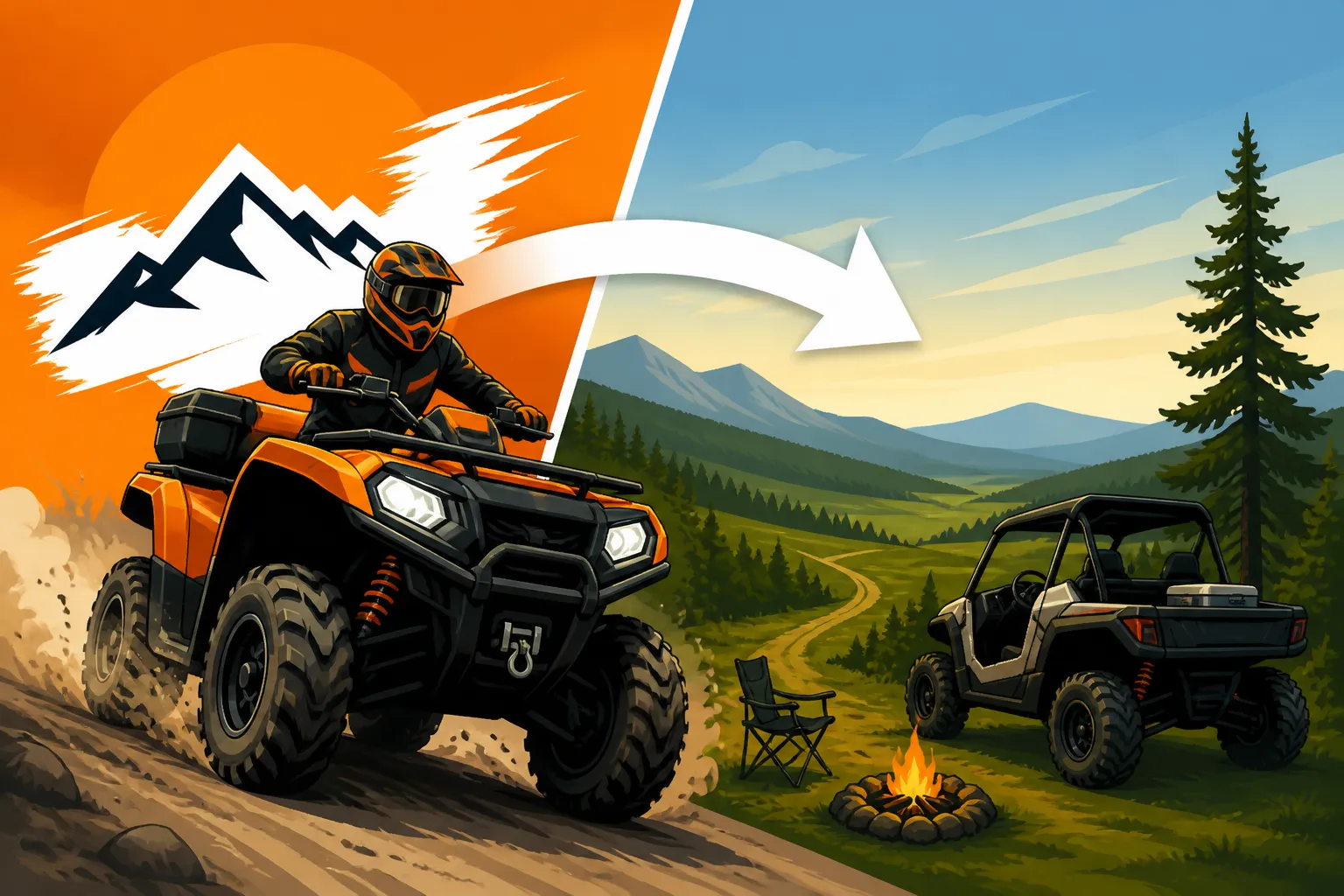
Moving a Kilometre Away and Staying Gone Seventy-Two Hours
Moving a camp on Alberta public land can feel like a simple way to extend a stay, but the relocation rule has two parts: distance and time away. The key is to move the camping unit far enough and stay away from the original location long enough. Here’s how to understand the rule, plan the move, and keep camping requirements separate from ATV and UTV riding rules.
What the kilometre and seventy-two-hour rule means
According to the Government of Alberta, campers may stay in the same location for a maximum of 14 days. After that, they must move their camping unit at least 1 km and remain away from the original location for a minimum of 72 hours.
Both parts matter. Moving the camp the required distance but returning before the required time has passed does not meet the stated rule. Nor does staying away long enough while moving the camp less than the required distance. If you are planning a longer trip, build both requirements into the itinerary rather than treating relocation as a quick change of scenery.
The rule concerns the camping unit and its location, not just where the ATV or UTV is parked. Moving a machine while leaving the camp in place is not the same as moving the camping unit. When deciding what counts as a qualifying move or how the distance is measured in a particular situation, check the current official guidance rather than relying on a map estimate or an assumption.
| Camping plan | What the Government of Alberta rule requires | Practical takeaway |
|---|---|---|
| Stay at one location | No more than 14 days | Plan a move before reaching the limit |
| Relocate after the stay | Move the camping unit at least 1 km | Make sure the new camp is far enough away |
| Return to the original location | Stay away for a minimum of 72 hours | Track the time away as well as the distance |
| Camp overnight on public land | Campers aged 18 and older must obtain a Public Lands Camping Pass | Check the pass requirement separately from the relocation rule |
For a fuller overview of how the time and move requirements fit together, see Alberta Camping Limits in One Spot, Alberta’s 14-Day Camping Limit and Alberta’s 1-Kilometre Relocation Rule. The article Moving a Random Camp After Fourteen Days may also help when planning a move between camping locations.
Keep the original location and the new one clear
Before packing up, note where your camp is and where you intend to set up next. A practical record might include map pins, a saved offline map, and the date and time you leave. These notes are not a substitute for meeting the rule, but they can help you avoid a rushed move or an early return.
The move should be planned around the actual camping location, not simply a nearby landmark or a different spot that looks separate. When the terrain, route, or boundaries make the distance uncertain, choose a clearly separate location and confirm that your plan meets the applicable rule. Avoid assuming that crossing a road, moving to another part of a staging area, or shifting a short distance within the same general camping spot is enough.
The time-away requirement also calls for more than a brief outing. If you leave the original camp and return before 72 hours have passed, the minimum stay-away period has not been completed. Write down the departure time and plan the return only after the full required period has elapsed.
Plan the move around the land and your route
A relocation that works on a road map may not work on the ground. Access can depend on whether the destination is open to camping, whether vehicles may travel there, and whether the approach crosses land with separate restrictions. Pick the next location before you leave, then check the rules that apply to the route and the destination.
Alberta’s public land includes different recreation settings, and not every open-looking space is automatically a suitable place to camp or ride. Public Land Recreation Areas are small areas intended to help manage high recreational use, often near places used for random camping, day use, or trail access. Most are located within Public Land Use Zones, according to the Government of Alberta. The presence of an information kiosk, trail access, or camping amenities does not remove the need to follow the rules for that area.
Use current official information to check where you may camp and whether a site has restrictions. If you use a mobile map, download it before leaving an area with reliable service. The Government of Alberta says georeferenced maps can be used offline through the Avenza mobile app. An offline map can help with navigation, but it should not be treated as proof that a location is open or that the camping move meets the distance requirement.
The required Public Lands Camping Pass is another separate part of an overnight stay. The Government of Alberta requires campers aged 18 and older to obtain a pass for overnight stays. A pass does not replace the obligation to move after the maximum stay, and meeting the relocation rule does not replace the pass requirement. See Alberta Public Lands Camping Pass and Alberta Random Camping Rules Explained when sorting out these separate camping conditions.
Before leaving the original camp, check whether the intended route uses a provincial trail or another designated route. The Government of Alberta says motorized users on provincial trails, except snow vehicle users, must stay on the trail tread. Vehicles must not be left unattended on the tread, and overnight parking of motor vehicles, off-highway vehicles, or camping units can occur only in designated areas. A trail that gets you close to a new camp does not necessarily authorize parking or camping wherever you choose.
A few practical checks can prevent a move from turning into a second problem:
- Confirm that the destination is available for camping and that the access route is open to your vehicle.
- Check current notices for closures, restrictions, or changes to designated access.
- Do not use a provincial trail tread as an overnight parking spot.
- Take waste with you or to a dump station. The Government of Alberta says garbage, recycling, compost, and human waste must be taken home or to a dump station.
- If you are unsure whether the site or route is permitted, verify before setting up rather than relying on what another camper has done.
If your trip involves a vehicle or camping unit left behind while you explore, plan where it will be parked. The rule for overnight parking on designated trails is distinct from the rule for how long you can stay at a camping location.
Keep camping rules separate from ATV and UTV requirements
The 1 km and 72-hour requirement is a camping rule. It does not by itself make an ATV or UTV legal to operate on the route to a new site. When off-roading on public land, the Government of Alberta requires an OHV to be registered and insured, with a licence plate displayed in a visible location. Public land OHVs must also have working head and tail lights, a proper muffler, and a spark arrester.
Those requirements apply alongside land-access and trail rules. A registered, insured machine is not automatically allowed on every road, trail, or piece of public land. Check whether your intended route is open to motorized use and whether it is a designated trail. For related riding requirements, see Alberta Equipment Required on Public Land, Alberta Rules for Riding Crown Land and Alberta OHV Trails: Riding Public Land.
Helmet rules are also separate from the camping move. According to the Government of Alberta, OHV users must wear a Canadian Standards Association-compliant helmet when riding on public land. Off-road drivers on public land must be at least 14 years old unless closely supervised by an adult aged 18 or older, according to Alberta.ca. These rules concern riding, not whether a campsite has been moved far enough or whether the required time away has elapsed.
Plan the riding part of the trip with the destination in mind. A relocation may require towing the machine, riding an authorized route, or using a road that has its own rules. Do not assume you can ride directly between two camping spots just because the map shows a connecting line. For public land recreation areas and trails, the Government of Alberta sets a speed limit of 20 km/h unless otherwise posted.
If a trail or route is closed, or a site is not open to the kind of use you have planned, choose a different route or destination. The need to relocate does not override land-use rules, trail closures, or restrictions on where vehicles can travel.
A simple planning sequence
- Choose the next permitted camping location before the current stay reaches its limit.
- Check that the camping unit can be moved at least 1 km from the original location.
- Record when you leave and do not return to the original location until at least 72 hours have passed.
- Confirm that overnight parking and access are permitted at the destination.
- Check the route separately for OHV access, trail rules, registration, insurance, and required equipment.
- Keep the camping pass and riding requirements distinct so that satisfying one is not mistaken for satisfying the other.
This approach makes it easier to see whether the plan meets the camping rule and whether the journey between camps is allowed. If the meaning of “same location,” the measurement of the move, or a local restriction is unclear, confirm it with the relevant official source before relying on an interpretation.
Common mistakes when moving camp
One common mistake is focusing on the distance and forgetting the time. The Government of Alberta requires campers to move at least 1 km and remain away from the original location for a minimum of 72 hours after the 14-day stay. A move that meets only one of those conditions is not a complete plan.
Another mistake is treating a day ride as the relocation. Riding away from camp does not move the camping unit. If the tent, trailer, or other camping setup stays at the original site, the camp has not been relocated simply because the riders spent time elsewhere.
It is also easy to confuse a new-looking spot with a qualifying new location. A nearby site may appear separate but still leave uncertainty about the distance or whether it should be treated as the same location. Leave a clear margin and use official guidance when the boundary is not obvious. Do not count on a small adjustment around the original site to satisfy a kilometre-based rule.
Some campers assume that moving to a new site resets every other obligation. It does not. A Public Lands Camping Pass may still be required for the overnight stay, and the new location and route still need to be suitable for the planned use. Likewise, a pass does not authorize off-trail riding or overnight parking in an area where it is not allowed.
Finally, do not base a plan only on another visitor’s setup or on an old map. Access conditions and land-use information can change. Check official information close to the trip, save relevant maps for offline use, and choose a backup location in case your first choice is unavailable. For practical help reviewing the move itself, Alberta Camping Distance From Facilities can help you assess another location-specific consideration.
Sources
- Alberta government — Off-highway vehicle helmet law | Alberta.ca (checked November 3, 2026)
- Government of Alberta — McLean Creek Off-Highway Vehicle PLUZ | Alberta.ca (checked November 3, 2026)
- Alberta.ca — Port obligatoire du casque pour les véhicules hors route | Alberta.ca (checked November 3, 2026)
Disclaimer
This article is for general informational purposes only and does not constitute professional advice. Laws, prices and regulations vary by location and change over time. Consult a qualified professional for guidance on your specific situation.