Camping a Kilometre Back From a Recreation Area
Camping with an ATV or UTV near an Alberta recreation area can be confusing: a nearby public-land spot is not automatically open for random camping. The one-kilometre setback is an important starting point, but it does not replace checking land status, access rules, closures and camping-pass requirements before you unload.
What the one-kilometre setback means
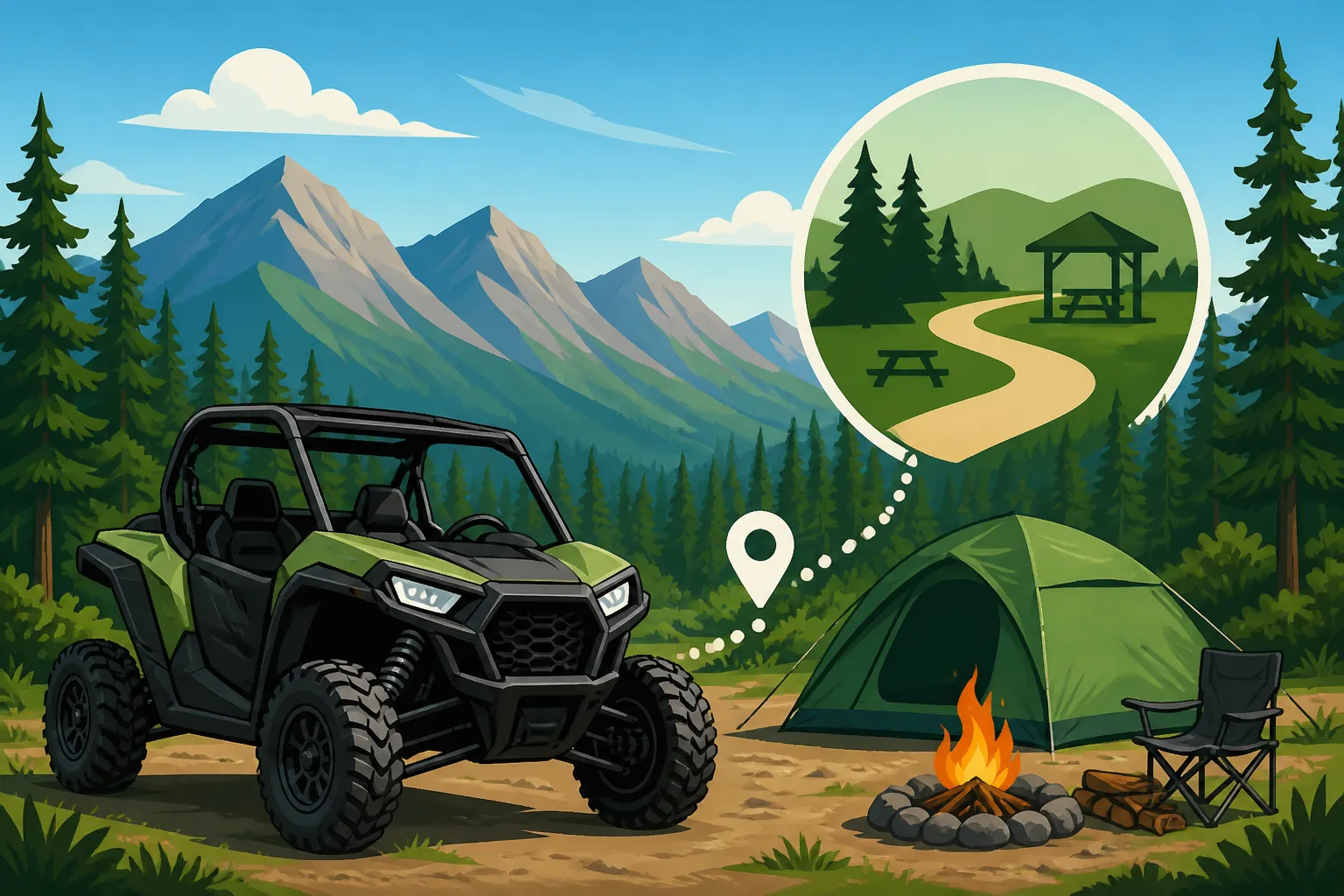
Alberta’s public-land camping rules can restrict random camping within one kilometre of a designated recreation area. The point is to keep random camps separate from managed sites and facilities, not to create an extra overflow campground just beyond the boundary.
A recreation area may have its own designated campsites, facilities and rules. If you want to camp there, use a site that is open and follow the area’s requirements. If you want to camp outside it, first confirm that the location is eligible for random camping and that it is far enough from the recreation area under the rules that apply to that land.
The word “recreation area” matters. It does not necessarily mean any place where people hike, fish or park. It refers to a managed area or site with a defined status or boundary. A pullout, trailhead, informal staging spot or old campsite may look similar on the ground without having the same designation. Conversely, a boundary shown on a map or identified on a sign may not be obvious from the campsite itself.
Do not estimate the setback only by looking at how far the campsite seems from a campground entrance. The relevant boundary may not be the entrance, parking lot or first facility you see. If the map or signage does not make the boundary clear, check the current land information or contact the responsible land manager before setting up.
The one-kilometre distance is also not a general guarantee that a site is lawful. It addresses one restriction; other restrictions can still rule out the location. For example, the land might be closed to camping, be private land, be part of a grazing lease where access conditions apply, or be subject to a seasonal restriction. See Alberta Random Camping Rules Explained for the broader rules that can affect a camp.
| Question | What to check before you camp |
|---|---|
| Is the spot outside the recreation area? | Confirm the area’s boundary on current maps, signs or land information. |
| Is it far enough away? | Check whether the one-kilometre restriction applies and how it applies at that site. |
| Is random camping allowed there? | Look for land-use restrictions, closures and designated-camping requirements. |
| Can you reach it by ATV or UTV? | Confirm that the route and riding area are open to your machine and type of travel. |
| Do you need a camping pass? | Check whether the location is on public land covered by the pass requirement. |
| Are there other access conditions? | Check private-land permission, lease access, fire restrictions and local notices. |
If you are unsure whether a particular area qualifies, do not rely on a general rule of thumb from another campground. Check the official information for the specific location. Land designations and access conditions can differ between nearby areas.
Check the land and access route, not just the campsite
A campsite can appear suitable on a map and still be off limits. Start by identifying who manages the land and what kind of land it is. Public land, private land, a designated recreation area and land subject to a grazing lease do not all have the same access rules.
Then confirm both parts of the trip: the place where you intend to camp and the route you will use to get there. A legal camping location does not make every trail, road or cutline leading to it open to motorized travel. A route may be closed, restricted to certain vehicles or affected by a temporary closure. Check Checking a Zone Before You Go and Alberta Rules for Riding Crown Land before planning an ATV or UTV route.
A few practical checks can prevent a frustrating arrival:
- Find the recreation area on a current official map or land information source, and note its boundary.
- Confirm that random camping is allowed at your intended location and that the one-kilometre setback applies as you understand it.
- Check whether the area has seasonal closures, fire restrictions or other temporary notices.
- Verify that your planned motorized route is open to your machine. Do not assume that a visible track is an authorized trail.
- Check whether you need a public-lands camping pass and whether other permits or permissions apply.
- Save or download maps and notices before leaving cell coverage, and carry enough information to identify your intended location.
A line on a map is useful, but it may not show every current closure or explain every local restriction. Signs at the site matter too. If a sign says camping or motorized access is prohibited, do not treat the one-kilometre rule as permission to ignore it. When two sources appear to conflict, check with the land manager rather than choosing the interpretation that makes the trip easiest.
Grazing leases need particular care. A lease is not an invitation to ride anywhere across the land, and a camp set back from a recreation area can still be in the wrong place. Keep gates as you found them, avoid livestock and contact the leaseholder when the access conditions call for it. Alberta Grazing Lease Access Rules explains why lease access deserves a separate check.
Camping passes, ATV permits and other requirements
The camping pass question is separate from the setback question. A location that meets the distance restriction may still require a public-lands camping pass, and having a pass does not make a closed area open. Check the rules for the exact location and the dates of your trip. For background on coverage and the pass itself, see Alberta’s Public Lands Camping Pass.
Do not confuse a camping pass with an ATV trail permit. A camping pass relates to camping where it is required; it is not permission to ride every public-land trail or to camp anywhere outside a recreation area. Alberta does not have a general OHV trail pass that replaces the need to check local access rules. Read Alberta Has No OHV Trail Pass alongside the land-specific information for your route.
Registration and insurance are separate again. If you are riding on public land, make sure the machine meets the applicable requirements before you leave home. A camping pass does not register an ATV or UTV, and registration does not give you camping permission. Review Alberta Registration Before Riding Crown Land and Alberta Insurance Requirements on Public Land if you need to check those obligations.
Visitors should not assume that a vehicle registration from another province answers every Alberta requirement. Rules for visiting riders can depend on how long the machine is in the province and the rider’s circumstances. If you are travelling from outside Alberta, check Alberta Reciprocity for Visiting Riders before the trip.
At the campsite, keep any required documents accessible and follow posted instructions. A phone can be useful for maps and digital records, but do not depend on having a signal at the trailhead. Download documents and maps ahead of time, and keep a practical backup if your phone battery or reception is unreliable.
| Requirement | What it does | What it does not do |
|---|---|---|
| Public-lands camping pass, where required | Meets a camping-pass requirement for covered public land | Make a closed location open or remove a distance restriction |
| ATV or UTV registration | Addresses vehicle registration requirements | Give permission to ride a closed trail or camp at a site |
| Insurance | Addresses insurance requirements for riding | Replace registration, a camping pass or landowner permission |
| Local access permission | Allows access where permission is required | Override a closure or other land-use restriction |
| Recreation-area reservation or site rules | Applies to the managed site you use | Authorize random camping outside that site |
The safest plan is to treat each requirement as its own check. Confirm the camping location, route, vehicle paperwork and passes independently. If one piece is uncertain, resolve it before the trip rather than assuming another document covers it.
Set up camp responsibly and have a backup plan
Once you have confirmed that a site is open and meets the applicable setback, choose a durable place that will not cause avoidable damage. Avoid wet ground, fragile vegetation, streambanks and areas where vehicles would widen an existing track. Keep your machine on an authorized route and park it where it will not block access or damage the site.
Bring only what you need and pack out what you bring. Keep food and waste secured, and follow current fire restrictions rather than relying on a previous visit or an old campsite ring. A fire ring does not prove that fires are allowed today. Check current notices before lighting any fire, and be prepared to go without one.
ATVs and UTVs can make it tempting to carry extra gear or move camp farther from a managed area, but access still depends on authorized routes. Do not create a new trail to reach a spot that looks convenient. Avoid riding through streams or around obstacles in ways that widen the route, and leave gates in their original position. These habits reduce damage and help prevent access problems for other visitors.
Have a backup before you set out. If your intended location is occupied, closed or closer to the recreation area than you thought, do not simply move a short distance and assume the new spot is acceptable. Use a second location that you have checked in advance, or stay at an open designated site. A backup plan is especially useful when maps are unclear or conditions change after heavy rain, fire restrictions or land-management notices.
A short pre-trip checklist helps:
- Confirm the recreation-area boundary and the setback that applies.
- Verify the campsite’s land status and whether random camping is allowed.
- Check access routes, closures and current fire restrictions.
- Confirm camping-pass, registration and insurance requirements separately.
- Download maps and relevant documents before losing cell service.
- Identify a legal backup location or a designated campground.
The one-kilometre setback is best treated as a minimum location check, not a shortcut around the rest of Alberta’s public-land rules. Confirm the boundary, make sure random camping is allowed, and check that both your route and your machine comply with the requirements for the area. If any detail remains uncertain, use a designated site or contact the responsible land manager before you ride in.
Disclaimer
This article is for general informational purposes only and does not constitute professional advice. Laws, prices and regulations vary by location and change over time. Consult a qualified professional for guidance on your specific situation.