Alberta Insurance Requirements on Public Land
It can be incredibly frustrating to figure out all the rules and regulations for enjoying your off-highway vehicle (OHV) in Alberta, especially when you just want to hit the trails or explore some backcountry. Many riders think that because they're "off-road," the same rules as cars on pavement don't apply, especially when it comes to insurance. However, this guide is here to clarify a crucial requirement that often catches riders off guard: the absolute necessity of carrying proper insurance when riding your ATV or UTV on public land in Alberta.
The Non-Negotiable Reality: Insurance for Alberta OHV Public Land Use
Let's cut right to it: if you plan on riding your ATV, side-by-side, dirt bike, or snowmobile anywhere that isn't your own private property, you absolutely need insurance in Alberta. This isn't a suggestion; it's a legal requirement outlined in the Traffic Safety Act. Thinking you can skip it because you're "just going on Crown land" or "only sticking to designated trails" is a common and potentially very costly mistake. The law is clear, and the consequences for non-compliance can be severe, ranging from hefty fines to your machine being impounded. It's a small upfront cost that saves you a world of trouble down the line, protecting both your finances and your peace of mind.
Why Insurance is a Must-Have, Not a Maybe
Picture this: you're out riding on a beautiful day, perhaps navigating some challenging terrain or just cruising along a scenic trail. Accidents happen, even to the most experienced riders. Maybe you misjudge a turn and slide into another machine, or perhaps your OHV veers off a trail and causes damage to public property, like a fence line or a delicate ecological area. Without insurance, you are personally on the hook for all the repair costs, medical bills for injured parties, and any property damage claims. These costs can quickly escalate into tens of thousands of dollars, or even more, turning a fun day into a financial nightmare that can follow you for years.
The province mandates this coverage not just to protect others from your actions, but also to ensure that victims of accidents caused by OHVs have a means of recourse and compensation. It’s about shared responsibility and safety within the riding community. This also protects you if someone else is at fault and uninsured, though your own liability coverage is the primary concern for the province. The legal framework is designed to prevent riders from being left in impossible financial situations after an unfortunate incident.
What Kind of Insurance Are We Talking About?
When the Alberta government talks about requiring insurance for OHVs on public land, they are primarily referring to third-party liability insurance. This type of insurance protects you financially if you are found legally responsible for injuring another person or damaging their property while operating your OHV. It's the same fundamental principle behind the insurance required for your car or truck on public roads. This isn't about covering damage to your own machine, though many riders wisely choose to add that comprehensive or collision coverage for their own peace of mind.
The minimum amount of third-party liability coverage generally required is usually quite substantial, often hundreds of thousands of dollars, though the exact figures can vary and are set by provincial regulations. It's always a good idea to check with your insurance provider for the current minimums and consider opting for higher limits if your budget allows. Many riders feel more secure with a higher liability limit, especially given the potential for significant damage or injury in an OHV accident. You'll find that insurers offer a range of options, from basic liability to comprehensive packages that cover everything from theft to hail damage, allowing you to tailor your policy to your specific needs and machine value. For a deeper dive into the specific types and costs, you might find articles like [Alberta Insurance Cost for an ATV] and [Alberta Insurance for a Side-by-Side] helpful.
Understanding What "Public Land" Truly Means for OHV Insurance
The term "public land" in Alberta is broader than many riders realize, and it's where much of the confusion (and potential for tickets) arises. It's not just the obvious places like provincial parks or designated OHV zones. The Traffic Safety Act defines "highway" in a way that includes much more than paved roads, and this definition directly impacts where you need insurance. Essentially, if you're not on private property that you own or have explicit permission to ride on, assume you need insurance. This is why you need to know exactly where you're riding and what regulations apply.
Crown Land, PLUZ, and Designated Trails
When most people think of public land for OHV riding in Alberta, they often picture vast stretches of Crown land, Public Land Use Zones (PLUZs), or officially designated trail systems like those found in McLean Creek or the Ghost PLUZ. And yes, absolutely, you need insurance when riding in these areas. These are the playgrounds for many riders, offering incredible opportunities for exploration and adventure, but they come with responsibilities. Whether you're blazing a new trail (responsibly, of course!) or following a well-worn path, you are expected to be fully compliant with all provincial regulations, and that includes having your insurance in order.
Consider a scenario where you're riding with friends in the picturesque foothills, enjoying the challenges of a rocky ascent in a PLUZ. If, during a tricky maneuver, your side-by-side rolls and damages a trailside structure or a sensitive natural feature, your liability insurance would be crucial. The cost of environmental remediation or repairing public infrastructure can be staggering, and without proper coverage, that burden falls squarely on you. Always remember that riding on [Alberta Registration Before Riding Crown Land] means you're operating under provincial laws, and insurance is paramount.
The Surprising Scope: Ditches, Alleys, and Even Some Roads
Here's where it gets tricky for many riders: the definition of "highway" under Alberta's Traffic Safety Act includes more than just major roads. It encompasses road allowances, ditches, alleys, and other public rights-of-way. This means that if you're riding your quad along the ditch beside a rural road, or even crossing a paved road to get to another trail section, you are technically on a "highway" as defined by the law. And when you're on a "highway," regardless of whether it's paved or just a grassy ditch, you need insurance. This catches many people off guard, especially those who only ride casually around their rural properties but occasionally venture beyond their fence lines.
Think about a farmer who uses their ATV to check fences or herd cattle. If they momentarily ride along a municipal road allowance or cross a county road, even for a short distance, they are legally required to have insurance. The same goes for someone using their machine to access a remote hunting spot, or even just driving a short distance to a staging area. It's a common misconception that "off-road" means "off-highway," but in Alberta's legal terms, that's not always the case. For more details on these specific areas, you might want to look into [Alberta Rules for Riding a Ditch] and [Alberta Highways Include Ditches and Alleys]. It's far better to be safe and ensure your machine is insured, rather than risk a ticket because you didn't understand the full scope of "public land."
What Happens If You're Caught Without Insurance?
Ignorance of the law is never an excuse, and when it comes to OHV insurance on public land in Alberta, the penalties can be quite steep. An encounter with law enforcement without valid insurance can quickly put a damper on your day and leave a significant dent in your wallet, not to mention creating a lasting headache. Officers regularly patrol popular riding areas, staging points, and even rural roads to ensure compliance with registration, helmet, and insurance regulations. They're not just there to catch speeders; they're ensuring everyone's safety and adherence to the rules that keep these recreational opportunities available.
The Immediate Financial Hit and Vehicle Seizure
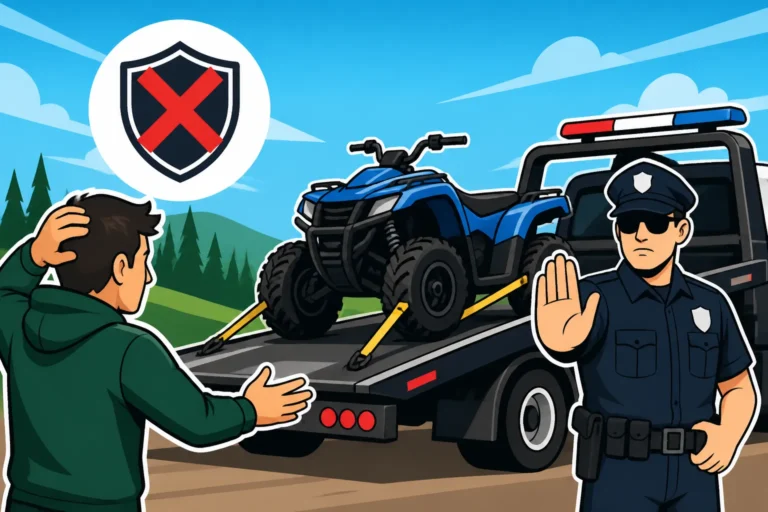
If an Alberta peace officer, Fish and Wildlife officer, or RCMP member pulls you over and you cannot produce valid proof of insurance for your OHV, prepare for immediate consequences. The most common immediate outcome is a significant fine. These fines are not trivial; they are typically substantial and designed to act as a serious deterrent. In addition to the fine, your OHV can, and often will, be seized. This means your machine will be impounded, and you'll be responsible for towing fees, storage fees, and potentially other administrative costs before you can even think about getting it back.
Imagine being miles from home, having your quad loaded onto a tow truck, and then needing to arrange a ride for yourself and your gear. It's an inconvenient and costly ordeal that far outweighs the annual premium for an insurance policy. The financial hit from the fine, towing, and storage alone can easily exceed the cost of several years of insurance premiums. This is not a situation you want to find yourself in. You can learn more about this specific consequence by reading [Alberta Vehicle Seizure for No Insurance]. The process to retrieve a seized vehicle is often complex, involving proving ownership, showing valid insurance, and paying all outstanding fees, which can quickly add up.
Long-Term Repercussions Beyond the Ticket
The impact of being caught without OHV insurance extends beyond just the immediate fine and seizure. A conviction for riding uninsured can also affect your future insurance rates for all your vehicles, including your car or truck. Insurance companies view such infractions as a sign of higher risk, and this can lead to increased premiums or even difficulty securing coverage in the future. It becomes part of your driving record, even though it was an off-highway vehicle incident. This can be a particularly nasty surprise for riders who thought their OHV activities were completely separate from their road vehicle records.
Furthermore, if you're involved in an accident while uninsured, and you are found at fault, you could face civil lawsuits for damages and injuries. This means individuals or insurance companies could pursue you directly for compensation, potentially leading to wage garnishments, liens on your property, or even bankruptcy. The legal costs alone for defending such a lawsuit can be astronomical, let alone the actual damages awarded. It's a stark reminder that the cost of insurance is a small price to pay for the peace of mind and financial protection it offers. While LawDepot offers templates for legal documents like bills of sale, helping you prove ownership for your OHV, they cannot protect you from the legal and financial ramifications of riding uninsured.
Securing Your Coverage: Practical Steps for Alberta Riders
Now that we've established why insurance is so critical, let's talk about how to get it and stay compliant. It's not a complicated process, but it does require a bit of due diligence. Ensuring your OHV is properly insured is a foundational step before you even think about loading it onto a trailer or driving it to a staging area. Taking the time to understand your options and prepare your documentation will save you from potential grief down the trail.
Comparing Insurance Providers and Policies
The first step is to shop around for insurance. Many reputable insurance companies that offer auto insurance also provide OHV coverage. It's wise to get quotes from several providers to compare rates and coverage options. Don't just look at the premium; pay close attention to the deductibles, the liability limits, and any additional coverage that might be included or available, such as collision, comprehensive, or even roadside assistance for your machine. Some companies specialize in powersports insurance, while others offer it as an add-on to existing auto policies, which might provide a multi-vehicle discount.
When you're comparing policies, make sure you understand exactly what "public land use" means in their terms and conditions. Some policies might have exclusions or specific requirements. Be upfront about where and how you intend to ride your OHV. If you own multiple machines, ask about multi-vehicle discounts. It's also worth discussing any unique situations, like if you frequently travel to [Alberta Registration for Visiting Riders] or have youth riders in your household. The goal is to find a policy that provides adequate coverage at a competitive price, giving you confidence every time you hit the trails.
Carrying Proof and Being Prepared for Inspection
Once you've secured your insurance, the final crucial step is ensuring you always have valid proof of insurance with you whenever you're riding on public land. An Alberta officer can demand to see this proof, along with your OHV registration and your driver's license (if applicable for your age and machine). Typically, your insurance provider will issue an insurance card or a digital certificate. While a digital copy on your phone might be acceptable, it's always safest to carry a physical copy in a waterproof bag or container on your machine, especially since cell service can be spotty in many remote riding areas. For more on what an officer can ask to see, check out [What an Alberta Officer Can Ask to See].
Officers aren't just looking for proof of insurance at random checkpoints; they'll also ask for it if you're involved in an accident or if they stop you for any other infraction. Being unable to produce proof of insurance on demand is, in itself, an offense and can lead to a ticket, even if you are in fact insured. So, make it a habit: before every ride, do a quick checklist. Is your machine registered? Do you have your helmet? And most importantly, is your proof of insurance securely stowed? This simple routine can save you from a major headache and ensure your adventures in Alberta's beautiful outdoors remain enjoyable and worry-free.
Disclaimer
This article is for general informational purposes only and does not constitute professional advice. Laws, prices and regulations vary by location and change over time. Consult a qualified professional for guidance on your specific situation.