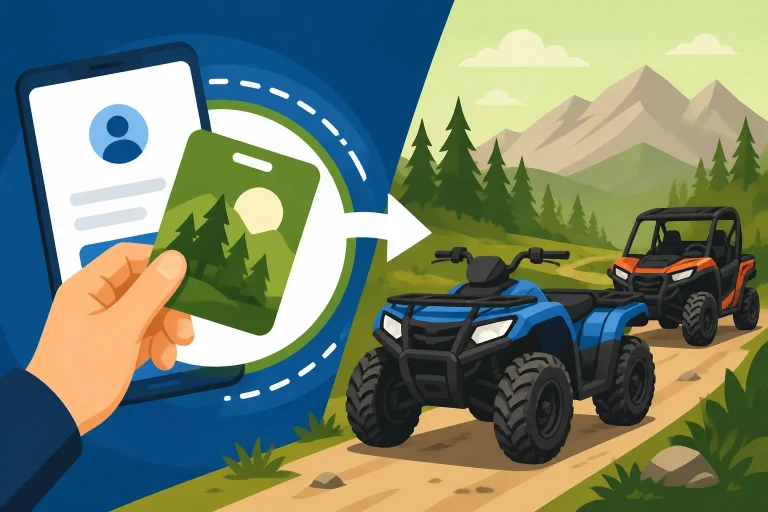
Alberta Passes in Porcupine Hills
Porcupine Hills can be an easy place to confuse a camping pass with a riding permit. They are not the same thing, and the rules depend on whether you are camping, riding, or doing both. This guide explains which pass may apply, who needs one, what it does not authorize, and what to check before you head out.
Which pass applies in Porcupine Hills
The main pass question for a Porcupine Hills trip is usually whether you will camp on public land in an area covered by Alberta’s Public Lands Camping Pass program. Porcupine Hills is associated with the Eastern Slopes camping-pass area, but don’t rely on the place name alone to decide whether a particular campsite is covered. Check the current official coverage map and rules for the precise location.
The Public Lands Camping Pass is about camping on covered public land. It is not an ATV or UTV trail permit, vehicle registration, or insurance. If you’re riding for the day and not camping, don’t assume you need a camping pass just because you’re visiting the area. Conversely, if you camp overnight, riding a registered machine does not replace the camping pass requirement.
| What you plan to do | What to check |
|---|---|
| Ride for the day, without camping | Public-land access, trail and vehicle rules, registration, and insurance |
| Camp on public land | Whether the site is in a camping-pass area and which campers need a pass |
| Camp in a formal campground | The campground’s own reservation and fee rules |
| Ride and camp | Both the riding rules and the camping-pass rules |
| Visit as an out-of-province rider | Your registration, insurance, length of stay, and any camping requirements |
The pass is not a general permission slip for every activity on public land. It does not open a closed route, allow travel off designated trails, grant permission to cross private land, or replace any local restriction. A camping pass also does not make a campsite available if camping is prohibited there.
If you’re not sure whether your chosen spot falls within the covered area, look up the location rather than relying on a general description such as “near Porcupine Hills.” Boundaries can be less obvious on the ground than on a map. The overview Which Land the Eastern Slopes Camping Pass Covers can help you understand the area-wide question, while Alberta’s Public Lands Camping Pass explains the pass itself.
One more distinction matters: there is no general Alberta OHV trail pass that substitutes for the camping pass. The pass you may need for an overnight stay is a land-use camping requirement, not a ticket to ride. For the riding side of the trip, you still need to check where machines are permitted, whether the trails are open, and what equipment and documents apply.
Who needs a camping pass
The pass requirement depends on the type of land, the activity, and the people in your camping party. For covered public land, adults camping overnight are generally the people who need to pay attention to the pass requirement. Children are treated differently, but don’t assume that a family purchase automatically covers every adult in the group. Confirm the current rules before buying.
A common planning mistake is to count vehicles instead of campers. A family may arrive in one truck and one trailer, but the relevant question is not simply how many vehicles are parked there. Work out who is camping, who is an adult under the current rules, and whether the proposed location is covered. The guide Does Every Adult in Camp Need Their Own Pass? addresses that question, and Do Alberta Kids Need a Camping Pass? is useful when children are part of the group.
You may also need a Wildlife Identification Number, often called a WIN, to purchase a pass through Alberta’s system. That is a separate identifier, not the camping pass itself and not a substitute for registration. If you haven’t used the system before, read Alberta’s WIN Card Explained and check the current purchase instructions before you leave home. Sorting out the account and required details in advance is easier than trying to do it with weak reception at a staging area.
The options may include a short-duration pass and a longer-term pass. Which one makes sense depends on the length and timing of your stay, not on how much riding you plan to do. The exact validity periods, prices, and purchase conditions can change, so verify them through the official sales channel. Alberta Three-Day Pass vs Annual Pass compares the general choice, and Alberta Camping Pass Cost is the place to check the cost structure. Don’t rely on an old screenshot or a price quoted in a past trip report.
If several adults are joining you, sort out the pass question for each person rather than assuming one purchase covers the whole party. For a group, it helps to make a simple list before leaving:
- Names of the adults who will camp on covered public land
- The dates and location of the stay
- Whether the location is within the camping-pass area
- The pass type each camper needs under the current rules
- The purchase confirmation or other proof you may need to show
This isn’t busywork. It prevents a group from arriving at camp and discovering that one person thought the organizer had handled everything while the organizer thought everyone would buy their own.
If your trip includes both public land and a commercial or government campground, check each overnight location separately. A formal campground can have its own reservation, fee, and access conditions. A public-land camping pass does not automatically pay those charges or guarantee a site, and a campground booking may not cover a separate night of random camping elsewhere.
A camping pass does not authorize ATV or UTV riding
The pass question and the riding question overlap on a trip, but they are different decisions. A camping pass relates to camping in covered public-land areas. Riding an ATV or UTV requires you to follow the rules for the land and route, use a machine that meets applicable requirements, and carry the required documents.
Before unloading, confirm that the trail or route is open to your type of machine. Access can depend on the specific zone, trail designation, vehicle size or weight, and seasonal restrictions. A route that appears on an old map or a social-media post may have changed, been closed, or never been open to OHVs. Start with current official maps and notices, then use local signs and barriers on the ground. Checking a Zone Before You Go and Alberta Trail Maps Worth Downloading can help you build that habit.
A pass does not authorize riding off a designated route to reach a preferred campsite, avoid a muddy section, or get around a gate. Nor does it give you permission to cross private land or land where access is restricted. If a route is closed, the camping pass does not override the closure.
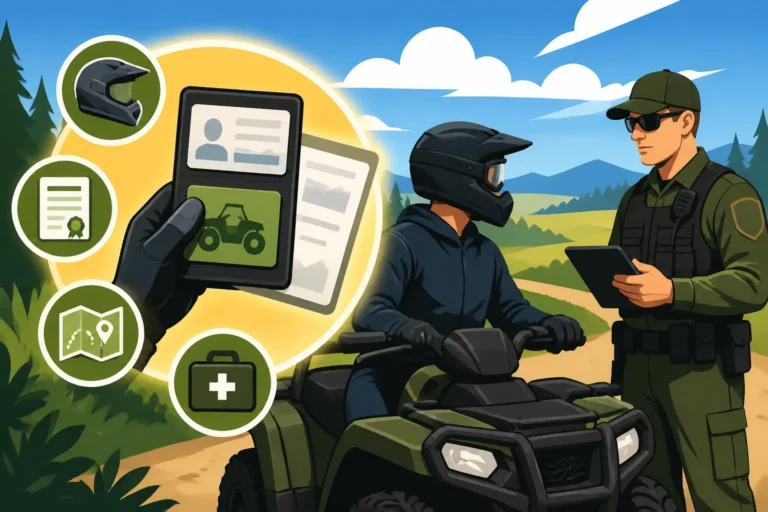
For an Alberta-registered OHV, make sure the machine’s registration is current and that the registration certificate is available in the required form. Alberta also requires insurance for OHVs used on public land. Those obligations are separate from the camping pass. Review Alberta Requires Insurance on Public Land and Alberta Has No OHV Trail Pass if you need to separate the riding documents from the camping requirement.
Visitors should not assume that their home-province plate settles every question. A visiting rider may be able to use valid home-province registration for a limited period, but residency and length of stay can affect what is required. Insurance also needs to be valid for the use and location. If you’re travelling from another province or the United States, check the relevant visitor rules before setting off; Alberta Reciprocity for Visiting Riders is a useful starting point.
On the trip itself, keep your paperwork easy to reach. A phone may be convenient, but backcountry reception and battery life are unreliable. Have a practical way to access proof of registration and insurance, and follow the current requirements about what form of document is accepted. The camping-pass confirmation, vehicle documents, and any campground booking should not be treated as interchangeable.
Planning a Porcupine Hills camp and ride
A smooth trip begins with choosing the campsite and route separately. First, identify the overnight location and confirm whether it is public land, a formal campground, or another type of site. Then check whether the public-land camping pass applies there. After that, choose a route your machine is permitted to use and confirm that it is open for your travel dates.
This order helps avoid a familiar problem: choosing a ride first, then picking a nearby place to camp without checking whether camping is allowed. A staging area is not automatically a campsite. A wide, flat patch beside a trail is not proof that overnight camping is permitted there. Check land-use rules, designated camping information, and signs before settling in.
For random camping, use the current Alberta guidance on where and how long you may camp. Pay attention to setbacks from facilities, recreation areas, and other restricted locations. Don’t treat a previous visitor’s fire ring or tire tracks as evidence that a location is legal or suitable. [Alberta Random Camping Rules Explained] gives the broader framework, while [Camping a Kilometre Back From a Recreation Area] covers one location issue that can matter when choosing a site. Always confirm the current rule and its application to your exact spot.
If you are travelling with an ATV or UTV, plan for the machine as well as the campsite:
- Choose a specific staging area and destination. Don’t rely on a broad region name when you need to know where you can park, unload, camp, or ride.
- Check current access information. Use current official maps, closure notices, signs, and any posted vehicle restrictions.
- Confirm your overnight plan. Determine whether the location is covered by the camping-pass rules or has separate campground requirements.
- Get documents and purchases in order. Check registration, insurance, pass requirements, and purchase instructions before travelling.
- Bring a backup for essential information. Save maps and directions for offline use, and keep essential documents accessible if your phone loses service.
- Recheck conditions close to departure. Weather, fire restrictions, trail closures, and access conditions can change.
Offline navigation is especially useful when you leave reliable cell coverage. Download the map or information you need before you travel, and make sure you can tell the difference between a mapped route and a route that is currently open to your machine. A paper map can provide a useful backup, but it should be current and should not replace checking for closures. If you prefer to buy accessories online, a map sleeve or power bank from Amazon may help protect a paper map or keep a phone charged; the official map and current notices are still the sources to rely on for access decisions.
Be ready to adjust your plan. If a closure blocks the route, don’t ride around it. If your intended campsite is not permitted, move to a location where camping is allowed rather than treating the pass as permission to stay. If the route is wet or fragile, staying on durable ground and avoiding trail widening protects access for the next visitor.
For mixed groups, explain the basic plan before anyone starts riding. Agree on the staging point, route, turnaround time, and what to do if someone gets separated. A map case or mount sold through Amazon can make navigation easier to consult while stopped, but avoid handling a phone while operating a machine. Keep the important details saved offline and share them with the group before you ride.
Common mistakes and a final checklist
The most common mistake is assuming that one pass covers everything. It doesn’t. A camping pass does not register your machine, insure it, open a trail, authorize travel across private land, or reserve a campground. A vehicle plate and insurance do not replace a camping pass when one is required. Each requirement addresses a different part of the trip.
Another mistake is buying a pass based only on the words “Porcupine Hills.” Confirm the actual campsite location against the current coverage information. A place name can refer to a broad area, while the legal boundary or access rule may apply to a more specific parcel or zone. When maps, signs, or online descriptions seem inconsistent, pause and verify rather than guessing.
Other avoidable problems include:
- Assuming a day-use visit requires the same pass as overnight camping
- Assuming a pass for one camper automatically covers every adult in the party
- Treating a campground reservation as permission to camp elsewhere nearby
- Using an old trail map without checking for current closures
- Assuming a route is legal because another rider used it
- Leaving documents in a vehicle that is not with the riding group
- Relying on cell service for directions or proof of a purchase
- Treating a pass purchase as proof that every other riding rule has been met
A compact pre-trip checklist can keep the pieces straight:
- Camping: Is the planned overnight location on public land, and does the camping-pass program cover it?
- People: Which campers need a pass under the current rules, and does each person have what they need?
- Purchase: Have you checked current validity, cost, sales instructions, and any required WIN information?
- Riding: Is the route open to your machine, and are there seasonal or vehicle-specific restrictions?
- Machine: Is registration current, and is the required insurance in place?
- Maps: Have you saved current maps and notices for offline use?
- On-site conditions: Are there signs, gates, fire restrictions, or closures that change your plan?
For a quick reference, How to Buy an Alberta Camping Pass can help with the purchase side. For the separate document questions that come with riding, consult Alberta Registration Before Riding Crown Land and [Alberta Insurance Proof on Public Land]. Check official information again before the trip if you last rode the area a while ago. A little preparation is much easier than trying to sort out a boundary, pass, or closure after you’ve already parked the trailer.
Disclaimer
This article is for general informational purposes only and does not constitute professional advice. Laws, prices and regulations vary by location and change over time. Consult a qualified professional for guidance on your specific situation.