Alberta Camping Distance From Facilities
Finding a legal place to camp on Alberta public land can be harder than finding a flat patch of ground. A spot may look remote but still be too close to a recreation area or an oil and gas site. Here’s how to think about the main distance rules, what to measure from, and what to check before setting up camp.
Which facility-distance rules matter
“Facility” can mean different things in the backcountry. A designated recreation area is not the same as a well site or other oil and gas facility, and the distance requirement can differ. The key is to identify what is nearby and whether the land is open to random camping at all.
Two distances are especially important to check:
| Nearby site or facility | Distance to plan for | What to check |
|---|---|---|
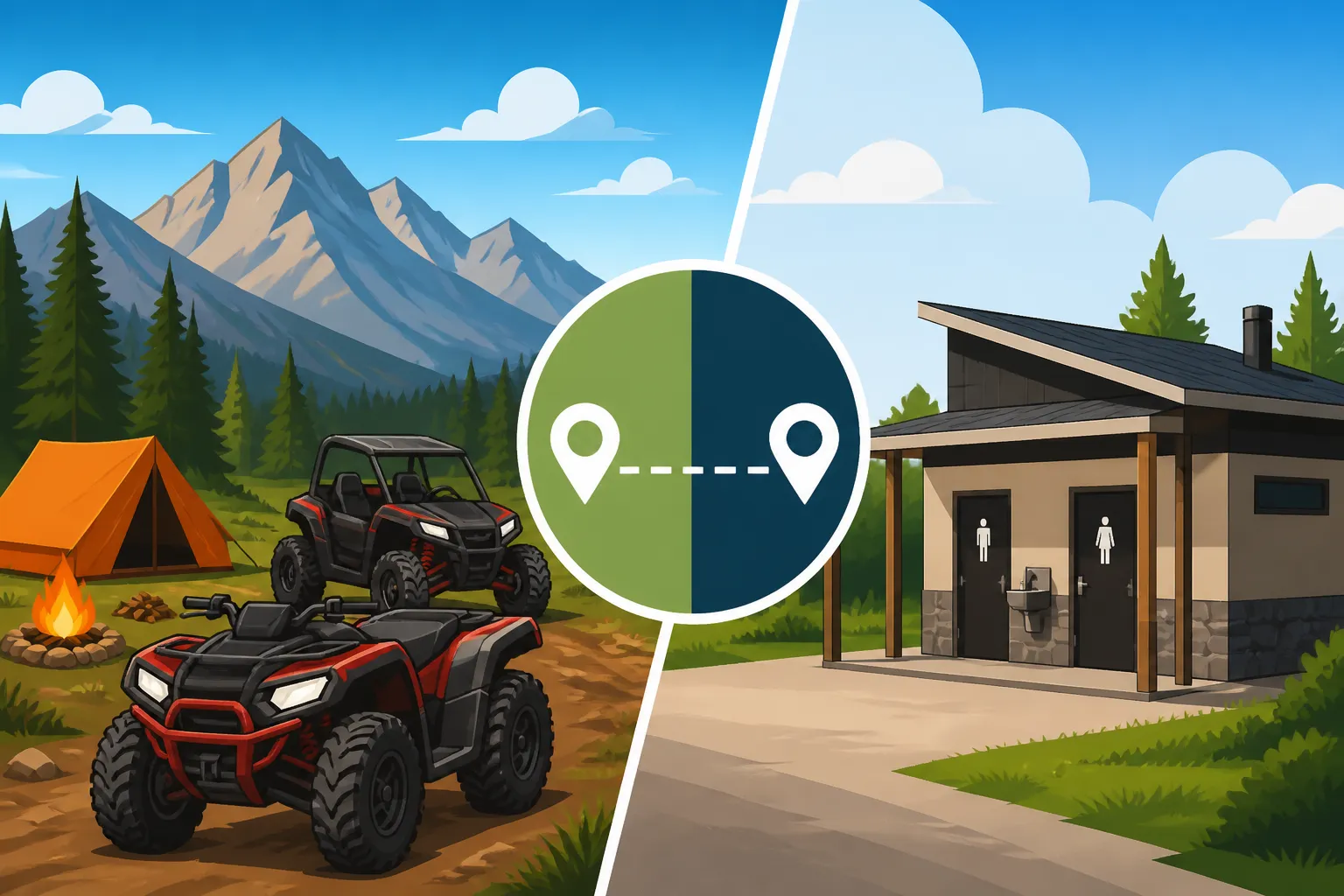
| Public land recreation area | At least 1 kilometre away | Confirm the recreation area’s mapped boundary and any site-specific restrictions |
| Oil and gas facility, including a well site | At least 100 metres away | Keep clear of the facility and check signs, access controls, and current land-use notices |
These are practical starting points, not a substitute for checking the current rules for the exact location. A map pin may mark a parking area or central point rather than the edge of a recreation area. Similarly, a visible facility may not be the only infrastructure or restriction in the vicinity.
Distance is only one part of deciding whether a campsite is permitted. Random camping is allowed only where the land designation and current closures permit it. Some areas have designated camping locations, seasonal restrictions, or other rules that can override a general expectation about where you may camp. Start with Alberta Random Camping Rules Explained and confirm the land status before travelling.
Also distinguish camping rules from riding rules. An ATV or UTV may be subject to separate access restrictions, and a legal campsite does not automatically mean you can ride on every nearby road, cutline, or trail. Check the route and the camp area separately.
Staying at least 1 kilometre from a recreation area
Random camping is generally not allowed within 1 kilometre of a public land recreation area. The separation helps keep informal camping from spreading into established sites and reduces pressure on places that already have facilities, services, or managed access. The specific rule and land designation matter, so verify them for your destination.
Measure from the boundary, not a convenient map pin
A common planning mistake is measuring 1 kilometre from the centre of a recreation area or from its parking lot. That can leave a proposed campsite closer than intended if the recreation area extends beyond the point shown on a basic map.
Look for a mapped boundary, not just a label or pin. When the boundary is unclear, choose a camp well beyond the minimum rather than trying to place it exactly at the edge of the permitted distance. A little extra separation gives you room for mapping inaccuracies, an imprecise location pin, or a change in where the recreation area is defined.
For details focused on this separation, see [Camping a Kilometre Back From a Recreation Area] and Alberta Camping Near a Recreation Area. If your map does not clearly show the site boundary, ask the relevant land manager or local authority before you set out.
Do not assume every facility is a recreation area
A staging area, trailhead, campground, or signed recreation site may have a formal designation and its own rules. A roadside pullout or informal parking spot may not. The name used in conversation is not always enough to tell which rules apply.
Check the site’s official designation and any signs at the entrance. If camping is restricted to designated sites, being more than 1 kilometre away does not make random camping acceptable. Likewise, distance from a recreation area does not override a closure or a separate restriction on the land.
If your plan is to camp near a riding destination, treat access and overnight use as separate questions. Alberta OHV Camping and Staging Areas can help with planning where to start a ride, while Alberta Trails With Camping is relevant when you are looking for riding areas with nearby camping options.
Keeping 100 metres from oil and gas facilities
Alberta’s public-land camping guidance also calls for keeping at least 100 metres from oil and gas facilities, including well sites. Do not treat a working site as a convenient place to park or camp. Industrial sites can involve vehicle movement, equipment, noise, and access restrictions; signs or barriers are a clear reason to stay away.
The facility may be easy to spot, but its edges may not be obvious from a distance. A wellhead is not necessarily the only part of the site to consider. Keep the full developed area in mind, watch for signs, and leave a generous margin rather than placing a tent or trailer just outside what looks like the edge.
For more on this requirement and related land-use considerations, see Keeping 100 Metres Clear of a Well Site and Alberta Camping Away From Gas Facilities. If a site’s boundaries or status are unclear, move farther away or get confirmation before camping.
A nearby road or pipeline is not permission to camp beside it
Oil and gas access roads and pipelines can cross public land, but their presence does not mean that the surrounding area is open for camping. A route may serve an active facility, and access may be controlled or affected by work, signs, or other restrictions. Do not block access or set up on an industrial road simply because it appears quiet.
The 100-metre distance is not a general buffer that makes every location beyond it suitable. You still need to check whether the land allows camping and whether a closure, site-specific condition, or other safety concern applies. If you are riding to camp, verify the route as well as the campsite; a line on a map is not proof that it is an open OHV trail.
How to choose and verify a campsite
A sound plan checks land status, nearby facilities, and access before the group leaves. Do not rely on one map layer or a single distance measurement, particularly in remote areas where map data may be incomplete or a phone may lose service.
- Identify the land and its rules. Confirm that the proposed area is public land where random camping is allowed. Check for closures, designated camping requirements, and any applicable pass requirements. Alberta’s Public Lands Camping Pass explains the pass topic; verify current requirements for your destination and group.
- Find nearby recreation areas. Look for mapped boundaries, signs, and official site information. Plan to be at least 1 kilometre away, measured from the area rather than from a convenient point in its centre.
- Look for oil and gas facilities. Check the map and scan the area on arrival. Keep at least 100 metres from a well site or other oil and gas facility, and stay clear of signs, barriers, and active work areas.
- Choose a location with a margin. Avoid a campsite that only meets the distance if the boundary or your position is uncertain. A larger buffer is more reliable than trying to camp at the exact limit.
- Check the route separately. Make sure your ATV or UTV can legally reach the staging or camping area. Confirm which roads and trails are open, and do not assume that a camping location grants permission to ride nearby routes.
- Recheck conditions before departure. Restrictions and closures can change. Check current land-use information, notices, and local signage, and have an alternate place to stay if your first choice is unavailable.
Offline maps can make it easier to review boundaries and find your position when cell service is limited, but they are a planning aid, not proof of permission. Save the relevant map information before leaving coverage and keep a second way to navigate. On arrival, signs and barriers matter even if an older map appears to show access.
For a broader overview of the rules that can affect a campsite, read Alberta Camping Limits in One Spot. If the plan includes riding during a fire restriction, check Alberta Fire Bans and Riding as well. Camping permission, riding access, and fire restrictions are separate issues, and each one needs its own check.
If the boundary is unclear
Do not guess your way into a borderline campsite. A recreation-area boundary may be difficult to identify on a small screen, and a facility’s visible footprint may not match its mapped symbol. Move farther away where possible, ask the relevant authority for clarification, or use an established campground or designated site instead.
That approach can add a little travel time, but it avoids building a plan around uncertain measurements. It also makes group decisions easier: everyone can agree on a clearly suitable location rather than debate whether a tent is just inside or outside a line on a phone.
The simplest rule of thumb is to treat the distances as minimum separation, then add room for uncertainty. Stay at least 1 kilometre from a public land recreation area and at least 100 metres from an oil and gas facility, while confirming that the land is open for camping. If any part of the site or its boundary is unclear, choose another spot or get authoritative confirmation first.
Disclaimer
This article is for general informational purposes only and does not constitute professional advice. Laws, prices and regulations vary by location and change over time. Consult a qualified professional for guidance on your specific situation.