Alberta Camping Away From Gas Facilities
Alberta Camping Away From Gas Facilities
When you’re planning an ATV or UTV trip in Alberta, a tempting flat spot can be too close to oil and gas infrastructure to use as a campsite. The practical rule is to keep your camp at least 100 metres from a well site, then check the land-use rules, access and signs before setting up. Here’s how to apply that setback and avoid confusing a safe-looking spot with an allowed one.
The 100-metre setback and what it means
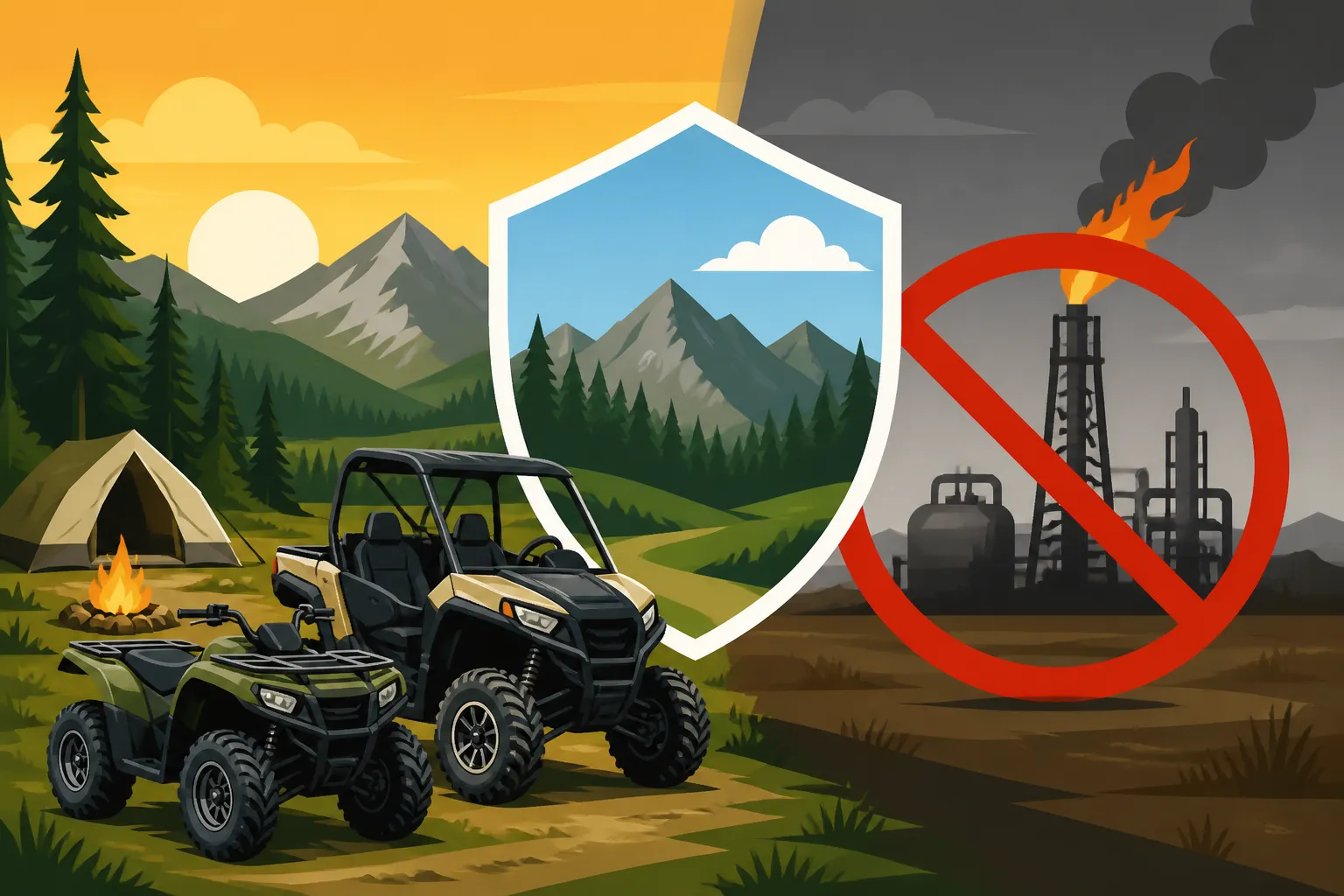
For random camping on Alberta public land, keep your campsite at least 100 metres from an oil or gas facility. A well site is a clear example: don’t pitch a tent, park a camper or set up camp within that buffer. The setback gives space between a campsite and industrial equipment, work areas and vehicle access.
The distance is a minimum, not a recommendation to camp as close as possible. If a site is noisy, has an odour, shows signs of recent work or appears to be in an active industrial area, move farther away or choose another location. A buffer does not make an unsafe or restricted site suitable for camping.
The rule is easy to misapply because “gas facility” can sound like it means any feature connected with oil and gas. A visible well site is different from a buried pipeline, a road serving a facility or a cleared line through the trees. Don’t assume that every feature has the same setback, or that staying 100 metres away automatically gives you permission to camp. The parcel’s land status, local restrictions and any signs or closures still matter.
| What you notice | How to treat it when choosing a camp |
|---|---|
| Well site or visible oil and gas facility | Keep the campsite at least 100 metres away. Give active work or equipment more room. |
| Industrial access road, gate or posted restriction | Don’t block access or enter a restricted area. Confirm whether camping is allowed nearby. |
| Pipeline marker or cleared right-of-way | Don’t treat the marker as the edge of a well site. Check for separate restrictions and avoid blocking access. |
| Unclear boundary or uncertain feature | Choose a different spot or confirm the rule with the responsible land manager before setting up. |
| Nearby public recreation area | Check the separate camping-distance and site rules that apply there. |
The 100-metre distance is about where you camp, not just where you park your truck. A tent, trailer or other part of the campsite should not extend into the setback. If the boundary is hard to judge, don’t try to squeeze in a few extra metres. Pick a larger clearing farther away.
You can read about the related setback in Keeping 100 Metres Clear of a Well Site and review the broader rules in Alberta Camping Distance From Facilities. Because restrictions can vary with land, activity and current orders, treat these as planning guidance, not a substitute for checking the rules for your actual location.
A setback does not grant access
The distance rule answers one question: how far away your camp needs to be from a facility. It does not answer whether you may camp on that land in the first place. A spot can be outside the buffer and still be off-limits because it is private land, a restricted area, a closed public-land site or part of an operation where camping is not permitted.
Nor does a setback give you permission to drive onto a lease road, pass a gate or use a facility road as an ATV trail. A road that looks open may be private, restricted, or needed for industrial traffic. Keep your machine on routes where riding is allowed, and don’t use a well site or access road as a shortcut to your chosen camp.
If you’re planning to combine camping with trail riding, check the riding rules separately. Alberta OHV Trails: Riding Public Land explains why being on public land does not automatically make every route available to OHVs. For the land-use framework and zone-specific restrictions, see Alberta’s Public Land Use Zones Explained.
Be cautious around active operations
A site may be operating even when no workers are visible. Equipment, vehicle tracks, warning signs, fencing, a locked gate or a maintained access road can indicate that the area needs to stay clear. Don’t enter a work site to check its boundaries or approach equipment to take a closer look.
An ATV or UTV can also bring a camp closer to infrastructure than you intended. Turning around near a gate, parking beside a service road or unloading machines at the edge of a facility may create access problems even when the tent is farther away. Keep your vehicles and gear clear of industrial routes, marked areas and gates. If you can’t tell where the site begins or where access must remain open, move to another place.
How to check a spot before camping
A map can help you plan, but it may not show every current restriction or every visible feature on the ground. Use several checks together: confirm the land designation, review applicable rules, inspect current signage and assess the site before unloading. If those checks leave you uncertain, choose a different location.
1. Confirm the land and camping rules
Start by finding out whether the intended spot is public land where random camping is allowed. Don’t infer land status from the lack of a fence or a nearby trail. Private land, public land, designated camping areas and restricted areas can be close together and may look similar from a trail.
Then look for rules specific to that area. A Public Land Use Zone, recreation area, closure or local restriction can change what you may do. The general overview in [Alberta Random Camping Rules Explained] is a useful starting point, but you still need to check the rules for your destination. The rules described in Alberta Random Camping Rules can also help you understand the broader requirements for a dispersed camp.
2. Look for facility signs and clues on the ground
Before choosing a site, scan the surrounding area for well sites, equipment, warning signs, fences, gates, facility roads and pipeline markers. Stay out of signed or fenced industrial areas. Don’t cross a gate or park in a way that could interfere with people or vehicles reaching a facility.
Use signs and visible infrastructure as reasons to be cautious, not as the only way to measure the setback. The edge of the equipment pad, a fence or a cleared area may not give you a simple boundary for measuring from. If you cannot confidently determine the closest point of the facility and your campsite’s position, move farther away. A map pin by itself is not enough to establish a precise boundary.
3. Measure conservatively
If you are relying on the 100-metre minimum, measure from the facility to the nearest part of your camp, not only to the centre of the spot where you intend to sit. A tent, trailer, parked machine or other part of the camp can extend closer than the point you first assessed.
Map distances can be approximate. Terrain, imagery and the mapped location of infrastructure may not match what is on the ground. Use a conservative buffer rather than aiming for the minimum when using a phone map. If the measurement is close or uncertain, reposition the camp until you have clearly more space.
Don’t walk onto a facility or cross a restricted area to get a better measurement. A campsite should be chosen from a lawful, safe approach. If reaching the spot requires going through a gate, around a sign or onto a road you are not authorized to use, pick another location.
4. Check current closures and conditions
A location that was usable on a previous trip may be closed or affected by new work, access restrictions or other conditions. Check current public-land information before you leave, then pay attention to notices at the site. If a sign or closure conflicts with an old map, follow the current restriction and leave the area.
Weather and fire conditions matter too. A camp can be far enough from a facility but still be inappropriate because of a fire ban, wet ground, a closed route or other local hazard. Check Alberta Fire Ban Lookups before planning a fire, and do not assume that a ban allows a fire merely because your camp is well away from oil and gas equipment.
5. Reassess after arrival
Before unloading, take a final look around. Confirm that the camp is outside the setback, does not block access and is not inside a posted or restricted area. If your intended clearing is closer to a facility than it looked on the map, move on rather than trying to make the original spot work.
For a group, do this check before several vehicles and trailers are positioned. A large setup can spread beyond the space one person initially judged to be clear. Make sure everyone in the group understands where the camp is allowed to sit and which nearby roads or areas are off-limits.
Planning an ATV or UTV camping trip near oil and gas activity
Public-land camping and OHV riding overlap, but they are not the same permission. You need to establish where camping is allowed and where your machine may travel. A legal campsite does not make a nearby service road an open trail, and an open trail does not mean you may camp beside it.
Plan the route to your camp as carefully as the camp itself. A GPS line can show a road or cutline without proving that OHVs may ride it. Look for local restrictions, signs and current information, and stay on routes that are open to your vehicle. If access depends on crossing an active lease, private land or a signed gate, find a lawful route or select a different camp.
Account for the Public Lands Camping Pass
Some public-land camping areas require a Public Lands Camping Pass. The requirement depends on where you plan to camp, so don’t assume that one pass rule applies everywhere in Alberta. Check whether the destination is in an area where the pass is required and whether your planned style of camping is permitted there. Alberta’s Public Lands Camping Pass explains the pass topic, while [Alberta Camping Near a Recreation Area] covers a separate set of location considerations.
A pass is not permission to camp anywhere. It does not override the 100-metre setback, make a closed area open, authorize access across private land or allow an OHV on a route closed to that vehicle. Think of the pass as one requirement to check among several, not a substitute for checking land status and restrictions.
If your trip includes a recreation area, verify its own camping arrangements and distance rules. Random camping near a recreation area may be subject to requirements different from camping in a dispersed area farther away. Don’t treat a turnout, parking area or trailhead as a campsite unless the applicable rules say it can be used that way.
Choose a site that leaves room to operate
When scouting, look for a durable, already-used spot that is clearly outside industrial areas and has enough room for your group without spilling toward a facility. Avoid fragile ground, drainage areas and locations where parking or turning around would block a road. A more distant campsite may mean a longer ride to the trail, but it is generally a better choice than setting up at the edge of an uncertain boundary.
Think about noise and daily movement. Starting and loading machines near an operating area can disturb workers or create a conflict with vehicles using access roads. Give facilities and their routes a wide berth, keep unnecessary riding away from the camp, and avoid revving or idling close to industrial sites. A place can meet the minimum setback and still be a poor place to camp.
If the group needs space for several machines, a trailer, a tent and a camper, don’t measure only to the first item you set down. Account for the full footprint. An ATV can be parked farther from the facility while a trailer or tent creeps into the buffer. Lay out the camp only after choosing a spot with room for the whole group.
Keep camp and ride decisions separate
Before setting out, agree on which areas are camp, which routes are open, and which places are off limits. This helps prevent a common mistake: treating the route to an attractive campsite as permission to ride wherever access seems easiest. If a service road is not clearly open to recreational OHV use, don’t rely on its appearance or on another rider’s tire tracks.
For the ride itself, check the rules for the particular zone and vehicle. Look for seasonal closures, designated trail requirements and restrictions on machine size. Stay on allowed routes, respect gates and signs, and don’t ride through an industrial site to reach another trail. Checking a Zone Before You Go can help structure that pre-trip check.
Keep your documents and route information accessible, and make sure the group can navigate back without relying on a single rider’s phone. Mobile coverage may be limited. Download maps before leaving service, but remember that an offline map can become outdated and may not show a new closure. Follow signs on the ground and turn back if a route is restricted.
Common mistakes and a practical pre-camp check
Many problems begin with an assumption that seems reasonable at the time: a clear patch must be public land, an unmarked road must be open, or a campsite just outside a visible fence must be far enough away. The safer approach is to verify the rules and leave extra space where boundaries are unclear.
Mistakes to avoid
- Measuring from the wrong point: The closest edge of the camp matters. A tent or trailer can be closer to a facility than the spot you initially measured.
- Treating the setback as permission: Being more than 100 metres from a well site does not establish that camping is allowed on that land.
- Equating a pipeline marker with a well site: These features are not interchangeable. Check for restrictions and keep access clear rather than assuming one distance settles every question.
- Driving through a gate or work area: Do not use industrial access as a recreational shortcut. A campsite nearby does not make that route public.
- Relying only on old maps or saved pins: Current signs, closures and work activity may not appear on older map information.
- Blocking access while setting up: Keep tents, trailers, machines and gear away from roads, gates and working areas.
- Assuming a pass covers all requirements: A camping pass, where required, does not cancel other restrictions or open a road to OHVs.
- Staying because the group has already unloaded: If the site turns out to be too close or restricted, pack up and relocate. Time spent setting up is not a reason to ignore a rule.
Pre-camp checklist
Before leaving home, identify the general camping area, confirm whether random camping is allowed there, and check any zone-specific notices or closures. Determine whether the Public Lands Camping Pass applies. Mark possible backup sites that are clearly away from facilities, rather than relying on one exact pin.
On arrival, look for signs, gates, equipment, well sites and industrial traffic. Confirm that the entire camp will be outside the required setback. Check that the route you used is open to your type of OHV and that your setup will not obstruct a facility road or other access. If any of those checks are uncertain, move farther away or choose another location.
Before starting a fire, check the applicable restrictions and follow any current ban. Keep the camp compact, use durable ground and avoid leaving rubbish or food behind. At the end of the trip, pack out what you brought and leave access routes clear for the next user and for people working in the area.
If a sign, boundary or facility condition is unclear, don’t try to resolve it by entering the site or guessing. Contact the responsible land manager for guidance, or choose a different camping location. The inconvenience of moving camp is small compared with the risks of setting up in a restricted or active area.
Frequently Asked Questions
How far from a well site should I camp in Alberta?
Keep the campsite at least 100 metres from a well site. If you cannot confidently identify the boundary or measure the distance, move farther away or choose a different location.
Does the 100-metre setback mean I can camp anywhere outside it?
No. The setback does not establish that the land is open for camping. You must also check land status, local restrictions, closures and any posted signs.
Does a pipeline marker count as a gas facility?
A pipeline marker and a well site are different features. Don’t assume the well-site setback answers every question about pipelines or other infrastructure. Check for specific restrictions and keep access clear.
Does a Public Lands Camping Pass let me camp near a facility?
No. Where a pass is required, it does not override the setback, authorize camping in a restricted area or permit OHV travel on a closed route. Check every requirement for the location.
What should I do if I’m unsure whether a camp is far enough away?
Don’t set up close to an uncertain boundary. Move to a location with a clear, generous buffer or contact the responsible land manager before camping.
Disclaimer
This article is for general informational purposes only and does not constitute professional advice. Laws, prices and regulations vary by location and change over time. Consult a qualified professional for guidance on your specific situation.