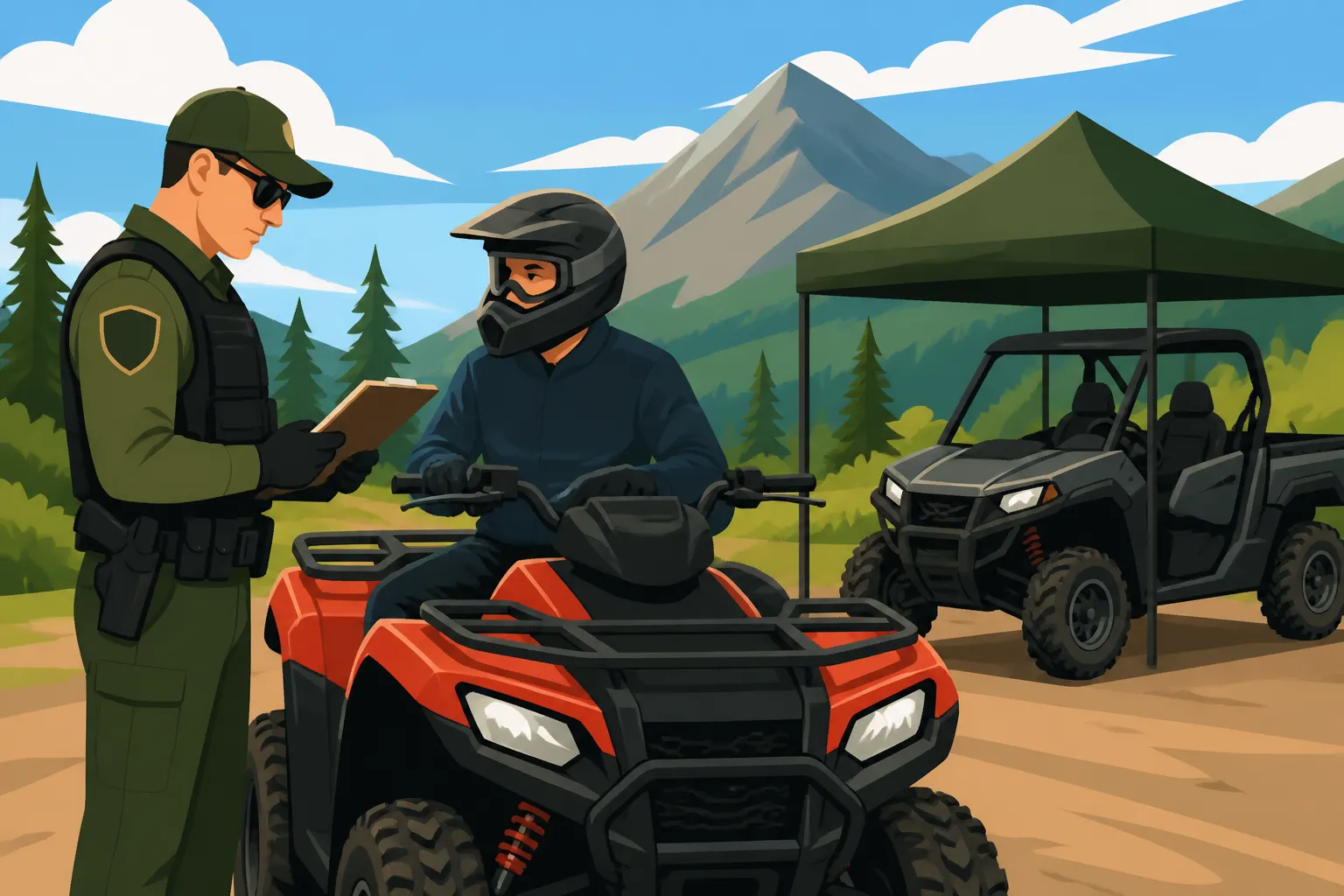
Alberta Officer Checks at a Staging Area
A stop at an Alberta staging area can be routine, but it is easier when your paperwork and machine are ready. Officers may check registration, insurance, safety equipment and whether your route is open to off-highway vehicles. Here’s what to carry, what to look over before unloading, and how visitors can prepare when their machine is registered elsewhere.
What an officer may check at a staging area
A staging area is a practical place to confirm that riders and machines are ready to enter public land. A check does not necessarily mean anyone has done something wrong. An officer may speak with riders, inspect equipment or ask to see documents before or after a ride.
The exact checks depend on the location, the officer’s role and the circumstances. Be ready to show that the machine is properly registered and insured for the riding you plan to do, and that required safety equipment is in place. If you are camping, check whether a separate camping pass applies to your destination. A camping pass is not the same as an ATV registration or a general trail-riding permit.
| What may be checked | What to have ready | Useful preparation |
|---|---|---|
| Registration | Current registration certificate and a readable plate | Confirm the certificate matches the machine and the plate is securely mounted |
| Insurance | Proof of valid insurance | Keep the proof accessible, not buried in a trailer |
| Rider safety | A compliant helmet when required, plus appropriate protective gear | Check the helmet label and condition before leaving home |
| Machine equipment | Lights, muffler and spark arrestor where required | Inspect the machine before loading it |
| Location and route | Whether the area, trail or road is open to your machine | Check the current map, signs and closures |
| Camping | Any pass or authorization required for the planned camping area | Confirm land-specific rules before setting up |
Registration and insurance are two of the most important items to sort out before you arrive. Alberta requires registration for many off-highway vehicles used on public land, and insurance requirements also apply. The exact rules depend on where and how you ride, so do not assume a machine that is legal on private property is automatically ready for a public-land trip. See Alberta Registration Before Riding Crown Land and Alberta Requires Insurance on Public Land for the basics.
An officer may also look at the physical plate. It should be attached securely and visible, rather than hidden by mud, cargo or an awkward mounting position. Alberta issues a plate rather than relying on a current validation sticker, so make sure the registration is current and that the plate can be read. Where Your OHV Plate Must Sit to Be Seen explains the visibility issue, and Alberta Digital Certificates Must Be Printed covers an important detail for riders using an online certificate.
Safety equipment can matter just as much as paperwork. Depending on the machine and location, an inspection may include lights, a muffler or a spark arrestor. Equipment that appears altered, damaged or unsuitable for the area can draw questions. A staging-area check is a poor time to discover that a light does not work or that a plate cannot be seen through a rack or cargo. Review Alberta Equipment Required on Public Land and Alberta Spark Arrestor Rules before you head out.
Papers and equipment to prepare before you leave
The best way to make a check straightforward is to prepare before the machine is unloaded. Keep the documents for each vehicle together, and make sure the information matches the machine you are riding. If there are several machines in the trailer, do not assume one person’s paperwork covers all of them.
Registration and insurance
Carry the registration certificate for the machine. Check that the owner information and vehicle details are correct, and that the registration has not expired. If you recently bought the ATV or UTV, confirm that the registration has been dealt with before riding it on public land. A bill of sale can help explain a recent purchase, but it is not a substitute for completing any required registration steps. Alberta Registration Paperwork Checklist is a useful starting point.
Keep proof of insurance available for the machine you are riding. A policy document, insurance card or other proof accepted by your insurer may be appropriate; confirm what your provider supplies and what details it shows. If you have more than one machine, check that the proof covers the one being operated. Alberta Proof of Insurance on Demand explains why it is worth being able to produce proof without delay.
Paperwork stored on a phone can be convenient, but relying on a screen alone can create problems if the device is out of battery, damaged or out of service range. If your registration certificate is issued digitally, check whether it must be printed before riding. Carrying a printed copy in a waterproof pouch is a simple backup. A pouch from a local outdoor shop or Amazon can keep papers together, but the important part is that the documents stay readable and accessible.
Helmet and machine inspection
Before loading up, inspect the parts an officer or another rider could notice immediately:
- Make sure the plate is secure, clean enough to read and not blocked by accessories or cargo.
- Test the lights and confirm that required head and tail lights work.
- Check the muffler and exhaust system for damage or unauthorized changes.
- Confirm that the spark arrestor is present and in serviceable condition where required.
- Look over tires, brakes, steering and other basic controls.
- Wear a helmet that meets the applicable standard when the law requires one.
Do not rely on the fact that a machine passed a previous check or that a friend rides the same model without a particular item. Requirements can depend on the machine, the land and the activity. If you are unsure about the helmet standard, review Alberta CSA Helmet Standards. If you have changed the exhaust, Alberta Bans Modified Exhausts can help you understand why a machine that sounds louder than stock may attract attention.
Route and land-use checks
Being registered and equipped does not give a rider permission to travel anywhere. Public land can have designated routes, seasonal closures, vehicle-size restrictions and local access rules. Check the relevant land-use map and look for signs at the staging area. A route shown on an old screenshot may have changed, and access can be affected by temporary closures or conditions.
Do not assume that a road, cutline or ditch is open just because it is physically passable. The legal status of the route and any local restrictions still matter. Checking a Zone Before You Go and Alberta OHV Trail Map Downloads can help you plan, while Alberta Public Land Use Zones Explained gives more context on how zone rules affect a ride.
If your plans include camping, confirm the applicable rules separately. Some public-land camping areas require a camping pass, while others have different restrictions. That requirement is about camping, not a general permit to ride an ATV or UTV. See Alberta Public Lands Camping Pass before planning an overnight stay.
Visitors, borrowed machines and other situations that need extra care
A staging-area check can raise more questions when the machine or rider is from outside Alberta, the machine has just changed hands, or the person riding it is not the registered owner. These situations are manageable, but it is better to settle the paperwork before travelling to the trailhead.
Riding with an out-of-province registration
Visitors may be able to ride temporarily using registration from their home jurisdiction, but the rules are not identical for every visitor or machine. The length of stay, residency status, home registration and insurance can all matter. Do not assume that a plate from another province or state automatically satisfies Alberta requirements for an extended stay.
Before riding, check the rules for your situation and carry proof of the machine’s current registration and insurance. If you are visiting from British Columbia or Saskatchewan, start with Alberta Registration for a Machine From BC or Alberta Registration for a Machine From Saskatchewan. Riders from the United States can review Alberta Registration for a Machine From Montana. For the general time limit, see Alberta’s 30-Day Rule for Out-of-Province Machines and confirm the current requirements with an official source if your stay is close to the limit.
Be ready to show that you are visiting rather than living in Alberta if residency affects which rules apply. Carry ordinary proof of identity and residency that supports your situation, and check what documents are accepted before departure. Alberta Proof of Residency for Visitors covers this issue.
Borrowed, newly purchased or recently transferred machines
If you borrowed the ATV or UTV, ask the owner to provide the registration and insurance information before you leave. A photo sent at the last minute may be hard to read, and the owner may not be reachable once you are out of service. Confirm that the insurance arrangement allows the machine to be used by the person riding it.
For a machine bought recently, bring the sale paperwork as supporting information, but do not treat it as proof that registration and insurance are already in order. Check that any required transfer or registration work is complete. The same care applies if the machine was inherited, purchased at an auction or transferred between family members. Alberta Registration Transfer After a Sale and Alberta Machines With No Paperwork explain why ownership documents and registration status are separate issues.
If the VIN or serial number is hard to find, unreadable or inconsistent with the paperwork, resolve that before heading out. An officer may have questions if the identification details do not line up. Photographing the number for your own records can be useful, but it does not replace clear identification on the machine.
Camping, groups and youth riders
When riding with a group, make sure each operator understands the route and has access to the documents for the machine they are using. A group leader may carry maps and emergency details, but that does not replace each rider’s own registration or insurance proof.
If a young rider is coming along, check the applicable age and supervision requirements before the trip. The rules can depend on the rider’s age and whether the riding area is public land. Do not assume that permission from a parent or landowner overrides public-land requirements. Alberta Supervision Rules for Young Riders and Alberta Riders Under 14 Need Supervision provide more detail.
For an overnight ride, keep camping compliance distinct from vehicle compliance. Confirm whether the campsite requires a pass, whether camping is allowed there and whether limits apply to the location or length of stay. A rider can have proper registration and still be in the wrong place to camp.
How to handle a check and avoid preventable problems
A calm, organized response usually makes a routine check easier. Stop where directed, keep your hands visible, and listen to the officer’s instructions. If asked for documents, provide the ones that relate to the machine and rider. If you do not understand what is being requested, ask politely for clarification rather than guessing.
Use this simple pre-ride sequence:
- Match the papers to the machine. Check the registration certificate, plate and vehicle identification details.
- Confirm insurance. Make sure the proof applies to the machine and is available to show.
- Inspect required equipment. Test lights and check the plate, exhaust and spark arrestor.
- Check the route. Review the current map, signs, closures and local restrictions.
- Separate camping requirements from riding requirements. Confirm any pass or authorization needed for camping.
- Pack documents where they can be reached. Use a dry, secure pouch rather than leaving them loose in a trailer.
If something is missing, do not try to explain it away by saying you meant to fix it later. Ask what the officer needs, follow any instructions and avoid continuing the ride if the machine or paperwork is not compliant. If you receive a ticket and disagree with it, keep the paperwork and note the relevant details while they are fresh. Do not argue at the staging area; use the process available to address a citation.
A check can also reveal that the issue is not the machine itself but the planned route. If an area is closed, a trail is not designated for your vehicle or a sign prohibits access, choose another legal route. Continuing because the staging area is busy or other riders have gone ahead is not a reliable way to establish that a route is open.
A little preparation is more useful than carrying a large stack of unrelated papers. Keep the current registration, insurance proof and any relevant visitor or camping documents together. Then verify the route and machine requirements for the specific place you intend to ride. That approach gives you a clear answer to the main questions an officer may raise and helps prevent a paperwork issue from ending the day before the ride begins.
Disclaimer
This article is for general informational purposes only and does not constitute professional advice. Laws, prices and regulations vary by location and change over time. Consult a qualified professional for guidance on your specific situation.