Alberta Camping Near a Recreation Area
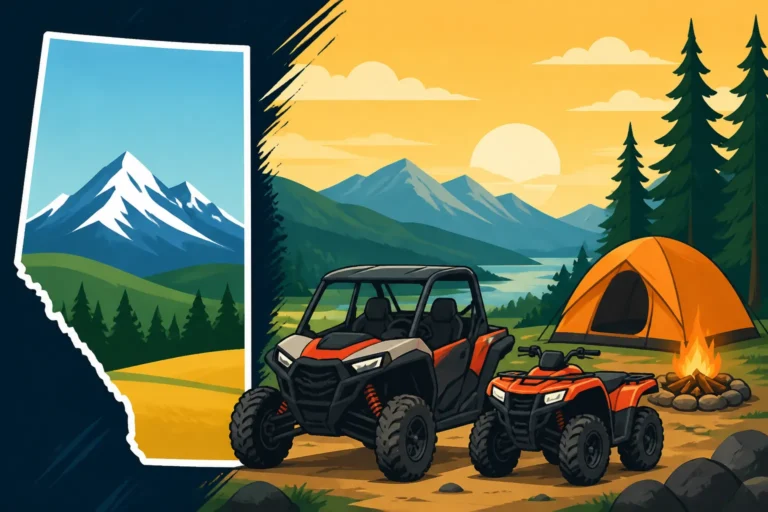
Camping near an Alberta recreation area can look like a convenient way to avoid a crowded campground, but random camping has location rules. The key is to know whether your proposed spot is inside a recreation area or close enough to count as near one. Here’s how to plan a legal, practical camp and keep your ATV or UTV ride separate from your camping permission.
The one-kilometre rule and what it means
In Alberta, random camping on public land must be at least one kilometre from a recreation area. The rule is intended to keep random camping separate from developed or designated recreation sites. It does not mean you can park just outside a campground fence, drive through a recreation area to reach a site, or use a staging area as an overnight campsite.
First, identify what kind of place you are considering. A recreation area may include facilities or a managed recreation site, while public land around it may have different camping rules. Boundaries are not always obvious on the ground. A sign, map, road junction or open patch of forest does not necessarily tell you where the legal boundary is.
The distance matters specifically when you are choosing a spot for random camping. If you reserve a site in a campground, follow that campground’s rules instead. If you are camping outside a managed site, confirm that the land is open to random camping and that the site meets the required separation distance. For more on the broader rules, see Alberta Random Camping Rules Explained and [Alberta Camping Distance From Facilities].
| Where you plan to camp | What to check |
|---|---|
| In a developed campground or recreation area | Site availability, fees, reservations, and the site’s own rules |
| On public land outside a recreation area | Whether random camping is allowed and whether the site is at least one kilometre away |
| Near a staging area | Whether overnight camping is allowed there; a place to unload an ATV is not automatically a campsite |
| On private land or a grazing lease | Land status and any permission or access requirements |
| At a site reached by riding an OHV | Both the camping rules and the separate rules for the route you plan to ride |
The one-kilometre distance does not create a camping right on the land beyond it. You still need to check whether the area is open to camping, whether other restrictions apply, and whether you have the right to access the site. A location can be far enough from a recreation area but still be unsuitable because of a closure, land status, environmental sensitivity or access restriction.
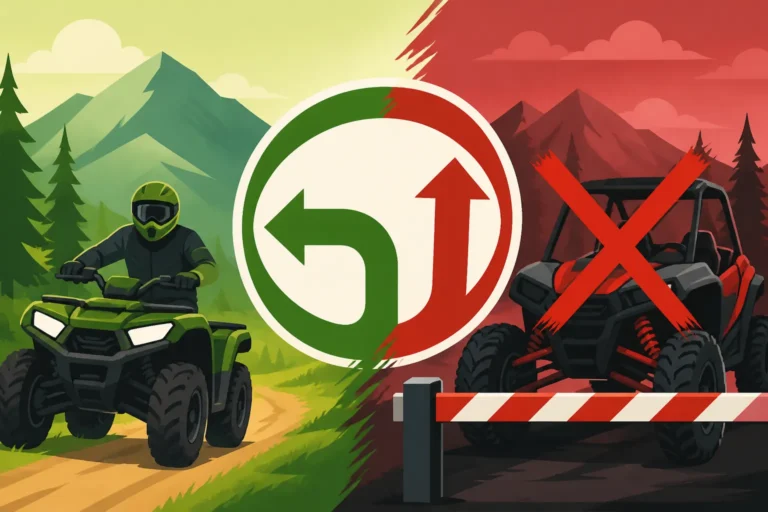
Nor does camping permission automatically authorize ATV or UTV use. Your campsite and your riding route are two separate questions. A road or trail that looks like the easiest way from camp may be closed to OHVs, restricted to certain vehicle types, or located on land where you do not have permission to ride. Check the applicable zone and route information before you unload. Alberta OHV Trails: Riding Public Land explains why camping access and riding access should be checked separately.
How to measure the distance before you set up
The most reliable approach is to plan your camp using current maps and information for the specific area, then confirm the location on arrival. Do not rely on a rough estimate from the truck window or assume that a large clearing is outside the recreation area.
- Find the recreation area boundary. Use current land-use information or a map that shows the relevant recreation area. Look for posted signs and boundary markers when you arrive, but do not treat an absence of signs as proof that the area has no boundary.
- Check whether the land beyond it is open to random camping. A nearby spot may be private land, a grazing lease, a restricted area or land subject to a temporary closure.
- Measure from the recreation area, not just from a building or campground sign. The one-kilometre separation is easy to misjudge if you use a single visible facility as your reference point.
- Choose a site with room to spare. If your map measurement is close to the minimum, pick another location farther away. Map position, boundary interpretation and the exact spot where you set up can all affect your estimate.
- Recheck conditions before the trip and at the site. Closures, access changes and local restrictions can affect whether a site is available. If the information is unclear, ask the relevant land manager rather than guessing.
A phone map can be useful, but it should not be your only tool. Backcountry reception may be weak or unavailable, and a general navigation app may not show legal boundaries or current restrictions. Download the relevant map or save the official information before leaving cell service. Checking a Zone Before You Go offers a useful starting point for confirming the area you intend to visit.
Also keep the question of distance distinct from the question of what counts as a recreation area. If a boundary is unclear, do not choose the nearest possible interpretation simply because it leaves you more room. Moving farther away is usually the more practical choice, and it reduces the chance of having to relocate after camp is set up.
Picking a campsite when you are riding an ATV or UTV
A campsite that meets the distance rule may still be a poor base for an OHV trip. Consider the whole route: how you will get there, where the machine will be parked, whether you can ride legally from the site, and whether the ground can handle the vehicle without damage.
Keep camping and staging separate
A staging area is designed for riders to unload and prepare machines. It is not automatically approved for overnight camping. Some staging areas are beside recreation sites, where camping may be managed separately; others may have restrictions on parking or overnight use. Check the specific site rules before planning to sleep in a trailer or tent there.
If you camp farther away, avoid assuming that you can ride directly from your campsite to a trail. The connecting route may cross a closed road, private land, a lease road or an area where motorized use is limited. Use routes that are clearly open to the machine you are riding and stay on designated or otherwise permitted routes. The general rules for public-land riding are covered in Alberta OHV Trails: Riding Public Land.
Choose a durable, low-impact site
Look for a previously disturbed or durable surface rather than opening a new campsite. Avoid wet ground, stream banks, fragile vegetation and places where vehicle tires could create ruts. Keep machines on established access routes and park them where they will not block a road, trail, gate or access point.
Before unloading, ask whether the site is suitable for the size and weight of your vehicle and trailer. A spot that looks firm in dry weather can become soft after rain or snowmelt. Turning a UTV around in a narrow clearing can also widen the disturbed area. If the ground is soft, the campsite is crowded, or parking would require pushing into vegetation, find another location.
Campfires, waste, noise and food storage also affect whether a site is appropriate. Follow current fire restrictions, use only permitted fire areas and pack out what you bring in. Do not assume that a fire ring means fires are currently allowed. Leave space for other visitors and keep noise low, especially near cabins, homes or established recreation sites.
Plan the riding route before settling in
A remote camp can put you far from fuel, services and help. Check the route length, expected terrain, weather, machine range and communications coverage. Carry what you need for a breakdown, and make sure the group knows how to return to camp if riders get separated.
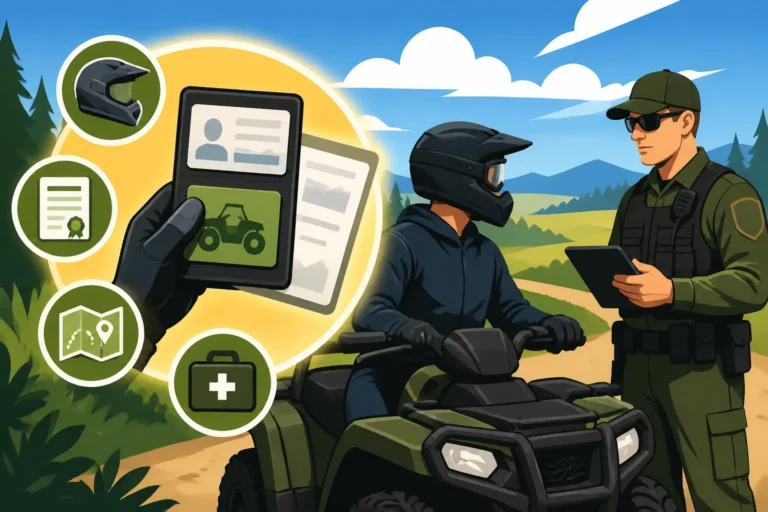
Before starting, confirm that each machine is properly prepared and that you have required documents and equipment. Camping on public land does not replace registration, insurance, or other requirements that may apply to the ride. For example, public-land use and OHV registration are separate issues; see Alberta Registration Before Riding Crown Land for the registration question and Alberta Insurance Requirements on Public Land for insurance.
A practical pre-trip check
Planning ahead helps prevent a common mistake: arriving late, finding the recreation area full, and setting up at the first open-looking spot nearby. Before leaving, settle the camping decision and the riding decision separately.
Use this checklist:
- Confirm the land status. Make sure your intended campsite is public land where random camping is permitted, rather than private land or a restricted area.
- Locate the recreation area boundary. Check that your proposed random campsite is at least one kilometre away. If the line is uncertain, choose a spot with more distance.
- Check current restrictions. Look for closures, fire restrictions, seasonal conditions and any local rules that could affect camping or riding.
- Verify the camping pass requirement. A public lands camping pass is required in areas where the pass applies, but it is not a substitute for checking land status or site restrictions. Confirm current coverage and purchasing requirements through the official information for the area. See Alberta Public Lands Camping Pass and What the Three-Day Camping Pass Does Not Cover.
- Check access separately. Confirm that the road or trail to your campsite is open to your vehicle and that you have permission where needed.
- Make an overnight plan. Know where the machines and trailer can be parked, how you will handle waste, and whether there is a safer or more suitable alternative if the site is occupied or wet.
- Have an offline backup. Save maps and trip details before you lose service, and share your plan with someone who is not on the ride.
If you arrive and cannot confidently establish that a site meets the rules, do not treat uncertainty as permission. Move farther from the recreation area, choose a managed campground, or contact the responsible land manager for clarification. That can mean a longer drive or a less convenient ride, but it is better than setting up in the wrong place and having to move camp.
The basic approach is straightforward: use a managed site when you want to camp inside a recreation area, and choose a verified public-land location at least one kilometre away when you plan to random camp. Then confirm that your OHV route is legal on its own terms. A little map work before departure can save a frustrating search after dark and help keep the area usable for the next visitor.
Disclaimer
This article is for general informational purposes only and does not constitute professional advice. Laws, prices and regulations vary by location and change over time. Consult a qualified professional for guidance on your specific situation.