Alberta Visitors From Saskatchewan
Saskatchewan riders can bring an ATV or UTV to Alberta, but a Saskatchewan plate does not settle every question. Registration, insurance, helmet rules and permission to ride all matter—and access can change from one road or land area to the next. Here’s what to check before unloading your machine, and what to carry while you ride.
What Saskatchewan visitors need for registration
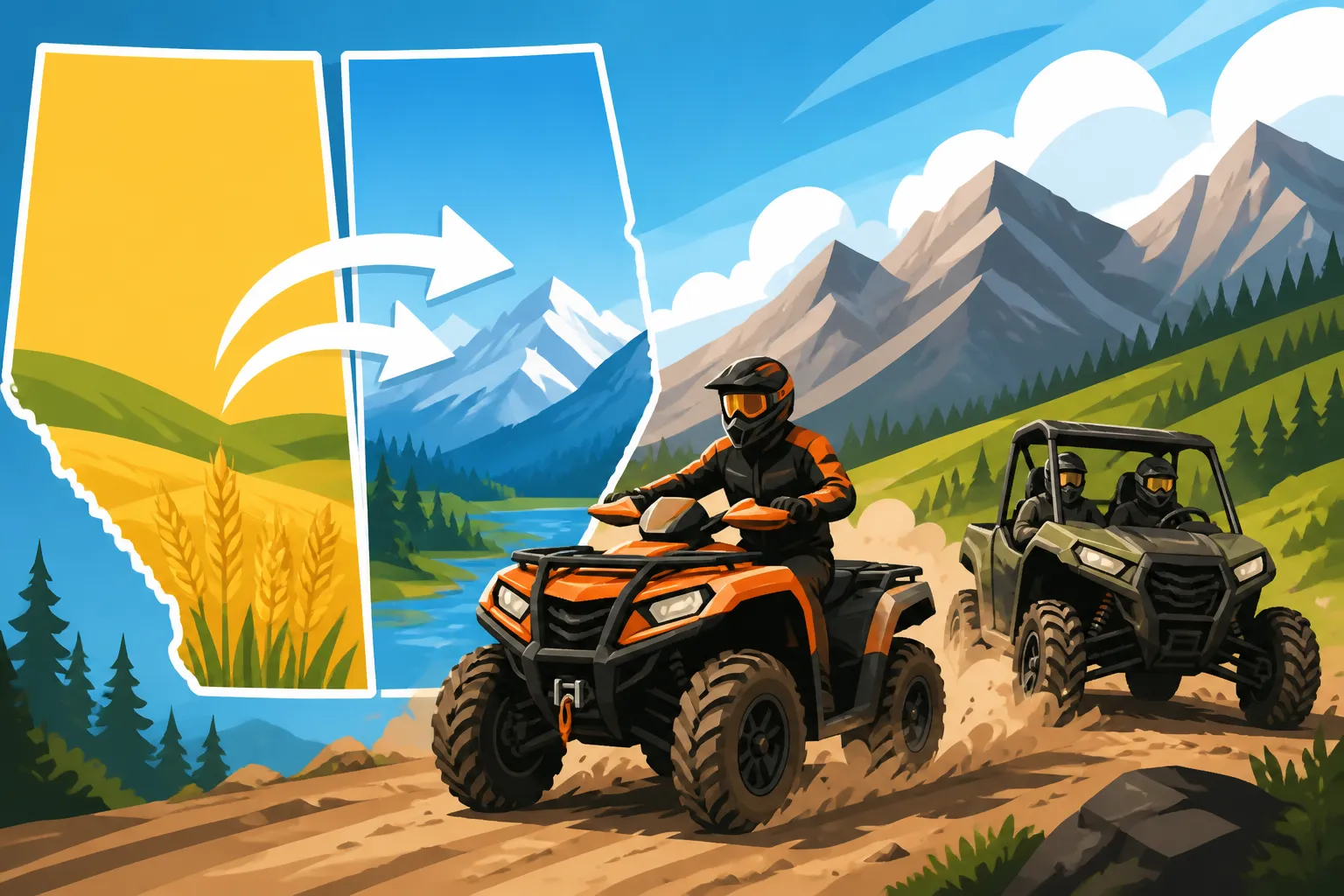
A short-term visitor can generally use a machine that is properly registered in their home jurisdiction without immediately transferring it to Alberta registration. The visitor allowance is limited: Alberta’s rule is commonly described as up to 30 consecutive days. If you stay longer, settle in Alberta or otherwise stop qualifying as a visitor, you may need Alberta registration before operating the machine.
The key point is that reciprocity is not a blanket pass. Your machine still needs valid registration under the rules that apply where it is normally kept, and you should be able to show that it is registered to you or that you are authorized to use it. A machine with missing, expired or incomplete Saskatchewan paperwork does not become legal just because it crosses the provincial boundary.
Use the 30-day period as a deadline to check, not as a planning loophole. Do not assume that riding only on weekends, parking the machine for a few days or taking a short trip out of Alberta resets the clock. If your stay may run past the visitor period, ask an Alberta registry agent what documents are needed and when Alberta registration becomes necessary. The overview at Alberta’s 30-Day Rule for Out-of-Province Machines is useful for understanding the limit, while Alberta Registration for Visiting Riders covers the broader visitor question.
| Before riding in Alberta | What to check |
|---|---|
| Saskatchewan registration | It is current, belongs with the machine and satisfies Saskatchewan requirements |
| Visitor status | You are still visiting rather than establishing Alberta as your place of residence |
| Time in Alberta | Your stay will not exceed the visitor period without arranging Alberta registration |
| Insurance | Your policy covers the machine and its use in Alberta, including the kind of riding you plan to do |
| Land access | The route or riding area is open to your type of machine and your planned use |
| Required equipment | The machine and rider meet applicable public-land and local requirements |
Keep registration paperwork accessible, not buried under luggage or left at home. If the certificate is electronic, check whether you can display it reliably where you plan to ride; cell coverage may be poor. Carrying a printed copy is a sensible backup. Have proof of Saskatchewan residency available too, especially if your registration, licence and travel plans could leave an officer with questions about whether you are a visitor. See Alberta Proof of Residency for Visitors for examples of the issue.
Registration is also separate from permission to use a road, trail or property. A valid plate does not make a closed trail open, authorize riding across private land, or override a municipal restriction. Treat the registration as one part of the checklist, not as a permit for every place you can reach.
Insurance and documents to carry
Check your insurance before you leave Saskatchewan. Alberta requires insurance for OHVs operating on public land, and a policy that works for ordinary use at home may have limitations, exclusions or conditions that matter when you travel. Ask your insurer directly whether the machine is covered in Alberta, where it may be operated, and whether your policy covers the activities you intend to do.
Registration and insurance serve different purposes. A valid registration certificate does not prove that the machine is insured, and an insurance card does not establish that its registration is current. Keep proof of both available while riding. Alberta may require you to produce insurance when asked, so do not rely on being able to phone someone at home to retrieve it. The details are covered in Alberta Insurance Requirements on Public Land and Alberta Proof of Insurance on Demand.
A practical document kit includes:
- The machine’s current Saskatchewan registration certificate
- Proof of insurance that applies to the machine and its use in Alberta
- Identification and proof of Saskatchewan residency
- Written permission if you are using someone else’s machine or accessing private land
- Any local access information, such as a current map or route notice
If you are borrowing a quad or side-by-side, confirm that the owner’s insurance covers you as an operator. Ask the owner to explain any restrictions before the trip. Do not assume that a policy covers every rider, every type of terrain or every activity simply because the machine is insured.
If you are bringing a trailer, that is a separate paperwork question. The machine’s registration does not automatically cover the trailer. Check the trailer’s own requirements before towing it, and make sure your tow vehicle and trailer documents are in order.
If you decide that Alberta registration is required, allow time to resolve any paperwork gaps. A bill of sale, registration certificate, proof of identity and proof of address may be relevant depending on the machine and circumstances. Requirements can vary with ownership history, so call a registry agent before making the trip to register. Alberta Registry Agents and OHV Paperwork and Alberta Registration Paperwork Checklist can help you prepare.
Helmet, equipment and rider rules
Alberta’s public-land rules apply to visitors as well as residents. Saskatchewan rules do not travel with you in place of Alberta requirements. Before riding, check the public-land rules that apply to your machine and the place you are visiting.
Alberta requires helmets for OHV riders on public land, subject to specific legal exemptions. A helmet that looks suitable is not necessarily compliant: check for the required certification label and make sure it is in good condition and fits properly. The details are in Alberta Helmet Law on Public Land. If you are riding a side-by-side, do not assume that a roof, cage or seat belt automatically removes the helmet requirement; confirm whether the specific legal exemption applies to the machine and occupants.
Equipment requirements also matter. Check that required lights work, and confirm the rules for items such as a spark arrestor and exhaust system before heading out. These are not just mechanical niceties: a machine can be registered and insured yet still fail an equipment check. For a pre-ride overview, see Alberta Equipment Required on Public Land.
Rider age and supervision requirements can differ from the rules a Saskatchewan family is used to. If a child is coming along, check Alberta’s public-land requirements for the rider’s age and the level of adult supervision needed. Also follow the machine manufacturer’s limits for rider size, passenger capacity and age guidance. An adult’s permission does not make a machine suitable for a young rider.
A passenger is not automatically allowed just because there is room to sit. Follow the manufacturer’s passenger limit and use a machine designed for that number of occupants. Make sure each rider has properly fitting protective gear, and brief everyone on how to use the controls, seat belts and any rollover protection before starting.
Where you can ride and how to prepare
The most common mistake is treating “public land” as though it means “open to OHVs.” Alberta’s Crown land, designated trails, forestry roads, ditches and municipal roads can all have different access rules. Some areas allow motorized travel only on designated routes; other routes may be closed seasonally or restricted by vehicle type. A Saskatchewan registration plate does not grant access where Alberta rules prohibit it.
Check the exact area and route before leaving. Look for current notices about closures, trail conditions and permitted vehicle types, and use a map that distinguishes authorized routes from visible tracks. In a Public Land Use Zone, stay on routes open to your vehicle and obey posted restrictions. Alberta Rules for Riding Crown Land explains why access depends on the location, while Alberta Bylaw Lookups Before You Ride is a helpful starting point for checking local rules.
Do not assume an ATV can use a highway shoulder, ditch or county road as a convenient connection between trails. A road’s appearance does not establish that OHVs may ride there. Local bylaws and specific authorizations determine where road use is allowed. If a route crosses a municipality, check that municipality’s current bylaw rather than relying on another county’s rules.
Private land is another separate issue. Get permission from the landowner before entering, and do not treat a cutline, lease road or open gate as an invitation. Public access rights can also be limited by grazing leases, active work, temporary closures or land-use conditions. When in doubt, choose a clearly authorized route rather than pushing ahead.
A straightforward pre-trip process can prevent most avoidable problems:
- Confirm your visitor status and dates. If the trip may extend beyond the consecutive-day allowance, contact an Alberta registry agent about registration before the deadline.
- Check the machine’s paperwork. Make sure Saskatchewan registration is current and that you can identify the machine and show you are entitled to use it.
- Call your insurer. Confirm coverage in Alberta and ask about limits for public land, passengers, recreational use and any planned activity.
- Choose a specific riding area. Check access rules, closures, vehicle limits and municipal bylaws for the route, not just the general region.
- Inspect the machine and gear. Confirm required equipment works and that every rider has compliant protective gear.
- Carry the documents and route information. Keep registration, insurance and identification available, and save a map for areas without dependable service.
If your plans include camping, check camping requirements separately. A camping pass, where required, concerns camping and does not replace machine registration, insurance or permission to ride. Similarly, any conservation pass or land-use condition that applies to a destination is a separate requirement. Confirm what applies to the precise place you intend to visit.
Finally, leave room for conditions to change. A route may close because of weather, fire risk, maintenance or land management. Recheck notices close to departure and again at the staging area. If a sign or current closure notice conflicts with an older map, follow the current restriction and use an open route instead.
Disclaimer
This article is for general informational purposes only and does not constitute professional advice. Laws, prices and regulations vary by location and change over time. Consult a qualified professional for guidance on your specific situation.