Alberta Supervision Rules Under 14
Alberta’s under-14 supervision rule can leave families unsure whether a child may ride alone, who must supervise, and what changes on private land. The key is to separate public-land rules from safe riding practice: a rider under 14 needs adult supervision on public land, and the adult must be able to supervise effectively.
What Alberta’s under-14 rule requires
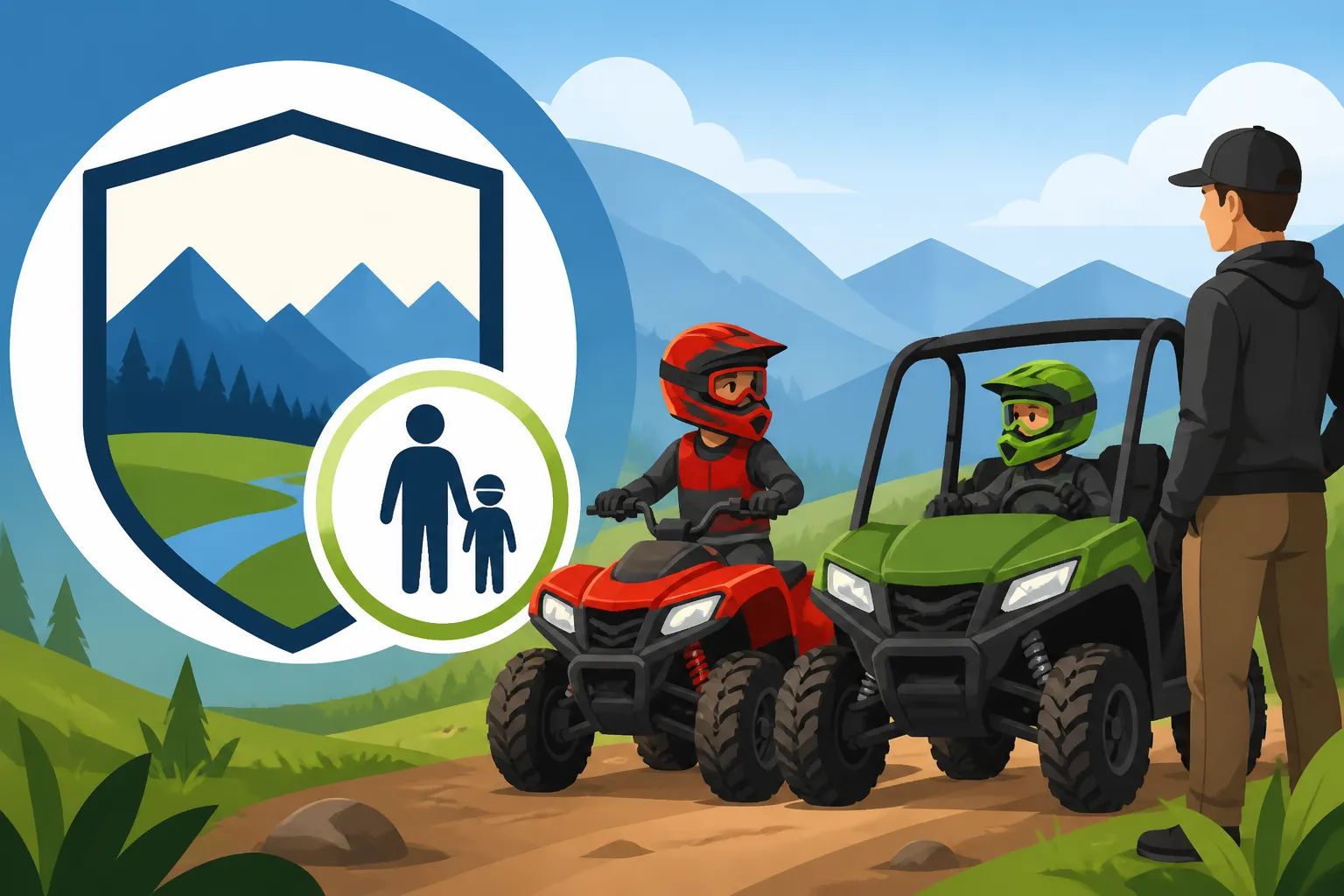
In Alberta, a person under 14 must be accompanied by an adult while operating an off-highway vehicle on public land. The adult must be 18 or older. The requirement applies to machines such as ATVs, dirt bikes and side-by-sides when they are being operated in places covered by the public-land rule.
That does not mean every child can safely ride every machine just because an adult is nearby. The legal age threshold sets a minimum supervision requirement; it does not replace appropriate machine size, training, protective gear or sound judgment. A young rider needs to be capable of controlling the specific vehicle in the conditions they will encounter.
For the broader age rule and how it relates to riding alone, see Alberta’s Minimum Age of 14 on Public Land. For a closer look at a particular age, Alberta Rules for a 12-Year-Old Rider and Alberta Rules for a 14-Year-Old Rider explain what changes around that threshold.
| Rider and location | Supervision expectation | Practical takeaway |
|---|---|---|
| Under 14, operating on public land | Must be accompanied by an adult who is at least 18 | Keep the adult close enough to observe the ride and respond |
| 14 or older, operating on public land | The under-14 supervision requirement no longer applies | Other riding, equipment and land-access rules still apply |
| Under 14, on private land | The public-land supervision rule may not apply in the same way | Get permission and use a conservative safety standard regardless |
| Any age, carrying a passenger | Passenger limits and machine design matter | Check the manufacturer’s limits; supervision does not make an unsuitable passenger setup safe |
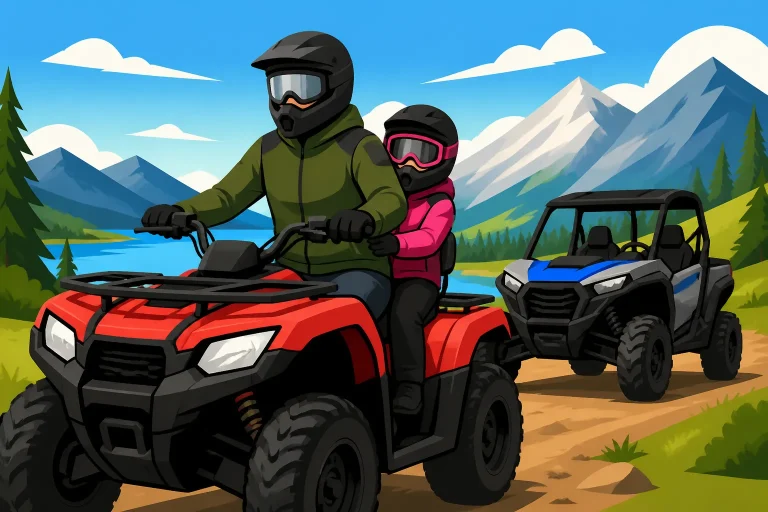
“Accompanied” should not be treated as a technicality. An adult who leaves the child out of sight, rides far ahead, or cannot help if the machine gets stuck may be present in a broad sense but is not providing useful supervision. The safest approach is active, close oversight throughout the ride.
There is no practical reason to test the outer edge of what “accompanied” might mean. Keep the young rider within sight and close enough that the adult can respond promptly if the child loses control, becomes separated, or reaches a hazard. Close Supervision of a Young Rider and Alberta Rules for a Supervising Adult cover that responsibility in more detail.
What counts as effective supervision
Effective supervision is more than having an adult somewhere in the riding group. It means the adult knows where the child is, can see what is happening, and can intervene or get help if the situation changes.
The right setup depends on the terrain, the child’s ability, the machine and the adult’s own riding role. A narrow, familiar trail with good visibility is different from a busy staging area, a steep descent, a creek crossing or a route with several junctions. As the riding environment becomes more difficult, the adult may need to be closer, reduce the pace or choose an easier route.
A practical supervision plan should include the following:
- Choose an adult who can focus on supervision. The supervising person should be capable of riding safely and making decisions, not distracted by navigation, a phone or managing several riders at once.
- Agree on the route and boundaries before starting. Tell the young rider where the group is going, where to stop, and what to do if they cannot see the adult.
- Keep the child in view. Avoid letting the young rider travel ahead around blind corners or fall behind until the adult can no longer see them.
- Set a pace the child can manage. A child struggling to keep up is more likely to make rushed decisions or take unsafe shortcuts.
- Pause before hazards. Discuss steep sections, water, traffic, trail crossings and other difficult features before the child reaches them.
- Stop if conditions change. Weather, fatigue, poor visibility, mechanical trouble or a crowded trail can turn a manageable ride into one that needs to end or take a different route.
An adult riding another machine may be able to supervise, provided they can maintain close oversight. But an adult should not assume that being in the same group is enough. If the adult is too far ahead to see the child, or the child cannot reach the adult quickly, adjust the group arrangement.
Young riders may also need more frequent breaks than adults. Fatigue can make it harder to judge speed, steer accurately and remember instructions. Watch for signs that the child is overwhelmed, including repeated stalling, abrupt steering, a loss of attention or reluctance to continue. Ending a ride early is a sensible decision, not a failure.
The adult’s role is to make choices that suit the child, not simply to follow the child’s enthusiasm. If the terrain is beyond the young rider’s current skill, turn back or find a more appropriate route.
The machine, passenger and protective gear still matter
Supervision does not make an oversized or poorly matched machine suitable for a child. Before riding, consider whether the child can reach and operate the controls, steer without strain, stop reliably and keep the machine stable at a controlled speed. Manufacturer guidance is an important starting point. Putting a Child on a Machine Too Big for Them discusses why a child’s ability to handle a vehicle matters independently of the age rule.
An adult should also consider the child’s experience, strength, coordination and confidence. A young person who can manage a machine in an open area may struggle with uneven ground, mud, ruts or a sudden obstacle. Start with simple conditions and build skills gradually. Avoid making the first ride a test on difficult terrain.
Passengers create a separate set of questions. A child riding as a passenger is not the same as a child operating the machine, and an adult’s supervision does not override the vehicle’s passenger limits. Use only a machine designed and equipped for the number of people aboard, and follow the manufacturer’s instructions. Review Alberta Passenger Rules on an OHV before planning a ride with a child passenger.
Protective equipment is also essential. Alberta requires helmets on public land, subject to the applicable rules and exemptions. A child’s helmet should fit correctly and meet the required standard; a helmet that is too loose, poorly secured or unsuitable for the rider is not a useful substitute. See Alberta Helmet Law on Public Land for the public-land requirement.
When shopping online, including on Amazon, check the actual helmet certification and fit rather than relying only on a product title or a general claim that it is “approved.” The required label should be present on the helmet itself. The child should try it on, fasten it properly and be able to wear it comfortably for the length of the ride.
Other gear and checks matter too:
- Use eye protection suitable for dust, branches and changing light.
- Wear gloves, long sleeves, long pants and sturdy footwear.
- Make sure the machine is in working order and appropriate for the route.
- Explain how to stop safely and what to do if the machine stalls.
- Carry a way to contact help when riding beyond easy access to other people.
- Confirm the machine’s registration and insurance obligations for the land and use involved.
For public-land riding, registration and insurance are separate from the under-14 supervision rule. A supervised young rider does not make an otherwise non-compliant machine lawful to ride. See Alberta Registration Before Riding Crown Land and Alberta Insurance Requirements on Public Land for those requirements.
Public land, private land and a family ride plan
The supervision rule is especially important when planning a ride on public land, including many Crown-land riding areas and trails. Do not assume that a route is private simply because it is near a home, farm or staging area. Land status and access permissions can vary along a route.
Highways and roads can raise additional issues. A ditch, road allowance or right-of-way may be treated differently from a private trail, and riding access can depend on local rules or permission. A child being supervised does not automatically make riding on a road or ditch legal. Check the rules for the specific route, including local bylaws, before setting out. Alberta ATV Road Rules: Bylaws Decide explains why road access cannot be assumed.
On private property, the public-land under-14 supervision requirement may not apply in the same way. That is not a reason to leave a child unsupervised or to ignore permission and safety. The landowner’s consent matters, and other rules may still apply depending on the place and activity. A conservative family standard is to keep a responsible adult close by even when the ride is entirely on private land.
Before taking a young rider out, use a short planning check:
- Confirm where you will ride. Identify whether the route is public land, private land, a road, or a mixture.
- Check that the child is allowed to operate the machine there. If the ride is on public land, arrange for an adult who is at least 18 to accompany the under-14 rider.
- Choose a route that fits the least experienced rider. Avoid routes where the child could become separated or face hazards beyond their ability.
- Match the machine to the rider. Consider controls, size, power and the child’s capacity to stop and steer.
- Set clear riding rules. Agree on spacing, stopping points, hand signals or other communication, and what to do if the group gets separated.
- Check equipment before leaving. Confirm helmet fit, protective gear, machine condition, registration and insurance as applicable.
- Reassess during the ride. Turn around if the child is tired, uncomfortable or unable to keep up safely.
The supervising adult should not rely on a young rider to make every route decision. Children can be eager to continue even when tired or out of their depth. Adults should set limits, stop the group when needed and be willing to change plans.
For many families, the simplest rule is also the safest: under 14 means an adult stays close, watches continuously and chooses the ride. That approach respects the supervision requirement while addressing the real risk behind it: children may not yet have the judgment, size or riding experience to deal with unexpected situations on their own.
Disclaimer
This article is for general informational purposes only and does not constitute professional advice. Laws, prices and regulations vary by location and change over time. Consult a qualified professional for guidance on your specific situation.