Alberta Insurance Rules for an Out-of-Province Machine
Alberta Insurance Rules for an Out-of-Province Machine
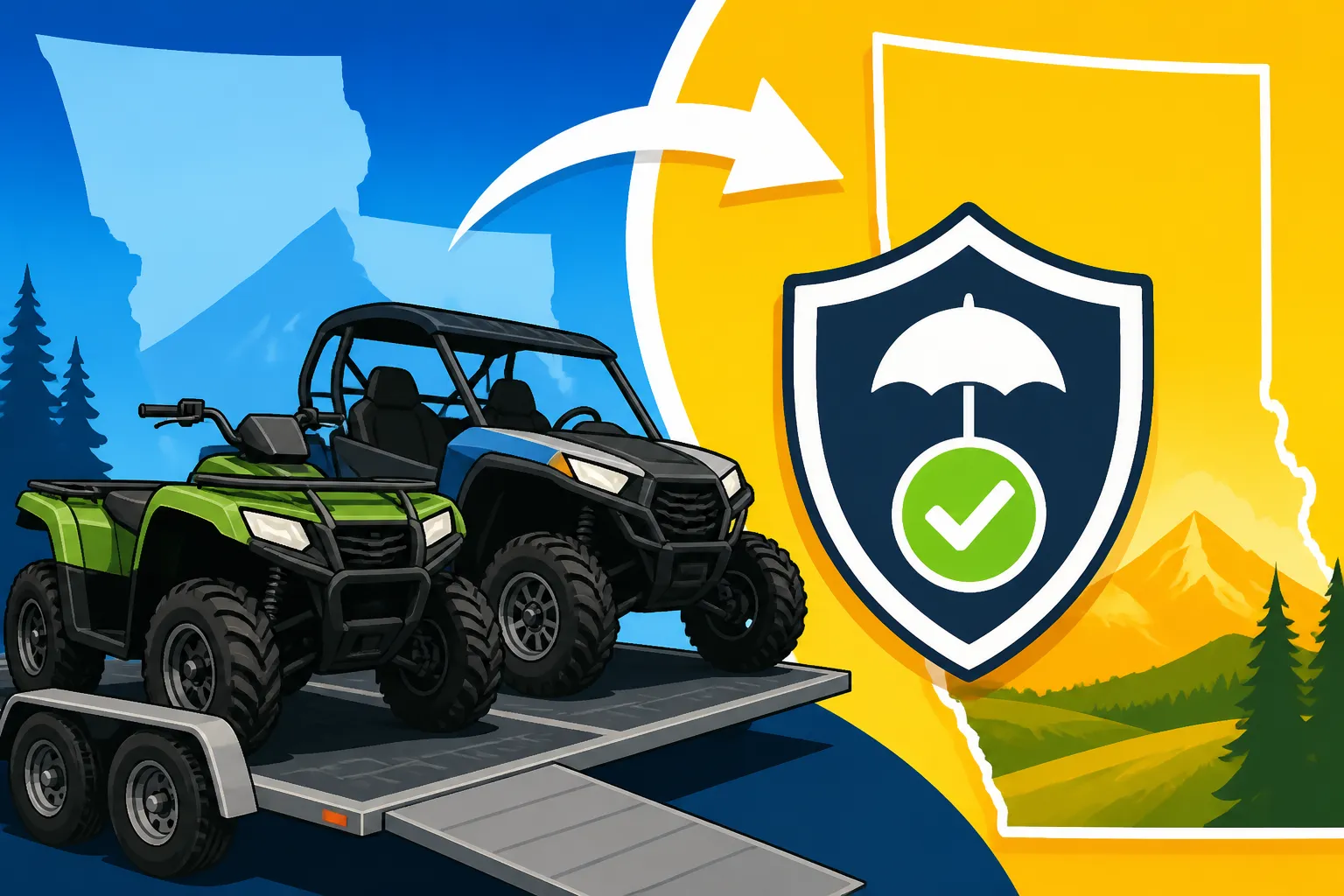
Bringing an ATV or side-by-side into Alberta raises a practical question: will the insurance from home cover the ride you have planned? The answer depends on your policy, where you ride and whether the machine is properly registered. Check those details before crossing the border, and carry proof you can produce during the trip.
The basic insurance rule for visiting riders
An out-of-province registration does not automatically mean your machine is insured for every kind of riding in Alberta. Registration and insurance are separate requirements: the registration identifies the machine and its registered owner, while insurance provides coverage under the policy’s terms.
Alberta requires insurance for off-highway vehicles operated on public land. That means a visitor should not assume that a machine can be ridden simply because its home-province plate is current. The policy needs to cover the machine and the planned use in Alberta. For an overview of the provincial requirement, see Alberta Requires Insurance on Public Land and Alberta Insurance Requirements on Public Land.
The first step is to contact your insurer, not just check whether the policy is active. Ask specifically whether the ATV or side-by-side is covered while being operated in Alberta, including on the public land and trails on your itinerary. A policy may be current but still have restrictions that matter to an off-road trip.
Confirm the details for each machine. A policy covering one ATV does not necessarily cover a second machine, a side-by-side, or a vehicle borrowed from someone else. If the machine is financed, leased, rented or owned jointly, clarify who is insured and who is allowed to operate it.
As a visitor, you generally need to meet both Alberta’s rules and the requirements that apply to your machine where it is registered. Recognition of an out-of-province registration is not a substitute for insurance. The rules for visiting vehicles are covered in Alberta Registration for Visiting Riders and Alberta’s 30-Day Rule for Out-of-Province Machines. For the broader reciprocity picture, see Alberta Reciprocity for Visiting Riders.
The practical rule is simple: before riding, make sure you can answer yes to both questions:
- Is the machine’s registration valid for its visit to Alberta?
- Does its insurance cover the machine’s intended operation in Alberta?
If either answer is uncertain, ask the relevant registry or insurer before setting out. Do not rely on a plate, a verbal assurance from a previous owner, or the fact that the machine was insured for a different kind of use.
What to verify with your insurer
Insurance documents can be hard to interpret if you only look for the word “ATV.” Ask your insurer to confirm the specific machine, territory and use. If possible, get the answer in writing or ask for an updated document that clearly identifies the coverage.
Coverage territory
Ask whether the policy covers operation in Alberta, not only transport through the province or storage while travelling. A policy may cover a vehicle in one province but limit certain activities outside its home jurisdiction. Explain that you intend to ride an off-highway vehicle, rather than merely haul it across the border.
If the machine is registered outside Canada, ask the insurer how its coverage applies during operation in Alberta and what proof an Alberta officer can review. Do not assume that an automobile policy or a general travel policy covers an ATV.
The machine and its use
Have the machine’s make, model and identification number available when you call. Confirm that the policy lists the correct vehicle type. An ATV and a side-by-side may be treated differently by an insurer, and a policy for a road vehicle should not be assumed to insure a separate off-highway machine.
Describe where and how you expect to ride. For example, tell the insurer if you plan to use public land, designated trails, a work lease or private property. Ask whether recreational use, work use, competition, commercial activity or guided trips affect coverage. If your plan changes, check again rather than assuming all forms of off-road use are covered.
Liability and exclusions
Ask what liability coverage applies when the machine is operated off road in Alberta, and whether any exclusions could affect your planned ride. The insurer can explain the policy’s limits and exclusions; the fact that a policy contains liability coverage does not mean every incident or use is covered.
Questions worth asking include:
- Does the policy cover this exact machine while it is being operated in Alberta?
- Does coverage apply on public land and designated OHV trails?
- Are there restrictions on the rider’s age, licence status or experience?
- Does the policy exclude racing, commercial use, or particular types of terrain?
- Are passengers covered, and are there limits based on the machine’s seating?
- Does a modification affect coverage?
- What should the operator do after a collision or claim?
A passenger seat or manufacturer-approved capacity is not proof that insurance covers every passenger or circumstance. Check your policy and follow the machine’s passenger limits as well as any rules that apply where you ride.
Borrowed, rented and recently purchased machines
If you are borrowing a machine, ask the owner to confirm that the insurance applies to another operator and to use in Alberta. Do not treat the owner’s assurance that “it’s insured” as a complete answer. The policy may have named-operator restrictions, use limitations or other conditions.
For a rental, ask the rental operator what insurance is supplied, what it covers and what you remain responsible for. Do not assume your personal policy covers a rental ATV or side-by-side. If you have separate coverage, confirm that it applies to rented machines and to the planned activity.
A recent purchase needs special attention. A seller’s policy does not become the buyer’s insurance simply because the machine has not moved. Arrange the coverage required for your own operation before riding. For related ownership questions, Insuring a Machine the Day You Buy It can help you plan the handover.
| Situation | What to confirm before riding |
|---|---|
| Your own machine from another province | The policy covers that machine and off-road use in Alberta |
| A borrowed machine | The owner’s policy permits your operation and the planned use |
| A rental machine | The rental operator’s insurance terms and any coverage you need separately |
| A recently purchased machine | Coverage is in place for you as the new owner and operator |
| A machine registered outside Canada | Territorial coverage and acceptable proof for operation in Alberta |
| A modified machine | Whether the modification changes coverage or needs to be reported |
Where the insurance requirement matters
The insurance question is especially important when your route includes public land. Riders sometimes assume the rules only apply to remote Crown land, but “public land” should not be treated as a synonym for an isolated trail. Road rights-of-way and other public areas can raise different legal questions from a private riding area.
Before setting out, identify what land you will actually use. Check whether a trail is open to your machine and whether it is public land, private land, a designated area or a road right-of-way. Do not rely only on a map pin or an informal description such as “the trail starts at the highway.” The location and access rules can affect what requirements apply.
Registration is also a separate part of the check. Visitors often need to follow rules tied to their home registration and the length of their stay. If you are staying longer or becoming an Alberta resident, ask whether the visiting-vehicle rules still apply. Alberta Visitors Under 30 Days and Alberta Registration for a Machine From BC provide more detail for common visitor situations.
Private property does not make every insurance concern disappear. Alberta’s public-land insurance requirement may not apply in the same way to a machine used only on private land, but that is not a reason to assume that riding without insurance is safe or permitted. A collision can injure another person, damage property or involve a vehicle that later travels on public land. The landowner’s permission is not insurance coverage.
Be especially cautious about riding from private property onto a road, ditch, public trail or public staging area. A machine that begins the day on private land may later be operated somewhere different, where other requirements apply. Confirm the insurance before the ride, rather than trying to sort it out at the trailhead.
If your route includes a highway crossing, ditch or municipal road, check the rules for that location separately. Insurance does not make an otherwise prohibited route legal. Likewise, having registration and insurance does not necessarily give permission to use a trail or cross private land.
Carrying proof and preparing for a check
Having valid coverage and being able to show it are two different things. Keep proof of insurance with the machine or operator so it is available during the ride. Alberta officers may ask for proof when checking an off-highway vehicle, so do not leave the only copy at home or in a vehicle parked far from the trail.
A useful document set includes:
- Proof of insurance that identifies the covered machine or clearly applies to it
- The machine’s registration or equivalent home-jurisdiction document
- The insurer’s contact information and policy details
- Permission or rental documents, when relevant
- Any documents needed to clarify who owns or may operate the machine
Carry a paper copy if you can. A phone can be useful for keeping a backup, but a dead battery, poor reception or a damaged device can leave you unable to retrieve it. A small waterproof pouch from Amazon or another retailer can help keep paper documents dry, but make sure the documents are still easy to remove and read.
The insurance document should be legible and current. Before leaving home, check that the machine details match, the coverage dates include the trip, and the document is not for a different vehicle. If you have several machines, label or organize the papers so you can quickly show the correct one.
For a more complete paperwork checklist, see [Alberta Insurance Proof on Public Land], Alberta Proof of Insurance on Demand and Alberta Registration Paperwork Checklist. Those details can help prevent a simple documentation problem from turning into a delay during a ride.
If the insurer confirms coverage by phone, ask for an email or updated proof where possible. Keep the name of the representative and the date of the conversation with your trip records. A note is not a substitute for the insurance document, but it can make a follow-up easier if the paperwork is unclear.
Do not alter an insurance document or rely on a screenshot that cuts off the policyholder, dates or machine details. If the proof does not make the coverage clear, contact the insurer before travelling.
A pre-trip check for out-of-province riders
A short check before departure is easier than discovering a coverage gap after arriving at a staging area. Use this sequence for every machine, including a borrowed or rented one.
- Confirm the machine’s registration. Check that it is current and that the machine can be operated in Alberta under the rules for visitors. If your stay may exceed the applicable visiting period, confirm what changes.
- Call the insurer. Give the machine details, explain that it will be ridden in Alberta, and describe the intended use and locations.
- Ask about exclusions. Confirm rules for public land, passengers, operator eligibility, modifications and any work or commercial use.
- Get clear proof. Obtain a current document that identifies the machine or clearly shows that it is covered.
- Check the route. Verify that the land and trails are open to your vehicle, and that any required permissions or local rules are satisfied.
- Pack the documents. Keep registration and insurance proof accessible, protected from weather and readable.
- Recheck if plans change. A switch from private land to public trails, a different operator, or a different machine may change what you need to confirm.
If the insurer cannot confirm coverage for the planned use, do not treat that uncertainty as permission to ride. Ask the insurer what change is needed, arrange suitable coverage, or choose a different activity. If the issue is registration rather than insurance, contact an Alberta registry agent or the appropriate authority for the home jurisdiction.
A visiting rider’s goal is not just to arrive with a plate. The machine needs valid registration, appropriate insurance and a route that is legal for that vehicle. Checking all three before the trip keeps the paperwork question from overshadowing the ride.
Frequently Asked Questions
Does my home-province ATV insurance automatically cover me in Alberta?
Not necessarily. Ask your insurer to confirm that the policy covers the specific machine while it is being operated in Alberta and for the type of riding you plan to do.
Do I need insurance if I only ride on private property?
The rules can differ depending on where the machine is operated, but private land does not remove the practical risks of an uninsured collision. Confirm the legal requirement for your situation and consider the financial consequences of riding without coverage.
Is a current out-of-province plate enough?
No. Registration and insurance are separate. A valid plate does not establish that the machine has suitable insurance for public-land riding in Alberta.
Can I show proof of insurance on my phone?
A digital copy may be useful, but do not rely on having power or reception. Carry a legible paper copy when possible and confirm that your proof clearly applies to the machine.
Disclaimer
This article is for general informational purposes only and does not constitute professional advice. Laws, prices and regulations vary by location and change over time. Consult a qualified professional for guidance on your specific situation.