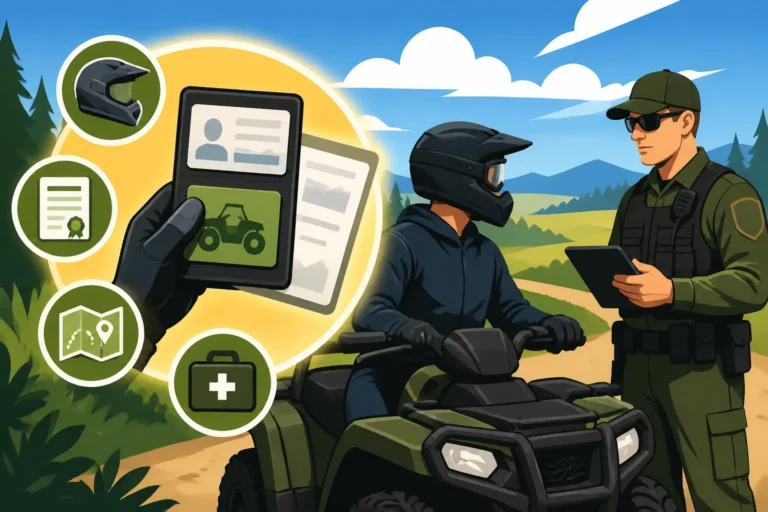
Alberta Voluntary Rider Courses
Alberta riders can legally operate an ATV or UTV without taking a general safety course, but legal permission and practical readiness are different things. A voluntary course can help you build control, judgment and trail habits before you ride alone, with a child or in unfamiliar terrain. Here’s what courses usually teach, who benefits most and what training does not replace.
Are rider courses required in Alberta?
A voluntary rider course is exactly that: optional training. Alberta does not require every ATV or UTV rider to complete a general safety course before riding. Taking a course also does not, by itself, give you a driver’s licence, register a machine, provide insurance or grant permission to ride on a particular road or trail.
That distinction matters because riders sometimes treat a course certificate as if it were an all-purpose pass. It is better understood as evidence that you completed a particular training program. It may be useful to an employer, rental operator, parent or insurer, but do not assume that every organization recognizes every certificate. Ask the organization that needs proof what it accepts.
The basic legal obligations still depend on the rider, machine and location. Registration and insurance rules can apply when you ride on public land, and local restrictions may determine whether a route is open to OHVs. A course does not override those requirements. Before a public-land trip, check Alberta Registration Before Riding Crown Land and Alberta Insurance Requirements on Public Land. If your route includes roads or ditches, confirm the rules separately; a course does not make an otherwise prohibited road ride legal.
A useful way to separate the questions is:
| Question | What a course can do | What it does not do |
|---|---|---|
| Can I control the machine safely? | Teach and practise operating skills | Guarantee that every rider is competent in every situation |
| Am I allowed to ride here? | Help you understand why route planning matters | Open a closed trail or replace local rules |
| Is the machine properly documented? | Encourage a pre-ride paperwork check | Register the machine or provide insurance |
| Can a young rider go alone? | Build skills under instruction | Change age or supervision requirements |
| Does my certificate count for a specific purpose? | Provide proof of course completion | Guarantee acceptance by an employer, insurer or rental operator |
The legal baseline and the safety baseline are not the same. A new rider may meet the minimum legal requirements and still need supervised practice. Conversely, completing a course does not remove the need to follow current rules or make cautious decisions on a difficult trail.
For the broader legal picture, start with Alberta Has No Mandatory Safety Course and Alberta Safety Course Options. If you are visiting from another province, training is only one part of preparation: Alberta Visitors From BC and Alberta Visitors From Saskatchewan explain why visitor status and machine paperwork deserve separate attention.
What a voluntary ATV or UTV course usually teaches
Course content varies by provider, machine type and rider group. Some programs focus on ATVs, some include side-by-sides, and some may offer different formats for youth and adults. Read the course description before registering rather than assuming that a class for one machine transfers neatly to another.
A practical course generally combines instruction with hands-on exercises. The aim is not simply to show a rider where the controls are. It is to help them make decisions while operating a machine that can be affected by its weight, speed, terrain, passengers and load.
Topics may include:
- Pre-ride checks and basic machine familiarization
- Starting, stopping, shifting or selecting drive modes, where applicable
- Throttle and brake control
- Body position, balance and turning
- Managing hills and uneven surfaces within the machine’s limits
- Recognizing hazards and choosing a safer line
- Riding at a suitable speed and leaving space between machines
- Communicating in a group
- Passenger and load considerations
- What to do when a machine becomes stuck, unstable or difficult to control
- Protective equipment and basic safety planning
The exact exercises matter. A classroom discussion can explain why a hillside is risky, but the rider still needs to understand the limits of their own machine and skill. Likewise, a brief practice session in a controlled setting cannot prepare someone for every combination of mud, rocks, water, weather and traffic they might encounter outdoors.
A good course makes room for questions and gives students a chance to practise under supervision. Look for a description that clearly identifies the type of machine, the intended age or experience level, the amount of practical instruction and any equipment students must bring. If those details are missing, ask before paying.
For a closer look at typical topics, see What a Rider Course Covers. Training through safety organizations may be another option; Alberta Courses Through Safety Councils and Taking the Canada Safety Council’s Rider Course are useful starting points for comparing programs. Confirm course availability, location, machine requirements and current registration details directly with the provider.
Training is not a substitute for experience
Finishing a course is a starting point, not proof that someone is ready for every trail. A rider who has practised on open ground may still be inexperienced on steep or narrow terrain. A UTV driver who understands the controls may not yet be comfortable managing a full cabin, a passenger conversation, changing traction and limited visibility at the same time.
Build experience in stages:
- Practise the controls and basic manoeuvres in a safe, permitted area.
- Choose easy terrain that matches the rider and machine.
- Ride with a more experienced person who can help, without pressuring the learner to keep up.
- Add more challenging conditions gradually.
- Stop or turn back if the terrain, weather, machine or rider’s confidence changes.
A course can help someone recognize when they are approaching a limit. It cannot remove that limit. The rider remains responsible for deciding whether a trail is suitable and whether to continue.
Choosing a course and preparing to attend
The best course is not necessarily the one with the most impressive-sounding certificate. Start by matching the program to the rider’s real needs: age, experience, machine type and intended use. A new ATV rider, a teenager moving onto a larger machine and an adult learning to operate a side-by-side may need different instruction.
Before booking, ask the provider:
- Is the course designed for ATVs, UTVs or both?
- Is it intended for beginners, experienced riders or a particular age group?
- How much practical riding is included?
- Does the provider supply machines, or must participants bring their own?
- What protective equipment and clothing are required?
- Is there a prerequisite, minimum age or adult-consent requirement?
- What happens if weather or trail conditions disrupt the session?
- What document, if any, does a participant receive after completing it?
- Is that document accepted by the employer, rental operator or other organization that requested training?
These questions help avoid a common mismatch: booking a course that is technically available but does not cover the machine or skill the rider needs. For example, a person seeking workplace training should check with the employer about accepted providers and required documentation before enrolling. A family hoping to prepare a child for recreation should ask how the course handles youth riders and supervision.
If you already own a machine, ask whether it is appropriate to bring. A familiar machine can help a student connect instruction to their own controls and fit, but a provider may supply equipment for safety or training reasons. Do not assume that a machine can be used just because it is mechanically sound. It needs to suit the participant, meet the provider’s requirements and be operated only where the training is authorized.
What to bring
Follow the provider’s list first. Depending on the course, participants may need a helmet, eye protection, gloves, sturdy footwear, weather-appropriate clothing and water. Ask whether protective equipment is supplied and whether it meets the provider’s standards. If a helmet is required, check that it fits correctly and is appropriate for the activity.
Pack for the conditions, not just the forecast at the time you leave home. A training session may include waiting outdoors or practising in changing weather. Layers, rain protection and a way to carry water can make it easier to focus on instruction rather than discomfort. Avoid loose clothing or unsecured items that could interfere with riding.
Arrive ready to listen and practise. Tell the instructor about relevant concerns, such as limited experience, difficulty reaching controls or uncertainty about a machine’s size. The point is not to impress anyone by attempting a manoeuvre beyond your ability. Ask for a demonstration or a slower progression when needed.
If the course involves your own machine, check its condition beforehand and bring any documents the provider requests. A course is not a substitute for a mechanical inspection, registration or insurance. For public-land use after training, review [Alberta Insurance Proof on Public Land] and What to Show an Officer on Alberta Public Land so you know what paperwork may be expected outside the training setting.
Who benefits most from voluntary training?
Almost any rider can benefit from instruction, but it is especially useful when someone is new to OHVs, returning after a long break or moving to a different type of machine. Familiarity with a snowmobile or dirt bike does not automatically transfer to an ATV or UTV. Each machine has different handling, visibility, braking and passenger considerations.
New adult riders
A new adult rider may be comfortable with recreational vehicles generally but still lack practice with low-speed control, turning, slopes or terrain assessment. A course gives them an opportunity to learn fundamentals in a more controlled setting than a busy trail. It can also give friends or family a shared vocabulary for discussing safe riding.
Experienced riders can benefit too. Training may reveal habits that have become automatic but are not ideal, such as carrying too much speed into a turn, following too closely or continuing after conditions have changed. A refresher can be particularly useful after a crash, a long period away from riding or a change in machine size.
Youth riders
For young riders, a course works best as part of a wider plan that includes the right machine, close supervision and gradual practice. A child’s confidence can grow faster than their ability to manage weight, speed and unexpected terrain. Parents should not use course completion as a reason to leave a child unsupervised or put them on a machine that is too large for them.
Alberta’s age and supervision requirements still apply where they apply. Review [Alberta Supervision Rules Under 14] and the age-specific rules relevant to your child, including Alberta Rules for a 12-Year-Old Rider or Alberta Rules for a 14-Year-Old Rider. A course can support a parent’s judgment, but it does not change those legal requirements or the manufacturer’s guidance for the machine.
When evaluating a youth course, ask whether instructors have experience teaching the intended age group and whether the practice machines suit the students. A useful program should make it possible to learn without being rushed or pressured to ride beyond a child’s control. Parents should also ask what is expected of them during the course and what supervised practice should follow.
UTV and side-by-side drivers
A side-by-side can feel familiar to someone who drives a car, but that resemblance can create false confidence. A UTV has different handling, sightlines, ground clearance and rollover risks. A driver also needs to account for passengers, belts, doors or other restraints, and the way cargo changes the machine’s behaviour.
Training is a chance to practise smooth inputs, spacing, turning and route choice without assuming that road-driving habits are enough. Passenger rules and manufacturer limits remain important. Review Alberta Rules for Passengers on a Quad for passenger considerations and check the machine’s own instructions for its approved seating and load limits.
Visitors and occasional riders
Visitors may benefit from training if they are unfamiliar with local terrain, riding conventions or the machine they plan to use. But an Alberta course does not automatically settle the legal position for an out-of-province machine or rider. Visitors should check registration, insurance and any applicable time limits separately. Start with Alberta Insurance Rules for an Out-of-Province Machine and [Alberta Visitors Staying Over 30 Days] if either situation may apply.
Occasional riders may also find a refresher useful before a group trip. Being part of a group can make a ride more enjoyable, but it can also lead a less-experienced person to keep pace when they should slow down or stop. Agree on a pace, meeting points and a no-pressure rule before setting out.
What a course certificate does not replace
A course certificate can be useful evidence of training, but its value depends on who is asking for it and why. Ask the recipient what they require rather than relying on a general statement that a course is “recognized.” Requirements can differ among employers, rental businesses, organized events and insurers.
Keep the certificate or completion record with your other important documents. If it is digital, save a copy somewhere accessible and check whether the recipient needs the original, a printed copy or particular course details. Keep the provider’s contact information as well, in case someone needs to verify the training.
Most importantly, do not treat the certificate as a riding permit. Before a trip, check the separate requirements that apply:
- Registration: Confirm whether the machine needs registration for the place and type of riding planned.
- Insurance: Check that the machine has appropriate coverage and that you can show proof if asked.
- Access: Confirm that the route is open to OHVs and that you have permission where required.
- Equipment: Check the machine and required safety equipment before leaving.
- Rider rules: Follow age, supervision and passenger requirements.
- Conditions: Check closures, weather, fire restrictions and other current notices before travelling.
These checks still matter for a skilled rider. A well-trained operator can be turned around by a closed route, inadequate paperwork, poor visibility or a machine fault. For planning beyond the training day, Alberta Safety Course Options can help you compare instruction with other preparation needs, while Alberta Registration Before Your First Ride provides a reminder to handle the basics before heading out.
A sensible course should leave a rider more capable of recognizing risk, not convinced that risk has disappeared. Use the skills in small steps, ride within the machine’s limits and make room for the least-experienced person in the group. That is a more useful outcome than a certificate treated as a guarantee.
Frequently Asked Questions
Is a safety course mandatory to ride an ATV in Alberta?
A general ATV or UTV safety course is not mandatory for every rider. Other requirements, including rules for registration, insurance, access, age and supervision, may still apply.
Does a course certificate count as a licence?
No. A course certificate shows that a participant completed a particular program. It does not automatically function as a driver’s licence, registration, insurance or permission to ride.
Can a youth course replace adult supervision?
No. Course completion does not change Alberta’s age or supervision rules. Parents should also consider the child’s ability, the machine’s size and the terrain.
Should visitors take a course before riding in Alberta?
It can be helpful, especially for a new rider or someone unfamiliar with the machine or terrain. Visitors must still check the separate rules for their machine, insurance, registration and planned riding area.
Disclaimer
This article is for general informational purposes only and does not constitute professional advice. Laws, prices and regulations vary by location and change over time. Consult a qualified professional for guidance on your specific situation.