Alberta Rules for Riding at Night
Many ATV and UTV riders in Alberta cherish the unique experience of hitting the trails or open country as twilight fades, embracing the quieter atmosphere and the cooler temperatures. However, riding after sunset isn't just about turning on your headlights; it introduces specific legal obligations and enhanced safety considerations that every rider needs to understand. Ignoring these rules can lead to serious hazards, fines, or even jeopardize your machine. This guide will illuminate Alberta's regulations for night riding, ensuring you're prepared for a safe and legal adventure in the dark.
Understanding "Night" in Alberta's OHV Regulations
It's easy to assume "night" simply means "when it's dark outside," but Alberta's legal definition of night for off-highway vehicle operation is a bit more precise. This isn't just a technicality; it's the specific timeframe when certain equipment and operational rules kick in, making it critical for you to know exactly when you're considered to be riding at night in the eyes of the law.
Defining Legal Nighttime Hours
In Alberta, for the purposes of operating an off-highway vehicle, "night" is generally understood to be the period commencing one-half hour after sunset and ending one-half hour before sunrise. This definition aligns with many other vehicle regulations in the province, creating a clear window during which your machine must meet specific lighting requirements. It’s not about how dark it feels but rather the official sunset and sunrise times for your specific location on a given day. You can easily check these times on weather apps or websites.
This precise definition means that even if it's still quite bright just after sunset, legally you might already be in the "night" period. Conversely, on a heavily overcast morning, it might feel dark, but if it's more than half an hour before sunrise, you're technically still in the night riding window. Always err on the side of caution; if visibility is low, treat it as night conditions regardless of the exact legal clock.
Why the Distinction Matters
The legal distinction between day and night isn't just there to make things complicated; it's fundamentally about safety and visibility. During daylight hours, natural light typically provides sufficient illumination for other riders, pedestrians, and wildlife to see your machine. Once that natural light diminishes, your OHV's lighting system becomes your primary means of being seen and seeing what's ahead.
This regulatory framework is designed to reduce the risk of collisions and ensure that all OHVs operating in low-light conditions are adequately equipped. Without clear legal definitions, it would be a subjective call every time, leading to inconsistencies and potential hazards. Knowing these hours helps you plan your rides, ensuring you're either off the public land before night falls or fully compliant with the lighting requirements if you choose to ride into the darkness.
Essential Lighting Requirements for Night Riding
When you're out on the trails or exploring public land in Alberta after dark, your machine's lights aren't just a convenience; they're a legal necessity and your lifeline for safety. The law specifies exactly what kind of illumination your ATV or UTV must have to operate during those legally defined nighttime hours. These requirements are in place to ensure you can see where you're going and, crucially, that others can see you.
Mandatory Headlights and Taillights
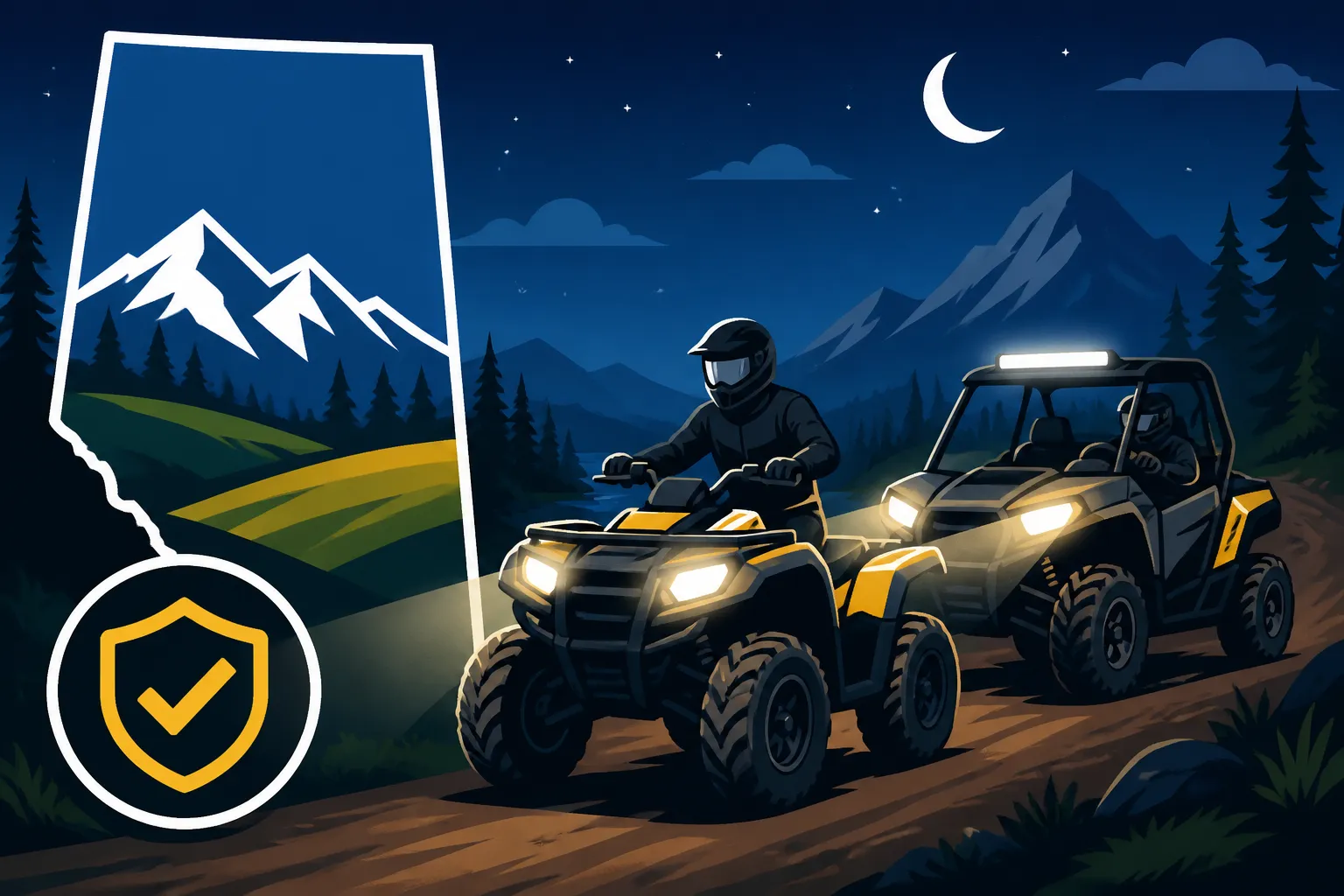
Under Alberta's Off-Highway Vehicle Regulation, any OHV operating on public land or a highway (which includes ditches and shoulders) during night hours must be equipped with at least one headlight and one taillight. These aren't just any old lights; they need to be fully functional and visible from a specific distance. Your headlight needs to illuminate the path ahead effectively, while your taillight must be clearly visible from the rear. [Alberta Requires Working Head and Tail Lights] goes into more detail about these requirements.
It’s not enough to have them; they must be working. A burned-out bulb or a broken wire can lead to a ticket, regardless of how new your machine is. Before every night ride, do a quick walk-around. Check your headlight for brightness and aim, ensure your taillight is visible, and don't forget your brake lights if your machine has them. Even small utility lights can enhance visibility, but they don't replace the mandatory headlight and taillight.
Enhancing Visibility with Auxiliary Lighting
While the law mandates specific headlights and taillights, many riders choose to go above and beyond, especially for serious night riding. Aftermarket lighting, such as LED light bars, auxiliary spotlights, or floodlights, can dramatically improve your field of vision in dark conditions. Companies like SuperATV offer a wide range of robust lighting solutions designed to withstand the rigours of off-road use, providing far more illumination than stock lights. These can be particularly helpful when navigating challenging terrain, identifying trail hazards, or spotting wildlife that might cross your path.
However, a word of caution: while auxiliary lights are fantastic for off-road use, they are generally not permitted on public roads or highways (including ditches) if they are overly bright or not properly aimed. Using high-intensity light bars on a highway could blind oncoming traffic and lead to a fine. Always understand the local bylaws and provincial regulations regarding auxiliary lighting, especially when transitioning from trails to roads. Most riders will have a separate switch for their auxiliary lights, turning them off when approaching other vehicles or public roadways.
Additional Reflective Gear and Safety Practices
Beyond your machine's lights, consider personal visibility. Wearing reflective clothing or gear, such as vests or stripes on your helmet, can make a significant difference in how easily others can spot you. This is especially true if you ever have to dismount your machine on a trail at night. Bright, contrasting colours are always a good idea, but reflective elements are crucial after dark.
Additionally, carrying a flashlight or headlamp with you can be invaluable for tasks like reading maps, making minor repairs, or navigating around your camp. Think of your lighting system as a layered approach: mandatory machine lights for legal compliance, auxiliary lights for enhanced vision, and personal reflective gear plus a backup light for all-around safety. [Alberta Equipment Required on Public Land] touches on other general equipment rules you should be aware of.
Safe Practices and Legal Considerations for Night Riding
Riding an OHV at night in Alberta isn't just about having the right lights; it's about adopting a completely different mindset and set of safety practices. The darkness amplifies every challenge, reduces reaction time, and introduces hazards that might be negligible during the day. Understanding where you can legally ride at night and how to do so safely is paramount for a responsible off-road experience.
Reduced Visibility and Terrain Hazards
The most obvious challenge of night riding is significantly reduced visibility. Even with excellent lighting, your depth perception is altered, and shadows can play tricks on your eyes. Familiar trails can look entirely different, and obstacles like rocks, roots, or sudden dips become far harder to spot. Speed is your enemy at night; riding slower than you would in daylight is not just recommended, it's essential for safety. You need adequate time to react to whatever your lights reveal.
Always be acutely aware of the terrain. If you're on unfamiliar trails, it's generally best to save them for daylight hours. Stick to routes you know well and can anticipate the twists, turns, and elevation changes. Pay close attention to your machine's handling, as even small bumps can be jarring if unexpected. Keep an eye out for reflective trail markers, if available, which can be invaluable navigational aids after dark.
Wildlife Encounters and Environmental Awareness
Nighttime is when many animals become active, increasing the likelihood of wildlife encounters. Deer, elk, and moose can dart across trails with little warning, and their eyes reflecting in your headlights can be the first, and sometimes only, indication of their presence. Maintain a keen watch on the shoulders of the trail and scan ahead. Reducing your speed gives you a better chance to react, brake, or steer to avoid a collision.
Beyond wildlife, be mindful of environmental conditions. Temperatures drop significantly at night, even in summer. Dress in layers to stay warm. Dew or rain can make trails slippery, further compromising traction. Ensure your tires are in good condition and provide adequate grip. Riding through puddles or water crossings at night is particularly risky because you can't gauge depth or hidden obstacles. Exercise extreme caution or avoid them altogether if unsure.
Impaired Riding: A Zero-Tolerance Policy
This goes without saying, but it bears repeating: impaired riding, whether by alcohol or drugs, is never acceptable, but it is exponentially more dangerous at night. Your judgment, reaction time, and ability to process information are already compromised by the darkness; adding impairment into the mix is a recipe for disaster. [Alberta Impaired Riding Penalties] are severe and apply equally off-road as on.
Law enforcement actively patrols popular OHV areas, day and night. They are looking for signs of impairment and will not hesitate to lay charges. The risks are not just legal; they are physical. A serious accident could result in life-altering injuries or worse, not just for you but for any passengers or other riders in your group. Always appoint a designated sober rider, or better yet, save the celebration for after the ride.
Riding on Public Land, Ditches, and Private Property
The rules for night riding can also vary depending on where you are. On designated public land use zones (PLUZs) or managed trails, the general lighting requirements apply. However, if you're riding in a road ditch or crossing a highway, you're entering an area that falls under the broader Traffic Safety Act, which often has stricter rules, including specific times when OHVs are prohibited entirely. [Alberta Ditch Riding Is Not Automatic] outlines some of these complexities.
For private land, the rules are different. If you have permission from the landowner to ride on their property, Alberta's OHV regulations about lights for public land don't strictly apply. However, common sense and courtesy dictate that you should still have adequate lighting for your own safety and to avoid disturbing neighbours. Always ensure you have explicit permission to be on private land, day or night, to avoid trespassing charges. [Alberta Rules for Riding Private Land] offers more insight.
Here's a quick overview of night riding considerations:
| Aspect | Daytime Riding | Nighttime Riding |
|---|---|---|
| Visibility | High, natural light | Low, relies on artificial lights |
| Speed | Generally higher, dependent on conditions | Significantly reduced, cautious pace essential |
| Obstacle Detection | Easy to spot, good depth perception | Challenging, shadows, depth perception altered |
| Wildlife Risk | Present, but often visible | Higher, animals more active, harder to see |
| Legal Lighting | Not strictly required on most public land | Mandatory headlight, taillight, brake light (if equipped) |
| Fatigue | Less common to be impacted by light | Increased, darkness can hasten eye strain and fatigue |
| Emergency Prep | Standard kit | Enhanced kit (extra lights, warmth, comms) |
Penalties for Non-Compliance and Enforcement
Ignoring Alberta's rules for night riding isn't just risky; it can lead to tangible consequences, from monetary fines to having your off-highway vehicle seized. Law enforcement officers, including RCMP, Fish and Wildlife officers, and municipal peace officers, are authorized to enforce these regulations across the province.
Fines for Inadequate Lighting
The most common penalty for riding an OHV at night without proper lighting is a ticket. Fines for equipment violations can vary, but generally, they are designed to be a deterrent, making it clear that compliance is expected. Riding without a working headlight or taillight when required is a direct violation of the Off-Highway Vehicle Regulation. An officer might issue a ticket for "operating an OHV with inadequate lighting" or a similar charge.
These fines can quickly add up, especially if you have multiple infractions. It's far cheaper and safer to ensure your machine is properly equipped before you head out. A simple bulb check takes minutes; a fine could cost you a significant amount and spoil your ride. Remember, enforcement officers can perform [Alberta Officer Checks at a Staging Area] and on the trails themselves.
Consequences Beyond Monetary Fines
Beyond the initial fine, persistent non-compliance or serious violations can lead to more severe outcomes. If your machine is deemed unsafe to operate, or if you are found to be driving impaired, officers have the authority to issue an order to discontinue operation. In extreme cases, particularly involving impaired operation or repeated dangerous behavior, your OHV could be seized. This means your pride and joy gets towed away, and you'll incur additional costs for impoundment and potentially legal fees to get it back.
Furthermore, any fines or convictions related to OHV operation can sometimes impact your regular driving record, depending on the specific charge and how it's processed. It's always best to consult the current provincial traffic safety acts and regulations to understand the full scope of potential penalties. The general principles of [What the Traffic Safety Act Requires of Alberta OHVs] extend to off-highway activities as well.
How to Avoid Penalties and Stay Safe
The best way to avoid penalties and ensure a safe night riding experience is proactive preparation and adherence to the rules.
- Inspect Your Lights Regularly: Before every ride, especially if you anticipate riding into the evening, check your headlights, taillights, and brake lights. Ensure they are clean, functional, and properly aimed. Carry spare bulbs if you know how to change them on the trail.
- Understand the Law: Know the specific legal definition of "night" and what lighting equipment is mandatory for your machine. Familiarize yourself with where OHVs are permitted to ride at night in your chosen area, as municipal bylaws can add further restrictions.
- Invest in Quality Lighting: While stock lights meet the minimum, upgrading to brighter, more durable aftermarket lights, perhaps from a reputable provider like SuperATV, can significantly improve safety and visibility. Ensure they are installed correctly and won't blind other riders or traffic.
- Ride Responsibly: Always ride sober, at a reduced speed, and within your capabilities. Be extra vigilant for hazards, both environmental and wildlife-related. [Alberta Lighting Rules on Public Land] are there for a reason – your safety and the safety of others.
By taking these steps, you not only avoid potential penalties but also ensure your night riding adventures in Alberta are enjoyable, safe, and respectful of the regulations and other trail users.
Disclaimer
This article is for general informational purposes only and does not constitute professional advice. Laws, prices and regulations vary by location and change over time. Consult a qualified professional for guidance on your specific situation.