Alberta Passes Along the Eastern Slopes
The Eastern Slopes offer some of Alberta’s best backcountry riding and camping, but a public-land camping pass is easy to confuse with an OHV permit. They are not the same thing. This guide explains when you need a camping pass, who needs one, what it does not authorize, and how to check the rules for your route before setting out.
What the Eastern Slopes camping pass covers
Alberta’s Public Lands Camping Pass applies to random camping in designated public-land areas along the Eastern Slopes. It is a camping requirement, not a fee for riding an ATV or side-by-side. If you are riding for the day and not camping, the camping pass generally is not the document you need simply because you are on the Eastern Slopes.
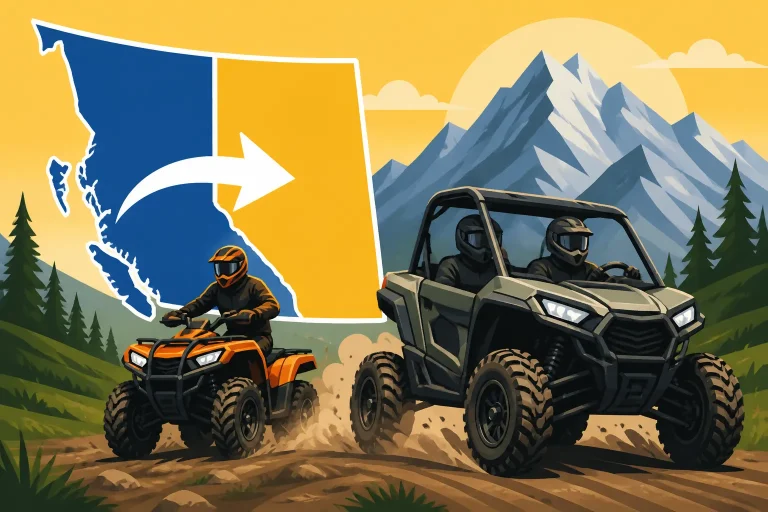
The tricky part is that “Eastern Slopes” is a broad regional description, not a guarantee that every trail, staging area, campground, or parcel of public land has the same requirements. The pass applies to designated areas, and land boundaries can be less obvious on the ground than they look on a regional map. Before leaving, check the current official public-land information and the details for the specific area where you plan to stay.
Some well-known riding regions are associated with the Eastern Slopes, including the Ghost and Livingstone areas and the Porcupine Hills. That does not mean every place within or near those regions has identical access rules. A developed campground, a random-camping area, a provincial park, private land, and a grazing lease can all have different rules, even if they are only a short ride apart. Start with Which Land the Eastern Slopes Camping Pass Covers and confirm your exact destination against current maps and notices.
A practical way to think about it is to separate three questions:
- Are you camping? The camping pass concerns eligible public-land camping, not simply riding.
- Is this a place where that pass applies? Check the specific land designation and current access information.
- Are you allowed to ride your machine there? Registration, insurance, trail or zone restrictions, and land access rules still matter.
The camping pass does not replace permission to use a trail or road. It does not open a closed route, make an undesignated trail legal, or give you permission to cross private land or a grazing lease. It also does not make every piece of public land available for random camping. Local restrictions, seasonal closures, environmental protection measures, and land-use rules still apply.
When a destination is close to the southern end of the Eastern Slopes, check the boundary rather than assuming it ends where the familiar riding area ends. The guide Down to Waterton Lakes can help you understand the southern reach of the camping-pass area, but use current official maps to confirm what applies to the specific site you have in mind.
The pass is for camping, not your quad
An OHV and a camping pass have different jobs. Your machine may need registration and insurance for riding on public land, while a camping pass may be required for an adult who is random camping in a covered area. One does not replace the other.
Alberta does not have a universal mandatory OHV trail pass that you buy in order to ride every public trail. That does not mean riding is unrestricted or free of requirements. A particular area may have its own rules, and you still need to establish that the route is open to your machine. For the separate machine requirements, see Alberta Has No OHV Trail Pass, Alberta Registration Before Riding Crown Land, and Alberta Requires Insurance on Public Land.
A camping pass also does not grant a right to camp at a managed campground that uses a reservation or fee system. Nor does it substitute for a permit an event organizer, commercial guide, or other operator may need. If you are organizing a group trip rather than simply camping with your own party, check Alberta Permits for an Event or a Guided Trip.
Who needs a pass and when
The pass is relevant when you plan to random camp on public land in an area where the requirement applies. It is not a general admission ticket for everyone who visits the Eastern Slopes.
If you are only riding in for the day, then returning home or staying in a hotel or other accommodation, you may not need a camping pass for that ride. If you set up a tent or otherwise camp on eligible public land, the camping rules become relevant. A rider who camps and a rider who goes home that evening can therefore have different pass requirements on the same trail system.
The pass requirement is based on people, not on the number of ATVs, tents, or campsites in your group. Plan for each adult who is required to hold a pass to have their own valid one. Do not assume that one pass covers a whole family, a group of friends, or every adult at a shared campsite. The details for children and other exceptions should be checked against current official guidance before travel; Do Alberta Kids Need a Camping Pass? addresses that question directly.
A pass is also not a substitute for carrying identification or for being able to explain where you are camping. Keep a record of your purchase and make sure the pass is valid for the dates and place of your trip. If you are buying shortly before you leave, do not assume that a payment receipt automatically answers every question about validity or proof. Check the confirmation and the current instructions for displaying or producing the pass.
| Your plan | Is the Eastern Slopes camping pass the main issue? | What else to check |
|---|---|---|
| Day ride, no overnight stay | Usually not, unless another specific requirement applies | Registration, insurance, open routes, and local access rules |
| Random camping on covered public land | Yes, check the pass requirement for each adult | Camping location limits, fire rules, closures, and land designation |
| Staying at a developed campground | Not necessarily; the campground may use separate rules | Reservations, campground fees, vehicle access, and local restrictions |
| Camping outside a covered area | The Eastern Slopes pass may not apply there | Rules for that land and any other pass or permit |
| Riding through a camping area without staying | The pass is not a riding permit | Trail access, machine requirements, and any site-specific rules |
| Visiting from another province or country | The pass question depends on camping, not your home registration | Visiting-rider registration, insurance, and residency requirements |
If you are visiting Alberta from elsewhere, do not confuse the camping pass with reciprocity rules for your vehicle. An out-of-province plate and insurance may be treated under separate rules, and the details can depend on how long you are in Alberta and where you ride. Start with Alberta Reciprocity for Visiting Riders and Alberta Visitors Under 30 Days if those situations apply. The camping pass does not validate your out-of-province registration, and valid registration does not waive a camping requirement.
People who ride with a group should make the plan explicit before the trip. Decide who is camping, where the group intends to camp, and who will be responsible for checking the current requirements. It is easy for one person to book or organize a trip while assuming that another person has checked the pass rules. A quick check before departure is less awkward than sorting it out in a staging area after the group has already arrived.
How to check your route before you leave
Do not rely on the name of a riding area alone. A ride may cross several land designations, and the place where you intend to camp may not be governed by the same rules as the trail you used to reach it. Check both the route and the overnight location.
- Choose the actual campsite or camping area. A general plan such as “somewhere in the Ghost” is not precise enough. Identify the area or node you plan to use, and have a backup if closures or conditions make it unavailable.
- Check the land designation. Confirm whether the spot is public land and whether the camping-pass requirement applies there. Do not infer that a place is open for random camping just because you can reach it by road.
- Check access for your machine. Confirm that the trail or road is open to your class of OHV. A route visible on an old map or a phone app is not proof that it is open now.
- Check current closures and restrictions. Seasonal closures, fire restrictions, weather damage, active work, and other notices can affect an otherwise familiar route.
- Confirm the pass rules and proof requirements. Use current official information for the pass type, validity period, purchase process, and what you need to show if asked.
- Save the information for offline use. Cell coverage can be unreliable in backcountry areas. Download current maps or save important information before driving out of service.
The official land-use information is the source to rely on for current boundaries and restrictions. A map or app is useful for planning, but it can be out of date or show a track without showing whether riding is permitted. Use Checking a Zone Before You Go and Alberta OHV Trail Map Downloads as starting points, then confirm notices for the specific area.
For a Ghost trip, for example, it is worth checking both the route and the camping location rather than treating the entire region as one open riding and camping area. Ghost PLUZ Camping Nodes in Alberta can help with the camping-node question, while Seasonal Closures in the Ghost is useful when planning around changing access. Do not let a familiar trail name stand in for a current access check.
The same approach applies in the Livingstone area and Porcupine Hills. Look for current land-use information, designated routes, and any closure notices, then verify that your intended camping location is allowed. If you are unsure whether a road, trail, or campsite is on public land, ask the relevant land manager or local office before relying on it. A gate, sign, or new closure notice on the ground should be taken seriously even if an older map shows the route.
Make the plan work without cell service
A backcountry trip is easier when you have the information before you reach the trailhead. Save maps to your phone for offline use and carry a backup plan for navigation. A paper map can be useful if a phone battery fails or a device is damaged. If you order a map sleeve or another protective item through Amazon, choose it for the map size and conditions you expect rather than assuming any waterproof-looking case will keep paper dry.
Keep a screenshot or saved confirmation of your pass purchase if that is accepted under the current instructions, and bring any additional proof the official guidance requires. A phone is convenient, but it is not a dependable sole storage method if it is wet, out of battery, or out of service. Some riders keep key trip details printed with their other documents; What to Show an Officer on Alberta Public Land and Alberta Digital Certificates Must Be Printed explain related document questions.
For a long day, also consider how you will manage navigation, fuel, and emergencies. An offline map helps with route-finding, but it does not tell you that a trail is open unless the map includes current information. A small waterproof pouch from Amazon can keep a paper copy of your route and emergency contacts readable, while a power bank can help keep a phone usable. These are convenience items, not substitutes for checking official access notices or carrying required documents.
What the pass does not allow
A camping pass is narrow in purpose. Treating it as an all-access permit is one of the easiest ways to misunderstand the rules.
It does not open trails
A valid pass does not authorize an ATV or UTV on every road, trail, cutline, or right-of-way. The area may restrict riding to designated routes, prohibit certain vehicle types, or close access for a season or emergency. Your route must be legal for your machine regardless of where you camp.
This is especially important when an app shows a line that looks like a trail. A mapped line may be an old road, an industrial route, a private access road, or a trail that is now closed. Check the current zone guide and route status. If the destination depends on crossing a lease road or private parcel, confirm the access rules instead of assuming that public-land camping makes the crossing permissible. See Do You Need Permission to Cross a Grazing Lease? and Alberta Private Land Permission for those separate issues.
It does not replace registration or insurance
The camping pass does not register your quad, provide liability coverage, or satisfy a request for proof of insurance. Those responsibilities remain separate. Before riding on public land, check that your machine meets the applicable registration and insurance requirements, and carry proof in the form required.
This applies to visiting riders too. A plate from home may be relevant to reciprocity, but it does not settle every Alberta requirement by itself. A camping pass cannot correct an expired registration or missing insurance. Review [Alberta Insurance Proof on Public Land] and How Long an Out-of-Province Plate Is Good For if you are unsure about your documents.
It does not guarantee a campsite
Having a pass does not reserve a site or guarantee that a particular area is available. It does not override camping limits, local restrictions, fire bans, closures, or requirements to use a designated camping node. It also does not necessarily cover developed sites that have their own booking or payment process.
Before travelling, check whether your intended camping area is open and whether you must use a specific location. Bring a backup plan that stays within the rules. If the first location is full, closed, muddy, or affected by a fire restriction, do not solve the problem by setting up wherever there is open ground.
It does not cover every fee or permit
A camping pass should not be confused with a conservation pass, a campground charge, an event permit, or an authorization for commercial activity. These may apply for different reasons and to different places. If you are driving a truck to a staging area, the vehicle’s parking requirements may be separate from what applies to the OHV itself. Check the relevant rules for the place where you park rather than assuming that one pass covers the entire trip.
Likewise, a guided ride, organized event, or commercial trip may require additional permissions that an individual camper does not need. Ask the operator or organizer what is included and what remains your responsibility. If you are the organizer, get the requirements confirmed before advertising the ride or collecting fees.
A practical checklist for an Eastern Slopes ride and camp
A little preparation prevents the most common mix-ups. Before you leave, use this checklist:
- Identify the exact riding area, trail route, and overnight location.
- Confirm whether the camping pass applies to that location.
- Confirm how many adults in your party need a pass.
- Buy the correct pass through the current official process and save the confirmation.
- Check whether the site is random camping, a designated node, or a managed campground.
- Verify that the route is currently open to your machine and vehicle class.
- Confirm your OHV registration and insurance are valid for the trip.
- Check seasonal restrictions, fire bans, and area closures.
- Save maps and notices for offline access.
- Carry the required documents and enough navigation backup to manage without cell service.
- Have a legal backup campsite in case your first choice is unavailable.
For the purchase itself, use the current official pass service rather than an old saved link or a third-party page that may not reflect current instructions. The process may require a Wildlife Identification Number, or WIN, before you can buy a pass. If you do not already have one, review Why You Need a Wildlife Identification Number First and check the current requirements before starting the purchase.
Keep your trip documents together. Depending on how you ride, that might mean your camping-pass confirmation, registration certificate, insurance proof, route map, and any permissions relevant to the area. A waterproof document pouch can make paper copies easier to carry; Amazon is one place riders may look for outdoor storage gear, but the important point is that the documents remain readable and accessible. If you use digital records, charge your phone in advance and keep a backup copy where it can be reached without a signal.
Finally, do not leave the campsite or trailhead without checking for last-minute changes. A route that was open when you planned the trip can be affected by weather, fire conditions, or a posted closure. If a sign or official notice conflicts with an old map, follow the current notice and choose another route. The pass helps satisfy a camping requirement; it is not a promise that every part of your planned trip will be available.
Disclaimer
This article is for general informational purposes only and does not constitute professional advice. Laws, prices and regulations vary by location and change over time. Consult a qualified professional for guidance on your specific situation.