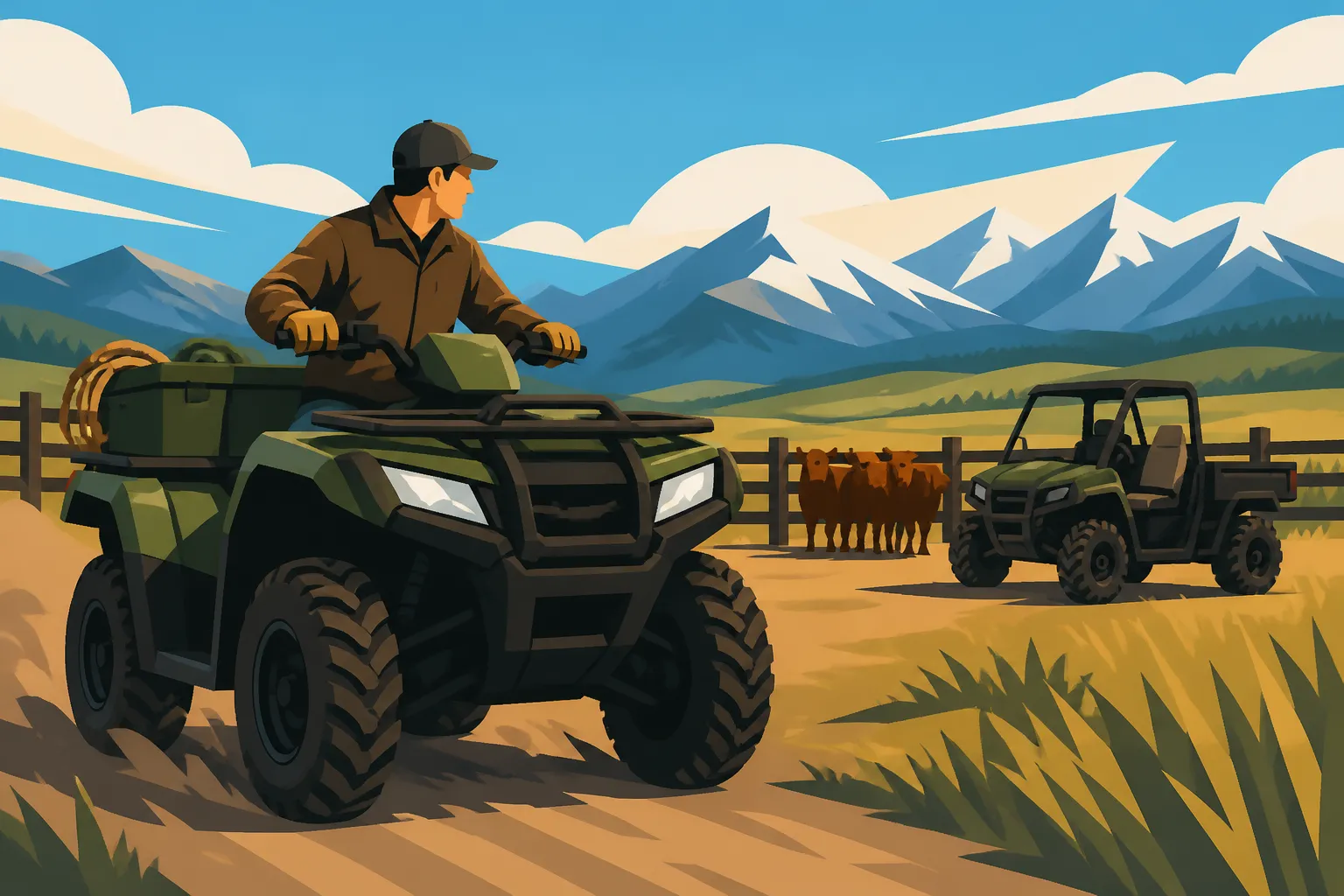
Occupational Work on a Ranch
If you're a rancher here in Alberta, you know your ATV or UTV isn't just a toy for weekend fun; it's an indispensable tool, the workhorse that helps you manage your land, check fences, move livestock, and get to those remote corners of your property. But when your day-to-day work takes you across a public road or down a short stretch of highway ditch to access another field, the rules around registration, helmets, and general legality can feel like navigating a legal minefield. This guide is here to untangle those rules and help you understand what's required when your occupational duties intersect with Alberta's off-highway vehicle (OHV) regulations.
The Unique Challenges of Ranch Work and OHVs in Alberta
Ranch life in Alberta is tough, rewarding, and often necessitates a practical approach to getting things done. Your off-highway vehicle is critical to that operation, but the very nature of ranching means you're frequently moving between your private property and small sections of public land or roads. This constant transition creates a grey area in the regulations that can be incredibly frustrating to interpret.
The Blurry Line Between Private and Public Land
One minute you're zipping across your pasture, no worries about plates or permits, and the next you need to cross a county road to reach the south quarter. Or perhaps a piece of your land is bisected by a public utility right-of-way, requiring you to briefly enter what the law considers "public land" just to keep your operation running smoothly. This isn't recreational riding; it's work, and the distinction is often lost in broad regulatory language. The frustration comes from knowing your intent is purely occupational, yet the rules seem to lump you in with recreational riders who might be out for a joyride. It creates a constant low-level anxiety about whether you're breaking the law simply by doing your job.
Imagine needing to check a far-flung fence line only accessible by a short stretch of gravel road that technically falls under a municipal jurisdiction. Or moving a small herd of cattle down a road allowance, with your UTV leading the way to keep them contained. In these scenarios, you're not trying to evade rules; you're simply trying to efficiently manage your ranch. Understanding these boundaries is key, as different rules kick in the moment your tires touch ground that isn't explicitly private.
Why Standard Road Rules Don't Always Fit Ranch Life
The typical rules for operating an OHV on public roads are designed for recreational use or specific designated trails. They often require full registration, insurance, and adherence to specific equipment standards. For a rancher, whose UTV might be equipped with special tools, a spray tank, or simply hauling feed, these rules can feel cumbersome and disconnected from reality.
Take the issue of speed, for example. Your UTV might be capable of higher speeds, but when you're checking cattle, you're crawling along, perhaps under 20 km/h. Yet, if you briefly enter a public road, the posted speed limit applies, and you're operating a vehicle not typically designed for road speeds, or even to blend with road traffic. The sheer practicality of moving heavy equipment, navigating uneven terrain, and dealing with livestock often means your occupational use deviates significantly from how a recreational rider might use their machine. This disconnect is why Alberta has developed specific exemptions, recognizing the unique operational needs of the agricultural sector. [What the Traffic Safety Act Requires of Alberta OHVs] offers a good overview of the broader context.
Alberta's Exemptions for Occupational Ranch Use
Thankfully, Alberta law recognizes that a quad or side-by-side on a working ranch isn't the same as one being trailered to a recreational area. There are specific exemptions designed to ease the burden on ranchers and farmers, acknowledging that these machines are vital for their livelihood. However, it's critical to understand the precise conditions under which these exemptions apply.
Understanding the "Farm Exemption" for OHV Registration
The most significant relief for ranchers is often the farm exemption regarding OHV registration. In Alberta, if your OHV is primarily used for farming or ranching operations, and it's operated exclusively on your own land or land leased by you, or for crossing a public highway or using a highway ditch to move from one part of your land to another, it may be exempt from the usual registration requirements. This is a huge benefit, as it means you don't need to go through the annual process of getting a plate and certificate for every single work machine. For more details, check out [Alberta's Farm Exemption From Registration].
It's vital to stress the "primarily used for farming or ranching" and "occupational purposes" aspects. This exemption is not a blanket pass to use your farm quad for recreational trail riding down the road without registration. If you're using it to run into town for groceries, or taking it out for a spin on designated OHV trails on a weekend, those would typically fall outside the scope of the farm exemption, and you would need to have it registered, plated, and insured like any other recreational OHV. The intent behind your use is paramount, and you should be able to clearly articulate how its operation on public land is directly related to your agricultural work.
When a Farm Exemption Applies to Helmets and Other Gear
Beyond registration, the question of helmets often comes up. While [Alberta Helmet Law on Public Land] generally requires helmets for all OHV riders on public land, there are specific exemptions for those engaged in farming or ranching operations. An individual who is working on a farm or ranch, operating an OHV in the course of that work, may be exempt from the helmet requirement. This is particularly relevant when you might be frequently dismounting to open gates, check equipment, or tend to animals, where a helmet could actually impede your work.
However, this exemption comes with a significant caveat: it generally applies only when the OHV is being used for the direct purpose of farming or ranching activities. If you're simply crossing a road, or riding in a ditch to get from one field to another, you might still be expected to wear a helmet, depending on the specific interpretation and local bylaws. It's always safest to wear a helmet when on any public land, even for short distances, unless you are absolutely certain of the exemption's application in your exact scenario. For other gear, such as working headlights and tail lights, or a functioning spark arrestor, these are generally still expected to be in good working order when operating an OHVs on public land, even if exempt from registration.
Navigating Public Roads as a Rancher with an OHV
While the farm exemption offers some relief, it's not a license to treat all public roads as an extension of your pasture. There are strict rules governing how and when you can use an OHV on public roads, particularly for occupational purposes. Misunderstanding these distinctions can lead to fines, or worse, dangerous situations.
The Critical Distinction: Crossing vs. Riding Down a Road
This is perhaps the most crucial point for ranchers. Alberta law generally differentiates between crossing a public highway and riding down a public highway. For occupational purposes related to farming or ranching, the law allows for a machine to cross a public highway or to use the ditch adjoining a highway to move from one part of your land to another. This is to facilitate access between parcels of land that might be separated by a public thoroughfare.
However, this is not an invitation to ride your OHV on the paved or gravel surface of the highway itself for any significant distance. The intent is to allow for practical movement between your own land. If you need to travel a kilometre down a road to get to another field, you need to check local municipal bylaws. Some municipalities have specific bylaws that permit limited travel on certain roads for agricultural purposes, but this is not universal. Always consult your specific county or municipal district's bylaws. [Alberta Rules for Riding a Ditch] provides more context on this often-misunderstood aspect of OHV use.
When you are crossing, do so with extreme caution. Yield to all road traffic, signal your intentions clearly, and ensure visibility. Just because you have a legal right to cross doesn't mean other drivers will be expecting an OHV. A heavy-duty UTV might be built tough, and SuperATV offers some robust suspension and axle upgrades that make them even more durable, but they're still no match for a full-sized truck at highway speeds.
Essential Safety Gear and Modifications for Public Road Use
Even if your OHV is exempt from registration for farm use, when it ventures onto a public road, certain safety standards apply. You are still expected to have working headlights and tail lights, even in broad daylight, to ensure visibility to other motorists. Brake lights are also crucial. Mirrors might be a good idea, though not always explicitly required for a brief crossing, they greatly enhance situational awareness.
Another critical piece of equipment is a visible orange safety flag, especially if you're crossing a hill or a blind spot. Consider adding reflective tape to your machine, particularly if you're out near dawn or dusk. While a factory muffler is usually sufficient, any modifications that make your exhaust excessively loud could lead to a ticket, regardless of your occupational use. While [Alberta Insurance Requirements on Public Land] states you need insurance, it's also true when merely crossing a road, as it's still considered public access. Your farm insurance policy might cover OHVs for occupational use, but it's essential to confirm this with your insurer and ensure you have proof of insurance on hand.
Best Practices for Ranchers: Staying Legal and Safe
Navigating the rules for OHVs on a ranch doesn't have to be a constant headache. By implementing a few best practices, you can ensure you're operating within the law, protecting your assets, and most importantly, keeping yourself and others safe.
Documenting Your Occupational Use
It might sound overly bureaucratic, but having clear documentation can save you a lot of trouble. If you're ever stopped by law enforcement while operating an unregistered OHV on public land under the farm exemption, being able to quickly demonstrate the occupational nature of your activity can make a huge difference.
- Proof of Land Ownership/Lease: Keep a copy of your land title or lease agreement in your truck or even a laminated copy on your OHV (securely, so it doesn't get lost or damaged). This proves you are operating on or between your own parcels.
- Farm/Ranch Business Documentation: Have something that identifies your operation as a legitimate farm or ranch business. This could be a business card, a livestock brand certificate, or a statement from an agricultural organization.
- Insurance Documents: Always carry proof of valid insurance that covers your OHV for occupational use, even if it's exempt from registration. A digital copy on your phone is usually acceptable, but a printed copy can be useful if you're in an area with no cell service. [Alberta Registration Paperwork Checklist] gives an idea of what general paperwork is often expected.
Having these items readily available shows due diligence and can help an officer quickly understand your situation, distinguishing you from someone trying to skirt the rules for recreational purposes.
Choosing the Right OHV for Ranch Work (and the Road)
When it comes to ranch work, the right machine can make all the difference. While the general rules apply to all OHVs, the type of machine you choose can impact your day-to-day operations and how easily it transitions between private and limited public use.
For many ranchers, a utility task vehicle (UTV) or side-by-side offers significant advantages due to its cargo capacity, seating, and often more stable ride. Brands like SuperATV specialize in aftermarket accessories that can enhance a UTV's utility even further, with options for robust cargo beds, heavy-duty suspension components, or even full cab enclosures for comfort in all weather. These kinds of upgrades are perfect for the demands of ranch life, where reliability and carrying capacity are paramount.
When making your selection, consider:
- Purpose-Built Utility: Does the machine have features specifically designed for work, like towing capacity, cargo space, and a durable chassis?
- Visibility: Can you easily add a safety flag, mirrors, and extra lighting if needed for brief road use?
- Maintenance: Is it easy to maintain, and are parts readily available? The last thing you need is a broken-down workhorse during calving season.
- Tires: While aggressive off-road tires are great for mud and snow, consider a tire that also handles well on gravel if you're frequently crossing roads. Some dual-sport ATV/UTV tires offer a good compromise.
Ultimately, whether you're working a small acreage or a vast cattle operation, understanding Alberta's OHV regulations for occupational use is crucial. It allows you to leverage your machines efficiently while staying on the right side of the law, keeping your focus where it belongs: on your ranch.
| Aspect | OHV Use on Private Ranch Land (Occupational) | OHV Use on Public Roads/Ditches (Occupational Exemption) |
|---|---|---|
| Registration | Not required | Exempt if primarily for farm/ranch work & limited use |
| Plate | Not required | Not required if exempt from registration |
| Insurance | Recommended (usually covered by farm policy) | Required (even if exempt from registration) |
| Helmet | Recommended | Exemptions may apply while working, otherwise recommended/required |
| Lights | As needed for visibility | Required (headlights, tail lights, brake lights in working order) |
| Spark Arrestor | Recommended (fire prevention) | Required |
| Muffler Noise | Rancher's discretion | Must not be excessively loud (stock usually acceptable) |
| Driver's Licence | Not required | Not required for the OHV itself (but recommended to carry general ID) |
| Speed Limits | Rancher's discretion | Posted road limits apply (or operate safely for conditions) |
| Bylaw Compliance | N/A | Critical – local bylaws may add requirements or restrictions |
Disclaimer
This article is for general informational purposes only and does not constitute professional advice. Laws, prices and regulations vary by location and change over time. Consult a qualified professional for guidance on your specific situation.