Down to Waterton Lakes
Alberta’s Eastern Slopes camping pass area reaches south to Waterton Lakes, but that does not mean the pass covers every place along the route. If you’re planning an ATV or UTV trip, the key is separating permission to camp on public land from permission to ride—and checking which land rules apply at your destination.
What “down to Waterton Lakes” means
The Eastern Slopes are a broad region along the eastern side of the Rocky Mountains. Alberta’s Public Lands Camping Pass applies to eligible public-land camping within a defined area of that region, which extends south to the Waterton area. The phrase describes the pass area’s general north-to-south reach; it is not a boundary line that makes every nearby parcel or recreation site subject to the same rules.
That distinction matters on an ATV or UTV trip. A route may pass through or beside public land, a provincial park, a national park, a designated campground, private land or a municipal area. Each can have different rules for camping and motorized access. Being within the broader Eastern Slopes region does not automatically mean you can camp wherever you find a flat spot, or ride every road and trail you see.
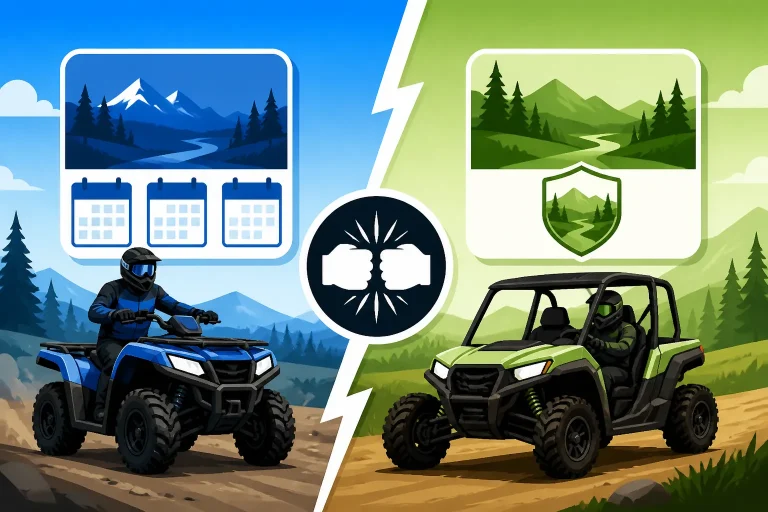
The public lands camping pass is about camping on eligible public land. It is not an OHV trail pass, machine registration, insurance or permission to ride. You may need to meet separate requirements for the machine and for the location where you intend to operate it. For a broader overview of the pass, see Alberta’s Public Lands Camping Pass. For the geographic distinction, Which Land the Eastern Slopes Camping Pass Covers is also relevant.
A useful way to think about the southern reach is as a planning signal, not a blanket authorization: if your trip includes camping on public land in the Eastern Slopes, check the official map and rules for your exact site. A place described as “near Waterton” might be inside the pass area, outside it, or subject to a different land manager’s rules.
What the pass does and does not cover
The pass is connected to camping on specified public land, not simply to travelling through the region. If you are riding for the day and not camping on public land, the camping pass may not be the requirement you need to focus on. You still need to check riding access, registration, insurance, equipment and any local restrictions that apply to your route.
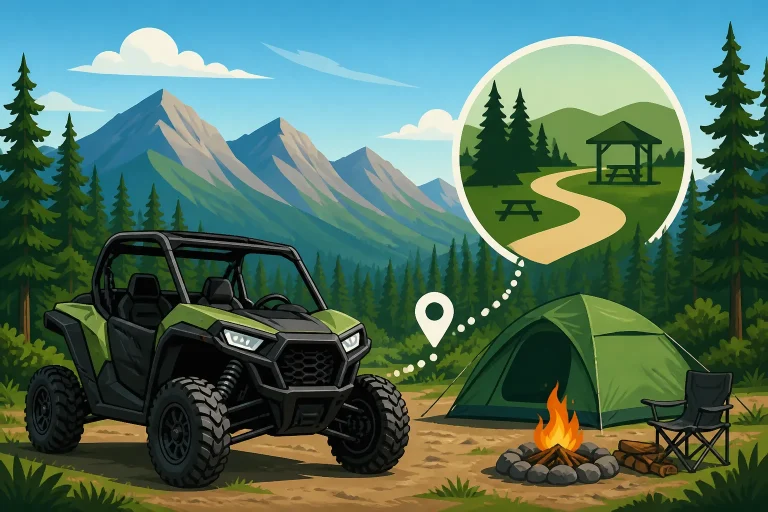
If you are camping, identify the type of site before you decide whether the pass applies. A designated campground may have its own booking or fee arrangements. Random camping on public land is a different situation, and the pass rules may apply there. Do not assume a site is exempt just because it is near a road, a staging area or a familiar recreation destination. Check the specific location and current guidance.
| Situation | What to check |
|---|---|
| Day ride with no public-land camping | Riding access, machine registration, insurance and local rules |
| Camping at a designated campground | The campground’s operator, fees and reservation requirements |
| Random camping on public land | Whether the site is in the pass area and whether each camper needs a pass |
| Camping near Waterton Lakes | The exact land boundary and whether the site is managed as public land, park land or another land type |
| Riding inside a park or protected area | The area’s motorized-access rules; a camping pass does not grant riding permission |
The pass also does not replace OHV registration or insurance. Before riding public land, confirm what is required for your machine and carry the relevant documents. Alberta Registration Before Riding Crown Land explains why registration is a separate question, while Alberta Insurance Requirements on Public Land covers the insurance issue.
For the same reason, do not treat a camping pass as proof that a trail is open. Public-land access can depend on designated routes, seasonal closures, land-use rules and temporary restrictions. Check your riding area separately using Alberta OHV Trails: Riding Public Land and the applicable area information.
A visit to Waterton Lakes is not a single land-use situation
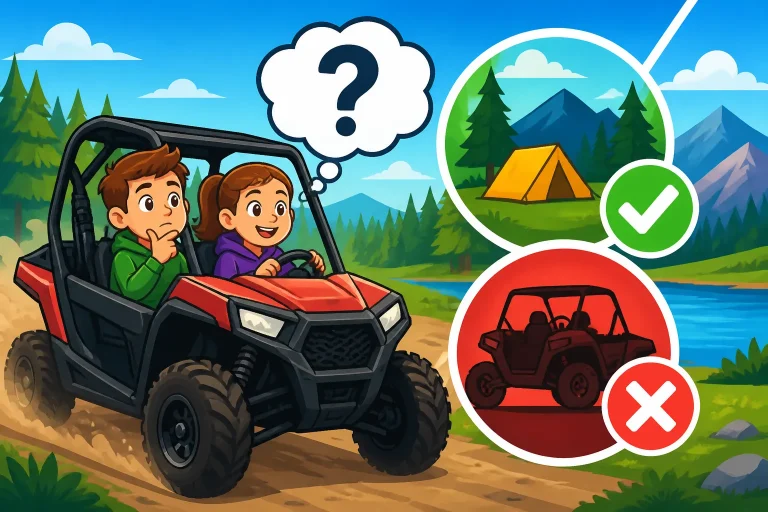
“Waterton Lakes” can refer to the townsite, nearby public lands, surrounding communities or Waterton Lakes National Park. Those places do not share one set of rules. A public lands camping pass should not be taken as permission to camp or ride inside the national park. Park boundaries and restrictions matter, and motorized recreation rules in a park can differ sharply from those on nearby public land.
Likewise, being close to a provincial park does not mean the pass covers camping inside it or allows an ATV or UTV on park trails. Check the rules for the named destination, not just the region shown on a broad travel map. Alberta Provincial Park Rules for Machines is a useful starting point when a route or campsite is near a provincial park.
Planning an ATV or UTV trip to the southern Eastern Slopes
Start with the place where you intend to camp, then plan the ride around verified access. This avoids a common planning mistake: choosing a trail first and assuming the nearby land will provide a legal camping spot.
- Pin down the campsite. Record the site’s location and determine who manages the land. A map label, social media post or general reference to “the Waterton area” may not tell you whether the site is on public land, in a campground or inside a protected area.
- Check whether the pass applies there. Use the current official map and pass information. The broad reach of the Eastern Slopes area is not enough to confirm the status of a specific campsite.
- Check camping rules separately. Confirm whether camping is allowed at the location and whether restrictions apply. If you plan to random camp, review Alberta Random Camping Rules Explained and Alberta Camping Distance From Facilities.
- Verify the riding route. Find out which routes are open to your type of machine. A public-land camping pass does not open a closed trail, authorize travel across private land or grant access through a gate.
- Prepare for document checks. Carry the required registration and proof of insurance for your machine. If you are visiting from outside Alberta, check the rules for visiting riders rather than assuming that a camping pass covers machine requirements.
- Recheck before departure. Closures, fire restrictions and access conditions can change. Review current notices for both the campsite and the riding area shortly before the trip.
The trip may also involve more than one kind of pass. For example, a conservation pass can apply to a separate destination or activity, while the public lands camping pass concerns eligible camping. One does not automatically replace the other. If your plans include Kananaskis, review Alberta Kananaskis Conservation Pass Rules rather than assuming the Eastern Slopes camping pass handles every access charge.
Visitors from another province should make two checks: whether their machine can be ridden under Alberta’s visitor rules, and whether their camping plan requires the public lands pass. Residency does not turn a camping pass into vehicle registration, and an out-of-province plate does not settle the camping question. Alberta Reciprocity for Visiting Riders can help with the first part of that planning.
A practical checklist before you go
The south end of the Eastern Slopes can make an appealing base for a longer trip, but the right paperwork depends on what you will actually do. A day ride, campground stay and random-camping trip may each involve different rules. Treat them as separate decisions rather than expecting a single pass to cover the whole outing.
Before leaving, confirm the following:
- The campsite’s exact location and land manager.
- Whether the campsite is within the public lands camping pass area.
- Whether camping is permitted at that specific site and what other camping limits apply.
- Whether your planned trails or roads allow your type of ATV or UTV.
- That your machine meets Alberta’s registration, insurance and equipment requirements for the land where you plan to ride.
- Whether any fire, weather, wildlife or seasonal restrictions affect your route.
- That you have access to current maps and can use them offline where cell service is unreliable.
If you are comparing pass options, check the current terms before buying; the available options and their costs can change. Alberta Camping Pass Cost and Alberta Three-Day Pass vs Annual Pass can help frame that decision, but neither changes where you may camp or ride.
The simplest takeaway is this: “down to Waterton Lakes” describes the broad southern reach of the Eastern Slopes camping-pass area, not a universal permission slip. Confirm the exact campsite, check the separate riding rules, and do not assume the pass covers a nearby park or trail.
Disclaimer
This article is for general informational purposes only and does not constitute professional advice. Laws, prices and regulations vary by location and change over time. Consult a qualified professional for guidance on your specific situation.