Thirty Days as a Visitor
A short Alberta ride can turn into a paperwork problem if your visit lasts longer than planned. The key threshold is 30 consecutive days: visitors who stay beyond it must follow Alberta’s registration and licensing requirements. Here’s how to think through the cutoff, what to carry while visiting, and what to do if your stay will run longer.
How Alberta’s 30-day rule works for visitors
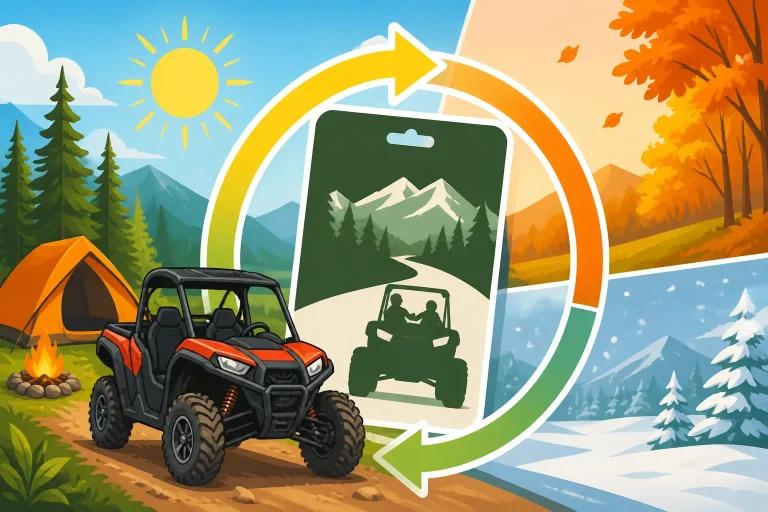
According to the Government of Alberta, an out-of-province visitor staying in Alberta for more than 30 consecutive days must follow Alberta’s registration and licensing requirements. The rule applies to the length of the visitor’s stay, not just the number of days spent riding.
That distinction matters if you are bringing a quad or side-by-side for a holiday, a work assignment, or an extended visit with family. A change of plans can take a trip past the visitor threshold, so it is sensible to consider the likely duration before unloading your machine.
The phrase “more than 30 consecutive days” is the important part. A stay of 30 consecutive days is not more than 30, but a longer stay crosses the threshold. If you expect to leave Alberta and return, don’t assume that a brief trip across the border resets the clock. Ask the relevant Alberta authority how your circumstances are treated before relying on a reset.
| Your situation | What to keep in mind |
|---|---|
| Visiting for 30 consecutive days or less | Carry proof of residency and be prepared to show that your machine’s registration and insurance are valid. Confirm that your home-province documents are suitable for the vehicle and the riding you plan to do. |
| Staying in Alberta for more than 30 consecutive days | The Government of Alberta says you must follow Alberta’s registration and licensing requirements. Check the process before the visitor threshold passes. |
| Unsure how your dates will be counted | Contact an official source and explain your arrival, departure, and return plans rather than relying on an assumption about the clock. |
The visitor rule is not permission to ride anywhere. Registration, insurance, equipment, land access, and local restrictions still matter. A machine that is acceptable for a short visit can still be unsuitable for a particular trail or public-land area.
For the broader visitor rules, see Alberta Registration for Visiting Riders. If you are planning around the time limit, Alberta’s 30-Day Rule for Out-of-Province Machines and Thirty Consecutive Days and the Clock cover the same issue from a paperwork and timing perspective.
What to carry and check before you ride
Start with proof that you are a visitor. The Government of Alberta says out-of-province visitors must carry proof of residency. Keep a document that supports your home address with you, and make sure the name and address are consistent with your other vehicle papers where possible. For examples of what to prepare, see Alberta Proof of Residency for Visitors.
You should also be ready to show that the machine is registered and insured. According to the Government of Alberta, OHVs must be registered and insured, and an enforcement officer can request valid proof of insurance from an out-of-province visitor. The government also states that every OHV or road-legal vehicle used for off-road travel must have valid insurance and registration. Check that your home policy and registration are current and that they cover the kind of riding you intend to do in Alberta.
It helps to carry documents where you can reach them without searching through luggage or a phone with no signal. Before leaving home, check that the registration identifies the right machine and that your insurance documents are legible. If your proof is digital, consider whether you can access it when reception is poor and keep an available offline copy if your insurer or registration authority permits it.
Confirm that the machine meets Alberta’s equipment requirements, too. The Government of Alberta says OHVs must display a valid licence plate in a visible location, have working head and tail lights, and have a proper muffler and spark arrestor. A modified exhaust that increases noise can create a problem even if the machine is properly registered at home.
A practical pre-ride check includes:
- Registration: Confirm that the registration is valid for the machine and that you can show it if asked.
- Insurance: Confirm coverage for Alberta and for off-road use; carry proof that can be produced on request.
- Plate: Make sure the plate is valid and visible, and is not hidden by a rack, mud, or cargo.
- Lights: Check that the headlight and taillight work.
- Exhaust: Check that the muffler and spark arrestor are in place and have not been altered to increase noise.
- Residency proof: Carry evidence of your out-of-province residence.
For details about insurance checks on public land, Alberta Insurance Requirements on Public Land explains why proof matters beyond the registration question. If you are bringing a machine from a neighbouring province, the relevant paperwork can differ by origin; see Alberta Registration for a Machine From BC or Alberta Registration for a Machine From Saskatchewan.
The word “OHV” covers more than a quad. Under the Alberta Traffic Safety Act, the Government of Alberta’s definition includes quads, side-by-sides, off-road motorcycles, snowmobiles, dune buggies, and amphibious crafts. If your vehicle is an unusual build or is not clearly described as an ATV, verify how Alberta classifies it rather than assuming the visitor rule does not apply.
Helmet and age rules are separate from the 30-day registration threshold. The Government of Alberta requires riders on public land to wear a Canadian Standards Association-compliant helmet. It also says riders under the age of 14 must be under the direct supervision of an adult. A visitor’s home-province rules do not replace Alberta’s rules for riding in Alberta.
If your Alberta stay will go beyond 30 consecutive days
If you already know you will stay longer than 30 consecutive days, treat Alberta registration and licensing as a task to handle before the threshold passes. The Government of Alberta says visitors who stay longer must follow those requirements. Don’t wait until a roadside check to find out whether your existing documents are enough.
Begin by contacting an Alberta registry agent or checking the government’s current instructions for out-of-province machines. Ask what documents are needed for your specific vehicle and ownership situation. The process can depend on the machine’s paperwork, so have its current registration and identification details available when you ask. Do not assume an ATV needs the same inspection as a passenger vehicle: according to the Government of Alberta, OHVs such as ATVs and snowmobiles do not require an out-of-province inspection.
Once you know what is required, make a plan for the transition. If documents are missing, ownership details are unclear, or the machine is registered to someone else, resolve those questions early. A useful starting point is Alberta Registry Agents and OHV Paperwork. For a step-by-step overview of the Alberta process, see How to Register an ATV in Alberta.
Alberta registration is not simply a matter of obtaining a plate and forgetting the rest. According to the Government of Alberta, passenger, motorcycle, and off-highway vehicle registrations are issued for a duration of one to two years. Alberta Registries says OHV registration products can be renewed online, but check the current eligibility and process before relying on online renewal for your situation.
If you register or renew online, pay attention to the certificate itself. Alberta Registries says digital vehicle registration certificates are available in My Account for 365 days after purchase. It also says a printed copy of the digital registration download is required once renewed. The initial digital download is available only between 6:00 am and 10:00 pm, according to Alberta Registries. Plan ahead so you are not trying to retrieve or print a certificate at the trailhead.
Plate details can also cause avoidable confusion. Alberta Registries says licence plate expiry stickers are no longer required. That does not remove the requirement to display a valid plate, so check that your plate is still valid and mounted where it can be seen. Alberta Issues a Plate, Not a Sticker explains the plate-and-sticker distinction.
Do not overlook insurance while changing registration. Registration does not itself prove that a policy covers your machine or the way you use it. Confirm the insurance remains active and that you can produce proof. If an officer asks, the Government of Alberta requires out-of-province visitors to provide valid proof of insurance.
Finally, registration is only one part of legal riding. Public land access and trail rules still apply. Alberta requires riders to follow designated routes where applicable, and provincial trails have their own use rules. Before setting out, check the area’s current trail information and any closures. On public land, the Government of Alberta sets a speed limit of 20 km/h in a public land recreation area or on a public land recreation trail unless otherwise posted. The same government source says off-trail public-land riders must be at least 14 years old unless closely supervised by an adult aged 18 or older.
A simple plan for a low-stress visit
Before the trip, decide how long you expect to stay and make a note of your arrival date. If your plans could extend past 30 consecutive days, contact an Alberta registry agent early to ask what applies to your machine. Confirm with your insurer that coverage is valid for your Alberta riding plans.
Before your first ride, check the documents and the machine together. Carry proof of residency, registration, and insurance. Check the visible plate, lights, muffler, and spark arrestor. Bring a compliant helmet for public-land riding, and check local access rules for the place you intend to ride.
If your plans change, reassess the registration question as soon as it becomes clear that the stay will last longer. Keep records of any advice you receive and follow up if the circumstances change. The important point is not to treat the visitor threshold as a substitute for the other rules: valid documents, insurance, equipment, helmets, and permission to use a route all matter.
For visitors, the simplest approach is to confirm the rules before the trip, keep evidence of your home residency and coverage with you, and arrange Alberta registration and licensing if you will stay beyond the permitted visitor period. That avoids relying on an assumption when your plans or riding location change.
Sources
- Alberta Registries — Renew Off-Highway Vehicle Registration (checked November 3, 2026)
- Government of Alberta — Motorized recreation on public land | Alberta.ca (checked November 3, 2026)
- Alberta government — Off-highway vehicle helmet law | Alberta.ca (checked November 3, 2026)
- Government of Alberta — McLean Creek Off-Highway Vehicle PLUZ | Alberta.ca (checked November 3, 2026)
- Alberta.ca — Port obligatoire du casque pour les véhicules hors route | Alberta.ca (checked November 3, 2026)
Disclaimer
This article is for general informational purposes only and does not constitute professional advice. Laws, prices and regulations vary by location and change over time. Consult a qualified professional for guidance on your specific situation.