Alberta Camping Away From Recreation Areas
Camping away from Alberta recreation areas can mean a quieter trip, but it does not mean you can pitch anywhere that looks empty. The right site depends on land designation, access rules, camping-pass requirements and distance limits. Here’s how to check the rules before hauling your ATV or UTV into the backcountry—and how to avoid treating a camping pass as permission to ride anywhere.
What camping away from a recreation area means
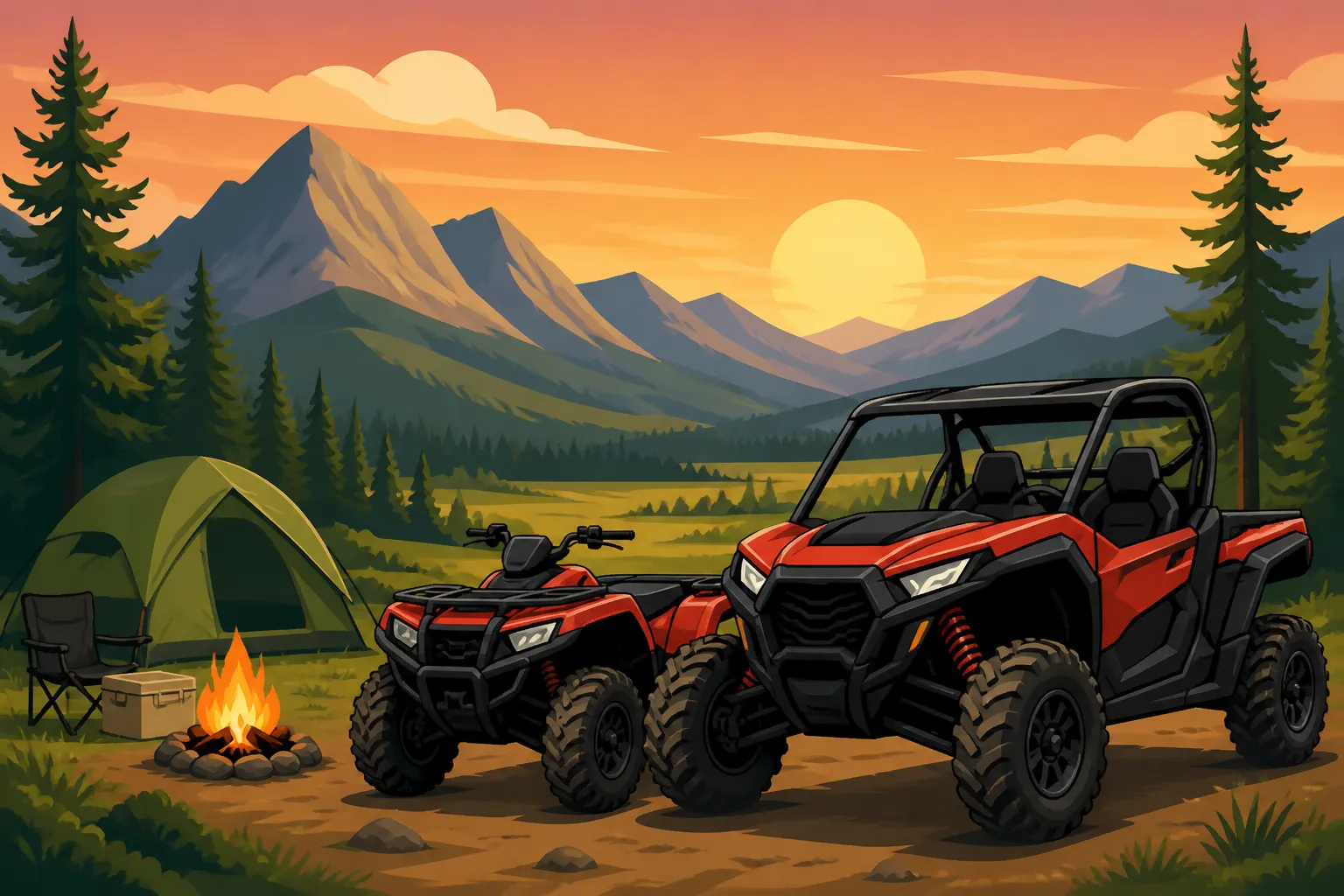
In Alberta, camping away from a developed recreation area is often called random camping or public-land camping. It generally means staying on eligible public land outside a designated campground or recreation area, rather than booking a site with services. It can offer more space and a less structured stay, but the freedom comes with more responsibility: you need to confirm the land is open, find a legal campsite and follow the rules that apply there.
“Public land” is not one uniform kind of land. A place may be public but still have restrictions on camping, motorized access, fires or the routes you can use. Land-use zones, closures, active work and local conditions can change what is allowed. A track on a map, an old campsite or an empty clearing is not proof that camping or OHV use is permitted.
The key distinction is between a recreation area and a suitable spot for camping outside one. A recreation area may include a campground, staging area or other managed facility. Camping rules can require you to stay a set distance away from these facilities if you are random camping. That distance is not a suggestion about where you might find a quieter view; it is a location rule to check before setting up.
A few common arrangements are easy to confuse:
| Camping arrangement | What it generally means | What to check |
|---|---|---|
| Designated campground | A managed site with designated camping spaces, which may have services or fees | Reservations, site rules, vehicle access, fire restrictions and whether your OHV can be used on nearby routes |
| Random camping on eligible public land | Camping outside a designated campground or recreation area where public-land rules allow it | Land status, distance from recreation areas, pass requirements, stay limits, closures and fire rules |
| Private campground or private land | Camping on land operated by a business or owned by a private party | The operator’s terms, permission, access arrangements and local rules |
Do not assume that “away from a recreation area” means “outside every restriction.” Some places are closed to camping, have specific camping locations, or permit camping but restrict motorized travel. Other areas may have temporary closures or conditions that affect access. Check the current land map and rules for the exact spot, not just the general region. [Alberta Random Camping Rules Explained] covers the broader picture of where random camping may be allowed.
Check the location, pass and OHV access separately
A useful way to plan is to treat camping permission, camping-pass requirements and OHV access as three separate questions. A “yes” to one does not answer the other two.
First, identify the land you intend to use. Confirm that camping is allowed there and whether the area is subject to specific restrictions. Then check whether a Public Lands Camping Pass is required for camping on that land. The pass applies to camping where required; it is not a general permit for every public-land activity, and it does not make an otherwise prohibited campsite legal. For an overview, see Alberta’s Public Lands Camping Pass.
Pass requirements depend on where you camp, not simply on whether you are a resident or visitor, what machine you brought, or whether the trip is short. The Eastern Slopes and other designated areas are important to check, but do not rely on a broad regional label to decide whether your specific site is covered. Use current official information to match the campsite to the pass rules. If a pass is required, confirm who in your camping party needs one and what identification or account information is needed to obtain it. How to Buy an Alberta Camping Pass explains the purchase process.
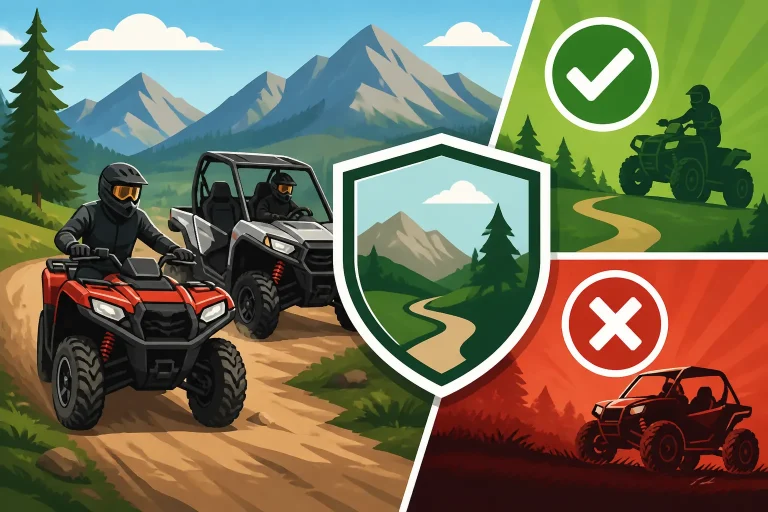
Next, check the access route for your machine. A camping pass does not register an ATV or UTV, provide insurance, or authorize riding on closed or undesignated routes. It also does not replace any required paperwork or equipment. Public-land riding has its own requirements, including rules about where motorized vehicles may travel. See Alberta OHV Trails: Riding Public Land for the distinction between camping access and riding access.
That separation matters when you are planning a camp-and-ride trip. You might be allowed to camp in a particular area but not ride your machine across every nearby road, cutline or meadow. Conversely, a legal riding route does not necessarily give you permission to camp beside it. Make sure both the campsite and your proposed route are allowed.
Before leaving home, gather the answers in one place:
- What is the land designation? Look up the specific location and check for closures, restrictions or special rules.
- Is camping allowed at the proposed spot? Confirm this independently of motorized access.
- Is a camping pass required? Check current coverage and the requirement for each adult in your party.
- How will you get there? Confirm that the access road or trail is open to your type of machine and that the route is legal.
- What rules apply on site? Check distance, duration, fire, waste and any seasonal limits.
- What is your backup plan? Choose another legal site or a designated campground in case the first location is unsuitable or closed.
When a rule or boundary is unclear, stop and verify it before setting up. A pin on a phone, a paper map or another camper’s advice can help you find the area, but none of those replaces checking the current rules.
Respect the distance and stay limits
Camping away from a recreation area is subject to location limits. A common requirement is to camp at least one kilometre from a recreation area or designated facility when random camping. The exact rule and what counts as the relevant recreation area should be checked for the location you plan to use. Do not measure from the edge of a visible parking lot by guesswork if the boundary or reference point is unclear. Alberta Camping Near a Recreation Area focuses on this distance question.
A distance rule can be easy to overlook because a campsite may look remote while still being close to a managed facility. A quiet patch of trees just beyond the staging lot, for example, is not automatically far enough away. Check the mapped location, use reliable distance tools and leave a margin rather than trying to camp right at the minimum. If you cannot confidently establish that the spot meets the requirement, choose another site.
Stay limits matter too. Public-land camping rules commonly limit how long you can remain at one location. Alberta’s rules include a 14-day limit in relevant circumstances; check how the limit applies to your site and dates. Do not assume that moving a tent a short distance within the same clearing resets the clock. The details of the time limit and required move are explained in Alberta’s 14-Day Camping Limit.
Where a relocation rule applies, moving a minimum distance may not be the only condition. You may also need to stay away from the original location for a specified period before returning. Confirm the current requirement rather than treating “move camp” as a quick trip to another spot nearby. Alberta’s 1-Kilometre Relocation Rule explains why moving the minimum distance and staying away long enough are separate parts of the rule.
Keep a simple record of your arrival and departure dates, and note the location where you camped. This is especially useful on a multi-stop trip or if several vehicles in your group arrive and leave on different days. It also helps you plan ahead instead of discovering a stay limit when you are ready to extend the trip.
A group should plan around the most restrictive rule that applies to its site and members. If some campers are staying longer, or if a second group joins later, their presence does not necessarily restart the allowed stay for everyone. Be accurate about when the camp began and avoid using a nearby move as a way to occupy the same small area indefinitely.
Distance and stay limits are not the only reasons a site may be unsuitable. A location may be too close to a facility, a road, a work site or another restricted area, or it may be subject to a temporary closure. Confirm all relevant boundaries before unloading the machine. If the map does not answer the question, choose a clearly permitted location or contact the responsible authority for clarification.
Set up camp with your machine in mind
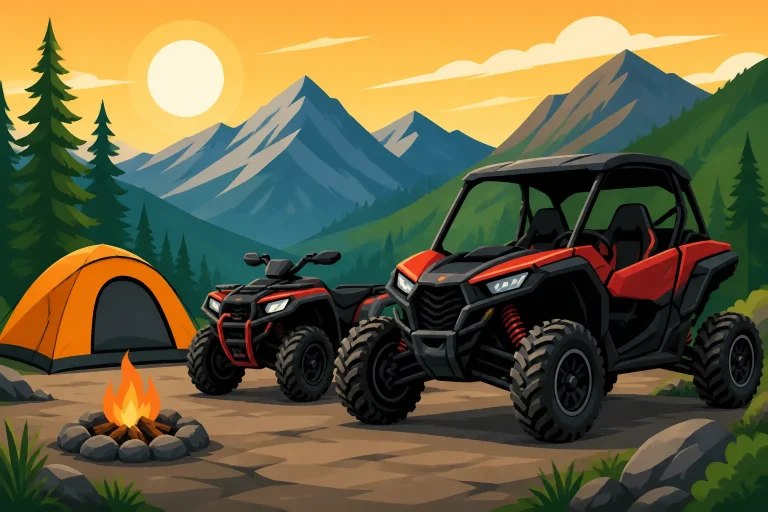
An ATV or UTV makes a remote campsite easier to reach, but it can also make it easier to cause damage. The best camp is not simply the one with the easiest trail access. Look for a durable, previously disturbed surface where camping is permitted, and avoid creating new tracks or widening an existing one to get closer to a tent site.
Keep vehicles, trailers and gear within the area where motorized access is allowed. Do not drive over wet ground, sensitive vegetation, stream banks or other fragile surfaces just to find a flat parking spot. If the site is muddy or the machine is leaving deep ruts, back out using the same route if safe and find a more durable place. The fact that a tire can cross an area does not mean the area can take repeated traffic without damage.
A practical camp-and-ride setup includes a plan for both the machine and the campsite:
- Park on firm, durable ground without blocking a trail, road, gate or access point.
- Keep the machine away from water edges and fragile ground.
- Secure loose equipment and food so it does not blow away or attract wildlife.
- Carry out packaging, food scraps and other waste rather than leaving them for the next visitor.
- Use established fire facilities only when fires are permitted, and follow any restrictions in effect.
- Keep the route into camp as short and low-impact as possible.
- Do not cut live trees or gather materials unless the rules clearly allow it.
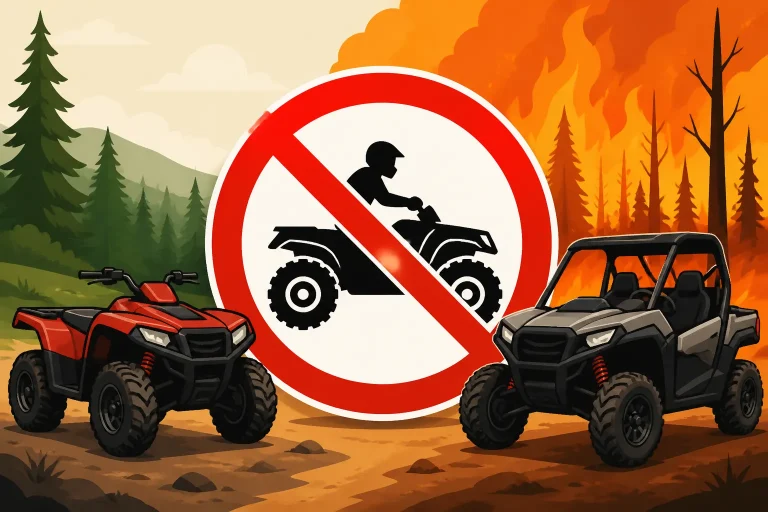
Fire rules deserve a separate check every time you go. Conditions can change quickly, and a fire that was allowed when you planned the trip may be prohibited by the time you arrive. A campsite, fire ring or pile of ash left by someone else is not proof that a fire is currently permitted. Confirm restrictions for the location and date, and follow the rules for extinguishing a fire completely. Alberta Fire Ban Lookups can help you check for restrictions before travelling.
Waste planning is part of choosing a remote site. There may not be toilets, garbage bins or water taps where you camp. Bring containers that can keep food waste and rubbish secured, and take everything you bring back out. If the site lacks a suitable way to manage human waste, plan for an appropriate alternative rather than assuming the next camper or a nearby facility will handle it.
A remote camp also needs a realistic safety plan. Mobile service may be weak or unavailable. Tell someone where you expect to go and when you expect to return, carry navigation that works offline, and bring enough water, warm clothing and basic repair supplies for the conditions. For an OHV trip, plan for a machine issue that could prevent you from riding back to camp. Do not let a plan to carry camping gear become a reason to overload a machine beyond the manufacturer’s limits.
If you need to buy a small item for the trip, such as a waterproof pouch to keep documents and a phone dry, Amazon is one possible source; make sure the item suits the conditions and is secure on the ride. Whatever you bring, keep essential documents accessible and protect them from rain, mud and fuel.
A good remote campsite should leave little evidence that anyone stayed there. If it is not possible to camp without driving over sensitive ground, cutting a new path or leaving waste behind, it is the wrong site.
Plan the trip before you leave the staging area
The more remote the camp, the harder it can be to fix a planning mistake after arrival. Spend time checking the location before loading the trailer, then do a final check at the staging area. This is not just about paperwork; it is a way to avoid finding out that a site is closed, the machine route is not permitted or the camp is too close to a recreation area after you have already hauled everything in.
Use this sequence:
- Choose a specific camping area. Avoid planning around a vague destination such as “somewhere near the trail.” Identify a primary site and one or more alternatives that are also legal.
- Check the map and current notices. Confirm land designation, closures, camping restrictions and motorized access. A trail map can show routes, but it may not answer every camping question.
- Confirm the distance. Check the required separation from recreation areas or other listed facilities. If boundaries are uncertain, choose a location with a clear margin.
- Check the pass requirement. Match the site to the current coverage and arrange any required pass before the trip. Keep proof accessible.
- Plan the stay length. Record when the camp begins and set a departure or relocation plan that meets the current limit.
- Check fires and weather. Verify fire restrictions close to departure and be prepared to avoid a fire even if conditions change after you arrive.
- Confirm the OHV route. Make sure the machine can legally travel from the staging area to the campsite and on the trails you plan to ride.
- Pack for self-sufficiency. Bring navigation, water, food storage, basic first aid, tools and a way to communicate or get help if service is absent.
- Leave a trip plan. Tell someone your route and expected return time, and update them if the plan changes.
- Reassess on arrival. If the site is occupied, damaged, closed or obviously unsuitable, do not force the plan. Move to a verified alternative or use a designated campground.
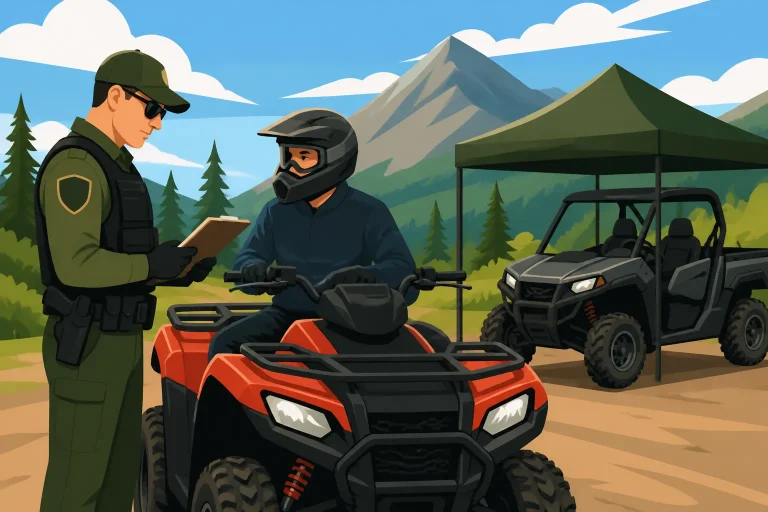
At the staging area, take a moment to check your documents and equipment before riding. Keep the camping-pass proof available where relevant, and carry the registration and insurance documents required for the machine. An officer may ask for documents or check equipment during a public-land trip; What to Show an Officer on Alberta Public Land is useful preparation. The campsite itself does not exempt an OHV from registration, insurance or equipment rules.
Be considerate of people using the same area. Keep noise down around other camps, avoid riding through a campsite and do not assume a nearby trail is open because another rider is using it. Leave gates as you found them, stay on permitted routes and give wildlife room. If a trail or road is closed, do not use it as a shortcut to the campsite.
The best backup is one you have checked in advance. If your primary location is too close to a recreation area, has a fire restriction that changes your plans, or is inaccessible because of a closure, a confirmed alternative can save the trip. Do not rely on arriving late and searching for a legal site in the dark.
Common mistakes and better alternatives
The most common mistake is treating distance from a recreation area as a matter of convenience. A camper may see empty ground beyond a parking area and assume it is fair game. Instead, use the applicable definition and distance rule, check the boundaries and choose a spot that clearly meets the requirement.
Another frequent error is assuming that a camping pass covers the whole trip. It does not answer whether a particular patch of land is open to camping, whether your machine can ride there, or whether a route is designated for motorized use. Keep the three checks—camping permission, pass coverage and OHV access—separate.
It is also easy to rely on old information. A site that was open on a previous visit may now have a closure, seasonal restriction or changed access. A trail map downloaded months ago may not show a current notice. Check current official information close to departure and again if signs at the site indicate a restriction.
Do not assume that an old fire ring makes a fire legal, that a clearing is a designated campsite, or that a lack of signs means there are no rules. Signs are helpful, but they may not mark every boundary or restriction. If you cannot confirm permission, do not set up there.
Some riders plan the trail first and think about camping only after reaching the area. That approach can leave the group with no legal campsite within riding distance, especially if a recreation area is full or a nearby location is restricted. Choose the camp and the riding routes together, and make sure the route between them is permitted.
A designated campground may be the simpler choice when you need services, want a known campsite or cannot confidently confirm that random camping is allowed at your preferred location. It can also make sense for families or groups that want a predictable setup. Compare campground rules and availability with the work of locating and managing a remote camp; the less structured option is not always the easier one.
If your plans depend on a particular remote site, verify it before departure and have a fallback. For a group ride, make sure every driver understands the route, camp location and rules rather than relying on one person to lead. That is particularly important when the group is split among machines or includes riders who may not have travelled in the area before.
The goal is not to avoid remote camping. It is to choose a place where camping is allowed, stay the required distance from managed areas, follow time limits and leave the land in good condition. A little planning protects access for the next trip and makes the camp more relaxing once you get there.
Frequently Asked Questions
Can I camp just outside a recreation area?
Not automatically. Random camping may require a specified distance from a recreation area or facility, and the land must also be open to camping. Check the current rule and map for the exact location before setting up.
Does a Public Lands Camping Pass let me ride my ATV or UTV anywhere nearby?
No. A camping pass addresses camping where it is required. It does not authorize travel on closed or undesignated routes, replace machine paperwork or make a restricted campsite legal.
How long can I stay at one random campsite?
A stay limit applies, and Alberta’s rules include a 14-day limit in relevant circumstances. Confirm how the rule applies to your location and whether a required move must meet additional distance or timing conditions.
Can I have a campfire at a remote campsite?
Only when fires are allowed at that location and there is no applicable fire restriction. Check current notices before travelling and again on arrival. An existing fire ring does not establish that a fire is permitted.
Disclaimer
This article is for general informational purposes only and does not constitute professional advice. Laws, prices and regulations vary by location and change over time. Consult a qualified professional for guidance on your specific situation.