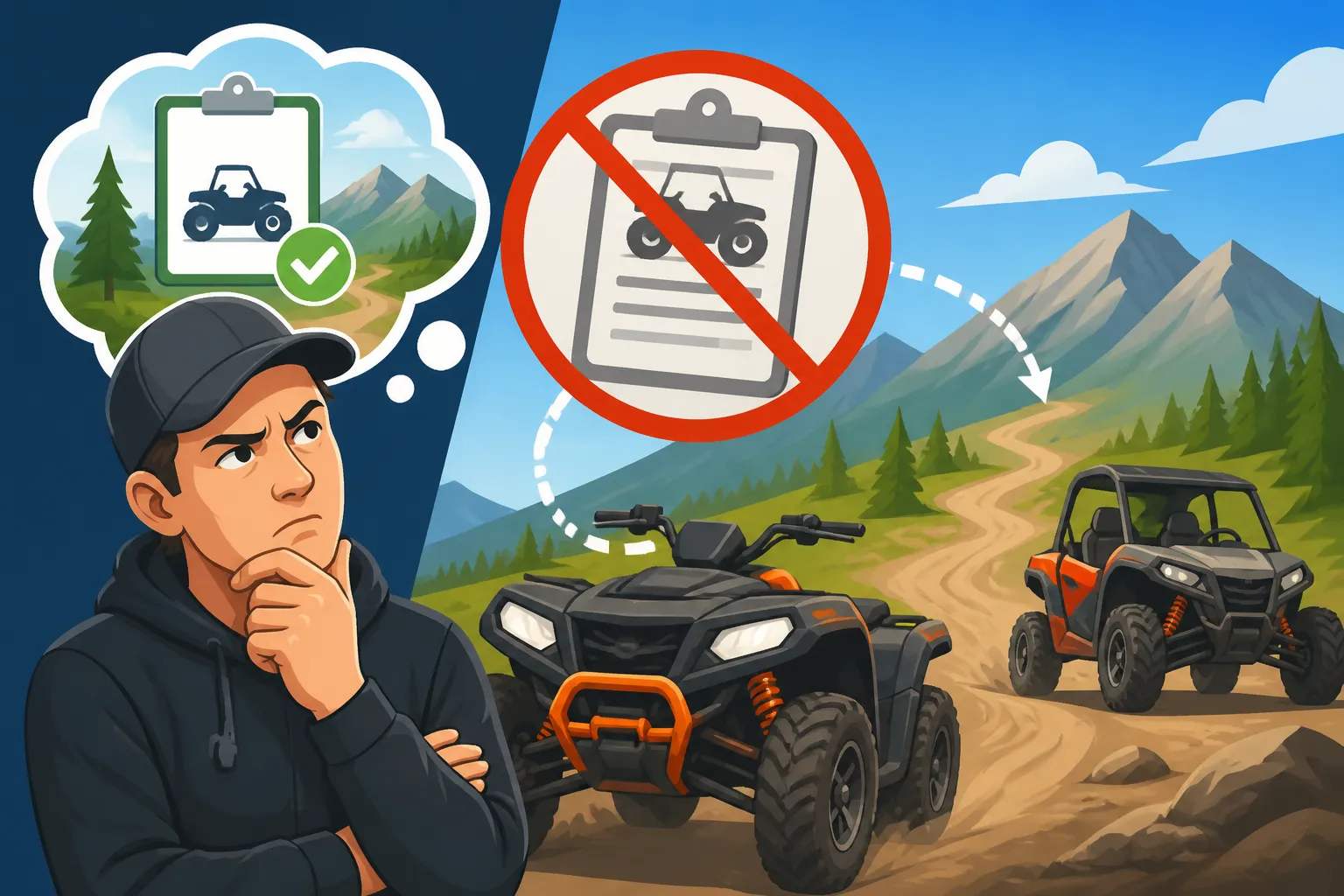
Why Alberta’s Promised OHV Trail Permit Never Arrived
Alberta riders may have heard that an off-highway vehicle trail permit was coming, then found no permit to buy. The gap between a proposed funding idea and a rule that actually takes effect can be confusing. Here’s what happened in practical terms, what Alberta requires instead, and how to check that your next ride is legal.
What the promised OHV trail permit was meant to do
The proposed permit was discussed as a way to raise money for off-highway vehicle trails and their upkeep. The basic idea was straightforward: riders would pay for a permit, and the proceeds would help support trail work, management or related services.
That idea did not become a province-wide permit requirement for recreational OHV riding. Alberta does not have a general OHV trail pass that every rider must purchase to use public trails. A proposal, announcement or policy discussion is not the same as a law or an operating program. To create a requirement riders must follow, the province would need to establish the program and put its rules into effect. That did not happen for the promised general trail permit.
The title can make it sound as if a permit was guaranteed and then simply delayed. A more useful way to understand the outcome is that Alberta considered a trail-funding approach but did not implement it as a mandatory permit system. The plan was reversed, and trail support has relied on other funding and management arrangements. Alberta’s Reversed Trail Permit Plan explains that shift, while Why Trail Funding Comes From Grants looks at the funding approach that riders encounter instead.
This distinction matters because riders sometimes hear “permit” and assume that a new charge applies whenever they unload a quad or side-by-side. That is not the case. A general OHV trail permit is different from machine registration, insurance, a camping pass, an event permit or permission to access particular land. Each has a separate purpose and may apply in different circumstances.
There is also no single provincial permit that guarantees access to every public trail. A trail may be open, restricted to designated routes, seasonally closed or unavailable to OHVs. Those decisions depend on the area and its current rules, not on whether a rider has bought a universal trail pass. What Makes an Area a Designated OHV Zone helps explain why checking the riding area is still essential.
| What riders may mean by “permit” | What it covers | Is it the proposed general trail permit? |
|---|---|---|
| OHV registration | The machine’s registration status under Alberta requirements | No |
| Insurance | Required coverage in situations where Alberta rules require it | No |
| Public Lands Camping Pass | Camping on applicable public land | No |
| Event or commercial permit | Certain organized or paid activities, where required | No |
| Local access permission | Use of land or routes where permission is needed | No |
| General OHV trail permit | A province-wide pass for recreational trail riding | This program was not implemented |
The practical takeaway is simple: don’t search for a general Alberta OHV trail permit as if it were an outstanding step before every ride. Instead, work through the requirements that actually apply to your machine, the land and the activity you have planned.
Why Alberta did not end up with a universal permit
A permit can sound like a tidy solution to trail funding: collect money from riders, then direct it toward the places they use. But setting up a province-wide system involves more than deciding that trails need support. Someone has to define who must pay, what a permit covers, how the proceeds are allocated, how compliance is checked and what happens when a trail or riding area is managed by different organizations.
Those are policy and administration choices, not details a rider can assume from the word “permit.” A proposed funding tool may be revised, replaced or set aside before it becomes an enforceable requirement. In this case, Alberta did not establish a universal OHV trail pass that riders must show to access public trails. The absence of that system does not mean trail maintenance is unnecessary or that no money is being spent on trails. It means the funding and management approach is not based on a mandatory province-wide permit for every recreational rider.
Trail work can involve route planning, signs, drainage, maintenance, volunteer effort, safety information and coordination with land managers. Those needs vary across the province. A single permit system would also have to account for different kinds of OHVs and different riding areas, including places with designated routes, seasonal restrictions or other site-specific rules. A fee by itself would not settle questions about where riding is allowed or who is responsible for maintaining a route.
Alberta’s alternative has included grant support and partnerships with clubs and trail organizations. That arrangement can support projects without requiring every rider to hold a general trail pass. It also means funding may depend on program decisions, applications and the organizations involved. Riders should not assume that all areas receive the same level of investment or that a grant-funded trail is automatically open in every season. AOHVA and Alberta Trail Management offers more context on the role of trail organizations, and Alberta Trail Funding for Clubs is relevant to how club work can be supported.
There are trade-offs either way. A universal pass could create a more direct connection between riding and trail revenue, but it would need administration, enforcement and a clear way to distribute funds. Grants and partnerships avoid making a general pass mandatory, but funding can be less visible to an individual rider and may not cover every local need. Neither approach removes the need to manage access carefully.
It is also worth separating a broad public-land policy question from individual access decisions. Even if a trail has been built or maintained with public funding, a land manager can still close it, restrict use or direct riders to designated routes. A permit would not necessarily override those controls. Conversely, the fact that Alberta has no general trail pass does not make public land open to unrestricted riding.
The best practical reading is not that Alberta has promised a pass that riders are somehow failing to find. It is that a proposed permit-based approach did not become the province’s operating requirement. When planning a ride, use current area information rather than relying on old coverage of a proposed program or assumptions drawn from another province.
What Alberta riders still need to check
No general trail permit does not mean there are no legal requirements. Several separate checks may matter before a ride, and which ones apply depends on where you will ride, what you will do and whether you are a resident or visitor.
Registration and insurance
Registration and insurance are not trail permits. They relate to the machine and the legal conditions for using it. Alberta requirements can apply when riding on public land, even though there is no province-wide trail pass. Check the rules for your machine and riding location before setting out. Alberta Registration Before Riding Crown Land and Alberta Insurance Requirements on Public Land cover two important parts of that preparation.
Do not treat a receipt, an old registration document or a permit from another jurisdiction as automatic proof that your machine meets Alberta requirements. Visiting riders should check how their home registration and insurance apply in Alberta, and newcomers should confirm when they need to register locally. Paperwork and eligibility can depend on the machine and the rider’s circumstances.
Camping passes
Alberta’s Public Lands Camping Pass is a separate program. It relates to camping on the public lands covered by its rules; it is not an OHV trail pass and does not authorize riding on a closed route. A rider who plans to camp may need to check camping requirements even when the ride itself does not involve a general trail permit. For details, see Alberta’s Public Lands Camping Pass and Alberta Has No OHV Trail Pass.
This distinction is easy to miss because a ride and an overnight camp often happen on the same trip. Think of them as two separate questions: “May I ride this route?” and “May I camp here, and what camping requirements apply?” A pass for one activity should not be assumed to grant permission for the other.
Land access and closures
Check where the route goes and who manages it. Public land can have designated routes, closures, seasonal restrictions and area-specific conditions. Private land and some other lands may require permission. A staging area, mapped line or worn track is not, by itself, proof that OHVs are allowed there.
Use current information for the specific area, and pay attention to notices on site. If maps, signs and online information appear inconsistent, do not assume that the least restrictive interpretation is correct. Confirm the applicable rules with the responsible land manager before riding. Checking a Zone Before You Go is a useful starting point for understanding why the area check matters.
A riding group should also agree on the route and restrictions before leaving the staging area. If one rider has an outdated map or assumes a route is open because it was used on a previous trip, the whole group can end up in the wrong place. Closures and access arrangements can change; yesterday’s ride is not a substitute for checking today’s conditions.
How to plan a ride without a trail pass
Use a short pre-ride routine rather than looking for a pass that does not exist. The goal is to confirm the machine is ready, the group is allowed to use the route, and any separate camping or activity rules have been handled.
- Name the riding area. Identify the actual zone, trail system or land you plan to use. “Somewhere on public land” is too broad to check reliably.
- Confirm current access. Check whether OHVs may use the area and whether riding is limited to designated trails, closed seasonally or affected by a temporary notice.
- Check machine requirements. Verify registration, insurance and any equipment rules that apply to your machine and location. Keep required documents available.
- Separate riding from camping. If you intend to stay overnight, check the camping rules and pass requirements independently. Do not treat a camping pass as trail authorization.
- Confirm special activity rules. Organized events, commercial guiding and other activities may have separate requirements. A recreational rider’s ordinary preparation may not cover them.
- Recheck before departure. Conditions can change after a plan is made. Confirm there are no new closures or restrictions, and make sure the group knows the route and access boundaries.
This process is more useful than asking only, “Do I need a trail permit?” That question has a clear answer for the proposed general pass, but it does not settle whether a specific ride is lawful. A properly registered machine can still be in the wrong place; a pass for camping does not open a closed trail; and a mapped route does not necessarily confer access.
A few common situations show why the distinctions matter:
- Day ride on public land: There may be no general OHV trail pass to buy, but registration, insurance, equipment and area-access rules may still apply.
- Ride with an overnight camp: Check both the riding rules and the camping-pass rules. They do not replace each other.
- Visit from outside Alberta: Confirm that your home registration and insurance meet the rules for your visit, and check any visitor-specific time limits or requirements.
- Organized group event: Ask whether the organizer needs an event authorization or other approval. A general recreational ride and an organized event are not automatically treated alike.
- Route crossing different land types: Check permissions and restrictions along the whole route, not just at the staging area.
Keep a record of the information you relied on, especially if you are coordinating a group. A saved map or screenshot may help you navigate where cell service is poor, but it does not override a closure or replace current official information. If signs at the site indicate a restriction, treat them seriously and resolve any uncertainty before proceeding.
The lack of a universal pass can make planning feel less straightforward because riders do not have one purchase that appears to cover everything. The upside is that riders are not paying a general trail-pass fee as a condition of every recreational ride. The trade-off is that responsibility sits with the rider to verify the separate requirements and local access rules.
Common misunderstandings about the cancelled plan
The proposed permit continues to cause confusion because the words “trail permit,” “registration” and “pass” can sound interchangeable. They are not.
“If Alberta has no trail permit, OHVs can ride anywhere on public land.”
No. Access depends on the rules for the specific area, including designated routes, closures and seasonal restrictions. Public ownership does not mean unrestricted OHV access.
“My registration is the trail permit.”
No. Registration is a machine-related requirement. It does not guarantee that a particular trail is open or that all other obligations have been met.
“The camping pass covers my trail riding.”
No. The Public Lands Camping Pass concerns camping where its requirements apply. It is not authorization to operate an OHV on a route.
“A trail organization’s work means I can use every trail it maintains.”
Not necessarily. Trail work and access authority are separate matters. Follow the current rules for the land and route, even when a trail has been maintained by a club or partner.
“The permit was announced, so I must still find somewhere to buy it.”
No. A proposal or policy plan is not a requirement unless a program is actually established and its rules take effect. The general permit discussed for Alberta OHV riding did not become a mandatory province-wide pass.
“There’s no permit fee, so there are no other costs.”
That conclusion does not follow. Riders may still have costs related to registration, insurance, fuel, transport, camping or a specific activity. For named providers and services, current charges can change, so check the relevant provider or official source.
The safest way to describe the situation is precise: Alberta’s proposed general trail permit did not arrive as a mandatory permit for recreational OHV riding. That answers the permit question, but it does not answer every question about a particular trip. Use current area rules and check each separate requirement rather than treating the absence of one pass as blanket permission.
Frequently Asked Questions
Does Alberta require an OHV trail permit?
Alberta does not have a general province-wide OHV trail permit that every recreational rider must buy to use public trails. Other requirements, including registration, insurance or area-specific access rules, may still apply.
Why was the permit never introduced?
The permit-based approach was proposed as a way to support trails but was not implemented as a mandatory province-wide program. Alberta’s trail support has used other arrangements, including grants and partnerships.
Does the Public Lands Camping Pass replace a trail permit?
No. The camping pass concerns camping on applicable public land. It does not authorize OHV riding or replace machine requirements and trail-access rules.
Could a specific trail or event still require permission?
Yes. A particular area, organized event, commercial activity or land-access situation can have separate conditions. Check the rules with the responsible land manager or organizer before riding.
Disclaimer
This article is for general informational purposes only and does not constitute professional advice. Laws, prices and regulations vary by location and change over time. Consult a qualified professional for guidance on your specific situation.