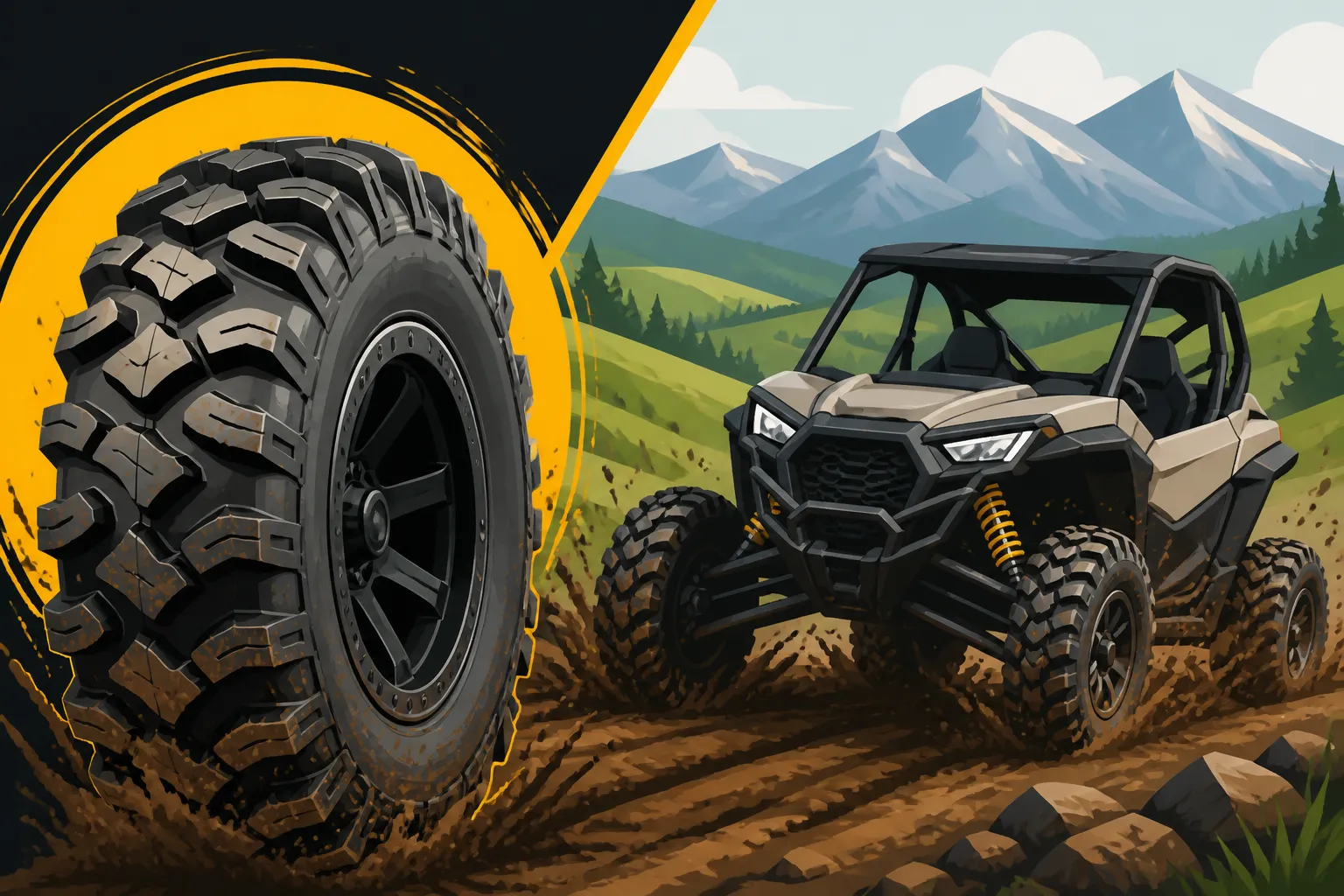
Tires for Foothills Mud
Soft foothills mud can turn a fun Alberta ride into a frustrating cycle of spinning tires, packed tread and repeated winching. The right ATV or UTV tires help you keep moving, but aggressive tread alone is not the answer. This guide explains how to choose tires for muddy foothills terrain, protect your machine and ride without chewing up trails.
What Makes Foothills Mud Hard on ATV and UTV Tires
Mud changes from one section to the next
A foothills ride may begin on dry gravel, cross a slick clay patch, then drop into a wet rut beneath the trees. That variety is why a tire that performs beautifully in deep mud can feel harsh, noisy or unpredictable on firmer ground. A tire choice is always a compromise between traction, steering, ride comfort and the surfaces you actually encounter.
Clay is especially frustrating because it can coat the tire and fill the spaces between tread lugs. Once the tread is packed, the tire may spin without clearing itself. Wet roots and rocks create a different problem: the tire needs to find grip without sliding sideways, and aggressive lugs cannot make a slippery surface safe.
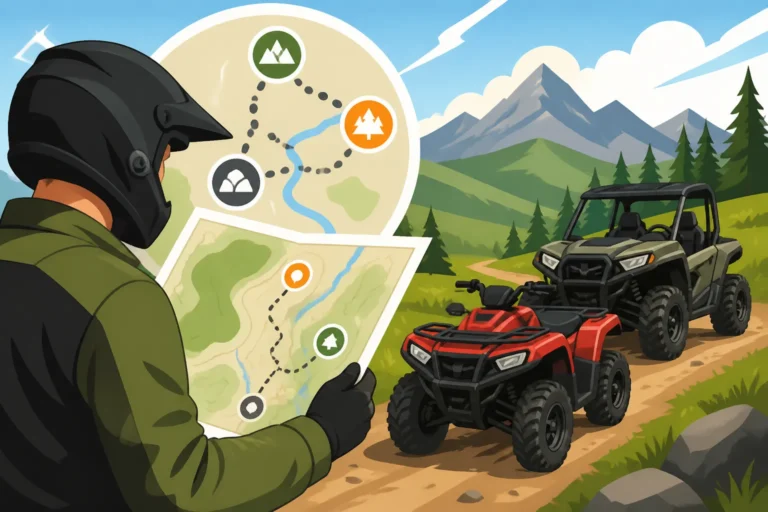
If you’re planning a route around McLean Creek or another foothills riding area, look beyond the word “mud” when considering conditions. Rain, recent trail traffic, drainage, elevation and the time of year all affect how a route feels. Check trail information before heading out, and use a map such as onX Offroad to help you understand the route and keep track of your position. Mapping helps with orientation; it doesn’t replace checking current closures or local rules.
Tread design matters more than an aggressive appearance
Mud tires often have widely spaced, pronounced lugs designed to bite into soft ground and release mud as the tire rotates. The open spaces between lugs give mud somewhere to go, while the lug edges help the tire find purchase. On a machine that regularly encounters deep, sticky sections, that self-cleaning ability may be more useful than simply choosing the tallest tread.
But bigger lugs are not automatically better for every Alberta ride. A very aggressive tire can make steering feel heavy, increase vibration on hardpack and add stress to parts of the drivetrain. It can also dig into soft trails more readily, which may worsen ruts and make the route harder for everyone behind you. If your usual rides involve a mix of mud, gravel and firm trail, a versatile all-terrain or intermediate tire may be a more comfortable choice.
| Tire style | Where it can help | Trade-offs to consider |
|---|---|---|
| All-terrain | Mixed hardpack, gravel and occasional mud | May struggle when deep mud packs into the tread |
| Intermediate or mud-capable trail tire | Varied foothills conditions with regular wet sections | Less specialized than a dedicated mud tire |
| Aggressive mud tire | Deep, soft mud where tread can clear itself | Can feel rougher on firm ground and may dig up trails |
| Stock tire | General riding, especially before you know your needs | May not suit repeated deep-mud use or a heavily loaded machine |
Think about the whole ride, not the single worst mud hole you’ve seen online. A dedicated mud setup can be worthwhile if deep mud is a regular part of your riding, but it can be an expensive and tiring choice if most of your route is firm trail.
Match the tire to your machine and riding habits
A tire that works on a light ATV may not behave the same way on a heavier side-by-side carrying passengers, tools and camping gear. Machine weight, tire size, suspension, power and the way you use the throttle all influence traction. Before buying, check the tire and vehicle manufacturers’ fitment guidance, including the permitted size and load suitability.
It’s also worth asking how often you ride in mud and what happens after the trail dries out. If you ride only a few muddy weekends each season, changing tires may not be the best first move. Better route choices, steady throttle and knowing when to turn around can make a bigger difference than a dramatic tread pattern.
For route planning, onX Offroad can be useful for reviewing your planned ride and keeping your location visible when landmarks are hard to recognize. Save the relevant map information before leaving reliable service, and carry a backup plan. A phone can lose power, get wet or become difficult to use with gloves on, so don’t make it your only navigation tool.
Choosing Tires Without Creating New Problems
Check fitment before you shop
Start by noting the size printed on your current tires and checking your owner’s manual. Don’t assume that a tire that physically fits will work well with your ATV or UTV. A different diameter or width can affect clearance, handling and how the machine responds, while an unsuitable load rating may be a poor match for a heavier machine or a full cargo rack.
Ask the dealer or tire specialist specific questions: Is this tire approved for my machine? Will it clear the bodywork and suspension through their full range of movement? Does the tire change affect the machine’s handling or recommended operating setup? If a tire is intended for a different use, such as racing or specialized deep mud, confirm that it makes sense for ordinary trail riding.
It can help to take a photo of your existing tire markings and the machine’s model information before you shop. That small step avoids the familiar situation of reaching the counter and realizing you’re not certain which size is on the vehicle.
Consider sidewalls, construction and ride comfort
Tire construction affects how the tire responds to bumps and obstacles. Broadly, riders often compare bias-ply and radial designs, but neither is automatically right for every machine or route. The right option depends on the tire’s intended use, the manufacturer’s recommendations and what matters most to you: durability, comfort, steering feel or performance in soft terrain.
A stiffer or more aggressive setup may seem appealing if you often ride through rough ground, but comfort matters on a long day. A machine that feels harsh or wanders on firmer trail can make the ride tiring, particularly for passengers in a side-by-side. If possible, ask experienced local riders about how a particular tire behaves on the surfaces you actually ride, rather than relying only on photos or a product description.
Remember that traction has limits. Even a tire designed for mud can slide on wet roots, steep side slopes or smooth rock. Keep your speed conservative where conditions are uncertain, use smooth inputs and avoid assuming that a more aggressive tread makes a difficult line safe.
Be cautious with tire pressure changes
It’s tempting to lower tire pressure to gain traction, but there is no universal pressure that works for every ATV or UTV tire. The correct operating pressure depends on the tire, machine, load and manufacturer guidance. Too little pressure can increase the risk of tire damage, bead problems or poor handling; too much can reduce the tire’s ability to conform to uneven ground.
Use the vehicle and tire makers’ instructions as your starting point, and don’t treat another rider’s preferred setup as a rule. A lightly loaded ATV and a fully occupied UTV do not necessarily need the same setup. If you make an adjustment, understand how to measure it accurately and recheck the tire before riding.
A practical approach is to begin with the recommended setup, then pay attention to how the machine behaves in safe, familiar conditions. Make one change at a time, keep notes and stop if steering, stability or tire shape seems wrong. Carrying a gauge and a way to restore pressure can help, but neither replaces knowing the limits of your equipment.
Riding Through Mud Without Getting Stuck or Damaging Trails
Use steady momentum and avoid sudden inputs
When you reach a muddy stretch, slow down enough to assess it before committing. Look for a firm route through, check whether the mud hides a rut or obstruction and notice where water is flowing. If the section looks deeper or less stable than expected, backing out and choosing a safer route is often smarter than testing your machine’s limits.
When the line is manageable, use controlled, steady throttle rather than a sudden burst of power. Spinning tires can dig a hole quickly, and once the machine is belly-deep, extra throttle may only make recovery harder. Keep your body balanced, steer smoothly and avoid abrupt braking or sharp turns on slick ground.
If you ride with a group, leave enough space that the person ahead can clear the section before you enter it. That gives you a better view of the track and avoids crowding someone who needs to stop or change direction. Before a ride, it’s also useful to review Alberta Trail Etiquette Locals Expect and check for conditions that could make a route unsafe.
Protect the trail as well as your machine
A deep rut may look like a harmless challenge, but repeated tire spinning can widen it, erode its edges and make the route more difficult for other users. If your tires are digging in, pause and reconsider rather than powering through. Choose a more durable line where permitted, or turn around if the trail is deteriorating.
Stay on legal, designated routes and avoid creating new tracks around a muddy section. Riding around a wet spot can damage vegetation and expand the affected area. Route planning matters here: use onX Offroad or another mapping tool to review your intended route, but verify local land-use rules and closures before riding. A line visible on a screen is not necessarily open to OHVs.
For broader planning, Alberta OHV Trails: Riding Public Land and Alberta’s Public Land Use Zones Explained can help you think through where riding is permitted. Conditions and access restrictions can vary by area, so confirm the rules for the specific place you plan to visit rather than assuming that a familiar route is open.
Know when to use a winch or turn around
If you stop making progress, ease off the throttle before the tires dig deeper. Check whether the machine is hung up on the frame, whether the tires are packed with mud, and whether there is a safe recovery direction. Avoid standing in line with a loaded winch cable, and follow the machine and winch manufacturers’ instructions when recovering a vehicle.
Not every stuck machine should be winched forward. A steep, unstable or obstructed route can turn a simple recovery into a more serious problem. If you’re riding with others, agree on a recovery plan before the ride and carry suitable equipment. A winch is useful only when the anchor point, cable path and people nearby are all managed safely.
A route that has become too wet for your tires or experience level is a reasonable place to turn around. Check Alberta Trail Closures After a Storm before setting out, and keep an eye on changing weather while you ride. A shorter day is a much better outcome than damaging the machine, the trail or someone’s safety.
A Practical Tire and Trail Plan for Alberta Rides
Before buying, answer these questions
Start with the rides you actually do. Are you mostly on gravel and hardpack, with a few wet patches, or do you regularly encounter deep mud? Do you ride alone, with passengers or with cargo? Is a rougher ride acceptable if it improves traction in your most common conditions? Clear answers make it easier to avoid buying a tire that looks impressive but doesn’t suit your use.
Then confirm fitment and manufacturer guidance. Compare tire styles, but keep the trade-offs in view: aggressive lugs may help in soft mud while feeling less pleasant on hard surfaces and potentially causing more trail disturbance. If your machine’s stock tires are in good condition, try improving your route selection and riding technique before replacing them.
Finally, check the entire setup, not just the tread. Inspect tires for damage, confirm they’re appropriate for the load and make sure your recovery gear is ready. A well-chosen tire helps, but it cannot compensate for a poor route choice, a worn tire or an overloaded machine.
Build a simple pre-ride routine
A little preparation can prevent the day from being derailed by a preventable problem:
- Check the route, local rules and closures before leaving.
- Review recent weather and consider whether the trail may be too wet.
- Inspect tire condition, pressure and fitment according to manufacturer guidance.
- Pack recovery gear, a tire gauge, basic tools, water and a first-aid kit.
- Save route information for offline use and carry a backup navigation option.
- Tell someone where you’re riding and when you expect to return.
If your ride involves public land, confirm the applicable equipment requirements too. Depending on where and how you ride, details such as Alberta Requires a Spark Arrestor and Alberta Requires Working Head and Tail Lights may matter alongside tire choice. Good tires are only one part of being ready for the trail.
Make the choice based on your real riding
There is no single best ATV or UTV tire for every Alberta foothills ride. A moderate, versatile tread may be the better choice for someone covering mixed surfaces, while a dedicated mud tire may suit a rider who regularly tackles soft, deep terrain and accepts the trade-offs. Machine fit, load, handling and trail impact all belong in the decision.
When conditions change, adapt the ride rather than expecting the tires to solve everything. Use steady control, avoid spinning in place and turn around when the route becomes unsafe or damaging. Planning with onX Offroad can help you keep your route organized, while checking the specific area’s rules and conditions helps ensure that the ride itself is appropriate.
Disclaimer
This article is for general informational purposes only and does not constitute professional advice. Laws, prices and regulations vary by location and change over time. Consult a qualified professional for guidance on your specific situation.