Manufacturer Age Guidance on Youth Machines
Choosing a youth ATV or side-by-side is not just a matter of matching a child’s age to a label. Manufacturer age guidance helps indicate who a machine was designed for, but it does not replace a hands-on fit check or Alberta’s rules for riding public land. Here’s how to use the guidance, assess a young rider, and avoid treating a recommendation as a legal permission slip.
What manufacturer age guidance tells you
Youth machines are designed around a particular rider size, experience level and intended use. A manufacturer’s age recommendation or warning is one way to communicate that intended rider group. It may appear on a label, in the owner’s manual, on product materials or in retailer listings.
Treat the machine’s own label and manual as the primary references. An online listing can be incomplete or out of date. If you are comparing listings on a marketplace such as Amazon, verify the exact model and year, then check the manufacturer’s documentation before buying. Similar-looking machines can differ in controls, power and intended age range.
Age guidance is useful, but it cannot tell you by itself whether a specific child can control a specific machine. Children of the same age can vary considerably in height, strength, coordination, maturity and riding experience. A child who falls within the stated age group may still be too small or inexperienced for the machine.
The guidance also should not be read as a guarantee that the machine is safe for every child in that age group. It is a starting point for choosing an appropriate model, not a substitute for adult judgment, instruction, protective equipment or supervision.
| What to check | What it helps you understand | What it cannot establish by itself |
|---|---|---|
| Manufacturer age label | The rider group the machine is intended for | Whether your child can reach and operate its controls |
| Owner’s manual | Operating limits, warnings and required procedures | Whether riding is permitted in a particular Alberta location |
| Machine size and controls | Whether the child can steer, brake and use the throttle | Whether the child has the judgment to ride responsibly |
| Alberta public-land rules | Supervision and other legal requirements | Whether the machine is a good physical fit |
| Passenger and loading information | Who may ride and how the machine may be loaded | Whether a child passenger can safely use the vehicle |
Before a first ride, confirm that the machine is in the right category for the child, that its controls can be operated safely and that the riding location allows the activity. These are separate questions. A machine may match the manufacturer’s age guidance and still be unsuitable for a particular rider or unlawful to use in a particular place.
How to tell whether a youth machine fits
A useful fit check happens with the machine stopped on level ground. The child should be able to sit in the normal riding position, understand the controls and operate them without stretching, shifting awkwardly or relying on an adult to help keep balance.
Check reach and control
Have the child demonstrate how they would use the throttle and brakes, steer, and stop the machine. They should be able to reach the controls comfortably and use them with enough control to make a smooth stop. If they cannot reach a control, have to twist their body to steer, or cannot hold the riding position, the machine is too large for them now.
Do not assume that an adjustable control solves every fit problem. Adjustments can help fine-tune a suitable machine, but they do not make an oversized ATV manageable. Likewise, adding a speed limiter does not fix a poor reach to the brakes or a child’s inability to steer the machine.
The child also needs to understand how the controls behave. Explain which control operates the throttle and which operates the brakes, then ask the child to identify them and demonstrate their use while stationary. If the child is confused or cannot operate them deliberately, pause rather than moving straight to a trail ride.
Consider strength, balance and judgment
Riding involves more than sitting on a seat. A rider needs to respond to changing ground, keep a stable position and follow instructions. A child may be physically capable of reaching the controls but not yet have the coordination or judgment to use them consistently.
Start in a controlled, permitted area with room to stop and turn. Keep the first practice simple: getting on and off safely, starting and stopping, steering at low speed and following clear instructions. A child who is nervous, distracted or unable to stop when asked should not be moved to a more demanding ride.
Do not use a larger machine as a reward or assume a young rider will quickly grow into it. The relevant question is whether the rider can control the machine today. If the machine feels difficult to manage at low speed, more power or a more challenging route is not the answer.
Think about the machine as a whole
Engine size alone does not determine suitability. Weight, seat height, throttle response, braking, steering effort and the machine’s overall design all affect how difficult it is to control. Check the manual for operating warnings and limits, and consider the terrain where the child will ride.
A youth ATV and a youth side-by-side also present different control challenges. A side-by-side may have a steering wheel and seat belt, but that does not automatically make it suitable for every child. The child must fit the seat and restraint system as intended and follow the operator’s instructions. For passenger questions, see Manufacturer Passenger Limits on a Side-by-Side.
Adult supervision should be active. Watching from a distance or assuming that a child can manage because they have ridden before is not the same as being close enough to respond. For Alberta’s public-land requirements, see Alberta Supervision Rules Under 14 and Alberta Rules for a Supervising Adult.
How manufacturer guidance relates to Alberta rules
A manufacturer’s age guidance and Alberta law answer different questions. The manufacturer indicates the intended rider group for a particular machine. Alberta rules govern what riders may do in specific places and under what conditions. Meeting one does not automatically satisfy the other.
On Alberta public land, riders under 14 are subject to supervision requirements, including supervision by an adult who is at least 18. The details of close supervision matter; an adult being somewhere in the general area may not be enough. Review Alberta Rules for a 12-Year-Old Rider or Alberta Rules for a 14-Year-Old Rider for age-specific context.
The distinction between public land and private property matters. Do not assume that a machine suitable for a child can be used on a ditch, road, trail or Crown land simply because the owner has allowed the child to ride it elsewhere. The location determines which rules apply. See Alberta Rules for Riding Private Land for the separate considerations on private property.
Registration and insurance are separate from manufacturer age guidance, too. A youth label does not create an exemption from the requirements that apply to the machine or the riding location. Before using a machine on Crown land, check the applicable registration requirements in Alberta Registration Before Riding Crown Land. Public-land insurance requirements are covered in Alberta Requires Insurance on Public Land.
Protective equipment is another independent requirement. For public-land rides, check the applicable equipment and helmet rules rather than relying on the age label or a dealer’s description. Alberta Helmet Law Explained and Alberta Equipment Required on Public Land cover those requirements.
A simple way to keep the questions straight is to check them in order:
- Is this machine intended for the rider? Check the manufacturer’s label, manual and operating limits.
- Can the rider actually control it? Confirm fit, reach, strength, coordination and ability to follow instructions.
- Is this rider allowed to use it here? Check Alberta rules for the location, age and supervision.
- Is the machine ready for that use? Confirm applicable registration, insurance and equipment requirements.
- Is the ride appropriate today? Consider the child’s confidence, the terrain, weather and adult’s ability to supervise.
If any answer is uncertain, resolve it before the ride rather than assuming that the other checks cover it.
A practical checklist before buying or riding
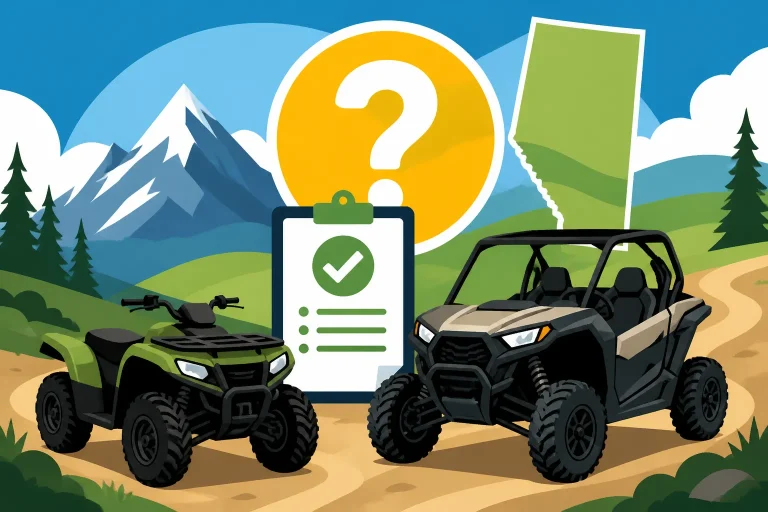
Use the manufacturer’s documentation as the starting point, then make the decision based on the child and the planned riding location. A quick checklist can make it easier to compare machines without focusing only on a product’s age label.
- Find the age guidance and warnings for the exact model, not just a similar machine in a retailer’s listing.
- Read the owner’s manual for operating instructions, restrictions and any rider or passenger limits.
- Have the child sit on the machine and demonstrate the controls while it is stationary.
- Check that the child can reach and operate the controls without stretching or losing a stable position.
- Consider the machine’s weight, power delivery, brakes, steering and the surfaces where it will be used.
- Make sure the child understands how to stop and can follow instructions before increasing speed or difficulty.
- Confirm whether the ride is on public land, private land or another type of area, then check the rules for that location.
- Arrange the required adult supervision for a young rider on public land.
- Check applicable registration, insurance, helmet and equipment requirements separately.
- Plan a low-pressure first practice in a suitable, permitted area and stop if the child cannot control the machine confidently.
If the label and the child’s actual ability do not line up, choose a different machine or wait. If a retailer’s listing conflicts with the manual, use the manufacturer’s documentation and ask the manufacturer or dealer to clarify the exact model. A child should not be asked to prove that they can handle a machine that is beyond their reach or control.
Age guidance is most helpful when treated as one part of a wider decision. The best match is a machine the child is intended to ride, can physically control, and may legally use in the planned location—with an adult prepared to supervise and the required safety steps in place.
Disclaimer
This article is for general informational purposes only and does not constitute professional advice. Laws, prices and regulations vary by location and change over time. Consult a qualified professional for guidance on your specific situation.