Alberta Rules for Towing a Trailer
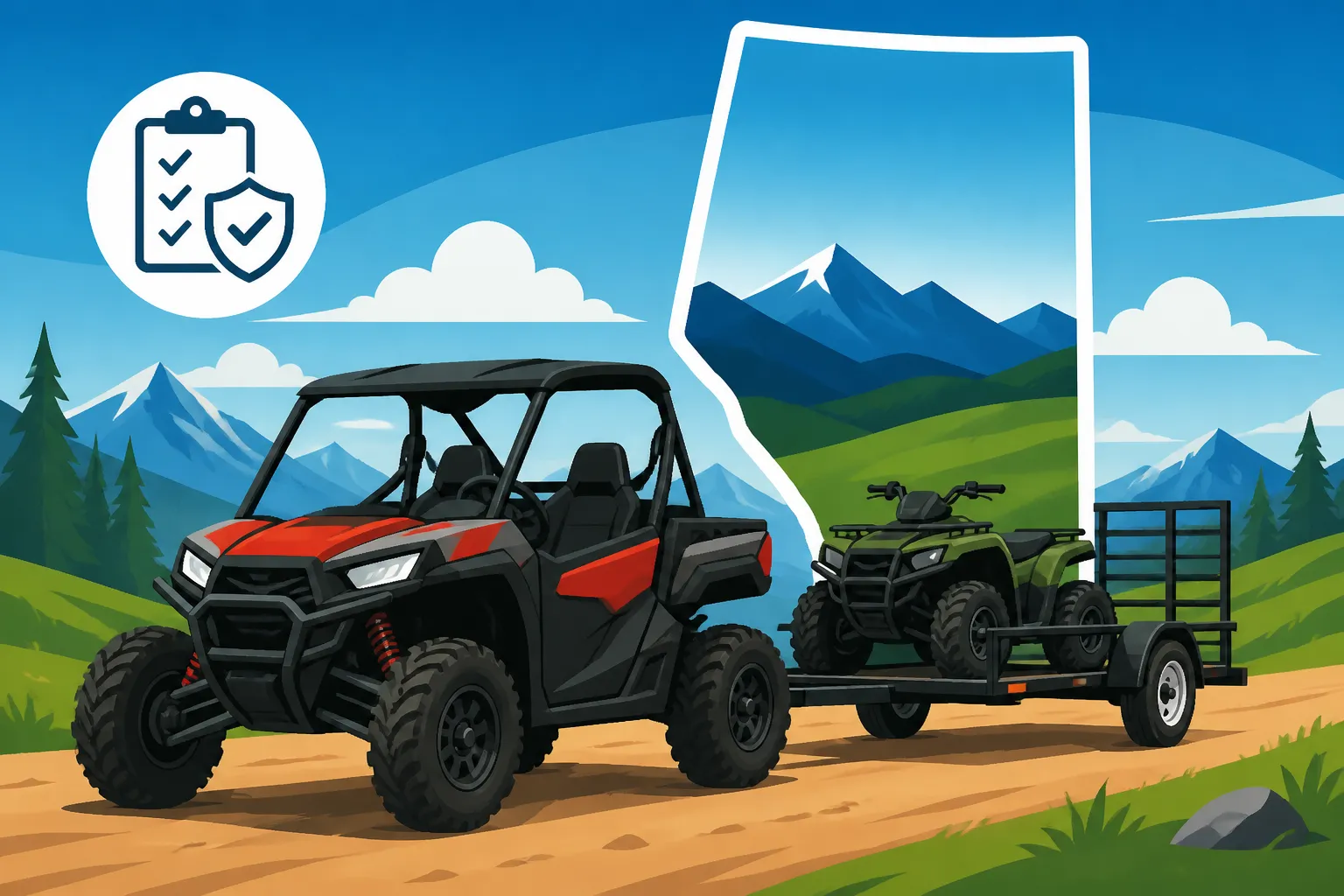
We’ve all been there: staring at our ATV or side-by-side, knowing it’s a workhorse, but then looking at all the gear we need for a weekend trip, a hunting expedition, or just hauling firewood around the acreage. The idea of hooking up a trailer seems like the perfect solution, offering that extra cargo space you desperately need. But then the nagging questions start – is it even legal in Alberta? What are the rules? What kind of trailer can I use? It’s a common dilemma, and navigating Alberta’s rules for towing a trailer with your Off-Highway Vehicle (OHV) can feel like sifting through a stack of old maps to find one hidden trail. This guide is here to clear up the confusion, helping you understand how to safely and legally tow a trailer behind your quad, side-by-side, or dirt bike across Alberta’s diverse landscapes.
The Basics of Towing a Trailer with Your OHV in Alberta
Towing a trailer with your ATV or UTV can vastly expand your machine's utility, turning it into an even more capable companion for work and recreation. However, it's not as simple as just hooking up any old wagon. There are foundational principles and legal requirements you need to understand to ensure you're towing safely and within Alberta's regulations.
Why Towing is So Appealing for OHV Riders
For many riders, the ability to tow a trailer transforms their OHV from a recreational toy into an indispensable tool. Imagine you’re heading deep into a Public Land Use Zone (PLUZ) for a multi-day camping trip. Instead of strapping gear precariously onto your racks or making multiple trips, a small utility trailer can carry all your camping equipment, extra fuel, water, and even a cooler full of grub. This convenience allows for longer, more comfortable adventures, reducing the physical burden of carrying heavy packs and making those remote campsites truly accessible.
Hunters, trappers, and landowners also find immense value in towing. Retrieving a downed animal, hauling supplies to a remote trapline cabin, or moving tools and fencing materials around a large property become significantly easier with a capable trailer. The versatility it offers is undeniable, turning your machine into a true utility vehicle. Companies like SuperATV offer a range of hitches and accessories specifically designed to enhance your machine's towing capabilities, making these tasks even more efficient.
Beyond the practical, there's a certain satisfaction in knowing your machine can handle the job, no matter how much gear you need to bring. It’s about being prepared, self-sufficient, and maximizing the potential of your investment. This capability often means the difference between a quick day trip and an extended backcountry excursion, opening up new possibilities for exploration and work.
General Principles of Safe Towing
Safety should always be your top priority when towing a trailer. The first rule of thumb is never to exceed your OHV manufacturer's stated towing capacity. This figure is crucial because it accounts for the machine's engine power, frame strength, braking capability, and suspension design. Overloading can lead to a host of problems, from straining your engine and transmission to compromising your braking distance and making your OHV unstable, especially on uneven terrain or downhill grades.
Proper weight distribution in the trailer is equally vital. You want to aim for roughly 10-15% of the total trailer weight (including cargo) to be on the hitch, creating what's known as "tongue weight." Too little tongue weight can make the trailer sway dangerously, leading to loss of control, while too much can lift the front end of your OHV, reducing steering control and traction. Distribute your heaviest items low and over the trailer's axle to maintain stability. Always ensure your load is centered and securely fastened to prevent shifting during transit.
Beyond weight, consider the terrain. Towing on flat, open trails is one thing, but adding a trailer to steep climbs, tight turns, or technical obstacles introduces a whole new level of challenge. Your stopping distances will increase dramatically, and your turning radius will be wider. Always ride cautiously, anticipate obstacles, and use lower gears when ascending or descending hills to maintain control of both your OHV and the trailer.
What the Law Says About Equipment
When it comes to the actual equipment, Alberta's regulations, primarily under the Traffic Safety Act and the Off-Highway Vehicle Regulation, have specific requirements. While these often apply more broadly to vehicles on highways, the principles extend to public land use to ensure safety. Your OHV must be equipped with a proper hitch assembly that is securely mounted to the frame. This isn't the time for makeshift solutions; a strong, purpose-built hitch is essential. Many modern ATVs and side-by-sides come with integrated hitches, but if yours doesn't, aftermarket options from reputable manufacturers are readily available.
Safety chains are a non-negotiable component. In the event of a hitch failure, these chains are designed to keep the trailer connected to your OHV, preventing it from detaching and becoming a runaway hazard. They should be crossed under the hitch tongue to create a cradle, preventing the tongue from dropping to the ground if it separates. The chains should also have enough slack to allow for turns but not so much that they drag on the ground.
Lighting and brakes become increasingly important, especially for larger trailers or when operating in low light conditions. While small utility trailers on recreational trails might not always require dedicated brake lights or turn signals in the same way a road trailer would, it's always best practice to ensure your trailer is visible. If your trailer obscures your OHV's taillights, you should consider adding auxiliary lights to the trailer itself. For heavier loads, a trailer with its own braking system, properly connected to your OHV, can be a lifesaver, significantly improving stopping performance and overall control. When an officer conducts [Alberta Equipment Checks by Officers], they'll be looking for these safety components.
Where You Can (and Can't) Tow a Trailer
Knowing you can tow a trailer is one thing, but knowing where you can legally and safely do so in Alberta is another. The province's varied landscapes come with different regulations, and what's permitted on Crown Land might not be on a municipal road allowance. Understanding these distinctions is crucial to avoid fines and ensure responsible riding.
Towing on Public Land Use Zones (PLUZ) and Designated Trails
Alberta's Public Land Use Zones (PLUZs) are specifically managed for various activities, including OHV recreation. In many of these areas, particularly those that permit random camping or offer extensive trail systems for multi-day trips, towing a trailer is generally allowed and often necessary. For instance, in popular spots like McLean Creek or the Ghost PLUZ, you'll see plenty of riders with trailers, hauling everything from firewood and water to hunting gear and small travel campers. The key here is to stay on designated trails and within the permitted boundaries of the PLUZ. [Alberta OHV Trails: Riding Public Land] provides excellent information on these areas.
However, "allowed" doesn't mean "anything goes." You're still expected to adhere to all safety protocols, keep your speed appropriate for the terrain and your loaded machine, and respect other trail users. Some narrower or more technical trails might not be suitable for towing a trailer, even if they're technically within a PLUZ that allows it. Always use good judgment. Remember that [Alberta Random Camping Rules] apply to how you set up your camp, regardless of how you transport your gear. And of course, your OHV needs to be properly registered before you hit any Crown Land. [Alberta Registration Before Riding Crown Land] is a must-read if you haven't sorted that out yet.
The goal of PLUZs is sustainable use. Towing a trailer that causes excessive damage to trails or sensitive ecosystems is against the spirit of these zones and could lead to enforcement. Always strive to leave no trace and protect the environment for future generations of riders.
Towing on Private Land and Lease Roads
On private land, the rules around towing are largely dictated by the landowner's permission and discretion. If you own the land, or have explicit permission from the owner, you typically have more flexibility regarding what and how you can tow. This is where you might be hauling materials for construction, moving hay bales, or dragging fallen timber, often with larger or more specialized trailers. The main considerations here revert to personal safety, the capacity of your OHV, and good judgment, as you're not subject to the same public land regulations.
Industrial lease roads, common in Alberta's energy and forestry sectors, present a different scenario. These are technically private roads, but they often have specific access rules. While companies might use OHVs for work on these leases and tow equipment, recreational access and towing may be restricted or require specific permission. Always assume you need permission to access and operate on lease roads, and if you plan to tow, ensure that activity is explicitly covered by your access agreement. Disregarding these rules can lead to trespassing charges and puts you at risk.
Regardless of whether you're on your own acreage or a permitted lease road, common sense prevails. Ensure your equipment is in good repair, your load is secure, and you're operating safely. Even without public land restrictions, an accident due to improper towing can have serious consequences.
The Tricky Business of Road and Highway Ditches
Here’s where it gets complicated and where many riders run into trouble: road allowances, highway ditches, and municipal roads. In Alberta, the legal definition of a "highway" is much broader than just the paved surface; it includes the shoulders, ditches, and even the right-of-way. This means that generally, OHVs (and by extension, OHVs towing trailers) are prohibited from operating on or within these "highway" areas unless specifically permitted by a municipal bylaw or ministerial order. For more depth on this, check out [Why a Highway Ditch Counts as Public Land].
So, if you're thinking of just zipping along a highway ditch with a trailer full of camping gear to get to your favourite staging area, think again. Without a specific bylaw from the local county or municipality allowing OHV use on those particular road allowances, you could be breaking the law. These bylaws are specific and often limit the type of machine, time of day, and purpose of travel (e.g., direct access to private property, agricultural use).
Towing a trailer exacerbates the visibility and safety concerns on or near public roads, making it even more likely to attract the attention of law enforcement. Always research the local bylaws for the specific area you plan to ride in if your route involves any kind of road allowance. When in doubt, it’s always better to transport your OHV and trailer to a designated staging area by truck and trailer, rather than risking a ticket or an accident on a roadway.
Practical Considerations and Avoiding Trouble
Successfully and safely towing a trailer with your OHV isn't just about understanding the rules; it's also about applying practical considerations and taking preventative measures. Even with the right hitch and an understanding of the law, overlooking key details can lead to mechanical issues, safety hazards, or unwelcome encounters with enforcement.
Weight Limits and Manufacturer Recommendations
The towing capacity of your specific ATV or UTV is the single most critical factor when considering a trailer. This isn't just a suggestion; it's a hard limit set by the manufacturer for the safety and longevity of your machine. Exceeding this limit can cause serious damage to your engine, transmission, and braking system. It also severely compromises your ability to safely control the OHV and trailer, especially during braking or on inclines. Always consult your owner's manual for precise figures, which often include not just the maximum towed weight but also maximum tongue weight.
Calculating the total weight of your loaded trailer can be a bit tricky, but it’s essential. Don't just guess. If you have access to a weigh scale (some truck stops or transfer stations have them), use it. Otherwise, estimate carefully. Add the empty weight of the trailer to the weight of all your cargo. For example, if your machine has a 1,200 lb towing capacity, and your empty SuperATV utility trailer weighs 300 lbs, you only have 900 lbs remaining for your gear. Always err on the side of caution. It's better to make two trips or leave some non-essential items behind than to overload your machine and create a dangerous situation.
Beyond the weight itself, consider the forces at play. A heavy trailer on a downhill grade can push your OHV, causing you to lose traction and control, or overheat your brakes. Conversely, pulling a heavy load uphill will strain your engine and clutch. Understanding these dynamics helps you anticipate how your OHV will perform and adjust your riding style accordingly.
Securing Your Load and Visibility
A well-secured load is a safe load. Everything in your trailer, no matter how small, should be tied down or contained to prevent it from shifting or falling out during transit. Use strong straps, bungee cords, or a cargo net. A shifting load can drastically alter the trailer's balance, leading to instability and making your OHV difficult to control. Imagine taking a sharp turn or hitting a bump, and suddenly all your gear slides to one side – that’s a recipe for disaster.
Visibility is another critical element, particularly if your trailer is large or if you're riding in dusty conditions or low light. Ensure your OHV's taillights and turn signals are visible and not obstructed by the trailer or its load. If they are, consider adding auxiliary lights to the rear of your trailer. Reflective tape on the sides and rear of the trailer can also significantly improve its visibility to others, especially when crossing open areas or on less-travelled routes where other users might not expect a towed unit.
Dust created by your OHV can also obscure your trailer, making it a "ghost" behind you. If riding in a group, communicate clearly with those behind you, and consider adding a flag to your trailer, similar to those used on sand dunes, to increase its profile. Being seen is being safe, and this applies just as much to your towed unit as it does to your OHV itself.
Pre-Ride Checks and Maintenance
Before every ride where you plan to tow a trailer, a thorough pre-ride inspection is non-negotiable. This isn't just about ticking boxes; it's about ensuring everything is in optimal working order to prevent mechanical failures and ensure your safety. Start with your hitch: inspect the receiver, the ball, and the coupler for any signs of wear, damage, or corrosion. Ensure the hitch pin is properly inserted and secured with a clip.
Next, check your safety chains. Are they securely attached to both the OHV and the trailer? Is there enough slack for turns, but not so much that they drag? Move on to the trailer's tires: check the pressure, look for any cuts or bulges, and ensure the lug nuts are tight. Low tire pressure on a trailer can cause sway and increase rolling resistance. Also, inspect the wheel bearings for any signs of play or excessive heat, especially on longer hauls.
Finally, test any trailer lights and brakes. If your trailer has its own lights, ensure they are functioning correctly – brake lights, turn signals, and running lights. If it has a braking system, test it to confirm it engages properly and smoothly. Don't forget to check your OHV's braking system too; it will be working harder with the added weight. Carrying out these [Alberta Equipment Checks by Officers] will not only keep you safe but also ensure you're compliant if you encounter a conservation officer or peace officer on your ride.
Common Questions and Misconceptions
Towing a trailer with an OHV often sparks a lot of questions, some of which are based on urban myths or confusion with road vehicle regulations. Let’s tackle some of the most common queries and clear up misconceptions, helping you ride with confidence.
Do Trailers Need Their Own Plates in Alberta?
This is a frequently asked question, and thankfully, for most small utility trailers towed by OHVs, the answer is usually no, they don't require their own separate registration and license plate in Alberta. The province generally exempts small, light utility trailers from registration if they meet specific criteria, such as being primarily designed for off-highway use and not used on public highways (like paved roads or major gravel roads) for general transportation.
However, the line can get blurry. If your trailer is larger, designed for highway use, or if you somehow find yourself using it on a municipal road where OHVs are permitted by bylaw, you might stray into an area where registration could be required. Always consider the primary purpose and design of the trailer. A small, single-axle trailer intended for hauling firewood on private land or supplies on a designated OHV trail is unlikely to need a plate. But if it's a larger, enclosed cargo trailer or a boat trailer that could easily be towed by a truck, then you'd be wise to check with an Alberta Registry Agent or refer to the specific sections of the Traffic Safety Act regarding trailers, just to be sure. Most of the time, the concern is solely with the OHV being legally registered. The officer will want to see [What an Alberta Officer Can Ask to See] for your OHV, not necessarily your small utility trailer.
Insurance for Your OHV and Towed Trailer
When it comes to insurance, the coverage for your towed trailer is typically tied to your OHV's insurance policy. Most standard OHV insurance policies are designed to cover the off-highway vehicle itself, including liability while it's in operation. If your trailer is damaged while being towed by your insured OHV, or if it causes damage or injury to a third party, your OHV's liability and comprehensive/collision coverage may extend to the trailer, but often with limitations.
It's absolutely critical to confirm the specifics of your coverage with your insurance provider. Don't just assume. Call your broker or agent and ask direct questions: "Is my utility trailer covered for damage if it's being towed by my ATV?" and "Does my liability extend to the trailer if it causes an accident?" Some policies might have specific exclusions or require you to declare the trailer and add it to your policy for full coverage. This is especially true for more expensive or specialized trailers. Remember that [Alberta Insurance Requirements on Public Land] mandate your OHV be insured, and this is the primary coverage that would likely extend to your trailer.
Understanding your policy's limits and deductibles for trailer coverage is also important. Knowing these details upfront prevents unwelcome surprises should you ever need to file a claim.
Specific Rules for Large or Specialized Trailers
While we've mainly discussed small utility trailers, there are many different types of trailers riders might consider. What about a boat trailer, an enclosed cargo trailer, or a specialized heavy-duty hauler from a brand like SuperATV? For these larger or more specialized units, the rules and practicalities change significantly.
First, your OHV's towing capacity becomes an even more critical constraint. Many ATVs and UTVs, while capable, simply aren't designed to safely tow a large boat or a fully loaded enclosed cargo trailer. The weight, aerodynamic drag, and tongue weight of these larger trailers can easily overwhelm an OHV, leading to instability, poor braking, and mechanical failure. Always refer to your manufacturer's maximum towing and tongue weight limits.
Second, the question of registration and lighting becomes more pertinent for these types of trailers. If the trailer is registered for highway use (like most boat trailers or enclosed cargo trailers are), it will have its own license plate and requires functional brake lights, turn signals, and running lights. While you might be towing it with an OHV off-highway, its inherent design for road use might subject it to more stringent requirements. Ensure all lights are connected and working, even if you don't anticipate riding in the dark.
Finally, consider the maneuverability. A long boat trailer or an enclosed cargo trailer will significantly increase your turning radius and make navigating tight trails or obstacles extremely challenging. Factor in the width of the trailer as well; some trails might be wide enough for your OHV but too narrow for a trailer that adds significant width. Common sense and cautious planning are your best allies when considering towing anything larger than a basic utility trailer with your OHV.
Disclaimer
This article is for general informational purposes only and does not constitute professional advice. Laws, prices and regulations vary by location and change over time. Consult a qualified professional for guidance on your specific situation.