Lights On at Dusk
There's nothing quite like heading out on Alberta's incredible trails on your ATV or side-by-side, feeling the fresh air and soaking in the views. But as the day starts to wind down, or when a sudden cloudburst rolls in, a common question pops into many riders' minds: When exactly do I need to turn my lights on? It can feel like a guessing game, and getting it wrong isn't just a safety issue – it can lead to a hefty fine. This guide is all about clearing up the confusion surrounding Alberta's off-highway vehicle (OHV) lighting rules, helping you understand when your headlights and taillights need to be shining bright to keep you legal and, more importantly, safe on the trail.
Deciphering Alberta's Lighting Laws for OHVs
Riding an off-highway vehicle in Alberta is a privilege that comes with responsibilities, and knowing when to use your lights is a big one. It's not always intuitive, especially when you're out in the backcountry where the light conditions can change on a dime. Let's break down what the law actually expects of us.
The Legal Mandate: Headlights, Taillights, and Reflectors
First things first, let's talk about the letter of the law. Alberta's Traffic Safety Act and the Off-Highway Vehicle Regulation are quite clear: your OHV needs to be equipped with certain lighting and it needs to be functional when specific conditions arise. This isn't just about having lights; it's about making sure they work. You're legally required to have a working headlight and a working taillight on your ATV or side-by-side whenever you're operating it between one half-hour after sunset and one half-hour before sunrise. That's your standard "night riding" rule.
But it's not just about the clock. The law also mandates that these lights must be on at any other time when, due to insufficient light or unfavourable atmospheric conditions, persons or vehicles are not clearly discernible at a distance of 150 metres. Think of that 150-metre rule as your personal visibility checker. If you can't clearly see 150 metres ahead, or you feel you can't be clearly seen from that distance, your lights should be on. This is where many riders get tripped up, thinking "it's not dark yet," when really, the conditions demand illumination. Beyond active lights, many machines also require certain reflectors to be present and in good condition, even if they aren't "on" in the traditional sense. It's all part of ensuring you're visible from various angles. If you want to dive deeper into these requirements, you can find more detail in [Alberta Requires Working Head and Tail Lights].
Beyond Simple Darkness: Low Visibility Conditions
Now, let's expand on those "unfavourable atmospheric conditions" because they're a huge factor on Alberta's diverse trails. It's rarely just about the sun being completely down. Imagine you're riding in the McLean Creek area, and a thick fog rolls in, hugging the valleys. Or maybe you're out near Grande Prairie after a dry spell, and a fellow rider kicks up a huge cloud of dust. Perhaps it's a sudden, heavy downpour that reduces visibility to mere metres, or a snow squall hitting hard in the mountains. In all these scenarios, even if it's the middle of the day, your lights need to be on.
These conditions make it incredibly difficult for other riders, hikers, or even wildlife to see you coming. Similarly, your own ability to spot obstacles on the trail—a fallen log, a hidden rut, or a rock—is severely hampered. It's a proactive stance: if you might not be clearly seen, or if your vision is at all compromised, turn those lights on. It’s not just a legal nicety; it’s a critical safety measure that could prevent a serious accident.
When "Dusk" Isn't Just a Time on the Clock
The concept of "dusk" is where many riders scratch their heads. It’s not like someone flips a switch at 7:30 p.m. and suddenly, it's lights-on time. The reality of light conditions on Alberta's trails is far more nuanced, demanding adaptability and good judgment.
Adapting to Changing Light on Alberta's Varied Trails
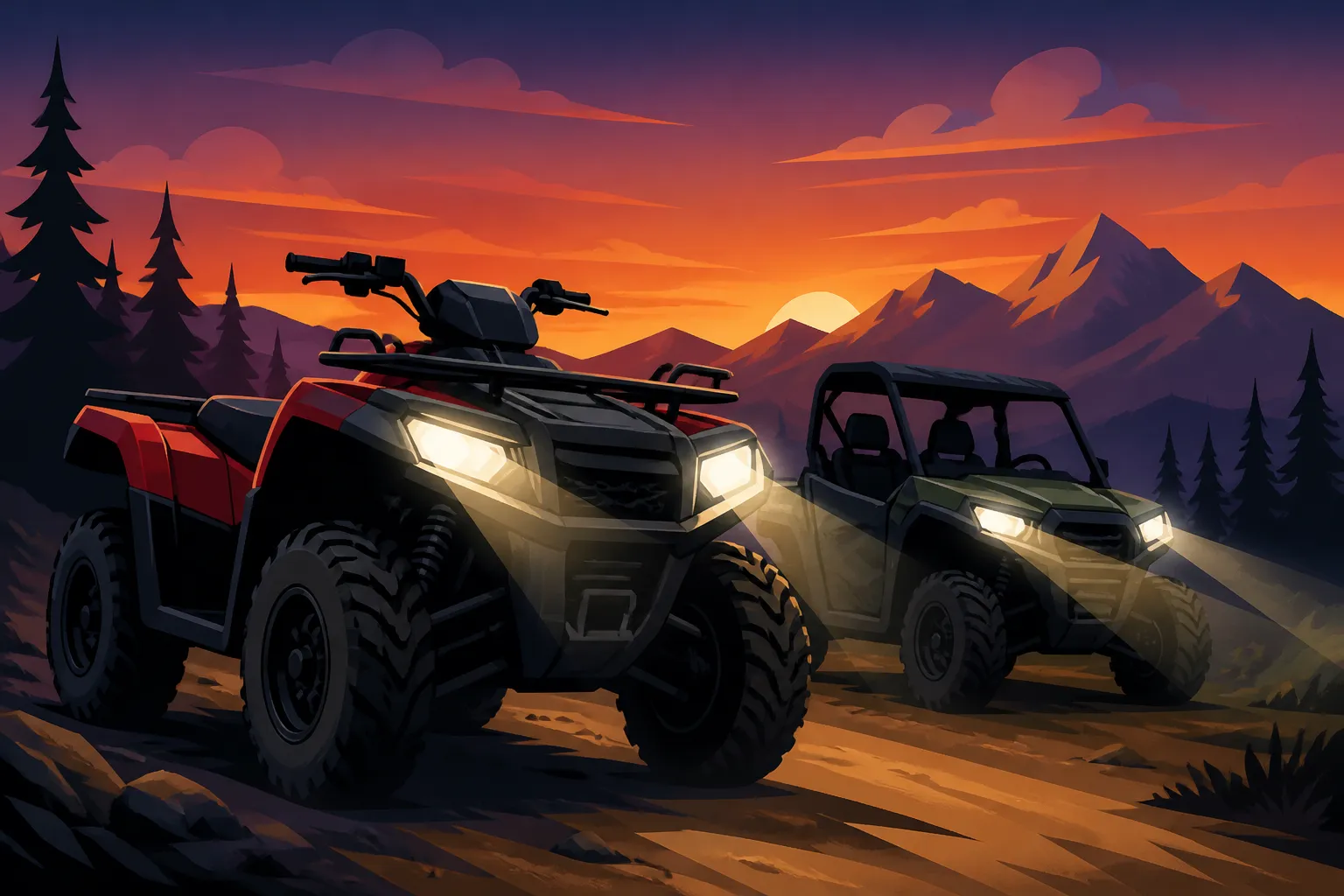
"Dusk" isn't a fixed minute on the clock; it's a gradual, often deceptive transition. The light can fade incredibly quickly, especially when you're riding through different environments. Think about it: an open prairie trail might still be bright and sunny, while just a few kilometres away, a dense treeline or a deep river valley can already be shrouded in shadows. The sun might still be "up" in the sky, but if it dips behind a mountain ridge or a thick bank of trees, the immediate area around you can become quite dim.
This is particularly true in the foothills and mountain regions like the Ghost PLUZ or Kananaskis, where geological features play a huge role in how light behaves. What might feel like adequate light for you, sitting on your machine, could be insufficient for someone else trying to spot you from a distance. The natural terrain itself can create pockets of low visibility, even on what seems like a sunny afternoon. For those venturing out in the evening, understanding [Alberta Rules for Riding at Night] can provide even more crucial context for these transitions.
The Safety Imperative: See and Be Seen
Beyond simply adhering to the law, the real reason we turn on our lights at dusk and in low-visibility conditions is pure, unadulterated safety. It's a two-way street: your lights help you see, and they help others see you.
When the light starts to fade, your eyes work harder, and it becomes much more difficult to pick out details on the trail. That seemingly small rock can become a wheel-busting hazard, and that faint trail marker might disappear entirely. Your lights cut through the gloom, illuminating the path ahead and giving you precious seconds to react to obstacles, sudden turns, or changes in terrain. This is vital whether you're navigating a rocky climb or cruising a smooth section of [Alberta OHV Trails: Riding Public Land].
Equally important is being seen. Many trails are multi-use, shared with hikers, mountain bikers, and even horseback riders who might not expect a fast-moving OHV around the next bend, especially as the day winds down. Your bright headlights and taillights act as a clear warning, giving them time to react and ensuring everyone's safety. And let's not forget about wildlife; a well-lit machine can help you spot animals on or near the trail, giving you time to slow down or stop and avoid a collision that could harm both you and the animal.
Equipping Your OHV for Optimal Visibility
Most new ATVs and UTVs come with factory lighting that meets the minimum legal requirements. But meeting the minimum isn't always enough when you're out exploring Alberta's diverse and often challenging terrain, especially as light fades.
Upgrading Your Lights for Alberta's Varied Terrain
If you spend a lot of time on the trails, especially outside of peak daylight hours, you'll quickly realize that factory lights can sometimes leave a lot to be desired. They might provide a narrow beam or lack the intensity to truly cut through fog or heavy dust. This is where aftermarket lighting solutions really shine (pun intended!). Upgrading your lights can make a monumental difference in your ability to see and be seen.
Think about adding a high-quality LED light bar across the front of your side-by-side or powerful auxiliary spotlights to your ATV. These aren't just for show; they can drastically improve your visibility, offering a wider, brighter, and more focused beam that illuminates not just the path directly in front of you but also the crucial peripheral areas. Brands like SuperATV offer a fantastic range of durable, weather-resistant LED light bars and pod lights that are designed specifically for the rigors of off-road riding. Their solutions often feature superior optics, allowing you to see further down the trail and pick out subtle changes in terrain or potential hazards that your stock lights might miss. This added illumination is especially valuable when you're in deeply shaded areas or find yourself navigating back to camp after sunset. When considering [Alberta Equipment Required on Public Land], enhanced lighting goes beyond just "having" lights; it’s about having effective lights.
Maintenance and Readiness Checks
Having the best lights in the world won't do you any good if they don't work when you need them. Regular maintenance and readiness checks are absolutely crucial for your OHV's lighting system. Before every ride, especially if you anticipate riding into the evening or in unpredictable weather, do a quick walk-around.
- Check all bulbs: Make sure your headlights, taillights, and brake lights are all fully functional. A burned-out bulb means you're not legal and not as safe.
- Inspect wiring: OHVs take a beating. Vibrations, mud, water crossings, and abrasive branches can damage wiring. Look for any exposed wires, loose connections, or corrosion that could lead to intermittent light function or complete failure.
- Clean lenses: Mud, dust, and grime can drastically reduce the output of even the brightest lights. A quick wipe-down with a damp cloth can make a huge difference.
- Carry spares: For longer trips, consider carrying spare bulbs or fuses for critical lighting components. You never know when you might hit a bump that jostles something loose.
Ensuring your lights are not only on but fully functional is paramount. A dim, flickering, or partially working light is almost as bad as no light at all, as it won't provide the visibility you need to ride safely or be seen clearly by others.
Avoiding Fines and Ensuring a Safe Ride
Nobody wants a ticket at the end of a fun day of riding, and certainly, no one wants to be involved in an avoidable accident. Understanding and adhering to Alberta's OHV lighting rules is a simple way to prevent both.
Understanding the Consequences of Non-Compliance
Let's be blunt: riding without your lights on when required can be an expensive mistake. Enforcement officers on Alberta's public lands are there to ensure everyone's safety and adherence to regulations. If you're caught riding after sunset, before sunrise, or in low-visibility conditions without your lights on, you're likely looking at a ticket. The specific fine amounts can vary, but generally, it's a financial hit that could have been easily avoided. To get a sense of what violations can cost you, take a look at [Alberta Ticket Costs for a Riding Violation]. Beyond the monetary penalty, there's the inconvenience and stress of dealing with an enforcement stop, which can put a real damper on your day.
More critically, consider the implications in the event of an accident. If you're involved in a collision and it's determined that your lights weren't on when they should have been, it could significantly impact your liability. Even if you believe you were "visible enough," the legal definition is quite clear, and ignoring it could have serious consequences for insurance claims or even legal proceedings.
Best Practices for Dusk and Low-Light Riding
To wrap it all up, let's talk about the best habits you can adopt to ensure a safe and compliant ride every single time you hit the trails in Alberta:
- When in doubt, turn them on. This is the golden rule. If there's even a question in your mind about whether your lights are needed, just flip the switch. It costs you nothing and could prevent an accident or a fine. Modern LED lights draw minimal power, so you don't have to worry about draining your battery.
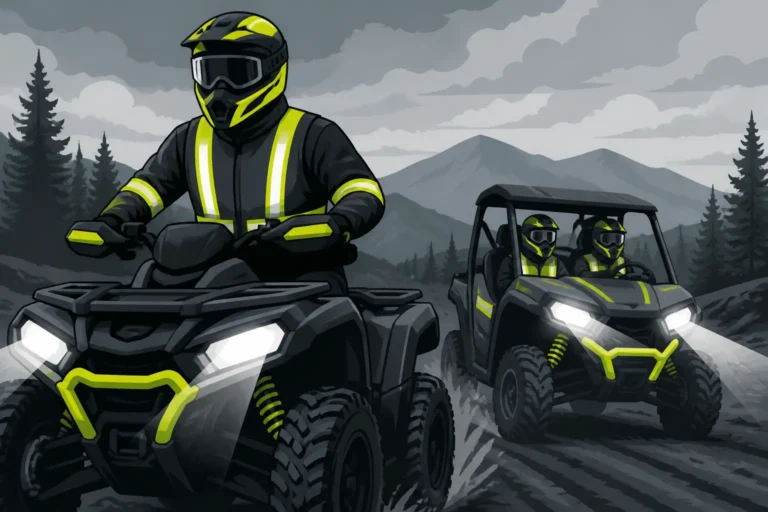
- Combine lighting with reflective gear. While your OHV lights are essential, enhancing your personal visibility also helps. Wear brightly coloured clothing, and consider adding reflective tape to your helmet, jacket, or even your machine. This can make you more noticeable to others, even if your machine lights are temporarily obscured.
- Reduce your speed. As visibility drops, your reaction time needs to increase. Slowing down gives you more time to spot obstacles, react to changing trail conditions, and avoid collisions with wildlife or other trail users. It’s also wise to ensure your general vehicle maintenance is up to snuff; for instance, checking [Lights That Work in Daylight] means your lights are ready for any condition.
- Carry a backup light source. A small, powerful headlamp or flashlight is an inexpensive lifesaver. If your machine's electrical system fails, or if you need to perform a trailside repair in the dark, a backup light source is invaluable.
- Know what an officer might ask. Part of being a responsible rider is being prepared for a quick check by an enforcement officer. They might ask to see your registration, insurance, and yes, confirm your lights are working. Being ready for [What an Alberta Officer Can Ask to See] ensures a smooth interaction.
By being mindful of Alberta's lighting regulations and adopting these best practices, you'll not only avoid potential fines but, more importantly, you'll significantly enhance your safety and the safety of everyone else enjoying Alberta's magnificent OHV country. Ride safe, and keep those lights shining bright!
Disclaimer
This article is for general informational purposes only and does not constitute professional advice. Laws, prices and regulations vary by location and change over time. Consult a qualified professional for guidance on your specific situation.