Alberta Rules for Carrying a Firearm
There's a special kind of freedom that comes with exploring Alberta's vast wilderness on an ATV or UTV, and for many, that freedom perfectly aligns with hunting, target shooting, or simply having a firearm for protection in remote areas. However, trying to figure out the exact rules for carrying a firearm on your off-highway vehicle can feel like navigating a legal minefield, with different acts and regulations seemingly overlapping. This guide is here to untangle that confusion, offering clear, actionable insights into how you can legally and responsibly transport firearms on your quad or side-by-side in Alberta.
Understanding the Legal Framework for Firearms in Alberta
Before you even think about loading your firearm onto your ATV or UTV, it’s absolutely critical to understand the layered legal framework that governs firearms in Canada and, more specifically, in Alberta. This isn't just about knowing what to do, but why you're doing it, which can save you a lot of grief and potential legal trouble down the road.
Federal vs. Provincial Laws: What Applies to Firearms?
One of the biggest sources of confusion for many outdoor enthusiasts is understanding that firearms are subject to both federal and provincial laws, each addressing different aspects of their ownership and use. Federally, the Canadian Firearms Program, administered by the RCMP, dictates everything related to possession, licensing, storage, and transport of the firearm itself. This means you absolutely must have a valid Possession and Acquisition Licence (PAL) for the class of firearm you possess, and any restricted or prohibited firearms must also be registered and have specific authorizations for transport (ATTs) if they ever leave your residence. Without meeting these federal requirements, any other provincial rules become moot, as you're already in violation of national law.
On the other hand, provincial legislation in Alberta, such as the Traffic Safety Act, the Off-Highway Vehicle Regulation, the Wildlife Act, and the Public Lands Act, steps in to govern where and how you can use and carry those firearms, especially when combined with an off-highway vehicle. These provincial rules focus more on the operational aspects: whether a firearm can be loaded, if it needs to be cased, and its proximity to the operator while riding on various types of land. For instance, while federal law says you need a PAL, provincial law will dictate that your rifle must be unloaded and encased while you're driving your quad through a Public Land Use Zone. It's a dual-layered system where both sets of rules must be satisfied simultaneously. Ignoring one for the other is a recipe for serious legal issues, potentially leading to fines, firearm seizure, and even criminal charges.
Defining "Loaded" and "Uncased" in Alberta OHV Context
When it comes to carrying firearms on your ATV or UTV in Alberta, the terms "loaded" and "uncased" are not just technicalities; they are foundational to compliance and safety. Misinterpreting these definitions can lead to immediate violations. Under the Alberta Wildlife Act and the Off-Highway Vehicle Regulation, a firearm is generally considered "loaded" if there are any rounds in the chamber, magazine, or feeding device attached to the firearm. This means if you have a magazine full of cartridges inserted into your rifle, even if there isn't a round in the chamber, it could still be deemed loaded for the purpose of these regulations, especially on an OHV. The safest approach is to ensure the firearm is completely clear of all ammunition, with the magazine removed, and no rounds in the chamber or tube.
"Uncased" refers to a firearm that is not contained within a proper carrying case or scabbard. This means it can't just be rattling around in the bed of your side-by-side or strapped openly to your ATV rack. A case or scabbard serves multiple purposes: it protects the firearm from the elements and trail hazards, prevents accidental discharge, and most importantly, physically restricts immediate access. While a hard-sided, lockable case is always the gold standard, particularly for transport on vehicles, a soft-sided gun scabbard specifically designed for OHV use can also meet the "cased" requirement, provided it fully encloses the firearm. The key here is that the firearm must be secured and not readily available for immediate use. An uncased firearm, even if unloaded, is a clear violation on public land when transported on an OHV, and can suggest an intent for immediate use that Alberta law seeks to control.
Specific Rules for Carrying Firearms on an ATV or UTV
Now that we've covered the foundational legal definitions, let's get into the specifics of how these rules apply when you're out on the trails with your ATV or UTV. The regulations are designed to ensure public safety while allowing responsible outdoor recreation.
Transporting Non-Restricted Firearms on Public Land
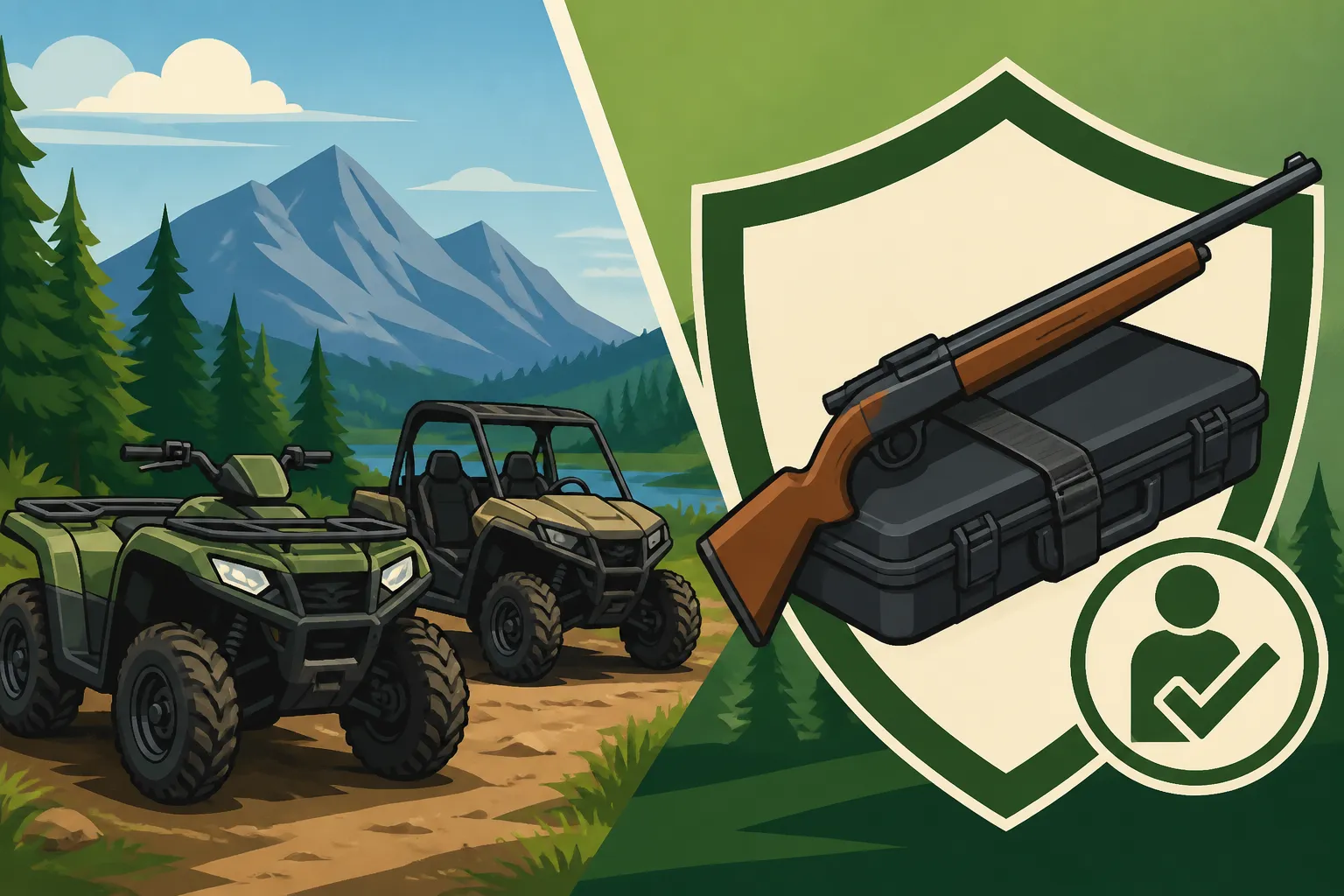
This is the most common scenario for many Alberta OHV riders who are also hunters or recreational shooters. When you're transporting a non-restricted firearm (like most hunting rifles or shotguns) on public land via an ATV or UTV, the rules are quite specific. The firearm must be unloaded, and it must be cased. Furthermore, it needs to be stored in a manner that is out of immediate reach and not readily accessible to anyone on the vehicle. This means you can't have your rifle uncased and leaning against the seat next to you, even if it's unloaded. The intention is to remove the possibility of rapid deployment or accidental discharge while the vehicle is in operation or easily accessible during a stop.
For ATVs, this typically means a sturdy gun scabbard mounted securely to the front or rear rack. Companies like SuperATV offer robust mounting systems and scabbards that keep your firearm protected and compliant. The scabbard should fully enclose the firearm and be firmly attached to prevent it from shifting or falling off during a bumpy ride. For UTVs, the options are often similar, but with more enclosed cargo space, you might opt for a hard case in the cargo bed or a scabbard mounted to the roll cage behind the seats. Again, ensuring it’s securely fastened and not easily reachable from the driver or passenger seats is key. Even an unloaded, uncased firearm visible and accessible in the cargo box of a side-by-side might be considered "readily accessible" and could draw a ticket. Always remember that even if you're transporting it correctly, there are still rules about where you can discharge it, such as [Alberta's 400 Metre Firearm Setback] from certain areas. This means your transport method is only one piece of the puzzle.
Restricted and Prohibited Firearms on an OHV: A Rare Exception
It's important to touch on restricted and prohibited firearms, though their transport on an OHV is an exceedingly rare and highly regulated scenario. For the vast majority of Alberta OHV enthusiasts, particularly those involved in hunting or general recreation, these categories are usually not relevant to their off-highway vehicle activities. However, for the sake of completeness, federal law requires that restricted firearms (like most handguns or certain semi-automatic rifles) and prohibited firearms (like automatic weapons or firearms with barrel lengths below a certain minimum) require specific Authorizations to Transport (ATTs) to be moved from one approved location to another. These ATTs usually specify the exact route, date, and purpose of transport.
Given the strict federal requirements, transporting a restricted or prohibited firearm on an ATV or UTV would be incredibly complex and generally impractical. Not only would the federal ATT conditions need to be met (which usually demand secure, locked, opaque containers, often separate from the ammunition, and direct, uninterrupted transport), but then these federal requirements would need to be overlaid with provincial OHV regulations for firearm transport. An OHV's open nature and often rugged travel conditions are typically not conducive to meeting the stringent security and direct transport conditions usually associated with ATTs for restricted and prohibited firearms. If you ever find yourself in a situation where you believe you need to transport such a firearm on an OHV, it is absolutely imperative to seek expert legal advice and consult directly with the Canadian Firearms Program to ensure you have all necessary permits and are fully compliant with both federal and provincial laws. Attempting this without explicit, well-understood authorization is a high-risk proposition.
Exceptions: Farm Use and Private Land
While the general rules for carrying firearms on an OHV on public land are quite strict, there are some important considerations and potential differences when it comes to farm use or riding on private land. For farmers and ranchers in Alberta, an OHV is often an essential tool for day-to-day operations, including pest control, predator management, or overseeing livestock. On your own private land, or on land where you have explicit permission from the landowner to carry a firearm for specific purposes, the immediate "unloaded and cased" rules often have some flexibility, particularly if you are actively engaged in farm-related work. For instance, a farmer might have a loaded shotgun easily accessible on their quad for immediate use against a coyote threatening livestock. However, this flexibility is strictly limited to the private land itself and the specific authorized activities. It does not extend to public roads, ditches, or Crown land, even if those lands are adjacent to the farm.
It's crucial to understand that even on private land, federal laws regarding firearm possession, licensing, and general safe handling still apply. Your PAL is always required, and you are always responsible for ensuring safe storage when the firearm is not in immediate use. The provincial "unloaded and cased" rule is primarily for public safety on shared public spaces. So, while a farmer might have different practical arrangements on their own acreage, the moment they leave that private property—even to cross a ditch or move to another private field via a public right-of-way—the stricter rules for transport on an OHV on public land immediately kick in. Always remember that even for [Alberta Farmer-Owned Machines on Private Land], the minute those wheels hit anything other than your own property, you're bound by public land regulations. If you're on someone else's private land, ensure you have explicit, ideally written, permission not just to ride your OHV, but also to carry a firearm, and understand any restrictions the landowner may impose.
Practical Considerations and Best Practices for OHV Riders
Beyond simply adhering to the letter of the law, there are many practical considerations and best practices that can make your experience carrying a firearm on an OHV safer, more convenient, and ultimately more responsible.
Choosing the Right Gear for Secure Transport
Selecting the appropriate gear for transporting your firearm on an ATV or UTV is paramount for both compliance and protecting your valuable equipment. The primary goal is to keep your firearm securely stored, protected from the elements and trail hazards, and inaccessible while you're riding. A good quality gun scabbard or hard case designed specifically for OHV use is an investment that pays dividends. When looking at options, consider hard scabbards over soft ones for superior protection against bumps, scratches, and mud. They also offer better security. Look for features like quick-release mounts that still hold the firearm firmly, vibration dampening to prevent damage to optics, and weather-resistant construction. Some scabbards even offer lockable features, adding another layer of security against theft or unauthorized access.
Many aftermarket accessory companies, like SuperATV, offer a range of robust solutions for securing cargo, including purpose-built gun scabbards and universal mounting brackets for hard cases. These products are often designed to integrate seamlessly with your vehicle's existing racks or roll cage, providing a stable platform for transport. Remember, simply tossing a rifle into a soft case and bungee-cording it to your rack isn't enough; it needs to be truly secured against movement, bumps, and potential dislodgment. A loose firearm can not only be damaged but can also become a hazard to you and others on the trail. Invest in a system that keeps your firearm clean, dry, secure, and compliant.
Navigating Public Land Use Zones and Hunting Regulations
Transporting your firearm legally is one thing, but knowing where and when you can actually use it is another crucial aspect, especially when riding in Alberta's Public Land Use Zones (PLUZs). These zones are designed to manage various activities, and regulations can differ from one PLUZ to another. Hunters, in particular, must ensure they not only follow OHV firearm transport rules but also adhere to all provincial hunting regulations, which cover licensing, seasons, bag limits, and ethical hunting practices. Simply having a firearm on your OHV doesn't give you carte blanche to hunt anywhere. You need to verify if the area is open to hunting, if your license is valid for that specific wildlife management unit, and whether there are any special restrictions.
Many PLUZs have designated trails where OHVs are permitted, and often, you are expected to stay on these trails. This can create a challenge for hunters who need to access specific areas. Always consult current [Alberta's Public Land Use Zones Explained] maps and regulations before heading out. Some PLUZs might have specific rules about where you can discharge a firearm, or even areas where hunting is prohibited entirely. Additionally, be acutely aware of [Alberta Fire Bans and Riding] as these can dramatically impact not only your ability to ride your OHV but also the permissibility of open fires or even the complete closure of certain areas, which would obviously preclude any hunting or shooting. Being prepared means knowing your route, understanding the land use rules for that specific area, and being aware of any current environmental restrictions.
What to Expect During an Encounter with Law Enforcement
Even if you're doing everything right, there's always a chance you might encounter a Fish and Wildlife Officer or an RCMP officer while riding with a firearm on your OHV. Knowing what to expect and how to respond can make the experience smooth and respectful. First and foremost, always carry all your required documentation: your valid PAL, your OHV registration, proof of insurance (which is required on public land), your public lands pass (if applicable), and your hunting license if you're hunting. Officers have the right to ask for these documents, and you should be able to produce them promptly. You can find more details on what officers can ask to see in [What an Alberta Officer Can Ask to See] and [Producing Insurance on Demand].
If an officer signals you to stop, do so safely and calmly. Turn off your engine, remove your helmet, and keep your hands visible. Inform the officer that you are transporting a firearm and its location, and offer to show them your PAL. Officers have the right to inspect your firearm to ensure it is unloaded, properly cased, and legally transported. Cooperate fully with their instructions. Remember, they are doing their job to ensure safety and compliance. Being transparent, respectful, and knowledgeable about the regulations will go a long way in ensuring a positive interaction. Any attempt to conceal a firearm, evade an inspection, or respond uncooperatively can escalate the situation unnecessarily and potentially lead to serious legal consequences, including fines or the seizure of your firearm and OHV.
Here's a quick reference table outlining key do's and don'ts when carrying a firearm on your Alberta OHV:
| Action | Do | Don't |
|---|---|---|
| Licensing & Documents | Always carry your valid PAL and all necessary vehicle/hunting documentation. | Ride without a current PAL or required permits. |
| Firearm Condition | Ensure all firearms are unloaded and clear of all ammunition. | Have a loaded firearm (magazine inserted, round in chamber, etc.). |
| Casing & Security | Use a proper gun scabbard or hard case; ensure it's securely mounted and fully enclosed. | Carry an uncased firearm or one that's easily accessible/visible. |
| Accessibility | Store firearms out of immediate reach while riding. | Keep a firearm within easy grabbing distance from the driver or passenger seat. |
| Public Land Rules | Understand and follow specific PLUZ and hunting regulations for your area. | Disregard [Alberta Rules for Riding Crown Land] or hunting area restrictions. |
| Private Land Rules | Confirm permissions with landowners when on private land for firearm carry. | Assume private land rules are the same as public land, or disregard federal laws on private land. |
| Law Enforcement | Cooperate fully and calmly with officers; declare firearm presence. | Attempt to conceal your firearm or act uncooperatively during a stop. |
| Gear Selection | Invest in quality OHV-specific scabbards or cases from reputable brands like SuperATV. | Rely on makeshift strapping or inadequate protection for your firearm. |
Remember, the goal is to enjoy Alberta's stunning landscapes responsibly and safely. By understanding and adhering to these rules, you can confidently combine your passion for OHV riding with your firearm activities.
Disclaimer
This article is for general informational purposes only and does not constitute professional advice. Laws, prices and regulations vary by location and change over time. Consult a qualified professional for guidance on your specific situation.