Alberta Hunting Access by OHV
An Alberta hunting licence does not automatically give you permission to ride an ATV or side-by-side wherever game may be found. Access depends on the land, the route and any local restrictions. The key is to check where you can hunt separately from where you can ride, then plan a route that respects both sets of rules.
Start with the land, not the hunt plan
Before loading a machine, identify who manages the land and what access rules apply. “Public land” is not one blanket category with one set of riding rules. A route may pass through a Public Land Use Zone, a grazing lease, private property, a provincial park or a municipal area, and the rules can change at each boundary.
Use an up-to-date map to confirm the land status, the permitted OHV routes and any closures. In a Public Land Use Zone, for example, riding may be limited to designated trails or routes. A cutline, forestry road or track visible on a map is not automatically an approved OHV route. Alberta’s Public Land Use Zones Explained and Alberta Rules for Riding Crown Land are useful starting points, but check current local notices before setting out.
| Land or route | What to confirm before riding to hunt |
|---|---|
| Public Land Use Zone | Whether OHVs are allowed and which trails or routes are designated |
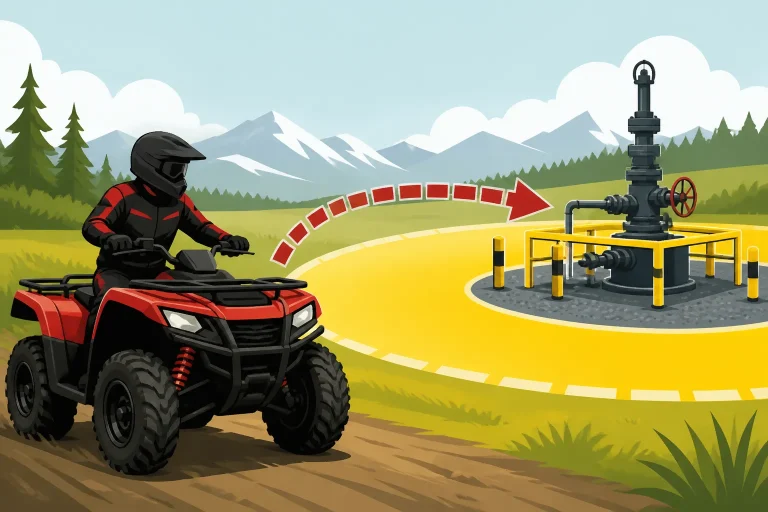
| Grazing lease | What access process applies, and whether the leaseholder has relevant restrictions or safety concerns |
| Private land | Permission to hunt and permission to enter or ride, including where the machine may go |
| Municipal road or right-of-way | Whether the local bylaw allows OHVs on that specific route |
| Provincial park or other protected area | Whether motorized access is allowed at all, and where |
A route that is legal to ride does not necessarily make every nearby area legal to hunt. Likewise, permission to hunt on a property does not necessarily include permission to drive across it. Treat those as separate questions and get clear answers for both. For private property, start with Alberta Private Land Permission; verbal permission should be specific about the land, dates, activities and vehicle access.
Grazing leases need particular care. A lease is not simply an open riding area, and a trail or gate does not tell you what access is allowed. Contact the leaseholder or follow the applicable access process before riding through. Ask about livestock, gates, active work, sensitive areas and where to park. Contacting a Grazing Leaseholder Before You Ride explains why checking in matters; Alberta Grazing Lease Access Rules can help you frame the access question.
Also check whether the route crosses land managed under another authority. A municipal bylaw may allow OHV use on certain roads while provincial land rules prohibit riding beyond them. A route that was open on a previous trip may now be closed for weather, fire risk, habitat protection, road work or other reasons. Do not rely on an old screenshot, trail app track or another rider’s memory as proof that access is still permitted.
What OHV access does and doesn’t let you do
An OHV can help you reach a legal hunting area, but it does not expand the area where you may hunt or remove hunting restrictions. Your licence, tags, season dates, wildlife management unit and species-specific rules still apply. Check the current Alberta hunting regulations for the hunt you are planning, including any rules about weapon use, access and the species involved.
Keep the machine on an authorized route. Riding off trail to get closer to a hunting spot, avoid a wet section or take a shortcut can damage land and may violate the rules for that area. In some places, simply being able to drive a route does not mean you may park there or leave the machine unattended. Look for signed restrictions and confirm what applies to the exact zone.
Do not assume a machine can be used to pursue or harass wildlife, push animals toward another hunter, or travel into an area closed to motorized use. If you are unsure whether a planned action is allowed, leave the machine on an approved route and check before continuing. Alberta Game Retrieval by Machine is a relevant topic to review if you expect to use an OHV to retrieve harvested game. The rules for getting to a hunt and the rules for recovering game may not be identical.
Firearm rules deserve a separate check. Restrictions can apply to where a firearm is discharged, including around trails, roads, buildings and occupied areas. The details may depend on the location and the rule in force, so do not rely on a general distance remembered from another zone. Review Alberta Firearm Setbacks on Trails and the current hunting regulations. A legal trail is not automatically a safe or lawful place to handle or discharge a firearm.
Plan how firearms and ammunition will be transported while riding, and follow the current requirements for your situation. Secure equipment so it cannot shift, fall from a rack or interfere with steering, braking or passenger safety. If you stop near other trail users, keep the firearm controlled and avoid creating an unsafe encounter. Leave extra room around camps, staging areas and other people, and do not handle a firearm casually on a busy trail.
OHV registration and insurance are separate from hunting authorization. If you ride on public land, confirm the machine meets the applicable requirements and that you can produce the required documents. Alberta Has No OHV Trail Pass helps distinguish vehicle registration from a trail-pass requirement, while Alberta’s WIN Card Explained covers a different requirement associated with hunting and other activities. One document does not replace the other.
A camping pass is another separate matter. It may apply if your plan includes camping in an area where a pass is required, but it is not a general hunting permit or a substitute for OHV registration. Check the rules for the land where you intend to camp, as well as for the route you intend to ride. The Alberta’s Public Lands Camping Pass overview can help you avoid treating a camping requirement as an access authorization.
Plan a lawful route and a safe recovery
A good access plan has a clear start point, an approved route and a realistic stopping point. Before leaving, mark where you will unload, where riding is permitted, where you will park, and how you will return. If the hunt takes you away from the machine, leave it in a safe place that does not block a trail, gate, work site or other access.
Use a map that shows land boundaries and approved routes, then save it for offline use. Cell service can disappear quickly in remote areas, and a phone map may not show a new closure or route restriction. Download maps before you leave coverage, carry a backup power source, and bring a paper map if the area is unfamiliar. A waterproof map sleeve, available through outdoor retailers such as Amazon, can protect a paper copy from rain and mud.
Do not treat a GPS track as permission. A line on a map may be an old route, a private track, an unmaintained road or a path that is not open to OHVs. Cross-check it against current land-manager information, signs and local access rules. If signs or barriers conflict with your saved route, follow the current restriction rather than the app.
A recovery plan matters just as much as the outbound route. Think about what you will do if the machine gets stuck, breaks down or cannot safely carry harvested game. Keep within the machine’s rated capacity, secure any load, and avoid attempting a recovery that could injure someone or damage the trail. If retrieval would require leaving an approved route, crossing a closure or entering land without authorization, stop and find a lawful alternative.
For a group hunt, agree on the route and meeting point before anyone rides ahead. Make sure each rider understands the boundaries and knows what to do if the group becomes separated. Carry a basic first-aid kit, enough water, suitable clothing and communication equipment for the area. In remote terrain, a satellite messenger may be more reliable than assuming a phone will work. Tell someone who is not on the ride where you are going and when you expect to return.
Pay attention to weather and fire restrictions. Heavy rain can make a route vulnerable to damage or unsafe to travel, while dry conditions can bring fire restrictions that affect activities on public land. Check Alberta Fire Bans and Riding before departure and again if conditions change. A closure or restriction can affect access even if your hunting plans and paperwork are otherwise in order.
When you encounter gates, cattle, equipment or active work, slow down and behave predictably. Leave gates as you found them unless the landholder has given different instructions. Do not ride through a work area or around a barrier simply because the route appears passable. If you meet other hunters or trail users, give them space and avoid surprising them with speed, noise or a sudden turn.
Before you leave: permissions, permits and checks
Make your checks close to the trip, not only when you first plan it. Access information can change, and a route that was available earlier in the season may be closed when you arrive. Use the following process:
- Confirm the hunting details. Check the current licence, tag, season, species and area requirements for your hunt.
- Identify every land type on the route. Include the parking or unloading point, the riding route and the hunting location.
- Confirm OHV access. Check whether motorized travel is allowed and whether you must stay on designated routes.
- Get permission where needed. Ask separately about hunting access, riding, parking and game retrieval. For leased or private land, do not treat a past invitation as current permission.
- Check local restrictions. Look for closures, fire restrictions, municipal bylaws and posted notices.
- Prepare your documents and machine. Carry the applicable registration and insurance information, and check that the machine and safety equipment meet the requirements for the area.
- Set a return plan. Share your route and expected return time, and carry maps and communication equipment suitable for the terrain.
If an officer or land manager asks questions, be ready to explain where you are going and how you reached that location. Keep relevant documents accessible and follow directions at a stop or checkpoint. What to Show an Officer on Alberta Public Land offers more context on the kinds of checks riders may encounter.
When rules or boundaries are unclear, pause and verify rather than guessing. A call to the relevant land manager, municipal office or landholder may take less time than sorting out an access problem after unloading. This is especially useful when a hunt crosses several land types or when a route depends on a grazing lease, local bylaw or temporary closure.
The safest assumption is that hunting authorization, land access and OHV access are three different permissions to confirm. A successful plan accounts for all three, keeps the machine on lawful routes and leaves room to change course if conditions or restrictions make the original route unsuitable.
Disclaimer
This article is for general informational purposes only and does not constitute professional advice. Laws, prices and regulations vary by location and change over time. Consult a qualified professional for guidance on your specific situation.