Keeping a Kilometre Between Your Camp and the Next
When you’re riding Alberta’s backcountry, finding a quiet place to camp can feel like part of the adventure—until another group pulls in nearby. For random camping on public land, keeping a kilometre between camps helps reduce crowding and pressure on the landscape. This guide explains how to plan that space, distinguish it from relocation rules, and camp responsibly with an ATV or UTV.
What a kilometre between camps means
Understand the spacing rule before you set up
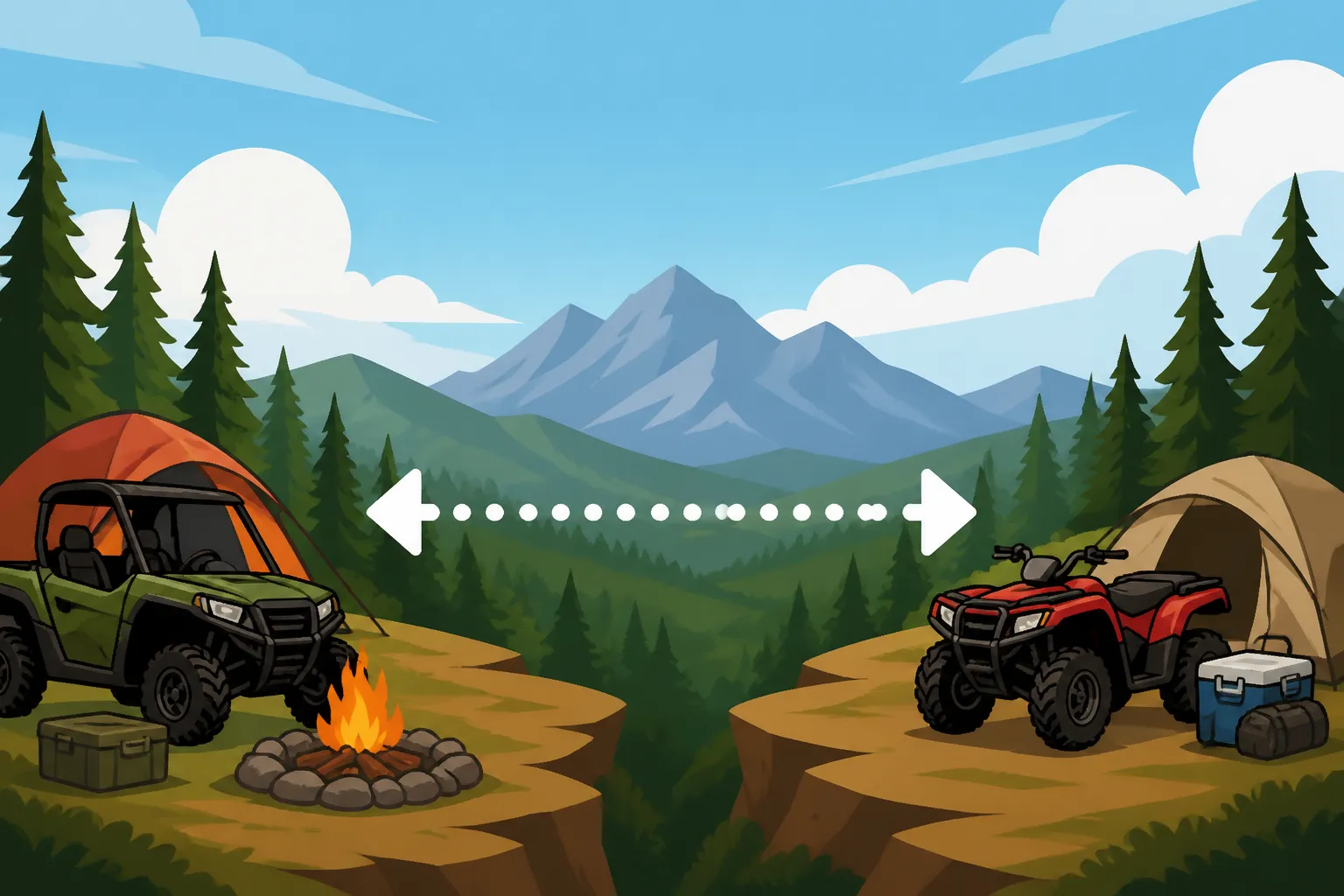
A one-kilometre separation is about spacing your random campsite away from another campsite, not about how far you must ride between trails or how far your tent needs to be from your ATV. The practical goal is to avoid crowding another camping party and spreading the effects of camping across a limited area.
That matters even when you can’t see another camper from your chosen spot. A ridge, trees, or uneven ground can hide a campsite that is still close by. Before unloading your machine, take time to look around, check the approach route, and consider whether a nearby fire ring, flattened clearing, or parked trailer suggests someone else is already camped there.
Rules can differ by location, land designation, and posted closures. Treat the one-kilometre distance as a planning standard, then check the specific rules for the area you intend to visit. Alberta Random Camping Rules Explained is a useful starting point for understanding the broader requirements.
Don’t confuse campsite spacing with the relocation rule
There are two different questions that can sound almost identical: how close your camp can be to someone else’s, and how far you must move after staying in one place for a set period. The one-kilometre spacing guidance concerns the relationship between campsites. The relocation rule concerns moving your own camp after the permitted stay.
For example, imagine your group has camped at a public-land site for several days. Another party sets up nearby. Moving your tent a short distance within the same clearing may not meaningfully create separation from that party, nor would it necessarily count as a proper move after a stay limit. The location and the applicable rule both matter.
Alberta’s random-camping rules commonly include a maximum stay and a requirement to move a minimum distance before returning. Those requirements are separate from campsite spacing. Read Alberta’s 1-Kilometre Relocation Rule alongside Alberta’s 14-Day Camping Limit so you don’t mistake one obligation for the other.
Check whether random camping is allowed at all
A map can show public land without telling the whole story about where you may camp. Some areas have designated sites, seasonal closures, access restrictions, or other conditions. Being able to ride into a spot does not automatically mean you may camp there.
Before setting out, identify the land designation and look for current notices or signs at the access point. A route shown as open for riding may lead through land where camping is restricted. If the rules are unclear, choose a designated campground or contact the responsible land office rather than assuming a quiet-looking clearing is available.
This is especially important near recreation areas, facilities, water, and active industrial sites, where additional distance or access rules may apply. Check Alberta Camping Distance From Facilities and Alberta Camping Away From Recreation Areas when planning a dispersed camp.
How to find a suitable campsite on an ATV or UTV trip
Scout the area before unloading
A location that looks spacious from the driver’s seat may be a poor camp once you stop. The approach could be muddy, the clearing could be too close to another group, or the ground could be vulnerable to vehicle damage. Take a short walk around before setting up, and keep the whole camp footprint in mind: tents, machines, trailers, cooking area, and any place you plan to gather.
Look for signs of existing use. Tire ruts, recent fire remains, a cleared tent pad, or a trailer tucked behind trees can indicate that another party has already claimed the space. Don’t treat an empty-looking site as unoccupied just because no one is standing outside. If there are clear signs of an established camp, give it room and look elsewhere.
A phone map can help with initial planning, but it is not a substitute for checking the ground. Tools such as onX Offroad can help you review roads, terrain, and nearby access before a trip. Use the map to narrow down possible areas, then confirm that camping is allowed and that the site is actually suitable when you arrive.
Use distance tools carefully
Estimating a kilometre by eye is harder than it sounds, especially in dense forest or rolling foothills. A map’s distance-measuring function can help you compare potential campsites, but check how the measurement is drawn. A straight line between two points is not the same as the distance along a winding trail or road.
For campsite spacing, the relevant measure may be the direct distance between sites, depending on the applicable rule. Don’t rely on your odometer: it measures the route your ATV or UTV travelled, not the distance between camps. If you can’t confidently establish that you have enough separation, pick another location rather than trying to justify a borderline site.
Offline maps are useful because cell service can disappear quickly once you leave town. onX Offroad can be one part of a pre-trip mapping setup, but download the information you need before losing reception and carry a backup map as well. You can also review Alberta Trail Maps Worth Downloading and Loading an Avenza Trail Map Onto Your Phone when preparing for an area with limited service.
Protect the ground around camp
The distance between camps is only one part of responsible camping. Choose durable ground where your tent and parked machines won’t damage wet soil, vegetation, or a sensitive shoreline. Avoid creating new tracks to reach a scenic viewpoint or to squeeze into a narrow gap between trees.
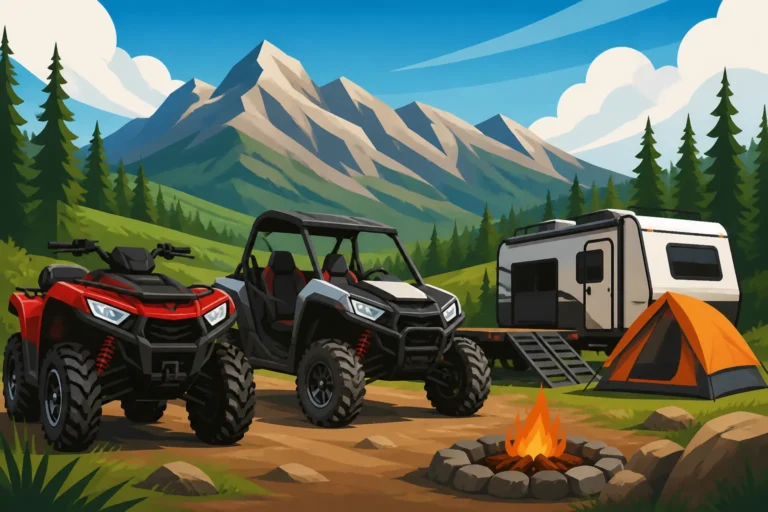
Keep machines on established access routes and park them on firm ground. A UTV and trailer take up more space than a tent, so plan the entire footprint before committing to a site. If your group needs several machines, position them together rather than spreading them across open ground in a way that looks like multiple camps.
Pack out everything you bring, including food scraps and small pieces of packaging. Keep fires within permitted areas and follow any fire restrictions in place. A campsite that is well spaced but left with ruts, litter, or a damaged fire spot still creates problems for the next visitors.
A practical way to plan campsite spacing
Compare your options before the ride
Before leaving home, identify more than one potential place to camp. Popular access areas can fill up, and a site that looked ideal on a screen may be closed, occupied, or unsuitable when you get there. Having a backup prevents the pressure to settle too close to another party late in the day.
Use this checklist when comparing options:
| Check | What to look for | Why it matters |
|---|---|---|
| Land status | Confirm camping is permitted in the area | Public access does not always mean camping is allowed |
| Nearby camps | Look for occupied sites and signs of recent use | Helps you avoid crowding another group |
| Separation | Measure distance between potential campsites | A map can help flag sites that may be too close |
| Access | Check road, trail, and seasonal conditions | A route may be unsuitable for a trailer or large UTV |
| Ground | Prefer durable, firm surfaces | Reduces rutting and damage to vegetation |
| Facilities and closures | Review local restrictions and posted notices | Extra rules may apply near facilities or recreation areas |
A tool such as onX Offroad can help you compare access routes and terrain, but confirm important details with the relevant land information and signs on site. Don’t assume a map app will show every temporary closure or local restriction.
Plan for a group, not just one machine
A group of friends can unintentionally take up much more room than a couple travelling in one ATV. Add a UTV, a trailer, tents, cooking gear, and several machines, and the camp’s footprint grows quickly. Agree on a compact layout before arriving so that the group can share one suitable area rather than scattering into separate clearings.
Have one person check the surrounding area while another stays with the group. If another party is already nearby, look for a different location rather than letting everyone start unloading while you decide. For a large group, consider a designated campground or another area specifically suited to group use.
Be considerate about sound and headlights, especially after dark. A kilometre of separation does not make noise disappear in a quiet valley. Keep music low, avoid unnecessary engine starts, and give nearby campers the same peaceful evening you’d want for your own group.
Know when to choose a different kind of campsite
Random camping is not always the best option. If you arrive late, the area is crowded, or you can’t confirm that a spot meets the applicable requirements, move on or use a designated campground. A longer ride to a lawful, suitable place is preferable to setting up in a questionable location because it is convenient.
Designated sites may be a better fit for families, groups with trailers, or riders who need dependable access to basic facilities. They can also simplify the planning process when you’re unfamiliar with an area. Check the rules for the specific campground, since site capacity, vehicle access, and fire conditions can differ.
Before choosing a spot, review Checking a Zone Before You Go. The time spent confirming access and camping rules is far less frustrating than arriving with a loaded trailer and discovering that the planned site is closed or unsuitable.
Common mistakes and how to avoid them
Assuming a clear view means enough distance
In open country, it may seem easy to judge whether another camp is far away. In forest or broken terrain, visibility is a poor measure of distance. A campsite can be hidden from view and still be closer than you think, so use a map or another reliable method rather than relying only on what you can see.
The reverse can happen too: two camps may appear close because they are visible across a valley, even when the actual separation is substantial. When you’re uncertain, move farther away if there is a suitable option. Giving extra space is usually easier than arguing over a marginal measurement later.
Treating the relocation requirement as a loophole
Moving your tent a few metres, shifting your machines to the other side of a clearing, or driving a short loop before returning does not necessarily satisfy a requirement to relocate. A meaningful move needs to follow the applicable distance and time conditions, not just make the campsite look different.
Keep simple notes about when you arrived and where you camped, especially on a longer trip. If your plans involve staying in the same general area, check the location-specific rules before extending your stay. Alberta’s 14-Day Camping Limit can help clarify why the time limit and distance requirement need to be considered together.
Relying on an old map or another camper’s advice
A friend may have camped in a spot last season, but land access, closures, and local conditions can change. An old map or a forum comment can be helpful background, not proof that a site is open now. Look for current area information and obey posted signs, even if they conflict with what someone told you before the trip.
It’s sensible to save offline maps and note alternate campsites, but treat those preparations as a starting point. Confirm conditions when you reach the area. If you cannot verify that random camping is allowed or determine whether the campsite is sufficiently separated, choose a clearly authorized option instead.
Disclaimer
This article is for general informational purposes only and does not constitute professional advice. Laws, prices and regulations vary by location and change over time. Consult a qualified professional for guidance on your specific situation.