What a Trail Manager Does Under the Trails Act
A trail manager is often the person or organization keeping a riding route usable, understandable and cared for, but the title does not mean they control every road or trail in Alberta. This guide explains what trail managers do under the Trails Act, how their work affects ATV and UTV riders, and where a manager’s role ends.
What a trail manager does under Alberta’s Trails Act
Management starts with an assigned trail and an agreed role
In Alberta, the Trails Act provides a framework for managing trails through arrangements between the province and trail managers. A manager’s role is tied to the trail or trails covered by the applicable agreement or authorization. It is not a province-wide licence to manage any route that happens to look like a trail.
That distinction matters when you are riding. A route may cross public land, connect with a road, or pass close to an industrial or recreational area. The trail manager may be responsible for certain trail-related work, while the province, another public authority, a landholder or an operator retains responsibilities for other aspects of the area. The exact division depends on the trail and the arrangements in place.
Trail managers may include organizations or groups with local knowledge and the capacity to look after a route. A riding club, for example, might take on trail work and visitor information in a defined area. How a Local Club Ends Up Managing a Trail explains how a local group can become involved; The Twenty-Four Clubs Behind Alberta’s Trails offers more context on the clubs that support Alberta’s trail network.
The manager is not automatically the landowner or the police
The word “manager” can sound broader than it is. A trail manager is not necessarily the owner of the land, the authority responsible for every nearby road, or the person who can make any legal decision about public access. Their authority depends on the relevant agreement and other applicable rules.
Nor should riders assume that a trail manager has the same enforcement powers as a peace officer. Managers may communicate rules, document problems, arrange maintenance or raise concerns with the appropriate authority. But a trail sign, a manager’s request and a formal legal closure are not interchangeable. If a route is closed or access is restricted, follow the posted direction and check the applicable official information rather than trying to determine the manager’s authority from the sign alone.
This is especially useful to remember around staging areas, trail junctions and public land boundaries. The person who installed or maintains a sign may be helping communicate a restriction, but questions about the legal status of a route should be confirmed with the responsible authority. What a Right-of-Way Bylaw Actually Lets You Ride and Checking a Zone Before You Go can help clarify why the route’s location and governing rules matter.
Day-to-day responsibilities on a riding trail
Trail maintenance and condition checks
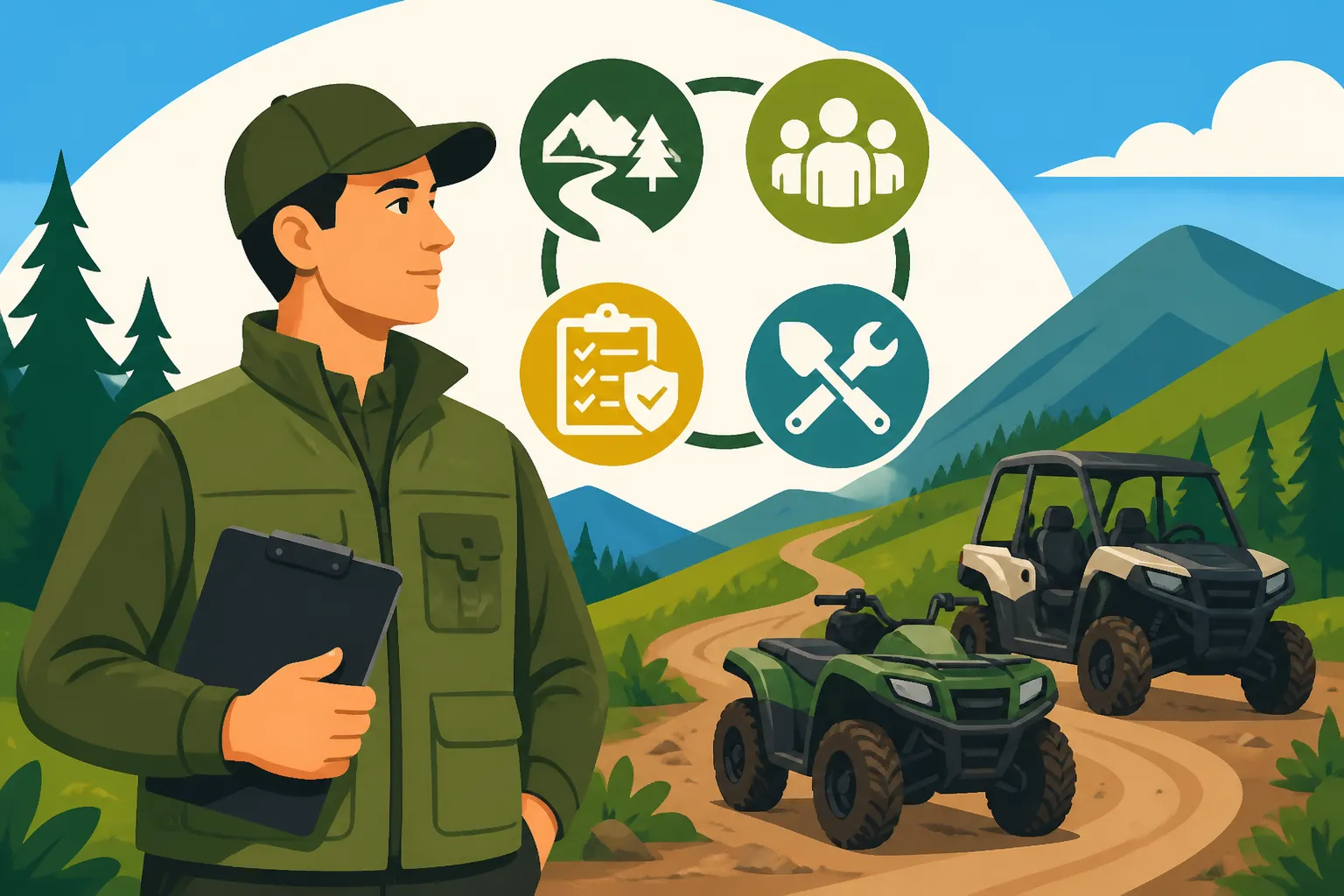
A practical part of trail management is keeping routes in reasonable condition for their intended use. Depending on the agreement, resources and local conditions, that can involve inspecting the trail, identifying damage, arranging repairs, and maintaining signs or other trail features. After a heavy rain, for instance, a manager or volunteer crew may notice deep ruts, washouts or a damaged crossing and report the problem or organize appropriate work.
Maintenance is not a promise that every trail will be smooth, open or suitable for every machine. Remote routes can change quickly, and a manager may not be able to inspect every section after every storm. Some repairs also require coordination or approval before work begins, particularly where land management, environmental protection or other uses are involved.
A trail manager’s work can include recognizing when a route needs attention rather than immediately repairing it. A washed-out section, a blocked route or unsafe conditions may call for a warning, temporary closure or referral to the relevant authority. For riders, that means a trail shown on a map is not necessarily in good condition on the day of a ride. Alberta Trail Closures After a Storm and Staying on the Trail Tread cover two practical ways trail condition and rider behaviour affect the route.
Signs, information and rider communication
Trail managers may help riders understand where a route goes, what type of use is intended, and whether there are local restrictions or hazards to be aware of. That work can include maintaining signs, sharing trail information, communicating closures, or helping visitors find staging and access points.
Clear information is particularly valuable for riders who are new to an area. A junction can be confusing when multiple tracks meet, and a route that appears to continue may lead outside a designated riding area. Managers and local clubs can help make trail information easier to interpret, but riders still need to check official maps and rules before setting out.
Digital mapping tools can add another layer of planning. For example, onX Offroad may be useful for viewing routes and preparing a ride, but a mapping app should not be treated as proof that a trail is open or legally available. Compare map information with current official land-use guidance and signs at the site. Alberta Trail Maps Worth Downloading and Reading a Public Land Trail Guide are useful companions when you are checking a route before leaving home.
Stewardship and coordination
Trail management is also about looking after the place around the route. Depending on the location, that can mean encouraging riders to stay on established trails, reducing avoidable damage, communicating sensitive areas, and reporting concerns to the appropriate land manager. A trail that is repeatedly widened or bypassed can create more disturbance than the original route, especially when riders make new tracks around mud or obstacles.
Managers may also coordinate with volunteers, local clubs, public agencies and other people who use or work in the area. For example, a trail might need attention after a storm, during a busy riding period or when other land activities affect access. Coordination helps avoid work that conflicts with a closure, creates a safety issue or damages an area that needs protection.
This is one reason trail management is not always visible as a freshly graded route. A manager might spend time gathering condition reports, arranging volunteers, sharing a closure notice or directing a concern to the right authority. Alberta Trail Funding for Clubs and What Alberta’s Trail Grant Money Actually Builds offer more background on the people and resources that can support this work.
| Trail-management task | What riders may notice | What it does not automatically mean |
|---|---|---|
| Checking trail condition | A hazard report, maintenance work or a warning | The manager can repair every problem immediately |
| Maintaining signs and route information | Directional signs or local guidance | Every sign replaces official rules or land-use information |
| Communicating closures or hazards | A notice at a trailhead or online | The manager independently controls every nearby route |
| Coordinating volunteers and partners | Work days or changes to trail features | The manager owns the land or has police powers |
| Promoting responsible use | Reminders to stay on established trails | A rider can ignore a formal restriction if a track is visible |
How riders can work with trail managers
Check the route before you unload
Before travelling to a riding area, confirm where riding is allowed, whether access is restricted, and whether the trail is suitable for your machine and experience. A route line in an app can be helpful, but it may not show a recent closure, local restriction or change in conditions. Use official land-use information as your main reference and treat third-party maps as planning aids.
If you use onX Offroad, check the details available for your area and compare them with official information before relying on a route. Downloading or reviewing map information ahead of time can help with navigation, particularly where mobile service is limited, but it cannot replace signs, closure notices or local rules. A visible tire track is not, by itself, evidence that the route is open to OHVs.
At the trailhead, take a moment to read posted notices and look for temporary warnings. If the information is unclear, do not assume the route is open simply because other vehicles are using it. Alberta OHV Trails: Riding Public Land provides broader context for planning a public-land ride, while Alberta Trail Etiquette Locals Expect covers considerate behaviour once you are out there.
Report problems clearly and respectfully
If you find a blocked trail, damaged sign, unsafe crossing or significant erosion, report it through the contact channel provided by the managing organization or responsible authority. A useful report is specific: name the trail or area, identify a nearby junction or landmark, describe what you saw, and note when you encountered it. If safe and appropriate, a photograph can help explain the issue.
Keep the report factual. “The crossing at the north end of the route is washed out, and the marked trail is difficult to identify” is more useful than a general complaint that an area is poorly managed. Avoid entering a closed section to investigate or attempting repairs yourself. Work may require permission, equipment or coordination with the land manager.
Riders can also help by following posted directions, staying on the established trail and packing out what they bring in. These small choices reduce wear and make it easier for managers and volunteers to focus on needed repairs rather than preventable damage.
Understand what to do when access is disputed
If a sign, map or verbal direction appears to conflict with another source, pause and verify the information before riding on. Note where the route is, what the sign says, and which authority or organization provided the information. Contact the relevant land manager or trail organization for clarification rather than treating a disagreement as permission to proceed.
A trail manager can often explain trail conditions, local routing or who to contact. For questions about legal access, boundaries or a formal restriction, the responsible public authority is the better place to confirm the rule. The manager’s role may be important, but it does not erase the need to follow applicable land-use rules and posted restrictions.
That distinction is useful in real situations: a club volunteer may know that a trail is muddy and advise riders to avoid it, while a formal closure may come from the authority responsible for the land. In either case, taking the safer route and checking before continuing is usually the least frustrating choice. It can prevent a wasted trip, avoid damage and help keep the trail usable for the next rider.
Disclaimer
This article is for general informational purposes only and does not constitute professional advice. Laws, prices and regulations vary by location and change over time. Consult a qualified professional for guidance on your specific situation.