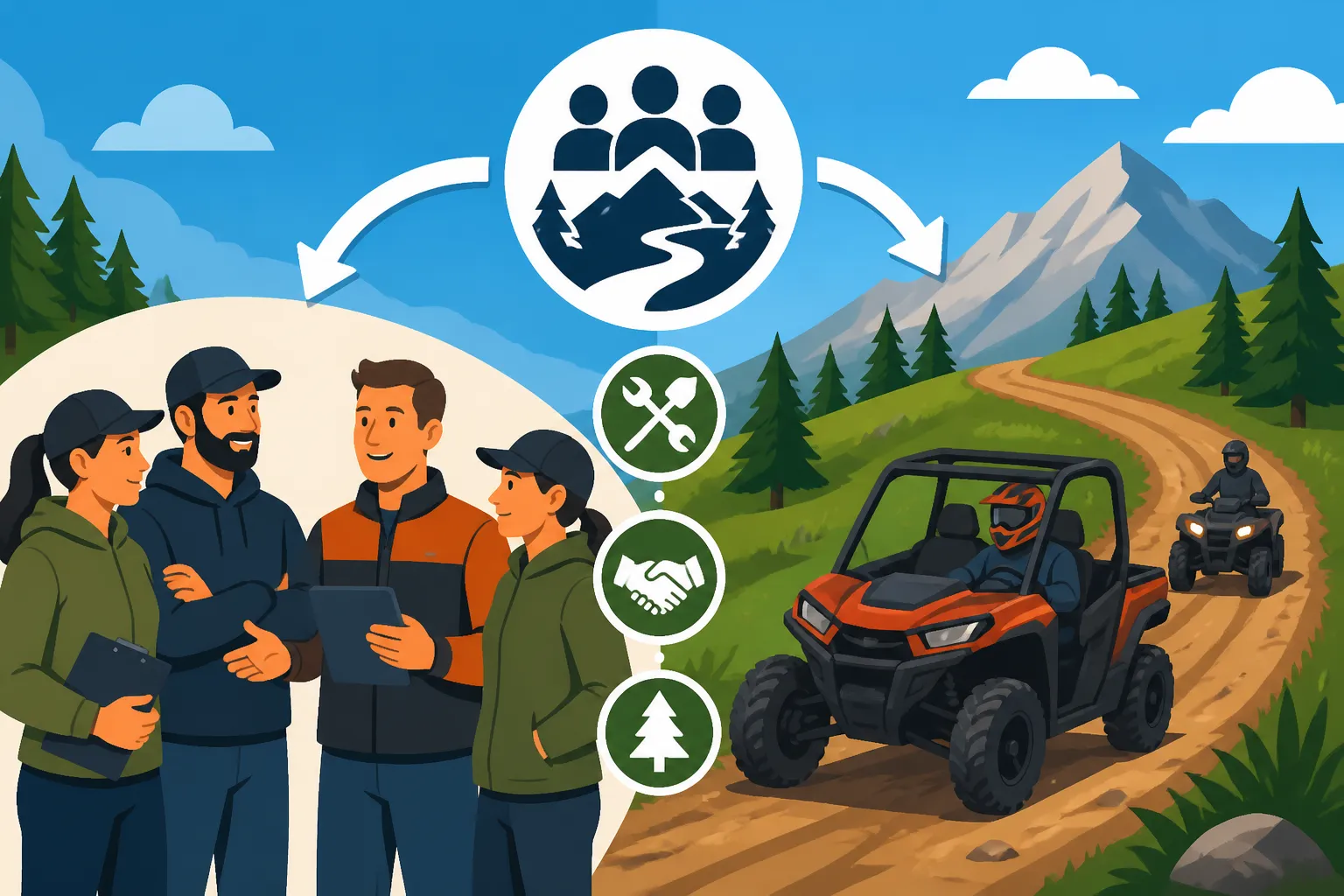
How a Local Club Ends Up Managing a Trail
A trail can look like it simply appeared through the trees, but keeping it rideable takes planning, maintenance, and coordination. In Alberta, local clubs sometimes take on that work through agreements with land managers, grants, and volunteer effort. Here’s how a club can become involved, what “managing” usually means, and why it doesn’t automatically mean a trail is open to every rider.
How a local club becomes involved with an Alberta trail
The need usually starts on the ground
A club’s involvement often begins with a practical concern. Riders notice a washed-out section, confusing junctions, litter at a staging area, or a route that has become difficult to follow. Sometimes a land manager identifies the need and asks an established club or trail organization to help. In either case, the club’s first step is generally to clarify what work is needed and who has authority over the land.
That distinction matters. A club may organize volunteers, provide local knowledge, or help with maintenance, but the public authority responsible for the land still determines what activities are allowed and what conditions apply. The relationship varies by location. A route near McLean Creek, for example, may involve different planning and access considerations from a community trail or a section of the Iron Horse Trail.
A club that wants to help will usually need to identify the trail or area precisely, describe the issue, and contact the relevant land manager or trail organization. A vague request to “fix the trail” can be difficult to act on. A specific report—such as a damaged sign at a named junction or erosion on a particular section—gives everyone a clearer place to start.
Permission and a working relationship come before maintenance
A club should not assume that a well-intentioned trail project is automatically permitted. Cutting brush, moving obstacles, placing signs, changing a route, or bringing equipment onto public land may require approval. The land manager can set the scope of work, identify sensitive areas, and explain any conditions that volunteers must follow.
Once the basic need is understood, the club and land manager can work out who is responsible for what. That may involve a written agreement, a defined maintenance area, reporting expectations, or a plan for how to handle closures and safety concerns. The arrangement is not necessarily the same from one trail system to another, so riders should not assume that a club’s role at one location applies elsewhere.
A club’s connection to an area can also grow gradually. It might first help with a cleanup day, then coordinate volunteer maintenance, and later assist with signs or trail information. Those steps still do not transfer ownership of the land or give the club authority to open routes. For a broader look at the relationship between clubs and trail systems, see AOHVA and Alberta Trail Management and What a Trail Manager Does Under the Trails Act.
What trail management can involve
Maintenance, signs, and local knowledge
“Managing a trail” can mean several different things. A club may help keep a route clear, report damage, maintain signs, share trail information, or organize volunteers. The exact work depends on the agreement and the location. It may be as modest as checking signs before a busy season, or it may involve a coordinated schedule of inspections and maintenance.
Local knowledge is valuable because riders often notice small changes quickly. A club may hear that a junction is confusing, a creek crossing has changed, or a staging area is becoming congested. That information can help a land manager understand what is happening on the ground. It does not mean the club can make every change itself; route changes and access decisions should go through the appropriate authority.
Trail work also includes unglamorous details that make a ride safer and more predictable. Volunteers may help remove litter, replace damaged markers with permission, or report washouts and fallen trees. Good maintenance respects the surrounding land. It avoids widening the trail unnecessarily, disturbing sensitive areas, or creating informal routes around a closure.
Funding and volunteer capacity
Trail work takes time and materials, and clubs often depend on volunteers. Grants can help pay for eligible work, equipment, signs, or other approved trail-related needs, but funding does not guarantee that a project will be approved or that access will remain open. Funding applications and project plans need to fit the program’s requirements and the land manager’s priorities. For more context, see Alberta Trail Funding for Clubs.
Volunteer capacity is another limit. A club may have a small group of people doing a large amount of work, and they may be balancing trail tasks with jobs, family commitments, and riding schedules. A trail that looks quiet on a map may require substantial checking after a storm, during spring melt, or after heavy use. That is one reason a maintenance plan needs to be realistic rather than built around an ideal volunteer turnout.
| Trail activity | What a club may contribute | What still needs to be confirmed |
|---|---|---|
| Trail inspection | Report erosion, damage, or confusing junctions | Who receives reports and how urgent issues are handled |
| Volunteer work day | Organize people for approved cleanup or maintenance | Permission, work boundaries, tools, and safety expectations |
| Signs and route information | Help identify missing or unclear information | Approval for sign placement and wording |
| Trail maps | Share local knowledge and route updates | Whether a route is currently open and suitable for a specific machine |
| Closure communication | Help pass along a closure notice | Which authority issued the closure and when it may change |
The table describes possible contributions, not a standard Alberta-wide arrangement. A club’s role can be narrow or extensive, and the responsible land manager remains the best source for the rules that apply to a particular area. For a closer look at club participation, Alberta Trail Volunteer Days explains the kind of work riders may encounter.
What club management does not mean for riders
A club does not automatically open a trail
One of the easiest assumptions to make is that a trail maintained by a riding club must be open to all off-highway vehicles. That is not necessarily true. Access can depend on the land designation, route designation, machine type, seasonal conditions, closures, and local rules. A club may help maintain a route without having authority to decide who can ride it.
This distinction is especially important when a route appears on an app or an older map. A mapped line is not, by itself, proof that riding is permitted. Check the applicable land information and notices before you unload. In Alberta’s public land areas, conditions can change, and a route shown in one place may not reflect a current closure or seasonal restriction.
Digital maps can still be useful for planning, but treat them as one reference rather than the final word. Some riders use onX Offroad to compare route information with official maps and local notices; the responsible land manager’s current guidance should take priority when information conflicts. Before heading into an unfamiliar area, Checking a Zone Before You Go is a useful reminder to confirm the rules at the destination.
A maintained route is not a promise of ideal conditions
Even when a route is open, “managed” does not mean every section is smooth, freshly cleared, or suitable for every rider. A club may focus its limited effort on priority locations, and conditions can change quickly after rain, snowmelt, fire activity, or logging. A trail that was passable on a previous visit may now have mud, debris, or a difficult crossing.
Riders can reduce unpleasant surprises by checking for recent notices and planning for conditions rather than relying on a single past experience. Look at the route length, access points, expected terrain, and options for turning back. If you are riding with a group, make sure everyone understands the route and has a plan if a machine becomes stuck or a section is blocked.
Map apps can support that preparation, but they should not replace official information or good judgment on the trail. For instance, onX Offroad may help a rider orient themselves while comparing possible routes, but the app should not be treated as permission to ride a line that has not been confirmed as open. Keep a copy of relevant maps or notices available offline when service may be limited, and check Alberta Trail Maps Worth Downloading before travelling to a new riding area.
How riders can support local trail management
Follow the route and report problems clearly
The most useful thing a rider can do is stay on the route that is open and designated for their machine. Riding around a muddy patch can widen the trail and create new damage. Bypassing a closure can undermine restoration work and make it harder for land managers and clubs to keep access options available. If a section is blocked, turn around where it is safe rather than making a new route through the surrounding land.
When you spot a problem, report it with useful details. Name the trail or area, describe the location as precisely as you can, explain what you observed, and include whether the issue creates an immediate safety concern. A photo can help if it can be taken safely and without leaving the trail. Avoid assuming that a club has received the report simply because it works in the area; use the designated reporting channel where one is provided.
Respectful trail behaviour also reduces the work that volunteers and land managers have to do. Pack out your garbage, avoid unnecessary noise near homes and other users, and give people and wildlife room. The practical expectations in Alberta Trail Etiquette Locals Expect apply whether a route is maintained by a club, a public agency, or a partnership.
Volunteer without freelancing
If you want to help, contact the club or trail organization connected with the area and ask what support is useful. A volunteer day is a better starting point than arriving with tools and making changes on your own. The club can explain where work is approved, what to bring, and whether volunteers need to follow particular safety procedures.
You can also contribute by sharing accurate observations, helping with approved cleanup, or supporting a club’s organized work. If you ride with a group, encourage everyone to follow closures and avoid creating unofficial cut-throughs. Those small choices help protect the trail’s condition and the relationship between riders, local communities, and land managers.
Before a ride, check the official information for your destination, then use supplementary resources thoughtfully. Some riders use onX Offroad alongside land-manager maps and posted notices to plan their route, but the key is to verify access rather than assume a line on a map is open. If weather or trail conditions have changed, look for Alberta Trail Closures After a Storm before leaving.
A local club’s involvement can make a trail system easier to understand and maintain, but it depends on cooperation, permission, and realistic volunteer effort. Riders help that work succeed by following designated routes, checking current access information, and reporting problems through the right channels.
Disclaimer
This article is for general informational purposes only and does not constitute professional advice. Laws, prices and regulations vary by location and change over time. Consult a qualified professional for guidance on your specific situation.