Where to Park a Long Trailer
A long trailer can turn an Alberta ATV trip into a parking puzzle: a staging lot may be busy, uneven, tight to turn around in, or not suited to your rig at all. This guide explains how to choose a practical place to park, check access before leaving home, and avoid arriving at a trailhead with nowhere safe to unload.
Choose a staging area that fits your whole rig
Check the lot, not just the trail
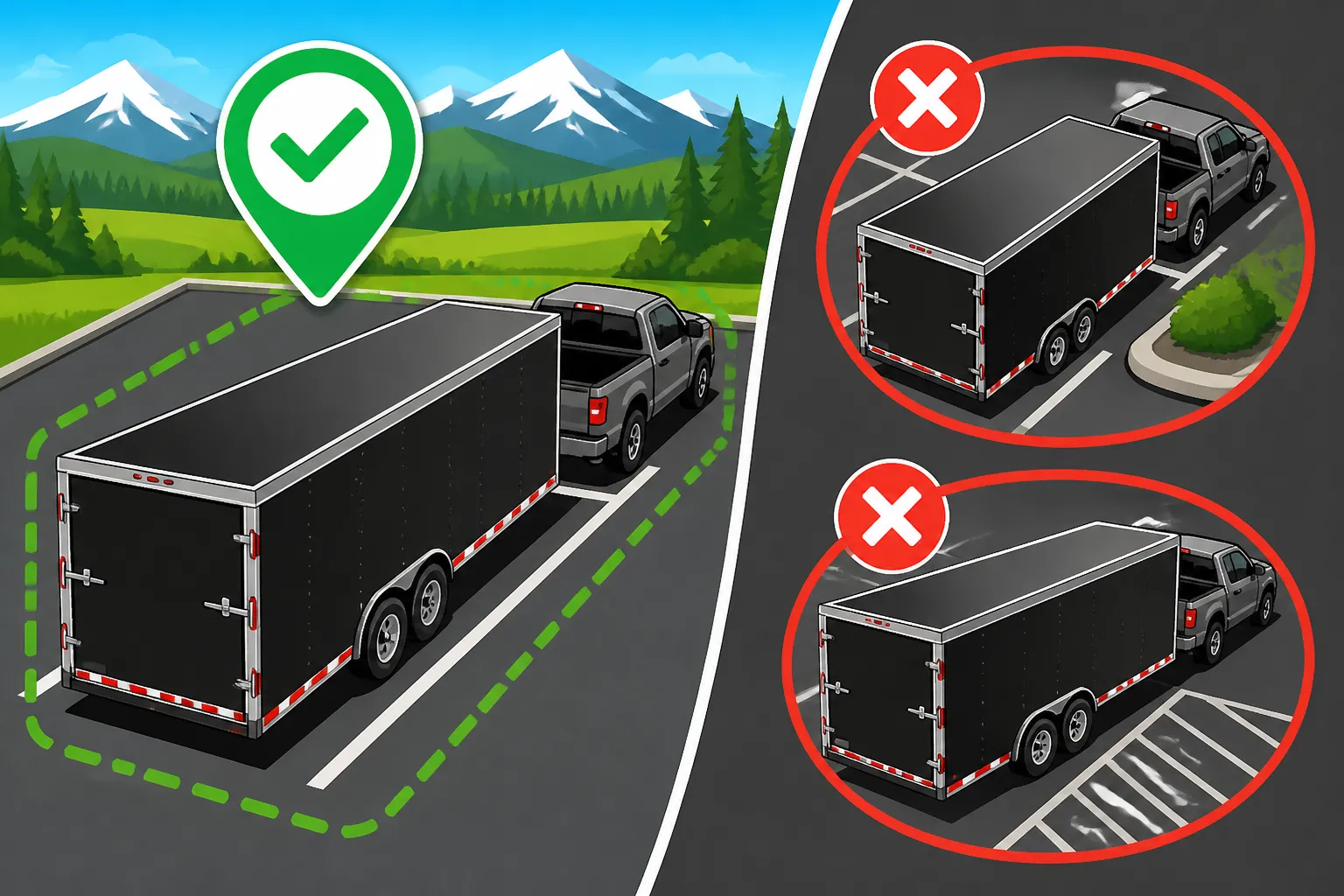
A trailhead that looks close to your route on a map is not automatically a good place to park a truck and long trailer. The actual staging area may have a short entrance, a narrow turning loop, soft shoulders, a steep approach, or limited room between parked vehicles. Even if you can reach the trail, you still need enough space to position the trailer, unload the machines, and leave without blocking someone else.
Look for information that describes the staging area itself, not simply the trails nearby. A marked parking area may serve hikers or smaller vehicles and may not be laid out for a long trailer. Check whether the access road is suitable for your tow vehicle, whether there is room to turn around, and whether parking is permitted for the kind of outing you have planned. When details are unclear, contact the land manager, municipality, or local trail organization rather than relying on a pin or an old comment online.
This matters at popular places such as McLean Creek and the Ghost Public Land Use Zone, where riders may be arriving and leaving throughout the day. A lot that feels roomy early in the morning can become awkward once several trucks, trailers, and groups are trying to maneuver at once. Browse broader options in Alberta OHV Camping and Staging Areas and check local details for Staging at Fisher East in Alberta. Treat any map as a starting point, not a guarantee of available parking.
Measure the complete setup before you go
When deciding whether a location will work, think about the full combination: tow vehicle, hitch, trailer, and the extra space needed to make a turn. A trailer’s advertised length may not include the tongue, and the truck needs room to swing through a turn without clipping a post, another vehicle, or a ditch edge. If you are travelling with a particularly long trailer, measure the whole rig from the front of the truck to the rear of the trailer.
Consider these practical questions:
- Can you enter and leave without making a difficult multi-point turn?
- Is there enough room to park without extending into a travel lane or blocking another vehicle?
- Can you unload without placing machines in the path of arriving traffic?
- Is the ground firm and reasonably level?
- Can you turn around if the main parking area is full?
- Is there a safe place to wait without obstructing the entrance?
A location can technically fit your trailer and still be a poor choice if you need to back a long distance through a crowded lot. For example, a driver arriving at a narrow staging area after a group ride has started may have to reverse while other vehicles are passing. Choosing a more spacious, confirmed location—or arriving when there is time to assess the layout—can make the whole day calmer.
Research access and parking before departure
Use maps to plan the final approach
Plan the last part of the drive as carefully as the highway portion. A navigation app may route you to a trail access point, but that does not necessarily mean the approach is suitable for a large trailer or that parking is available at the destination. Zoom in on the road network, look for the marked staging area, and check whether the route includes narrow roads, tight bends, gates, or surfaces that could be difficult after rain.
Tools such as onX Offroad can help you explore an area and compare route options before you leave. Use them to orient yourself, then cross-check important access and closure details against the relevant official land or trail information. A digital map can help answer “Where does this road appear to go?” It cannot reliably answer “Will there be a clear place for my trailer when I arrive?” or confirm that a road is open on the day of your trip.
Download or save the information you need before entering areas with unreliable reception. Alberta Trail Maps Worth Downloading and Alberta OHV Trail Map Downloads are useful starting points for planning. If you use a phone-based map, learn how to access it offline and make sure your route, parking location, and backup option are easy to find without a signal. Loading an Avenza Trail Map Onto Your Phone covers another practical way to prepare for navigation away from cell coverage.
Confirm local restrictions and changing conditions
Parking arrangements can differ between public land areas, municipal sites, and privately managed locations. A trail map may show a staging area without explaining every restriction that applies to parking there. Check posted signs when you arrive, follow instructions from land managers, and avoid assuming that roadside space is an approved overflow lot.
Conditions can also change. A road may be muddy, a lot may be affected by maintenance or seasonal closures, and a busy weekend can fill an otherwise usable area. If your plan depends on one specific staging lot, look for a second option before you leave home. Alberta Trail Closures After a Storm is a helpful reminder to check conditions, while Arriving Early When the Staging Lot Fills Up speaks to the practical value of timing your arrival.
| Planning question | What to check | Why it matters with a long trailer |
|---|---|---|
| Is parking designated? | Signs, official area information, or land-manager guidance | A nearby open space may not be approved parking |
| Is the approach suitable? | Road width, surface, turns, gates, and recent conditions | Tight or soft access can make towing difficult |
| Can the rig turn around? | Lot layout, loop roads, and a backup turnaround point | Reversing a long trailer in traffic is stressful |
| Is there room to unload? | Space beyond the truck and trailer, away from moving vehicles | Unloading should not block the entrance or other users |
| What is the backup plan? | Another confirmed staging area or a revised riding location | A full lot should not force an unsafe roadside stop |
Park, unload, and leave the area safely
Arrive with a simple parking plan
Before pulling into a busy staging area, slow down and look for signs, traffic movement, and available space. If you can, have a passenger check the layout while you approach. Avoid stopping across the entrance to discuss where to park; if the lot is congested, move to a safe place where you are allowed to wait and reassess.
Once you choose a spot, park so that other vehicles can pass and turn. Keep the truck and trailer within the designated parking area, and do not use access roads, gates, turnaround points, or emergency routes as overflow parking. If the lot is too tight for a comfortable turn, do not commit to a maneuver just because you have already driven in. A safer alternative may be to leave and use a location you have checked in advance.
For a group, agree on a meeting point and arrival order before the convoy reaches the staging area. One vehicle at a time can enter and park while the others wait somewhere lawful and safe. Alberta Group Ride Planning offers useful ideas for coordinating arrivals, especially when participants are towing different sizes of trailers or bringing several machines.
Make unloading orderly and considerate
Once parked, unload in a way that keeps the shared area clear. Set up ramps on stable ground, keep machines close to the trailer while riders gear up, and move equipment out of traffic lanes as soon as it is safe to do so. Avoid spreading helmets, tie-downs, coolers, and tools across the space other riders need to use.
Before heading out, check that the trailer is secure and that nothing valuable or loose has been left exposed. If you are leaving the trailer unattended, follow any posted parking rules and use a location where it is not blocking access or creating a hazard. When you return, load up efficiently so the space is available for the next group. A tidy, quick turnaround helps everyone, especially when the lot is busy.
Build a backup plan for tight or full lots
Decide in advance when to change plans
A good backup plan is more than a second map pin. Identify another confirmed staging area, estimate the additional drive, and decide what you will do if the primary lot is full or unsuitable. If the alternative would require a long, uncertain tow on a rough road, it may be better to change riding locations before you leave rather than improvising at the trailhead.
For example, a group towing several machines toward the foothills might plan to meet at a larger, verified staging location instead of assuming every nearby access point can accommodate the convoy. Check the complete route, not just the destination: a suitable lot can still be a poor choice if the final approach includes a narrow road or a difficult turn for your trailer. Hauling to a Staging Area in the Foothills is relevant when planning that final drive.
If you reach the area and discover there is no safe place to park, do not squeeze onto a shoulder, block a gate, or leave the trailer where it restricts other users. Pause somewhere safe, consult your backup plan, and contact the relevant local office or land manager if you need clarification. Being willing to adjust the day is frustrating, especially after a long tow, but it is better than creating a hazard or getting stuck in a tight access area.
Use a final checklist before towing out
A short check at home can prevent a long, uncomfortable reversal at the trailhead. Confirm the destination and backup, make sure your map works offline, and check the trailer’s measurements against the space you expect to use. If you are uncertain about parking capacity or access, seek confirmation before setting out.
Before departure, ask yourself:
- Have I identified a designated or otherwise permitted staging area?
- Have I checked the final approach for trailer-friendly access?
- Do I know where I can turn around if the lot is full?
- Have I checked for local notices, closures, or parking restrictions?
- Can I navigate to the area without relying on cell service?
- Does everyone in the group know where to meet and what the backup plan is?
Using onX Offroad or another mapping tool can make it easier to compare access routes and keep your destination organized, but treat mapped information as one part of the decision. Recheck official notices, watch for signs on the ground, and be prepared to change plans if conditions or parking make the original choice impractical. With a little preparation, the trailer becomes part of the trip rather than the problem that defines it.
Disclaimer
This article is for general informational purposes only and does not constitute professional advice. Laws, prices and regulations vary by location and change over time. Consult a qualified professional for guidance on your specific situation.