Staging a Group at Fisher East
A group can arrive at Fisher East ready to ride and still lose time sorting trailers, finding one another, and agreeing on a route. The staging area is a useful starting point for riding in the McLean Creek area, but a smooth meetup takes more than picking a time. This guide covers planning, parking, navigation, and trail etiquette for a group ride.
Plan your Fisher East meetup before leaving home
Confirm the destination and current access
Fisher East is associated with the McLean Creek riding area southwest of Calgary. Before your group sets out, confirm the staging area’s location and the route you plan to take using current official maps and local notices. Road conditions, trail access, and closures can change, so an old screenshot or a route remembered from a previous visit may not be enough.
Make sure every driver has the same destination details, rather than relying on one person to guide a long convoy from memory. Agree on a meeting point in town or at a clearly identified road junction if members are travelling from different directions. Then share the final staging-area location and a backup plan in case someone is delayed or takes a wrong turn.
If your group is comparing options in the wider area, McLean Creek: Alberta’s Best Known OHV Area offers useful context. For a broader look at the riding network, see McLean Creek’s 100 Kilometres of Alberta Trail. Those overviews can help everyone arrive with a realistic idea of the area, but use current trail information to decide which routes are open and appropriate for your machines.
Set a realistic arrival time
A start time should account for more than the drive. Riders may need to unload, secure their trucks and trailers, check machines, use the facilities if available, and discuss the route before heading out. If the first planned departure is early, tell the group when you expect people to be parked and unloaded—not simply when they should leave home.
Arriving early can be especially useful on busy days, but it does not guarantee a particular parking spot or an empty lot. Build in enough time to park without rushing, and avoid making the whole group wait while one person finishes loading or looks for missing gear. Arriving Early When the Staging Lot Fills Up is a helpful related read if your group is trying to avoid a last-minute scramble.
For a large group, staggered arrivals may work better than having every vehicle pull in together. Choose a time window, identify a person who will arrive first, and make sure later arrivals know where to check in without blocking other vehicles. Keep the meetup flexible enough to absorb ordinary delays, but set a latest departure time so the group is not debating its plan indefinitely.
Organize vehicles, trailers, and riders at the staging area
Coordinate parking without assuming the lot’s layout
Before the ride, ask each participant whether they are bringing a truck, trailer, or both. A group of riders may translate into far fewer vehicles than people, or it may mean a line of separate tow rigs. That difference affects how much space you need and how you should arrange the meetup.
Do not assume you can reserve spaces, park in a particular configuration, or leave a trailer in a specific spot. Follow posted signs and any directions at the site. Avoid taking up more room than your vehicle and trailer need, and leave clear access for other users. If there is not enough suitable space for the whole group to park together, have a secondary plan rather than circling repeatedly or blocking the entrance.
A quick vehicle count makes this easier. Ask who is towing, who can share a ride, and whether anyone needs extra room to unload. Alberta Staging Areas With Trailer Parking can help with the broader question of staging and trailer logistics, but check the conditions and signs at Fisher East when you arrive.
| Before the group arrives | Why it helps | Simple action |
|---|---|---|
| Count tow vehicles and trailers | Gives you a realistic sense of parking needs | Ask each rider how they are getting there |
| Choose a lead contact | Prevents several people giving conflicting directions | Share one person’s phone number with the group |
| Set a backup meeting point | Helps late arrivals find the group | Pick a clear public landmark on the way |
| Agree on a departure time | Keeps the meetup from stretching into the ride | Set a time for unloading and another for wheels rolling |
| Check current maps and notices | Helps avoid closed or unsuitable routes | Review access before the day and again before riding |
Make unloading and pre-ride checks orderly
Once parked, unload carefully and keep people, machines, and gear within the space available to your group. Avoid leaving ramps, tie-downs, fuel containers, or loose equipment where other visitors need to walk or drive. If the parking area is busy, have one person watch for traffic while others unload.
Give riders time to check their machines before the group moves out. A basic check can include fuel, tires, brakes, steering, lights, controls, and any gear needed for the planned route. Confirm that the machine is registered and insured where required, and that riders have the documents and equipment they need. For more on what may be checked during a ride, see Alberta Equipment Checks by Officers.
Agree on a simple departure routine: finish unloading, put away gear, confirm everyone is ready, then move out together or in a planned sequence. Starting engines while people are still walking behind machines or tightening straps creates unnecessary confusion. If someone discovers a problem, stop and deal with it before the group enters the trail network.
Choose a route the whole group can manage
Match the ride to the least experienced rider
A group route should suit the people and machines actually present, not the most confident rider’s idea of a fun day. Ask about experience honestly before you arrive. A beginner may be comfortable on a broad, familiar trail but uneasy on steep, rocky, muddy, or narrow sections. Differences in machine type and capability matter too.
Agree on a conservative first route, then reassess at a safe stopping point. That gives newer riders a chance to settle in and gives the group a chance to adapt if conditions are rougher than expected. If the route becomes uncomfortable for someone, turning around or choosing an easier option is sensible—not a failure. The best group ride is one everyone can complete safely.
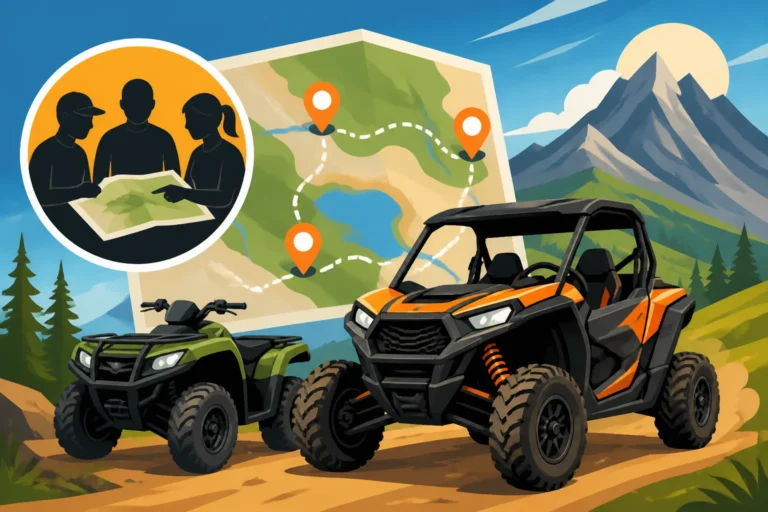
Use current maps to plan a route with clear landmarks and realistic stopping points. The official map and trail information should guide decisions about access and closures. A digital mapping tool can also help a group see where members are in relation to a planned route. For example, onX Offroad can be one navigation reference, but don’t treat any app as a substitute for current local information or sound judgment. Download or save what you need before leaving an area with reliable service.
Keep the group together without riding on top of one another
A practical group plan identifies a lead rider and a sweep rider. The lead knows the intended route and sets a pace that suits the group; the sweep stays behind the last rider and helps ensure nobody is left alone at a turn or junction. For a larger ride, choose a regrouping point before departure and agree that riders will wait there rather than improvising separate routes.
Leave enough distance between machines to see the trail and react to dust, braking, or obstacles. Avoid racing to catch up if a gap opens. The lead should slow down or stop at a safe place, while the rest of the group closes the gap calmly. If visibility is poor or the group is spread out, use a pre-agreed signal or a phone message when service is available; do not assume everyone can hear a shout over engines.
onX Offroad may help riders follow a shared route, but make sure the group agrees on the same map area and route before leaving the staging area. A phone battery can run down, a device can be damaged, and cell service may not be dependable. Carry a backup navigation option and know what to do if someone loses the group. Alberta Group Ride Planning has additional ideas for organizing riders, communication, and pace.
Ride considerately and finish the day smoothly
Respect other users and the trail
Fisher East is a shared staging point, and McLean Creek trails can have other riders and users nearby. Keep noise and speed under control around the parking area, watch for people on foot, and give other machines room to load and unload. On the trail, pass only when it is safe and appropriate, and avoid kicking up unnecessary dust near other riders or nearby properties.
Stay on routes that are open to your machine and follow signs, barriers, and local directions. Do not treat an old tire track or an inviting cutline as proof that it is an authorized trail. If your group is unsure whether a route is open, stop and check rather than pressing ahead. Alberta Trail Etiquette Locals Expect offers more on considerate riding habits, while Alberta Trail Maps Worth Downloading can help with map preparation.
Navigation apps can be useful as a second reference. If you use onX Offroad, check that the map and route are ready before the ride, and compare what you see with official information and signs on the ground. A route line on a screen does not override a closure or permission requirement. Keep the group’s plan flexible enough to turn around if access is unclear or conditions have changed.
Leave the staging area ready for the next group
When you return, park and unload with the same care you used when arriving. Keep the route clear for incoming vehicles, collect straps and tools, and pack out litter and any other items your group brought in. Check the ground around each vehicle before leaving; small items such as tie-downs, cans, and gloves are easy to miss in a busy lot.
Before the group disperses, confirm that every rider and vehicle is accounted for. If someone is delayed, has a mechanical issue, or is taking a different route back, make sure the rest of the group knows. That final check is especially worthwhile when people arrived separately or have different plans after the ride.
A successful Fisher East meetup does not depend on a complicated schedule. It comes from clear directions, realistic parking expectations, an agreed route, and a group pace that leaves room for less experienced riders. Prepare those details before arrival, then adjust to the conditions you find on the day.
Disclaimer
This article is for general informational purposes only and does not constitute professional advice. Laws, prices and regulations vary by location and change over time. Consult a qualified professional for guidance on your specific situation.