Alberta Registration for a Machine From BC
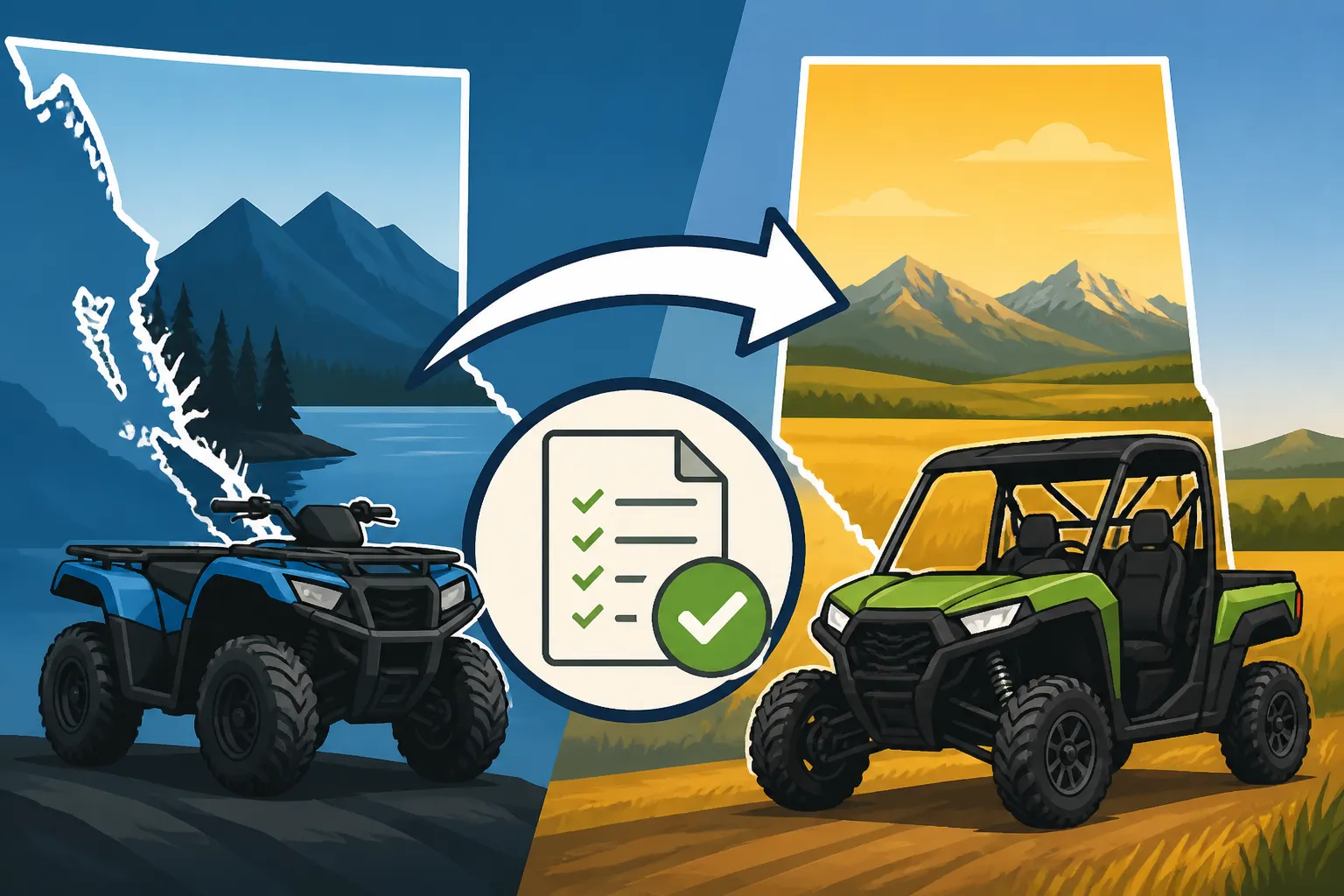
Moving your life, or even just your favourite recreational toys, from British Columbia to Alberta can bring a lot of excitement, but it also means navigating a whole new set of rules – especially when it comes to your off-highway vehicle (OHV). Many riders assume their BC registration will simply transfer over, only to find themselves confused by Alberta's distinct system. This guide is here to walk you through exactly what you need to do to properly register your ATV, side-by-side, or dirt bike from BC so you can hit Alberta's trails legally and without a hitch.
The Big Move: Understanding Alberta's OHV Registration Triggers
When you relocate your life, or even just bring your OHV for an extended stay, from British Columbia to Alberta, you're stepping into a new regulatory landscape. Unlike some jurisdictions where OHV registration might be entirely optional, Alberta has specific triggers that will require you to get an Alberta plate and registration certificate. It’s not just about becoming an official resident; it's about where and how you intend to use your machine. Many folks make the mistake of thinking their BC plate is good to go indefinitely, and that can lead to some uncomfortable conversations with enforcement officers out on the trail.
The 30-Day Rule: When BC Plates Aren't Enough
The most critical piece of information for any out-of-province rider is Alberta's 30-day rule. If your OHV is physically present in Alberta for more than 30 consecutive days, it must be registered here before it can be operated on public land. This isn't just for people moving permanently; it applies to anyone visiting for an extended period, perhaps for a long work contract, seasonal cabin use, or even an epic, month-long riding adventure. That clock starts ticking the moment your machine crosses the provincial border and enters Alberta.
Think about it this way: you drive your truck and trailer, with your beloved quad strapped down, from Kelowna to your new home in Calgary. The moment that quad is in Alberta, the 30-day countdown has begun. After those 30 days are up, if you take that quad out for a spin on a designated trail in a Public Land Use Zone, like McLean Creek, it absolutely needs an Alberta registration plate. This rule ensures that OHVs being used long-term in the province contribute to Alberta's system for trail maintenance, enforcement, and data collection. Ignoring this rule can lead to significant penalties, including fines for riding an unregistered machine. For visitors from BC looking to understand the specifics, you can find more details in [Alberta's 30-Day Rule for Out-of-Province Machines].
What Counts as Public Land in Alberta?
It's vital to understand what Alberta considers "public land" because that's the primary trigger for registration and insurance requirements. In Alberta, public land extends far beyond just designated OHV trails and provincial parks. It includes Crown land, grazing leases, the shoulders and ditches of public roads (even if you're just crossing them), road allowances, and even pipeline rights-of-way. Basically, if it's not explicitly private property that you own or have explicit permission to ride on, it's likely considered public land.
This is a key distinction because many riders assume "public land" only means formal riding areas. But even a quick jaunt down a gravel road allowance to get to your friend's property, or a ride across a remote cutline on Crown land, means you're operating on public land. So, unless your BC machine will never leave your private acreage or a friend's private land (with their permission, of course), you're going to fall under Alberta's registration requirements if you stay for more than 30 days. Understanding this definition is crucial for staying compliant. For clarity on where you can and cannot ride, [Alberta Rules for Riding Crown Land] offers more insight.
Gathering Your Proof: Essential Documents for a BC Machine
Registering an OHV that's coming from British Columbia means you need to satisfy Alberta's registry agents that you are the rightful owner and that the machine itself is legitimate. This isn't just about showing your BC registration; it's about providing foundational proof of ownership that Alberta recognizes. It can feel like a bit of a bureaucratic maze, especially if your original purchase wasn't heavily documented, but having the right paperwork upfront will make the process smooth.
The Bill of Sale: Your Proof of Ownership
The most crucial document you'll need is a comprehensive bill of sale. This is your primary proof that you legally acquired the machine. If you bought your OHV new from a dealer in BC, you'll likely have a formal sales invoice or purchase agreement. If you bought it used from a private seller, a handwritten bill of sale is generally acceptable, but it must contain specific information. At a minimum, it needs:
- The full names and addresses of both the buyer and the seller.
- The date of the sale.
- A clear description of the OHV, including the make, model, year, and most importantly, the Vehicle Identification Number (VIN) or serial number.
- The purchase price (even if it was $0 for a gift, it should state that).
- Signatures of both the buyer and the seller.
Having a robust bill of sale is vital for demonstrating legal ownership. If your original BC bill of sale is minimal or missing, you might need to try and get a more detailed one retroactively, or, if that’s not possible, inquire with the registry agent about alternative proofs of ownership, though these can be more challenging. Utilizing a template from a reputable service like LawDepot can ensure all the necessary details are captured, preventing headaches down the line. To learn more about what counts, check out [Will a Handwritten Bill of Sale Register a Quad?].
Manufacturer's Statement of Origin (MSO) vs. Past Registrations
Beyond the bill of sale, what other documents support your ownership claim?
If your OHV is relatively new and you're the first owner, you might have the Manufacturer's Statement of Origin (MSO) or Manufacturer's Certificate of Origin (MCO). This is essentially the birth certificate of the machine and proves it's never been registered before. An MSO is gold-standard documentation.
For machines that have been previously registered, your BC registration papers themselves will be important. While not a direct transfer, they serve as evidence of your prior legal ownership in BC. You'll present your existing BC registration alongside your bill of sale to the Alberta registry agent. The agent uses these documents to verify the machine's history and ensure there are no outstanding liens or issues before issuing an Alberta registration. If you're wondering about the overall checklist of what's needed, [Alberta Registration Paperwork Checklist] provides a comprehensive list.
Dealing with Missing Paperwork – What to Do
Life happens, and sometimes critical paperwork goes missing. Maybe your bill of sale was a hasty scribble on a napkin years ago, or you've lost your original MSO. This situation can complicate registration, but it's not always a deal-breaker. If you lack a proper bill of sale or MSO, an Alberta registry agent might accept a sworn statement or affidavit as proof of ownership. This is a legal document where you solemnly swear that you are the rightful owner and explain how you acquired the machine.
However, be prepared that this process can take longer and might require additional verification from the registry agent. It's always best to contact your chosen registry agent ahead of time to discuss your specific situation and find out what alternative documentation they might accept. They'll be able to guide you on the best path forward, which may include using a service like LawDepot to draft an affidavit if needed, ensuring it meets legal standards. Without proper documentation, you simply won't be able to register your machine, meaning you can't legally ride it on public land in Alberta.
Navigating the Registry: How to Officially Register Your OHV
Once you've gathered all your documents, the next step is to head to an Alberta Registry Agent office. This isn't a government office directly; rather, it's a privately operated business authorized by the provincial government to provide registry services. The process itself is usually straightforward if you're prepared, but knowing what to expect can ease any anxieties.
Finding an Alberta Registry Agent
You can't just register your OHV at any government building. You need to visit an authorized Alberta Registry Agent. These offices are found in communities big and small across the province, from Edmonton and Calgary to smaller towns like Hinton or Grande Cache near popular riding areas. A quick online search for "Alberta Registry Agent" will bring up a list of locations near you. They handle a wide range of services, including driver's licenses, vehicle registration, vital statistics, and, of course, OHV registration.
When you go, make sure you bring all your original documents – your BC registration, your bill of sale, any MSO you might have, and your personal identification (like your Alberta driver's license if you've obtained one, or another form of ID if you're still a BC resident but staying over 30 days). It's also a good idea to confirm their hours of operation, especially on weekends or holidays, as they can vary. Many agents are familiar with out-of-province registrations, so don't hesitate to ask questions if something isn't clear during your visit. For more on these offices, refer to [Alberta Registry Agents and OHV Paperwork].
The Paperwork Process: What to Expect
When you arrive at the registry, you'll typically take a number and wait your turn. Once called, you'll present your documents to the agent. They will review your bill of sale, BC registration, and ID to verify ownership and the machine's details, particularly the VIN. They'll input this information into the provincial system. Part of this process might involve them checking for any previous Alberta registration records or outstanding issues associated with the VIN.
You'll need to declare how long you want your registration to be valid for – typically one or two years. There will be a registration fee, which covers the cost of processing and the physical plate. Alberta issues a plate for your OHV, not a sticker, and this plate needs to be affixed to the machine where it's clearly visible. Your certificate of registration will be a digital document, which you'll need to print out and carry with you when you ride. The whole process, assuming you have all your documents in order, is usually quite quick, often less than 30 minutes from start to finish. For more details on what you'll receive, read [Alberta Issues a Plate, Not a Sticker].
What You Get: Plate and Digital Certificate
After successfully registering your OHV, you'll walk out with two essential items (or the information to get them): your physical Alberta OHV license plate and a digital copy of your registration certificate. The plate is a physical metal plate with a unique number that must be securely mounted on your OHV, typically on the front or rear, depending on the machine type, where it can be easily seen. You’ll want to mount it properly so it doesn't get lost or damaged on the trails.
The registration certificate, on the other hand, is usually emailed to you or provided via a secure portal. This is a crucial document that proves your machine is registered. Alberta regulations require you to carry a printed copy of this certificate with you whenever you operate your OHV on public land. Simply having it on your phone isn't usually sufficient; an officer will expect a physical copy. Make sure to print it, perhaps laminate it, and keep it in a waterproof bag on your machine. For guidelines on plate placement, refer to [Alberta Plate Placement on a Machine]. The typical processing time is quite quick, as outlined in [Alberta Registration Processing Time].
Beyond Registration: Insurance and Equipment Checks
Getting your Alberta registration is a major step, but it's not the only legal requirement you need to consider when bringing your BC machine to Alberta. There are crucial insurance mandates and equipment rules that apply to all OHVs operating on public land, regardless of where they were originally purchased. Failing to meet these requirements can lead to fines, or worse, your machine being seized.
Alberta's Mandatory Insurance Rule on Public Land
This is a big one, and it's often a surprise for riders coming from jurisdictions with different rules. In Alberta, any OHV operated on public land must carry valid liability insurance. This isn't optional; it's a legal requirement under the Traffic Safety Act. This insurance protects you and others in case of an accident where your OHV causes damage or injury. The minimum amount of liability coverage required is typically in the hundreds of thousands of dollars, though many riders opt for more for peace of mind.
If you already have OHV insurance from BC, you'll need to contact your insurance provider to ensure that your policy extends to Alberta and meets Alberta's minimum liability requirements. It's possible your current policy will cover you, but it's essential to confirm. If not, you'll need to arrange for new coverage with an Alberta-approved insurer. Always carry proof of your insurance on you when riding, as an enforcement officer can request it at any time. For more information on this, check out [Alberta Requires Insurance on Public Land].
Essential Equipment: Spark Arrestors and Lights
Beyond registration and insurance, your OHV also needs to comply with specific equipment requirements to be legally operated on public land in Alberta. Two key areas are spark arrestors and lighting. Every OHV must be equipped with a functional spark arrestor that is certified by the U.S. Forest Service or an equivalent standard. This critical piece of equipment prevents hot carbon particles from escaping the exhaust and potentially starting a wildfire, which is a huge concern in Alberta's dry seasons.
Furthermore, if you plan to ride at night, or even during periods of low visibility (like dawn, dusk, or foggy conditions), your OHV must have working head and tail lights. These aren't just for seeing where you're going; they're essential for other riders and trail users to see you, preventing collisions. Before you hit the trails, give your machine a thorough check. Ensure all lights are functioning, your spark arrestor is intact and not modified, and that your muffler isn't excessively loud or modified beyond factory standards. These checks are part of the broader requirements laid out in [What the Traffic Safety Act Requires of Alberta OHVs]. You can find more specific details on spark arrestors in [Alberta Requires a Spark Arrestor].
BC vs. Alberta: Key Differences for OHV Owners
Understanding the specific requirements for an OHV from British Columbia means recognizing where the two provinces diverge in their approach to off-highway vehicle regulation. While both aim for safety and responsible use, their administrative frameworks and operational rules have distinct differences that can catch a new Alberta resident off guard.
Registration Philosophy: Mandatory vs. Use-Based
One of the most significant differences between BC and Alberta's OHV systems lies in their fundamental approach to registration. In British Columbia, the registration of off-road vehicles (ORVs) is mandatory under the Off-Road Vehicle Act, regardless of where they are operated, including private land. You register your ORV with the ICBC (Insurance Corporation of British Columbia), and you receive a plate. This system ensures every ORV is identified.
Alberta, on the other hand, operates on a use-based registration philosophy. OHVs are only required to be registered if they are operated on public land. If your quad or side-by-side never leaves your own private property, or private land where you have permission, it does not need to be registered in Alberta. This is a common point of confusion for BC residents who are used to mandatory registration across the board. However, as we discussed earlier, "public land" in Alberta is a broad term, so for most riders, registration will be necessary if they stay beyond the 30-day visitor window. This difference in philosophy underlines why a BC-registered machine still needs to enter Alberta's system after a certain period of residency or extended stay.
Licensing and Road Access Contrasts
Another area where BC and Alberta differ pertains to operator licensing and road access. In British Columbia, operators of ORVs on Forest Service Roads or Crown land (even if they have an ORV plate) are generally required to have a valid driver's license. There are also specific rules about youth operators. When it comes to road access, BC has specific designations for ORVs on certain low-speed, low-volume roads, particularly in rural areas, and on designated sections of Forest Service Roads, often requiring a specific class of driver's license for such use.
Alberta's approach is somewhat more restrictive when it comes to road access for OHVs. Generally, OHVs are prohibited from operating on highways (which includes main roads, streets, ditches, and alleys) unless a specific municipal bylaw or ministerial order permits it. While you don't need a driver's license to operate an OHV on off-highway public land in Alberta, the minimum age for unsupervised operation is 14. Any road use is heavily dependent on local bylaws, which vary widely from county to county and town to town. This means that if you're used to more liberal road access in certain parts of BC, you need to be very cautious and research local bylaws meticulously before riding your OHV on any paved or gravel road in Alberta.
Alberta and BC OHV Document Comparison Table
To help clarify the differences and requirements, here's a quick look at some key documents and their status when moving an OHV from BC to Alberta.
| Document / Item | In British Columbia (Pre-Move) | In Alberta (Post-Move Requirement) | Notes |
|---|---|---|---|
| Registration Plate | Issued by ICBC, mandatory for all ORVs. | Issued by Alberta Registry Agent, mandatory for public land use (after 30 days). | Your BC plate is valid for 30 consecutive days in Alberta; then an Alberta plate is required for public land use. |
| Proof of Ownership | Bill of Sale, ICBC Registration, MSO. | Bill of Sale (or Affidavit), previous registration, MSO. | A solid bill of sale is crucial for registering in Alberta. BC registration serves as historical proof. Tools like LawDepot can help formalize bills of sale. |
| Operator License | Driver's license often required for public land/road use. | Not required for off-highway public land use (age limits apply). Driver's license required for any allowed road use. | Minimum age for unsupervised OHV operation on public land is 14 in Alberta. |
| Insurance | Mandatory liability insurance (often through ICBC). | Mandatory liability insurance (from an Alberta-approved insurer) for public land use. | Verify your BC policy covers Alberta and meets minimum liability requirements. Get new Alberta coverage if needed. [Alberta Insurance Requirements on Public Land] is key here. |
| Spark Arrestor | Generally required. | Mandatory for all OHVs on public land. | Ensure your machine's spark arrestor is compliant with USFS or equivalent standards. |
| Lights | Required for low visibility/night riding. | Head and tail lights required for low visibility/night riding. | Always ensure your lights are functional before riding. |
| Digital Registration Cert. | N/A (physical documents often used). | Digital, but must be printed and carried on machine. | Alberta requires a physical, printed copy of your registration certificate to be carried with you on the trail. Does a Printed Registration Certificate Count on the Trail? explains why. |
Moving your beloved quad or side-by-side from British Columbia to Alberta means a few extra steps, but by understanding the 30-day rule, having your ownership documents in order (perhaps even preparing them with a service like LawDepot), and getting your Alberta plate and insurance, you'll be ready to explore all the incredible trails and backcountry that Alberta has to offer. Taking the time to do it right means more worry-free rides and fewer encounters with enforcement that could spoil your day. Welcome to Alberta, and happy trails!
Disclaimer
This article is for general informational purposes only and does not constitute professional advice. Laws, prices and regulations vary by location and change over time. Consult a qualified professional for guidance on your specific situation.