What Happened to Alberta’s Cancelled OHV Trail Permit
Alberta riders may hear about an OHV trail permit and wonder whether they need one before heading out. The proposed province-wide permit was cancelled before it became a general riding requirement. Here’s what that means now, which passes still apply, and how to check what you need for a specific ride.
The proposed OHV trail permit was cancelled
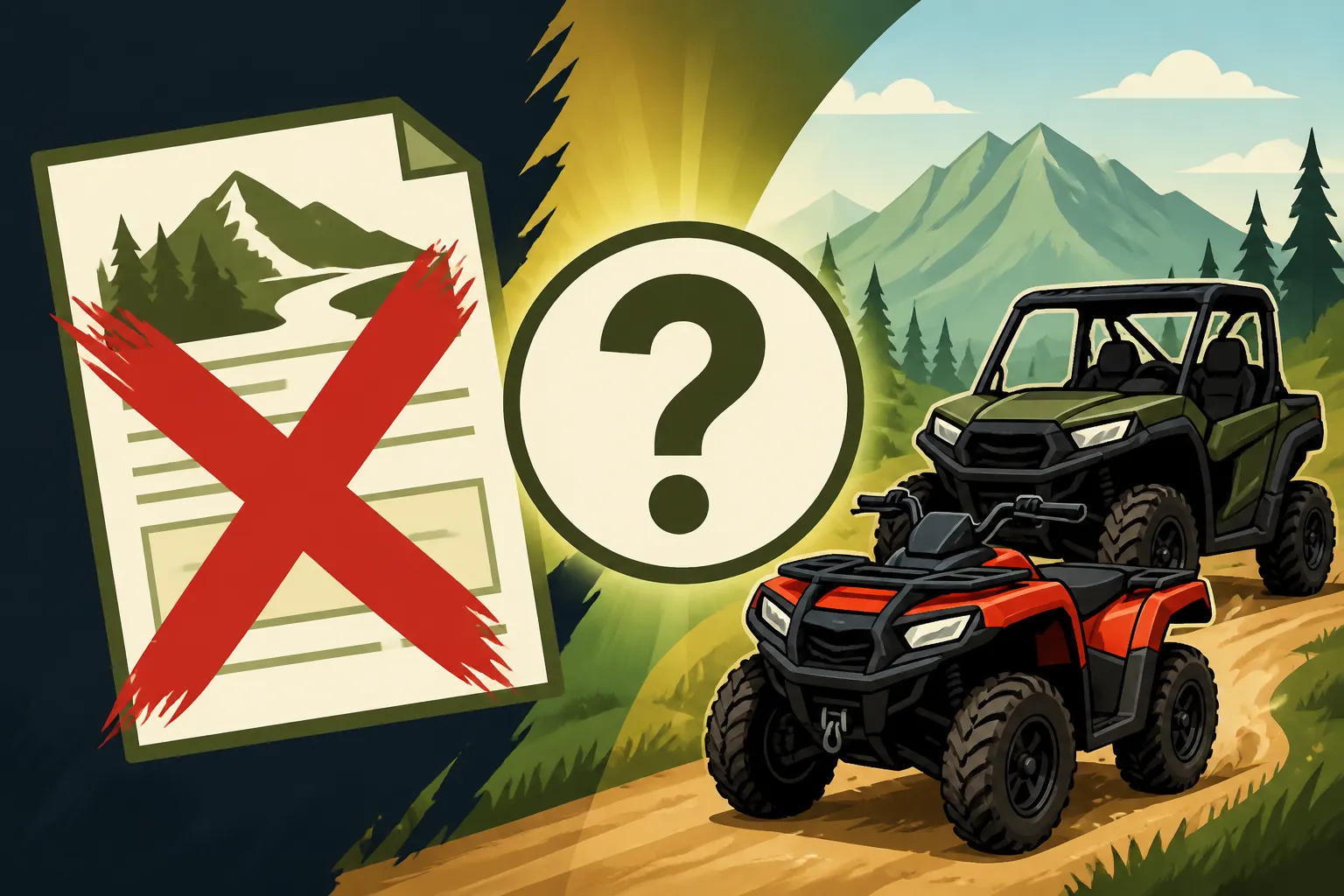
Alberta considered a mandatory permit intended to help pay for off-highway vehicle trail management and maintenance. The idea was to connect riding on public land with a dedicated source of trail funding. It did not become a general permit requirement for ATV and UTV riders.
That distinction matters: a proposal, announcement or consultation is not the same as a rule in force. The province’s planned OHV trail permit was withdrawn before riders had to buy it to use ordinary public-land trails. There is no general Alberta OHV trail pass that every rider must purchase before riding.
The reasons for abandoning the plan involved the design and implementation of a province-wide permit, including how it would work for riders and trail managers. The practical result is more important than the policy debate: riders should not buy a supposed Alberta OHV trail permit from an unofficial seller or assume that an old announcement still describes the current rules.
Trail maintenance still needs funding. Alberta trails may be supported through government grants, local clubs, partnerships and other sources, rather than a universal OHV trail permit. That funding arrangement does not mean every trail is open, maintained, or available to every machine. Access remains tied to the rules for the specific land and route.
| Item | What it means for a rider |
|---|---|
| Proposed OHV trail permit | The planned general permit did not take effect |
| Public Lands Camping Pass | A separate pass that may be required for eligible camping on public land |
| OHV registration | A separate vehicle requirement that can apply before riding public land |
| Insurance | A separate requirement for OHVs on public land |
| Local access rules | May limit where and when a machine can travel |
It helps to keep these requirements separate. The cancelled trail permit did not cancel vehicle registration, insurance rules, camping requirements, or land-use restrictions. For an overview of the broader riding requirements, see Alberta’s Reversed Trail Permit Plan and Alberta Has No OHV Trail Pass.
What you may still need before riding
The absence of a general trail permit does not mean there is nothing to arrange. Before unloading, check the machine, the type of land, and the planned activity. A rider may need to meet more than one requirement, and each one serves a different purpose.
Registration and insurance
Registration rules depend on where and how you ride. Public land is a key trigger for registration requirements, while certain private-land uses may be treated differently. Do not assume that a machine used mainly on a farm or at a cabin is automatically exempt everywhere; the details of the use and location matter.
Insurance is also a separate consideration. Alberta requires insurance for OHVs on public land. Carry proof so you can produce it if asked. Registration documents and insurance do not replace one another, and neither functions as a trail-use permit.
If you are uncertain whether a machine needs registration, start with Do You Need to Register an ATV in Alberta?. If you are preparing for public-land riding, Alberta Requires Insurance on Public Land explains the insurance issue, while Alberta Registration Before Riding Crown Land focuses on registration and access.
Public Lands Camping Pass
The Public Lands Camping Pass is not an OHV trail pass. It relates to camping on certain public lands, including areas where the pass requirement applies. It does not authorize you to ride a closed route, cross private land, or use a trail that is not open to your machine.
In other words, a rider who camps and rides may have to consider both camping rules and OHV access rules. A rider who visits for the day should not buy a camping pass merely because they are taking an OHV onto public land; check whether they will camp and whether the location is covered by the pass requirement.
For more detail, see Alberta’s Public Lands Camping Pass and Alberta Camping Passes Since 2021. Pass details and the areas they cover can change, so confirm the current requirements through Alberta’s official information before you travel.
Local permits and special activities
Some events, guided trips, commercial operations or organized activities may require permission or a permit even though there is no general OHV trail permit. Those are activity-specific approvals, not a replacement or revival of the cancelled province-wide trail pass.
Similarly, a trail system may have local conditions, seasonal closures, staging-area rules or machine restrictions. A pass or approval for one purpose does not automatically grant access for another. If you are attending an organized ride or operating commercially, check directly with the relevant land manager about what authorization applies.
How to check access for your planned ride
The most reliable approach is to identify the exact riding area first, then check its current rules. “Public land” is not a single open trail network. Designated routes, closures, vehicle-size limits, seasonal restrictions and local conditions can vary by zone.
Use this practical sequence:
- Name the riding area and route. A general plan to “ride the foothills” is not specific enough. Identify the staging area, zone and trails you expect to use.
- Check the current land-use information. Look for the applicable map, public land guide, trail notices and closure information. Use a current source rather than relying on an old social post or a map saved years ago.
- Confirm that your machine is allowed. A route may be limited by machine type, weight, size or other conditions. Do not assume that a route open to one OHV category is open to every ATV or UTV.
- Check your registration and insurance. Confirm the documents and coverage required for the land where you will ride. Keep the required proof with you.
- Check camping separately. If you plan to stay overnight, determine whether a Public Lands Camping Pass or other camping rule applies to that location and kind of camping.
- Look for temporary restrictions. Fire conditions, weather damage, wildlife concerns, active work and seasonal closures can change access. Recheck shortly before leaving.
- Respect property and route boundaries. A trail shown on a map does not give permission to cross private land or ignore posted restrictions.
For help interpreting maps and land-use zones, see Reading a Public Land Trail Guide and Checking a Zone Before You Go. If your question is whether you can ride a particular Crown land route, Alberta Rules for Riding Crown Land is a useful next step.
A common mistake is treating “no OHV trail permit” as permission to ride anywhere. The cancelled permit only answers one narrow question: Alberta did not put the proposed general trail permit into effect. It does not establish that a route is legal, open, or suitable for your machine.
Another mistake is confusing a registration plate with trail access. A properly registered machine can still be prohibited from a route or zone. Likewise, a camping pass does not authorize OHV travel. Each requirement has its own purpose, and the rider must meet all rules that apply to the trip.
What the cancellation means for riders and trail funding
For most riders, the cancellation means there is no province-wide OHV trail permit to add to the pre-ride checklist. You do not need to search for a universal trail sticker or pay an unofficial seller for one. Instead, focus on the requirements that do apply: registration, insurance, land access, any camping pass, and local restrictions.
For clubs and trail managers, the cancellation meant that the planned dedicated permit revenue did not become a universal source of funding. Trail work may still depend on grants, club effort, partnerships and other funding arrangements. That can affect how much maintenance is possible and how consistently routes are signed or managed. It is one reason to check current trail information rather than assume a route is open because it appeared on an older map.
Riders can support sustainable access without a mandatory permit. Stay on designated routes, avoid creating new tracks, follow closures, pack out waste and report hazards or damage through the appropriate local channels. Respectful use helps protect access and reduces pressure on land managers and neighbouring communities.
Keep a simple pre-ride document check, too. Make sure your registration information is current, insurance proof is available, and your route information is saved in a way you can access if cell service drops. If you are riding in an area with camping, confirm the pass rules separately. What to Show an Officer on Alberta Public Land covers the practical side of carrying and producing relevant documents.
The cancelled trail permit is not a loophole and not a hidden fee. It is a proposal that did not become a general requirement. The safe takeaway is straightforward: do not buy a province-wide Alberta OHV trail permit, but do check the rules for your machine, route and planned activities before riding.
Disclaimer
This article is for general informational purposes only and does not constitute professional advice. Laws, prices and regulations vary by location and change over time. Consult a qualified professional for guidance on your specific situation.