Camping on Durable Ground
Camping beside an Alberta ATV or UTV ride can be a great way to spend more time outdoors, but a convenient-looking patch of ground is not always a suitable campsite. Soft soil, wetland edges, and fragile vegetation can take lasting damage from tents, tires, and campfires. The key is to choose a resilient place that is also legal to camp in, then keep your machine and camp activity within the rules for that area.
What camping on durable ground means
Durable ground is a surface that can withstand ordinary camping use with relatively little lasting damage. Firm, dry soil, gravel, rock, and an already established campsite are generally more resilient than soft ground or living vegetation. The exact conditions matter: a gravelly surface may still be part of a sensitive streambank, while a patch of apparently tough ground may become easily rutted after rain.
Choosing durable ground is a practical way to reduce the impact of your stay. It does not make an otherwise prohibited location legal, and it does not give you permission to drive off a permitted route. Always check the rules for the land you plan to use. Alberta Random Camping Rules Explained covers the broader question of where random camping is allowed and what limits may apply.
Look at the ground, not just the view
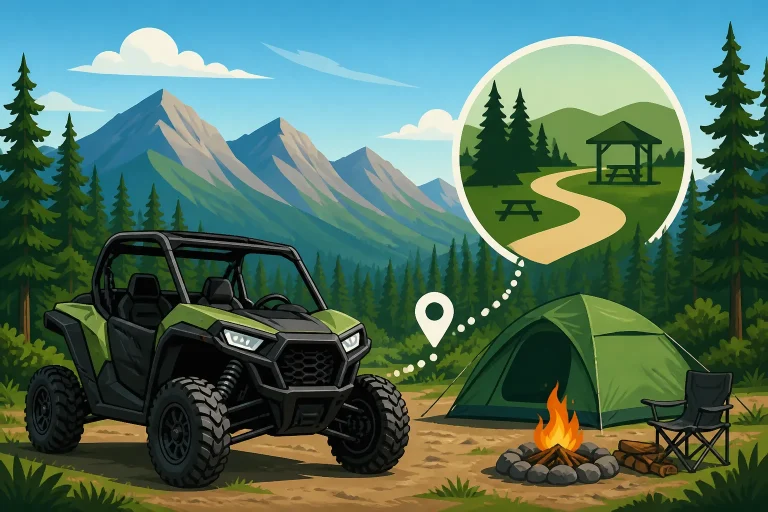
A level spot with a scenic view can be tempting, but first check whether the surface is stable and already disturbed. A well-used campsite is often a better choice than opening up a new patch of vegetation. Look for signs of previous camping, such as a defined tent area or an established fire spot, while making sure the site is not closed or posted against use.
Avoid setting up on:
- Wet or saturated soil that will sink or rut under boots, tires, or tent pressure.
- Grass, moss, wildflowers, or other living vegetation, especially in open or higher-elevation areas.
- Streambanks, lakeshores, marsh edges, and other places where trampling can loosen soil or damage vegetation.
- Slopes where rain can carry disturbed soil downhill.
- Areas with young trees, exposed roots, or fragile ground cover.
- A location that would require you to move rocks, cut vegetation, or drive across undisturbed ground to reach it.
If your boot leaves a deep impression or water collects where you step, choose a firmer spot. A site that looks dry at midday may still be soft after rain or snowmelt. When conditions are marginal, moving to an established site is usually the better decision.
Durable does not mean indestructible
Even rock and gravel can be damaged by repeated use, and a durable campsite can still be in the wrong place. Keep tents, cooking areas, and parked machines within the already used part of a site rather than spreading into adjacent vegetation. Avoid moving or stacking natural materials to create a larger campsite.
Think about the whole footprint of your group. A tent may fit on a small firm patch, but several machines, trailers, and vehicles can expand the disturbed area quickly. If the available space is too small for your group without pushing into plants or wet ground, find another legal site rather than making the site larger.
| Surface or location | Why it can be a poor choice | Better approach |
|---|---|---|
| Saturated soil or muddy ground | Foot traffic and tires can create ruts and persistent damage | Wait for drier conditions or use a firm, established site |
| Meadow or moss-covered ground | Vegetation can be slow to recover after trampling | Keep camp on already disturbed or naturally bare ground |
| Streambank or lakeshore | Erosion and damage to waterside vegetation can affect the edge | Camp farther back on firm ground; check local setback rules |
| Steep slope | Water can carry loose soil downhill | Choose a flatter, stable site |
| Existing campsite on firm ground | Repeated use may already have a defined footprint | Use it if it is open and permitted, without enlarging it |
| Bare gravel or rock | Often resilient, but not automatically legal or suitable | Confirm access rules and avoid sensitive shorelines or closed areas |
How to choose a legal, low-impact campsite
Start with the land-use rules, then evaluate the ground. Public land is not a single, uniform camping area: access, camping, trail, and seasonal restrictions can vary by location. Use current maps and notices for the specific area, and check for closures before you leave. A site being visible from a trail or used by other visitors does not prove that camping is permitted there.
For Alberta public land, camping requirements can include a pass in areas where one is required. The pass is separate from permission to ride an ATV or UTV, and buying one does not override a closure, access restriction, or local camping rule. Review Alberta’s Public Lands Camping Pass and confirm the requirements that apply to your destination. Do not assume that a pass required in one riding area is required everywhere, or that a pass by itself authorizes access.
Before settling in, check the location against the relevant rules:
- Confirm the land and its status. Identify whether the spot is on public land, in a recreation area, in a park, or on private land. Each can have different camping and vehicle rules.
- Check for local restrictions. Look for posted notices, current closures, fire restrictions, and rules about where camping is allowed. The applicable restrictions can change with conditions.
- Confirm distance requirements. Some rules limit how close a campsite can be to facilities or recreation areas. Check Alberta Camping Distance From Facilities and Alberta Camping Near a Recreation Area before choosing a spot.
- Stay within the authorized access route. Use permitted roads and trails. Do not cut across vegetation or make a new track simply because a potential camp looks close.
- Choose a spot that fits your group. Make sure tents, cooking, and parking can fit without spreading into fragile ground or blocking a trail, road, or access point.
On private land, get permission from the landowner before camping or riding. Permission to camp does not necessarily mean permission to bring an ATV or UTV onto the property, so ask about both. On public land, do not treat a grazing lease, cutline, work road, or open gate as blanket permission to camp or ride wherever you like.
For a fuller overview of site selection and restrictions, see Alberta Random Camping Rules Explained. If your plans include camping near a recreation area, check the specific rules for that area rather than relying on a general map or an old trip report. A site that was open on a previous visit may now be closed or subject to different conditions.
Using an ATV or UTV around camp
A good campsite can still be damaged by the way you arrive and move around it. Ride only on routes open to your vehicle and allowed for the season. A legal campsite is not automatically a legal route, and a trail nearby does not mean you can ride directly across the ground to your tent. For route basics, see Alberta OHV Trails: Riding Public Land.
Park on firm, already disturbed ground when possible. Avoid repeated manoeuvring around the campsite, especially when the soil is wet. A UTV and trailer can create a much larger impact than a person carrying gear, so consider whether you need to bring every vehicle into the site. If parking space is limited, follow posted instructions and do not block a trail, gate, or work access.
Before unloading, look at the approach you used. If the tires have left ruts or disturbed plants, stop using that line and avoid making it worse. Do not create a new route around a muddy patch; turn back or use an authorized alternative. Staying on established routes helps reduce erosion and keeps riders from gradually widening trails.
A few practical steps help keep camp and riding activity separate:
- Keep machines on the established parking area rather than riding around tents or cooking gear.
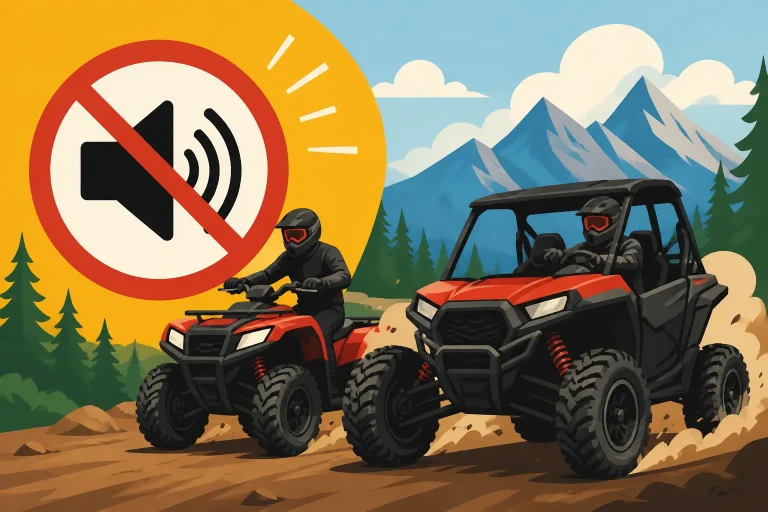
- Do not idle or rev machines unnecessarily near other campers, wildlife, or nearby homes.
- Keep children and pets away from vehicle movement, especially when machines are being unloaded or turned around.
- Store fuel and equipment securely, away from cooking and sleeping areas.
- Check fire restrictions before lighting a campfire, and use an existing fire facility where permitted rather than building a new one.
- Do not assume that a trail is open because it is visible on an older map. Verify current access and closures.
A compact groundsheet can help keep a tent floor and gear clean, and outdoor retailers including Amazon sell basic options. It does not make soft or sensitive ground suitable for camping, and it should not be left behind. Place it on a firm surface, avoid damaging vegetation to level the tent, and pack it out with the rest of your gear.
Keep the campsite small
The easiest way to reduce impact is to keep the camp footprint compact. Use the area already established for camping rather than spreading out to create separate tent, cooking, parking, and gathering zones. Avoid digging drainage trenches, cutting branches, or removing plants to make the site more comfortable.
If you have a large group, plan around the site’s capacity. A spot that works for one tent may not be appropriate for several tents and multiple machines. Divide the group among legal established sites if needed, while following any rules about site separation and group size. Do not solve a space problem by extending the campsite into a meadow or along a stream edge.
Keep noise and light in mind as well. A low-impact camp is not only about soil: loud engines, bright lights, and late-night activity can affect other visitors and wildlife. Shut machines down when they are not needed, and direct lights toward camp rather than across the surrounding area.
Leave the site ready for the next visitor
A durable site can still be left in poor condition if trash, food scraps, or waste are not handled properly. Pack out everything you bring, including small items that are easy to overlook: food wrappers, broken straps, cigarette ends, and bits of packaging. Do not leave scraps for wildlife. Packing Out What You Bring offers more on keeping a camp clean.
Plan for human waste before you arrive. The right approach depends on the land and the facilities available; use an established facility where provided and follow the applicable rules where there is none. Do not leave toilet paper or hygiene products on the ground. Check Human Waste on Public Land for practical guidance, and avoid placing waste near water, trails, or campsites.
At the end of your stay, take a slow look around the site and the route between your camp and machines. Pick up small litter and check that no food, gear, or waste has been left behind. If a fire was permitted, make sure it is fully out and follow any local instructions for ashes. A fire ring or marked fire area is not permission to burn during a restriction; check Alberta Fire Bans and Riding before your trip and again when conditions may have changed.
Camping limits also matter. Some public-land rules restrict how long a camp may remain in one place, and moving a short distance may not satisfy the requirements. Check Alberta’s 14-Day Camping Limit and Alberta’s 1-Kilometre Relocation Rule for the limits that may apply to your plans. Follow the current official guidance for the area rather than relying on a rule of thumb from another site.
A simple pre-departure check can prevent most avoidable problems:
- Is the site permitted for camping, and are any seasonal restrictions in effect?
- Is the ground firm, dry, and already disturbed?
- Can the whole group fit without spreading into vegetation or a waterway edge?
- Are machines parked on an allowed, durable surface?
- Have you checked fire rules, waste requirements, and camping limits?
- Is all rubbish and equipment packed out?
The best campsite for an ATV or UTV trip is not necessarily the closest spot to the trail or the most scenic patch of ground. It is a place where camping is allowed, the surface can handle ordinary use, and your group can stay without widening the impact. When the ground is wet, fragile, or uncertain, choosing an established alternative is usually worth the extra distance.
Disclaimer
This article is for general informational purposes only and does not constitute professional advice. Laws, prices and regulations vary by location and change over time. Consult a qualified professional for guidance on your specific situation.