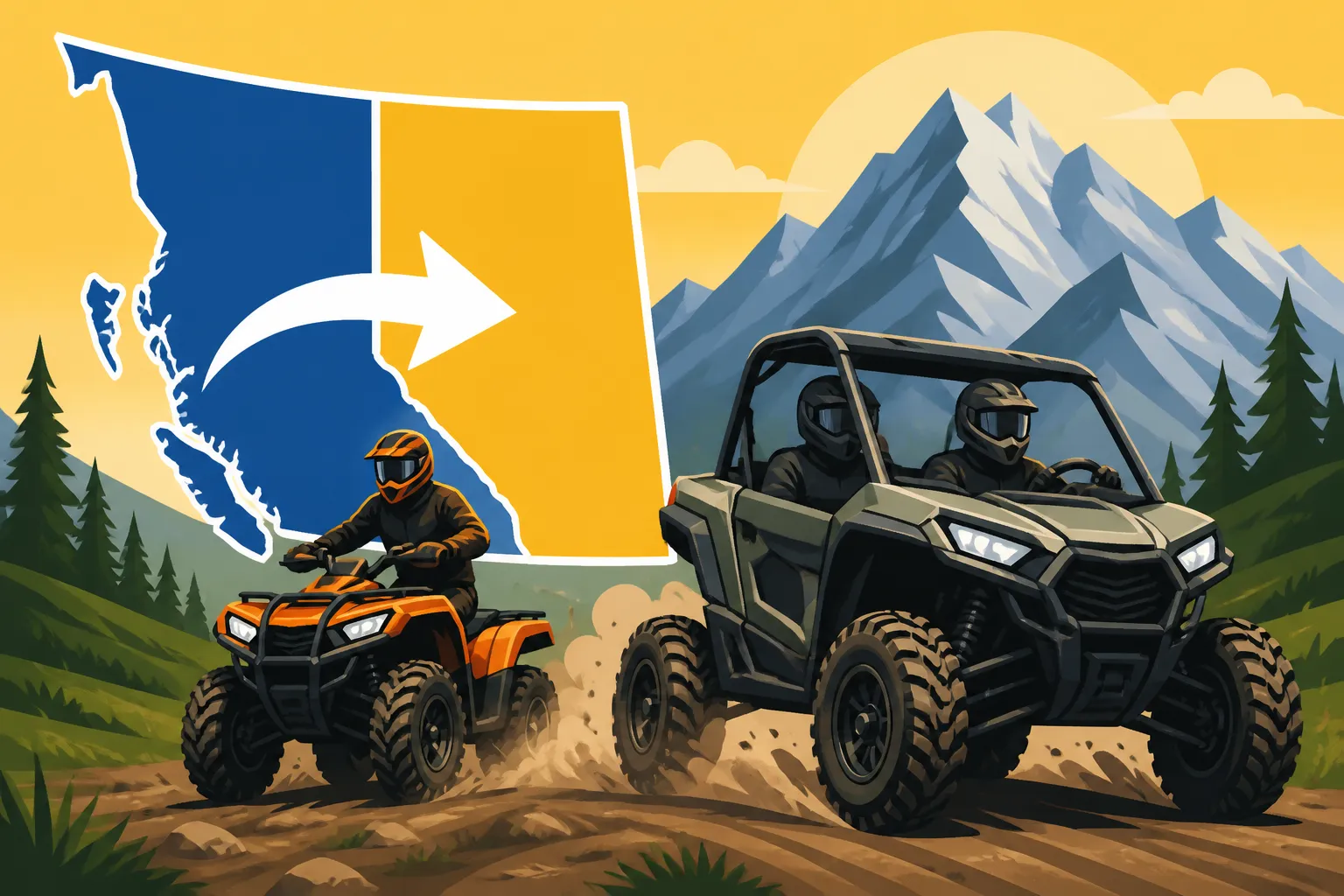
Alberta Visitors From BC
A BC plate does not mean every Alberta riding rule is covered by reciprocity. Before you unload, check how long you can ride on your home registration, what proof to carry, and which Alberta rules apply on public land. The key is to treat registration, insurance and permission to ride as separate requirements, then confirm local access rules for your route.
Before riding in Alberta, check your registration and insurance
Visitors can generally use a machine registered in their home province for a limited stay in Alberta, provided the registration is valid and the machine meets Alberta’s requirements for the place they plan to ride. Reciprocity is not a blanket exemption from Alberta law: it does not make an unregistered machine legal, replace required insurance, or give you permission to ride wherever you see a track.
For a BC rider, start by checking that the ATV or side-by-side is properly registered for use in BC and that its registration remains current for the whole trip. Carry the registration document, rather than relying only on a plate or a photo of paperwork. If there is any doubt about what your BC documents cover, ask the issuing authority or your insurer before travelling. The rules for Alberta Reciprocity for Visiting Riders apply to temporary visitors, not to a machine that has been brought to Alberta as part of a permanent move.
Insurance deserves a separate check. Alberta requires insurance for off-highway vehicles used on public land. A BC policy may provide coverage in Alberta, but do not assume that a policy covering your machine at home automatically meets every requirement for your trip. Ask your insurer whether the machine is covered while being ridden on Alberta public land, what liability coverage applies, and what proof you should carry. The details of Alberta Insurance Rules for an Out-of-Province Machine are worth checking before you set off.
| What to check | What to confirm before the trip |
|---|---|
| Home registration | The machine is registered in BC, the registration is current, and you have the documents with you |
| Length of stay | Your visit fits Alberta’s temporary-visitor period, or you have arranged Alberta registration |
| Insurance | Your policy covers the machine in Alberta and meets the requirements for the land where you will ride |
| Riding location | The route is open to your type of machine and you have any required landowner or local permission |
| Equipment | The machine and rider meet Alberta’s applicable requirements, including helmet and equipment rules |
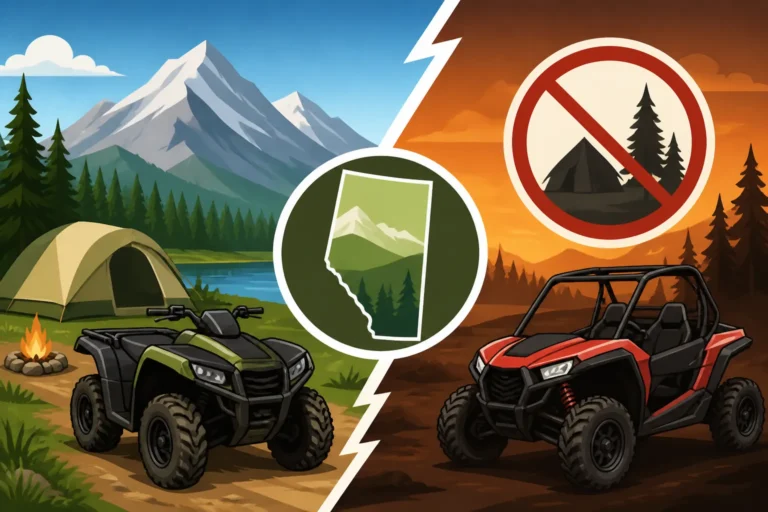
| Camping | If you plan to camp on public land, check whether a separate camping pass applies |
The registration document, insurance proof and permission to ride answer different questions. Registration identifies the machine and its status; insurance provides financial protection and may be legally required; permission or access rules determine whether you may ride on that particular land. Having one does not substitute for the others.
It is also useful to keep a record of when your Alberta visit begins. The temporary period is tied to the time the machine is in the province, not to how many days you actually ride. A machine sitting at a cabin or on a trailer may still be part of your Alberta stay. If you are approaching the limit, check Alberta Visitors Under 30 Days and Alberta’s 30-Day Rule for Out-of-Province Machines before planning more rides.
How long a BC-registered machine can stay
Alberta allows a qualifying out-of-province machine to be used by a visitor for a temporary period, commonly described as 30 consecutive days. The period is not a monthly riding allowance that resets each time you return to BC for a short visit. If you expect to remain in Alberta beyond the visitor period, check what is required to register the machine in Alberta before the temporary permission runs out.
The important distinction is between visiting and settling. A person bringing a machine for a short holiday is in a different position from someone who has moved to Alberta, is establishing residency, or is keeping the machine in the province for an extended period. A long stay can change the paperwork needed, even if the vehicle still carries BC registration. For a move, see Alberta ATV Registration for a New Resident and Moving to Alberta With a Machine.
Do not treat the 30-day period as permission to ride on any land. It concerns how long an eligible visitor may rely on out-of-province registration; it does not override Alberta’s insurance rules, safety requirements, road-use bylaws, land closures or private-property restrictions. A visitor can be within the registration period and still be breaking a rule by riding an unauthorized route or failing to carry required insurance.
A practical approach is to make the dates easy to prove. Keep your travel itinerary, accommodation records or other evidence of when you arrived, particularly if you plan to stay near the end of the temporary period. If your plans change, do not wait until the last riding day to ask what to do. Contact an Alberta registry agent or the appropriate official source and confirm whether the machine needs Alberta registration, what documents are required, and whether you can continue riding while the application is processed.
If the machine is not registered in BC, or the paperwork is incomplete, do not assume Alberta will accept it because you are a visitor. Reciprocity is based on the relevant conditions being met. An unclear VIN, missing ownership documents, expired registration or a mismatch between the machine and its papers can create problems at a roadside check or when you try to register it locally. For an overview of what to prepare, use Alberta Registration for a Machine From BC and Alberta Registration Paperwork Checklist.
Alberta rules that still apply to visiting riders
Once you ride in Alberta, Alberta’s rules for the location and activity apply. This is especially important on public land, where a visitor’s BC registration does not exempt them from provincial requirements.
Insurance and paperwork
Carry proof of insurance and registration on the ride, not locked in your truck at the staging area. An officer may ask to see documents, and being able to produce them promptly can prevent a simple check from turning into a longer delay. Review Alberta Proof of Insurance on Demand for practical details about producing proof, and make sure the insurance document clearly relates to the machine you are riding.
The names and identifying details on your papers should match the machine. If someone else owns it, bring documentation that helps explain your authority to use it. If the machine is borrowed or part of a group trip, sort this out before leaving home rather than expecting a verbal explanation to resolve a paperwork gap.
Helmets and machine equipment
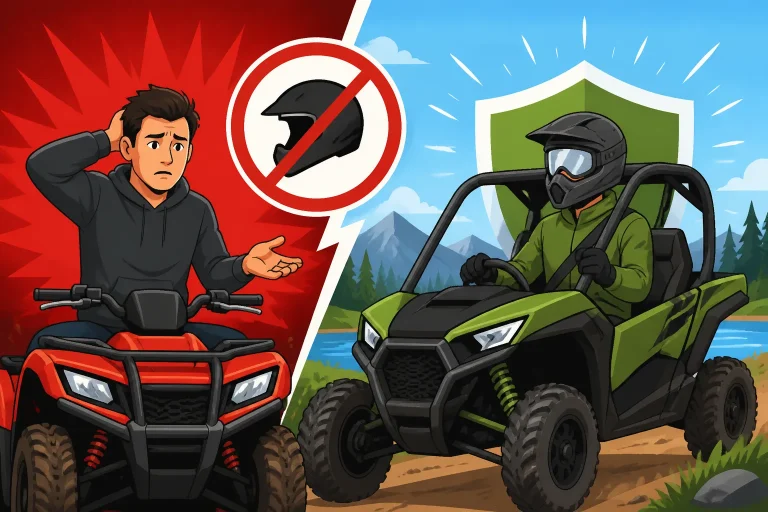
Alberta’s public-land helmet requirements apply to visitors as well as residents. Riders should check that their helmet meets the applicable standard and that the certification label is present and readable. A helmet that is legal or commonly used in BC is not automatically accepted in Alberta if it does not meet Alberta’s requirements. See Alberta Helmet Law on Public Land and Alberta CSA Helmet Standards before travelling.
Public-land riding can also bring equipment requirements. Depending on the machine and conditions, requirements may include working lights and a spark arrestor, and restrictions apply to modified exhaust systems. Do not rely on a machine being street-legal in BC as proof that it meets every Alberta off-highway requirement. Check Alberta Equipment Required on Public Land and the rules for the area you intend to ride.
These are simple items to inspect before loading: lights that work, a secure plate, an exhaust system that meets the rules, and the required safety equipment for each rider. A pre-trip check is easier than discovering a problem at the trailhead, where repairs or replacement gear may be difficult to arrange.
Where you may ride
A registration plate does not give you general access to public land, private land, a highway ditch or a municipal road. Land managers and local governments can restrict routes, close areas, or allow OHVs only on designated roads and trails. Conditions can also change because of fire risk, weather, wildlife protection, industrial activity or maintenance.
Before leaving, identify the exact riding area and check the current map or official land information for closures and allowed vehicle types. For public land routes, Alberta Registration Before Riding Crown Land explains why registration is only one part of being ready to ride. For road and ditch access, look up Alberta ATV Road Rules: Bylaws Decide and Alberta Bylaw Lookups Before You Ride. A road that appears usable on a map may be closed to OHVs, and a trail visible on the ground is not necessarily an authorized route.
Private land needs the landowner’s permission. A route crossing a grazing lease or an industrial access road may have additional access conditions. Do not assume that an open gate or existing tire tracks mean you can proceed. Ask first where permission is required, and leave gates as you found them.
Camping is a separate matter from riding. A public lands camping pass, where required, relates to camping rather than serving as an OHV registration or general trail permit. Check the rules for your specific campsite and riding area. Alberta does not have a universal ATV trail pass that replaces the need to follow local access rules.
A practical checklist for a BC visitor
A little preparation helps avoid confusion at the border, at a staging area or during an officer’s check. Use this checklist for each machine and rider in your group:
- Confirm the machine’s BC registration is current and that the paperwork matches its identifying details.
- Check your arrival date and make sure your plans fit within the temporary visitor period.
- Ask your insurer to confirm coverage in Alberta, including use on public land, and carry proof of insurance.
- Choose a specific riding area and confirm that your machine type is allowed on the intended routes.
- Check local road-use bylaws if your route includes a ditch, town road or other highway right-of-way.
- Confirm the helmet standard and inspect required equipment before loading.
- Bring the registration and insurance documents on the ride, along with any permission or other documents relevant to your route.
- If staying longer than planned or moving to Alberta, confirm the steps and timing for Alberta registration before the visitor period ends.
For a group, check each machine individually. One rider’s valid registration and insurance do not cover a companion’s machine. Likewise, a group leader’s route research does not automatically establish that every vehicle is permitted on every trail. Make sure all riders know the route, closures, equipment expectations and what documents to carry.
Visitors should also plan for poor cell coverage. Save the official map or route information before leaving service, and make sure the group can identify its staging point and intended trail system without relying on a live connection. Avoid using an old screenshot as the only source for closures: conditions and access can change. Check current official information shortly before the ride.
If you cannot confirm that your registration, insurance or route is acceptable, pause before riding and ask the relevant authority or provider. That is particularly important if your stay is close to the temporary limit, your machine has unusual paperwork, or the route crosses land with separate access controls. A few calls before the trip are far less disruptive than being unable to continue once you are already in Alberta.
Disclaimer
This article is for general informational purposes only and does not constitute professional advice. Laws, prices and regulations vary by location and change over time. Consult a qualified professional for guidance on your specific situation.