Alberta Registration on Private Land Only
It's a common assumption that if you're only planning to ride your ATV or UTV on private land in Alberta, you don't need to worry about registration. Many riders think they can bypass the paperwork and fees if they're not hitting public trails. However, this isn't always the full story, and misunderstanding the nuances can lead to frustration or even fines. This guide will clarify when registration truly isn't required for your off-highway vehicle on private property, and more importantly, when it absolutely still is, even if you rarely leave your own acreage.
Understanding the "Private Land Only" Exemption in Alberta
The idea that you don't need to register your off-highway vehicle (OHV) if it only touches private land is widely held, and for the most part, it's true. Alberta's Traffic Safety Act, which governs OHV registration, primarily focuses on vehicles operating on "highways" – a term that includes more than just paved roads. When your quad or side-by-side remains exclusively within the boundaries of private property, legally, it's generally exempt from the provincial registration requirements.
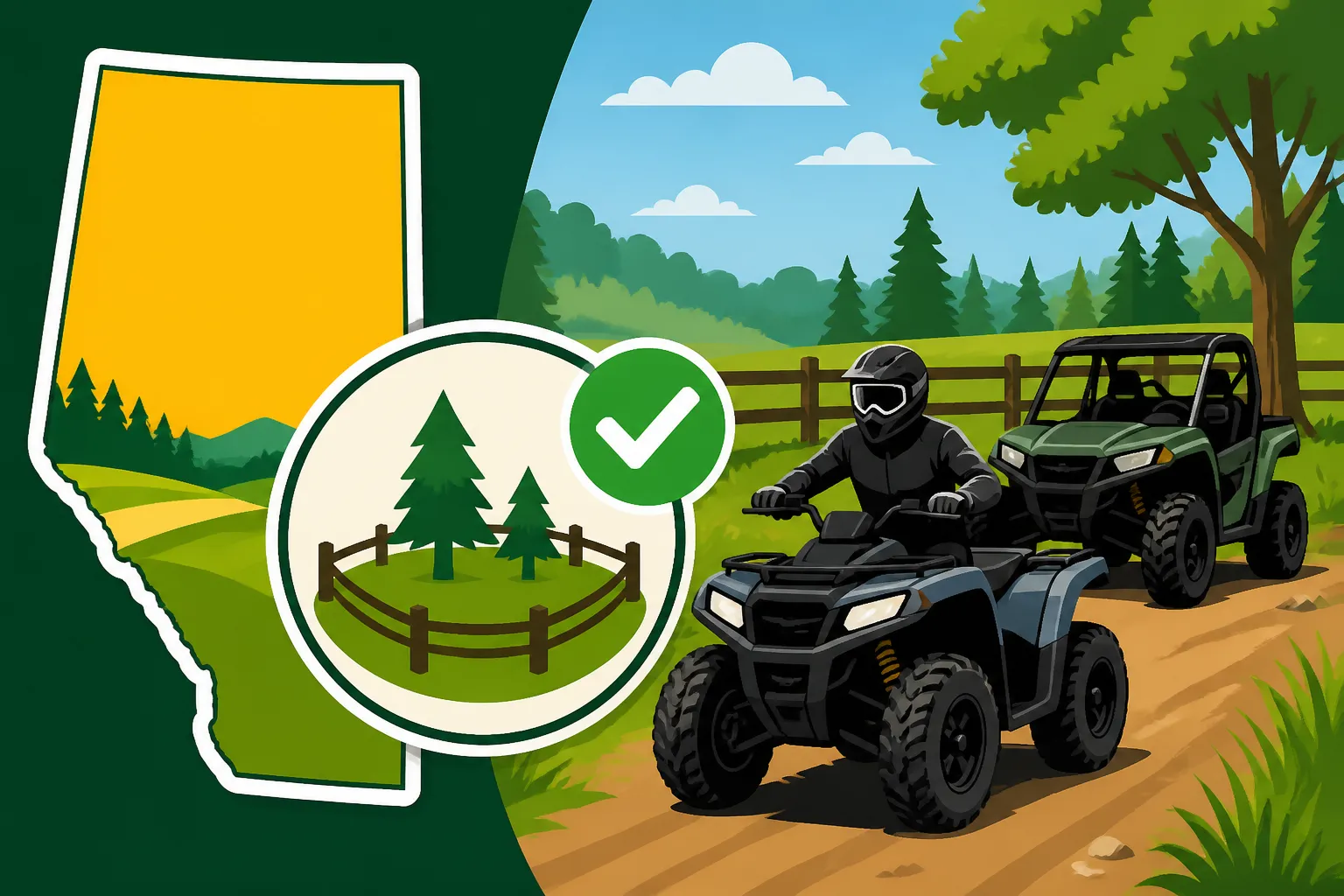
This exemption is designed for situations where the vehicle isn't interacting with public infrastructure or being exposed to the general public. Think about a farmer using a quad solely on their own fields, or a property owner enjoying their side-by-side strictly within their fenced acreage. In these scenarios, the provincial government doesn't require a licence plate or a registration certificate, as the machine's operation isn't impacting public safety or land management in the same way a vehicle on public land would.
However, the key here is the word "exclusively." Any deviation from strictly private land can quickly pull your OHV into the realm of requiring registration. This is where many riders get caught off guard, assuming that a quick hop across a road or a short trip down a ditch still counts as "private land riding." It's crucial to understand that even brief moments on what the law considers a "highway" can change everything.
What Alberta Considers "Private" Versus "Public" Land for OHVs
To truly understand when you might be exempt from OHV registration, you first need a solid grasp of how Alberta defines "private land" versus "public land" in the context of off-highway vehicle operation. This distinction is far more intricate than just looking for a "No Trespassing" sign, and it's a common area of confusion for riders.
Deeded Private Property
This is the most straightforward definition. If you own the land, or have explicit permission from the landowner to operate your OHV on their deeded property, and your machine never leaves those boundaries, then your OHV is considered to be on private land. This includes farm fields, private recreational land, or large acreage homes. The key here is undisputed ownership or clear, documented permission. For instance, if you're helping a neighbour move hay with your quad, ensuring you have their written permission can be a good idea, especially if local bylaws are strict. If you're buying or selling a machine for private land use, a clear bill of sale, perhaps using a template from a service like LawDepot, is always a good idea to prove ownership, even if registration isn't needed.
What often surprises people is how quickly this "private" status can be lost. Riding from one field to another across a public road, even if it's just a few feet, moves your operation onto a "highway" in the eyes of the law. Similarly, if your property borders undeveloped Crown land, and you accidentally cross the boundary, you're now on public land and subject to all the associated regulations. The definition is rigid; there's no grey area for "almost private" or "just barely public."
Grazing Leases and Other Leased Lands
This is where things get a bit more complex. While a grazing lease is private in the sense that a specific rancher or company holds the lease, these lands are still considered Crown land (public land) under the Public Lands Act. Therefore, operating your OHV on a grazing lease, even with the leaseholder's permission, generally requires your machine to be registered and insured, just as if you were riding in a Public Land Use Zone (PLUZ).
The leaseholder's permission is crucial to avoid trespassing charges, but it does not magically transform the land into privately owned property for the purposes of OHV registration. Many riders assume that because they have permission from the leaseholder, they're "good to go" without registration. This is a significant misunderstanding. Always double-check the status of the land you plan to ride on. A quick call to Alberta Environment and Parks or checking relevant land use maps can save you a lot of grief. [Alberta Trespass Law for Riders] has more details on understanding property boundaries.
Highway Ditches, Road Allowances, and Access Roads
Here's the biggest trap for private land riders. In Alberta, the legal definition of a "highway" is incredibly broad. It doesn't just mean paved roads; it includes highway ditches, road allowances, and even many unimproved access roads that might feel like private property. If you need to cross a road to get from one part of your private land to another, or if you ride along a ditch beside a public road, you are technically operating your OHV on a "highway."
This means that even if your ultimate destination is private property, the act of briefly being on a ditch or road allowance triggers the requirement for your OHV to be registered and plated. Many tickets are issued to riders who believe they are "just crossing" or "just getting to the private land" and are unaware that these areas are legally considered part of the highway system. It's a common frustration, but the law is clear on this point. For more on this, check out [Alberta Ditch Riding Is Not Automatic].
When Registration Is Still Required, Even for Private-Adjacent Situations
Even if your primary intention is to ride exclusively on private land, there are several common scenarios where you'll still need to register your OHV in Alberta. These situations often involve brief, incidental contact with public spaces, which the law considers sufficient to mandate registration.
Crossing a Public Road or Ditch
As mentioned, this is the most frequent reason private land riders find themselves on the wrong side of the law. If your property is bisected by a public road, or if you need to access different parts of your land by crossing a road or travelling briefly along a ditch, your OHV must be registered and plated. This applies even if the road is gravel, unmarked, or rarely used. The moment your tires touch what's legally defined as a "highway" – including its shoulders and ditches – provincial registration requirements kick in. This is not just about avoiding a ticket; it's also about insurance and accountability in case of an incident. [Alberta ATV Road Rules: Bylaws Decide] explains how local regulations can further complicate this.
Imagine you own a large property, but the only way to get your side-by-side from the front pasture to the back forty is to briefly cross a rural road. That brief crossing, perhaps only 20 feet, still means you're on a public thoroughfare. The expectation is that any vehicle operating on this "highway" is registered and, by extension, insured. This ensures that if there's an accident involving another vehicle or person, there's a record and a mechanism for liability.
Riding on Leased Crown Land
Many ranchers, farmers, and even recreationalists use leased Crown land. While you might have a lease agreement, this land remains "public land" in the eyes of the province. Therefore, if you plan to ride your OHV on any leased Crown land, such as grazing leases, traplines, or other types of dispositions, your machine must be registered. This is a critical distinction that often confuses individuals who feel they have a form of private access to the land.
The lease grants you certain rights to use the land for specific purposes, but it doesn't transfer ownership or change its status from public to private. The government still oversees the regulations for recreational or general vehicle use on these lands. So, whether you're checking cattle on a grazing lease or accessing a remote cabin on a recreational lease, ensure your OHV is properly registered before you hit the trail. For a clear understanding, you might want to look at [Alberta Registration Before Riding Crown Land].
Driving on Private Roads Open to the Public
Some private developments, such as industrial sites, rural communities, or large resorts, might have private roads that are nevertheless open for public access, even if intermittently. If these private roads are used by the general public (even if restricted to certain users or times), they can sometimes fall under interpretations that require OHVs to be registered, especially if there's any interface with the public road system. While less common, it's a point of due diligence to check with the land or development owner about their specific OHV rules and whether they align with provincial registration requirements for such roads.
This can be a tricky area because the "private" ownership of the road might suggest no registration is needed, but the "public access" aspect complicates things. If an accident were to occur on such a road, and your unregistered OHV was involved, you could face significant legal and financial repercussions. It's always best to err on the side of caution and ensure your machine is registered if there's any doubt about public access.
Important Considerations for All Private Land Riders
Even if you are absolutely certain your OHV will never leave your deeded private property, there are still crucial aspects to consider beyond just provincial registration. Thinking through these points ensures a safer and more responsible riding experience for everyone involved.
Proof of Ownership
Whether your OHV is registered or not, having clear proof of ownership is always essential. This could be a bill of sale, a manufacturer's statement of origin (MSO), or a previous registration certificate in your name. This documentation protects you in case of theft, allows you to sell the machine legally, and proves it's yours if you ever have a dispute. Using a standard template, perhaps from a service like LawDepot, for your bill of sale ensures all necessary details are captured.
Think about it: if your unregistered quad is stolen from your private property, how do you prove it belongs to you to the police? A strong paper trail, even for a machine only ridden on private land, is invaluable. Similarly, if you decide to sell the machine down the road, a prospective buyer will want to see proof of ownership, and providing a comprehensive bill of sale simplifies the process and instills confidence. [Alberta Private Sale Paperwork] offers more insights into this.
Insurance for Liability
While provincial OHV registration generally mandates insurance for public land use, having liability insurance is a non-negotiable safeguard even on private property. Accidents can happen anywhere. If someone is injured on your private land while riding your unregistered OHV, or if they crash into your barn, you could be held personally liable for damages and medical costs. A separate off-highway vehicle insurance policy, even if not tied to a registration certificate, provides crucial protection.
Many home insurance policies might offer some limited coverage for OHVs, but it's often minimal and comes with significant restrictions. Always check with your insurance provider to understand your coverage for OHVs on private property. A dedicated OHV policy is typically the safest bet to ensure adequate protection against property damage, personal injury claims, and legal fees. For more information, you can read [Alberta Insurance Requirements on Public Land] to understand the general expectations for OHV insurance.
Safety Gear and Practices
Just because you're on private land doesn't mean safety takes a backseat. Wearing a CSA-approved helmet, appropriate riding gear (gloves, sturdy boots, long pants, and sleeves), and understanding the machine's capabilities are paramount. This is especially true if you have young riders. Even a low-speed tip-over on your own property can result in serious injury. Establishing clear safety rules for anyone riding on your land is a responsible practice.
Alberta has specific helmet laws for public land, but those same safety principles apply to private land. Why risk a head injury on your own property when a helmet could prevent it? Ensure your OHV is well-maintained, with working brakes and lights, even if you only use it during the day. Consider taking a safety course, such as those offered by the Canada Safety Council, which teach critical riding skills that are beneficial regardless of where you ride. [Alberta Helmet Law on Public Land] gives you an idea of the standards.
Local Bylaws and Noise Restrictions
Even on private land, you might still be subject to local municipal bylaws regarding noise, operating hours, or the types of vehicles allowed. While most rural areas are more lenient, if your private property is close to residential areas, neighbours might still lodge complaints about excessive noise from your OHV. Always be a considerate neighbour and check with your local county or municipality for any specific bylaws that might apply to OHV use on private land, especially regarding sound levels and times of operation.
Riding responsibly on your own land involves more than just adhering to provincial laws; it's about being a good community member. Maintaining your machine with a stock exhaust system and avoiding excessively loud riding during quiet hours can prevent friction with neighbours and potential bylaw enforcement.
Here's a quick comparison of what's generally required:
| Situation | OHV Registration Required | Provincial Insurance Required | Helmet Required (Provincial Law) | Age Restrictions (Provincial Law) |
|---|---|---|---|---|
| Riding Exclusively on Deeded Private Land | No | No (but highly recommended) | No (but highly recommended) | No (but manufacturer age limits apply) |
| Crossing a Public Road/Ditch | Yes | Yes | Yes | Yes (14+ without supervision) |
| Riding on Leased Crown Land | Yes | Yes | Yes | Yes (14+ without supervision) |
| Riding on Private Roads Open to the Public | Potentially (check local) | Potentially (check local) | Yes | Yes (14+ without supervision) |
Ultimately, while the "private land only" exemption for OHV registration in Alberta does exist, it's far narrower than many riders assume. Any interaction, however brief, with what the law considers a "highway" or public land means your off-highway vehicle needs to be properly registered and insured. Staying informed and exercising caution will help you avoid potential tickets and ensure a safe, legal riding experience.
Disclaimer
This article is for general informational purposes only and does not constitute professional advice. Laws, prices and regulations vary by location and change over time. Consult a qualified professional for guidance on your specific situation.