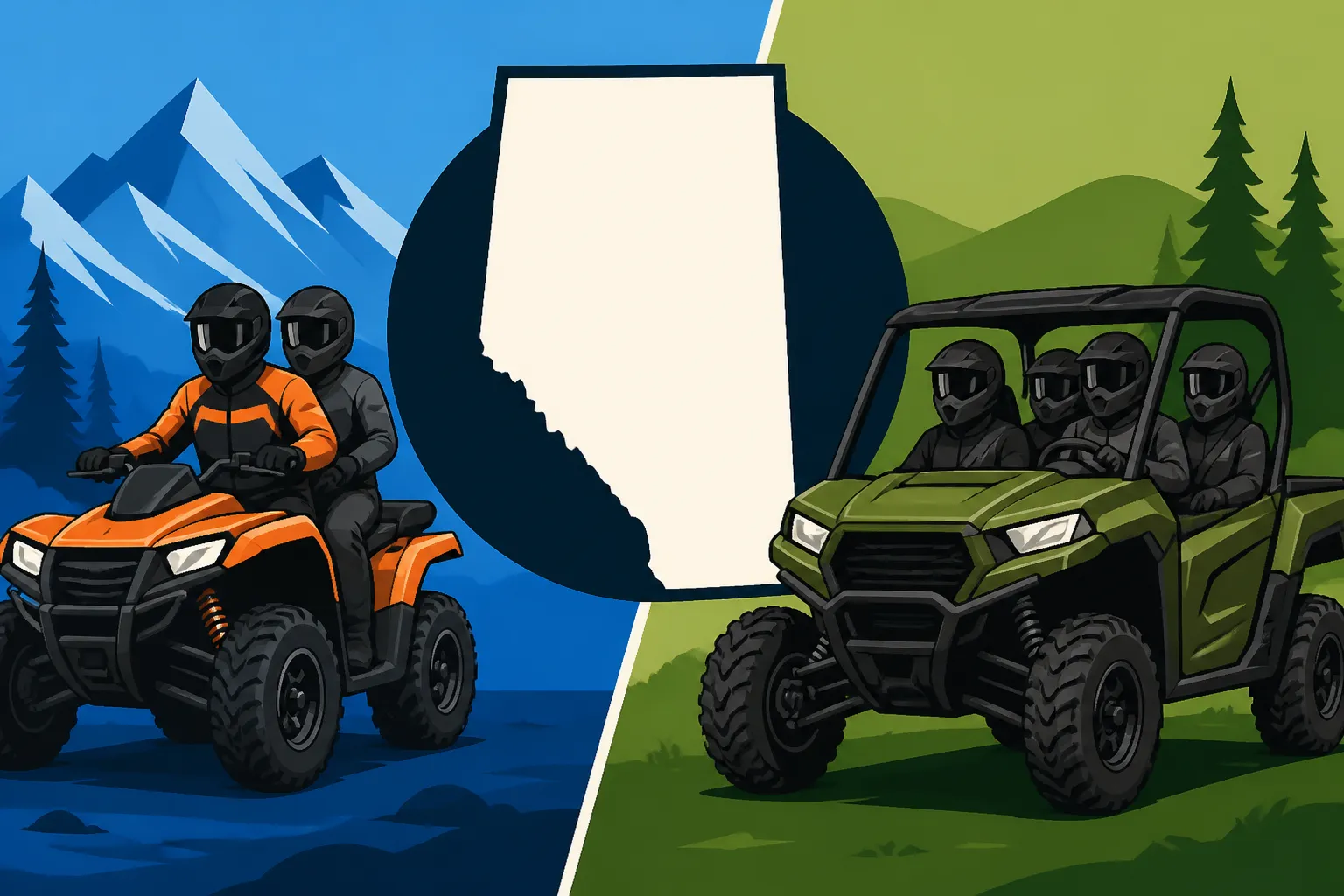
Alberta Passenger Limits by Manufacturer
It can be incredibly frustrating trying to figure out how many people you can legally and safely carry on your ATV or UTV in Alberta. With so many different types of machines on the market, from single-rider quads to multi-passenger side-by-sides, and the natural desire to share the adventure with friends and family, it's easy to get confused about what's allowed. This guide will cut through the noise, breaking down Alberta's rules for passenger limits on off-highway vehicles, focusing heavily on what your machine's manufacturer intended and how that aligns with provincial regulations to keep everyone safe and legal on the trails.
The Foundation: Manufacturer's Designated Passenger Capacity
When it comes to carrying passengers on your off-highway vehicle (OHV) in Alberta, the most important rule of thumb is also the simplest: always adhere to what the manufacturer designed your machine for. It might seem obvious, but many riders mistakenly believe that if they can physically fit more people on, it must be okay. This couldn't be further from the truth. The manufacturer's designated capacity isn't an arbitrary suggestion; it's a critical safety parameter based on extensive engineering, testing, and understanding of weight distribution, stability, and handling characteristics.
Reading Your Machine's Specifications
The first step in understanding your OHV's passenger limit is to consult its official documentation. Your owner's manual is a treasure trove of vital information, including the exact number of riders your specific model is designed to carry. This information might also be found on a VIN plate or safety stickers affixed directly to the machine itself. These decals often indicate the maximum weight capacity and the maximum number of occupants. Ignoring this specified limit isn't just a safety hazard; it also puts you at risk of fines if encountered by law enforcement.
For example, a traditional single-rider ATV, even one with a long, comfortable seat, is unequivocally designed for one person only. The suspension, wheelbase, and steering geometry are all calibrated for a single operator. Adding a second person, even a small child, dramatically alters the machine's centre of gravity, making it unstable, especially during turns, climbs, or descents. It significantly increases the risk of a rollover, which can have devastating consequences for everyone involved.
The "Two-Up" ATV: Designed for an Extra Rider
While many ATVs are single-rider machines, there's a specific class known as "two-up" or "two-rider" ATVs that are purpose-built to safely accommodate a driver and one passenger. These machines are distinctly different from their single-rider counterparts and are easily identifiable by several key design features. They typically boast a longer wheelbase for enhanced stability, a more robust suspension system to handle the increased load, and a specially designed, often stepped, seat that provides a comfortable and secure position for the passenger.
Beyond the extended chassis and tailored suspension, true two-up ATVs will also have dedicated passenger handholds and proper footrests. These features are not optional; they are integral to the safe operation of the machine with a second rider. Attempting to carry a passenger on a single-rider ATV, even by modifying it with an aftermarket "buddy seat" on the cargo rack, does not make it a legal or safe two-up machine. The fundamental engineering limitations for stability and weight distribution remain, and you're essentially overriding critical safety design. For a deeper dive into this specific setup, check out [Riding Two Up on One Seat].
Side-by-Sides: Capacity and Safety Features
Side-by-sides, also known as Utility Terrain Vehicles (UTVs) or Recreational Off-Highway Vehicles (ROVs), offer a fundamentally different riding experience compared to ATVs, especially when it comes to passenger capacity. Their design inherently allows for multiple occupants, often in a car-like seating arrangement, but they still operate under strict manufacturer-defined limits. Understanding these limits and the associated safety features is paramount for anyone riding a UTV in Alberta.
Understanding Multi-Passenger Configurations
Side-by-sides come in a variety of configurations, most commonly two-seater, four-seater, and even six-seater models. Each of these configurations is specifically engineered to accommodate its designated number of passengers safely. For instance, a two-seater UTV will have two bucket seats with corresponding seat belts, a four-seater will have a bench or bucket seats for four, and so on. The number of factory-installed seats and seat belts is your clearest indicator of the maximum passenger capacity. You simply cannot add extra people beyond these designated spots.
Even with the wide array of aftermarket accessories available from companies like SuperATV, which might offer cargo solutions, door upgrades, or windshields to enhance your UTV, these additions do not magically increase your vehicle's passenger capacity. The structural integrity of the chassis, the roll-over protection system (ROPS), and the suspension are all designed for a specific load. Attempting to fit more people than there are designated seats and seat belts is not only dangerous but also likely a violation of provincial regulations. When considering your UTV's capacity, always default to the original manufacturer's design and the number of factory-installed safety restraints. For more on UTV passenger rules, see [Manufacturer Passenger Limits on a Side-by-Side].
The Role of Seat Belts and ROPS
One of the most significant safety advantages of side-by-sides over traditional ATVs is the inclusion of seat belts and a Roll-Over Protection Structure (ROPS). In Alberta, if your OHV is equipped with these features – which nearly all modern UTVs are – it is mandatory for all occupants to use them. This isn't just a recommendation; it's a legal requirement designed to protect you and your passengers in the event of an accident or rollover. The ROPS is engineered to create a survival space around the occupants, and the seat belts ensure you remain within that protected zone.
The number of factory-installed seat belts serves as the definitive count for how many passengers your UTV can legally and safely carry. If your machine has four seat belts, it's a four-person machine, no more. There's no provision for passengers to ride without a seat belt, or to share a seat belt, just as there's no allowance for riding outside the protected confines of the ROPS. These safety systems work in tandem; without both functioning correctly and being utilized, their protective benefits are severely diminished. Tampering with, removing, or simply not using the seat belts and ensuring the ROPS is intact not only puts lives at risk but also exposes you to significant legal consequences. Understanding [When a Cage and Seat Belt Replace a Helmet] is crucial for side-by-side riders.
Alberta Law and Passenger Rules
Alberta's legal framework for off-highway vehicles is designed to ensure safety for all riders and to protect the environment. When it comes to passenger limits, the province's laws generally mirror the common-sense approach of adhering to manufacturer specifications. Disregarding these guidelines, whether through ignorance or intent, can lead to serious consequences, from fines to severe injury.
The Traffic Safety Act and OHV Regulation 319/2002
Alberta's primary legislation governing OHVs is the Traffic Safety Act, supplemented by the Off-Highway Vehicle Regulation (319/2002). These laws broadly state that OHVs must be operated in a safe manner, which inherently includes operating them within their designed capacities. For passengers, this means adhering to the manufacturer's designated limits for your specific machine. If your ATV is a single-rider model, carrying a passenger is a violation. If your side-by-side is a four-seater, you cannot legally or safely carry five people.
These regulations apply across all public lands where OHV use is permitted, including designated trails, Public Land Use Zones (PLUZs), and even when crossing a public road where allowed by municipal bylaw. The expectation is that you operate your OHV as it was intended, and that includes respecting its passenger limits. Beyond just the number of passengers, there are also rules around who can be a passenger, particularly concerning young riders. While there isn't a strict minimum age for being a passenger on a properly designed multi-passenger OHV, the operator must still be compliant with age and supervision requirements. For a full overview, consult [What the Traffic Safety Act Requires of Alberta OHVs] and [Off-Highway Vehicle Regulation 319/2002]. Also, specific rules for younger riders are detailed in [Alberta Rules for a Child Passenger].
Penalties and Consequences of Overloading
The financial and safety consequences of operating an OHV with more passengers than it's designed for can be significant. Law enforcement officers, whether RCMP, conservation officers, or bylaw enforcement, are vigilant about safe OHV operation. If you're caught overloading your machine, you could face substantial fines, which can quickly add up and take a big bite out of your riding budget. These penalties serve as a deterrent, but they also reflect the serious nature of the infraction. [Alberta Penalties for Illegal Road Riding] gives a general idea of the costs of violating OHV rules.
Beyond the immediate financial hit, the safety implications are far more dire. An overloaded OHV becomes much harder to control. Its braking distance increases, its ability to navigate obstacles or make sharp turns is compromised, and its susceptibility to rollovers skyrockets. A small bump or a sudden maneuver that would be perfectly safe with the correct load can become catastrophic with too many people on board. If an accident occurs while your machine is overloaded, your insurance company might very well deny your claim, leaving you personally responsible for all medical expenses, property damage, and legal fees. This financial exposure can be ruinous, highlighting why respecting passenger limits is about more than just avoiding a ticket – it's about safeguarding lives and your financial well-being.
Practical Scenarios and Common Misconceptions
It's easy to fall into traps of thinking that rules don't apply in certain situations, or that a quick modification can bypass safety guidelines. However, when it comes to OHV passenger limits in Alberta, safety and legality are consistently tied to manufacturer design, regardless of the circumstances.
"Just For a Short Ride" or "Around the Property"
A common misconception among OHV riders is that passenger limits only apply to long trips or specific riding zones. Many might think, "It's just a quick hop to the campsite," or "I'm only riding around my own property, so it doesn't matter." This line of thinking is dangerously flawed. The engineering limitations and safety considerations of your OHV do not magically disappear because the ride is short or happens on private land. While specific bylaws on private land might have some different allowances, the fundamental physics of an overloaded machine remain the same, making it unstable and hazardous anywhere.
On public land, even a "short ride" with too many passengers can result in a ticket and put you and your occupants at severe risk. Officers enforce the rules wherever OHVs are legally ridden. The complacency that often accompanies short, familiar rides can be particularly dangerous. Many serious accidents happen close to home or camp because riders let their guard down, thinking they know the terrain or that nothing bad could happen in such a short distance. These regulations are universal precisely because the risk of injury or fatality from an overloaded machine is constant, regardless of the journey's length or location. For more details on private land rules, consult [Alberta Rules for Riding Private Land].
Aftermarket Seats vs. Manufacturer's Intent
The aftermarket world offers a vast array of enhancements for OHVs, from performance upgrades to utility attachments. Companies like SuperATV produce high-quality accessories that can improve your machine's capabilities and comfort. However, it's crucial to understand that not all aftermarket additions are equal when it comes to modifying passenger capacity. Adding an aftermarket "buddy seat" or a custom bench to the cargo rack of a single-rider ATV, or even a side-by-side not designed for extra seating, does not legally or safely increase its passenger limit.
These modifications, while seemingly convenient, fundamentally alter the vehicle's weight distribution, handling dynamics, and structural integrity in ways not intended by the original manufacturer. A passenger perched on a cargo rack or on an unreinforced aftermarket seat is exposed to significant risks in the event of a bump, sudden turn, or rollover. There are no seat belts, no proper footrests, and no ROPS protection in such a setup. Always refer back to your owner's manual and the manufacturer's original design. If you truly need more passenger capacity for your adventures, the safest and most legally compliant solution is to invest in an OHV that was built from the factory to accommodate the number of riders you intend to carry. Do not compromise safety for a temporary workaround.
| Machine Type | Manufacturer's Standard Seating | Alberta Legal Consideration | Key Safety Features |
|---|---|---|---|
| Single-Rider ATV | 1 rider | Max 1 rider (as designed) | Balance, suspension, single seat |
| Two-Up ATV | 1 rider + 1 passenger | Max 2 riders (as designed) | Extended wheelbase, specific passenger seat/footrests/handholds |
| 2-Seat Side-by-Side | 1 driver + 1 passenger | Max 2 riders | ROPS, 2 factory seat belts, low centre of gravity |
| 4-Seat Side-by-Side | 1 driver + 3 passengers | Max 4 riders | ROPS, 4 factory seat belts, extended chassis |
| 6-Seat Side-by-Side | 1 driver + 5 passengers | Max 6 riders | ROPS, 6 factory seat belts, longest chassis |
Adhering to the manufacturer's designated passenger limits for your ATV or UTV is not just a suggestion in Alberta; it's a critical aspect of safe and legal OHV operation. It's about respecting the engineering that went into designing your machine, protecting yourself from potential fines and legal liabilities, and most importantly, safeguarding the lives and well-being of everyone who rides with you. Before every ride, take a moment to confirm your machine's capacity and ensure that every passenger is seated and secured according to both the manufacturer's guidelines and Alberta's regulations.
Disclaimer
This article is for general informational purposes only and does not constitute professional advice. Laws, prices and regulations vary by location and change over time. Consult a qualified professional for guidance on your specific situation.