Alberta Rules for Riding in a Provincial Park
It's a common dream for many Alberta ATV and UTV enthusiasts: picture yourself revving up your machine, ready to explore the stunning landscapes of one of our beautiful provincial parks. The thought of cruising through scenic trails, taking in the pristine wilderness, often clashes with the reality of strict regulations, leaving many riders confused and frustrated about where they can and cannot legally operate their off-highway vehicles. This guide aims to clear up that confusion, providing a comprehensive look at Alberta's rules for riding ATVs and UTVs in provincial parks, helping you understand where you can find adventure and where you need to respect nature from a distance.
The General Rule: Provincial Parks are Largely Off-Limits for OHVs
Let's get straight to the point: for the most part, Alberta's provincial parks are simply not set up for off-highway vehicle (OHV) recreation. It’s a hard truth to hear when you’re eager to explore, but these areas are primarily designated for conservation, passive recreation like hiking and camping, and protecting ecological integrity. When you drive up to a provincial park boundary, you should generally assume that your ATV or UTV needs to stay on the trailer. This isn't just about convenience; it's about preserving these vital natural spaces for everyone, and for future generations.
It's easy to look at a vast, wild provincial park and think, "There must be somewhere to ride here!" but the provincial park system operates under a different mandate than other public lands. While some areas of Alberta's public lands are specifically managed for diverse recreational uses, including OHV riding, provincial parks maintain a much stricter focus on environmental protection and low-impact activities. This distinction is crucial for understanding why access for motorized recreation is so limited.
The frustration often stems from seeing trails that look perfect for riding within park boundaries, but these are almost universally designated for non-motorized use such as hiking, mountain biking, or horseback riding. Attempting to ride your ATV or UTV on these trails, even if they appear open or unused, can lead to serious legal consequences and significant environmental damage. The rules are in place to safeguard delicate ecosystems, reduce conflict between different user groups, and ensure the tranquility that many visitors seek in these protected areas.
Why the Blanket Restriction?
The primary reason for the widespread restriction on OHV use in Alberta's provincial parks comes down to their core purpose: conservation. These parks are established to protect representative landscapes, ecosystems, and wildlife species. When you introduce motorized vehicles, even those designed for off-road use, you risk disrupting this delicate balance in several ways. The noise, the exhaust, and the physical impact of tires on the ground can all have detrimental effects on the natural environment and its inhabitants.
Consider the impact on wildlife. The noise from ATVs and UTVs can stress animals, disrupt their feeding or breeding patterns, and even displace them from critical habitats. Imagine a deer herd attempting to graze near a busy OHV trail; the constant disturbance can push them into less suitable areas, impacting their survival. Additionally, provincial parks are often home to sensitive plant communities that can be easily damaged or destroyed by vehicle tires, leading to erosion, spread of invasive species, and habitat loss. The intent of these parks is to offer a sanctuary for nature, which means limiting human activities that could compromise that goal.
Beyond environmental concerns, there's the matter of user conflict. Provincial parks attract a wide range of visitors, many of whom are seeking peace, quiet, and an immersive natural experience. The presence of OHVs can significantly detract from this experience for hikers, birdwatchers, and campers. The different purposes of these areas are clearly defined: provincial parks are for conservation and passive recreation, while areas like Public Land Use Zones (PLUZs) are specifically managed for a broader range of activities, including motorized recreation. Understanding this fundamental difference helps explain why the blanket restrictions are in place, aiming to provide distinct experiences for all Albertans.
Understanding the "Designated Trails Only" Principle
The "designated trails only" principle is paramount in provincial parks, and it’s where many riders can get tripped up. Essentially, this means that if a trail isn't explicitly marked and promoted by Alberta Parks as an OHV trail, it is strictly off-limits to motorized vehicles. This isn't a suggestion; it's a rule that carries weight. Unlike some areas of Crown land where general access might be permissible unless explicitly restricted, provincial parks flip the script: access is restricted unless explicitly permitted.
This principle is designed to concentrate any approved OHV activity to specific corridors that have been assessed for their environmental impact and managed to minimize disturbance. These designated trails, if they exist at all within or immediately adjacent to a park, would be clearly signed and maintained for that specific purpose. However, in the vast majority of Alberta's provincial parks, such trails simply do not exist. Therefore, any unmarked path, service road, or hiking trail within a park boundary should be considered a non-OHV route.
For riders accustomed to exploring vast stretches of open Crown land where trails might be self-made or less formally managed, this can feel restrictive. However, it's a necessary measure for park management to control impact, prevent habitat fragmentation, and maintain the integrity of the park's natural features. Always remember that relying on assumptions or outdated information can lead to inadvertently breaking the rules, so thorough research using official sources is always your best bet before you even load your machine onto the trailer.
Exceptions and Designated Areas Within or Near Provincial Parks
While the general rule is "no OHVs in provincial parks," it's worth exploring the nuances. Are there any exceptions? What about areas that are just outside park boundaries but offer similar terrain? This is where understanding Alberta's broader land management strategy becomes really important.
Alberta's vast landscape includes a patchwork of different land designations, each with its own set of rules. While provincial parks themselves maintain strict control over motorized access, the good news is that Alberta does have extensive areas specifically set aside for OHV recreation. These are typically found in Public Land Use Zones (PLUZs), some of which might be geographically close to or share a similar natural aesthetic to provincial parks.
The key takeaway here is that you're looking for areas managed for OHV use, which are generally not within provincial park boundaries. These alternative areas often provide the same kind of exhilarating riding experience many enthusiasts seek, but under a land designation that supports it. It’s about knowing where to direct your adventurous spirit so you can ride legally and responsibly.
Specific Parks or Adjacent Areas with OHV Opportunities
It's extremely rare to find designated OHV trails within the core boundaries of Alberta Provincial Parks. The few exceptions, if they exist, might be short access roads for specific purposes or trails that allow very limited, regulated access, but these are not for general recreational riding. You won't find extensive trail networks for quads and side-by-sides crisscrossing the provincial park system.
However, riders often confuse provincial parks with adjacent Public Land Use Zones (PLUZs). These PLUZs are specifically managed for a variety of public land uses, including motorized recreation, and some of them border provincial park lands. For example, while Kananaskis Country is a vast area that includes multiple provincial parks and protected areas, it also contains popular PLUZs like [McLean Creek: Alberta's Best Known OHV Area] and the [Ghost PLUZ Riding in Alberta], which are prime destinations for OHV enthusiasts. Similarly, the [Castle Park OHV Trails in Alberta] are within the Castle Wildland Provincial Park and Castle Provincial Park, but even there, OHV access is restricted to a much smaller, specific, designated trail system. These are critical distinctions; you're riding within a PLUZ or designated area next to a provincial park, not inside the provincial park itself in most cases.
When planning a trip, always double-check the exact land designation for your intended riding area. Many mapping apps and government resources clearly differentiate between provincial parks, wildland provincial parks, and PLUZs. This ensures you're heading to a place where your machine is welcome, preventing fines and protecting the natural environment. These designated areas offer fantastic riding opportunities, often with similar stunning mountain or forest scenery you'd expect near a provincial park, but they are managed with OHV recreation specifically in mind.
The Role of Municipal Bylaws and Public Land Use Zones (PLUZ)
Understanding the hierarchy of land management is crucial for Alberta OHV riders. While provincial parks are under the jurisdiction of Alberta Parks, the majority of legitimate OHV riding opportunities in the province fall under the umbrella of Public Land Use Zones (PLUZs), managed by Alberta Environment and Protected Areas. These [Alberta's Public Land Use Zones Explained] are the primary areas where you'll find designated trails and a more permissive environment for motorized recreation. Some PLUZs are quite extensive and offer hundreds of kilometres of trails, providing the adventure many riders seek.
It's also worth noting that municipal bylaws play a role, particularly in areas surrounding provincial parks or other protected lands. Counties and municipal districts can have their own bylaws governing OHV use on roads, ditches, and other local access points. While these bylaws rarely open up provincial park land, they might dictate how you can get to a staging area for a PLUZ that is near a park. For instance, a local county road might allow OHV use to access a trail system that eventually leads into an approved PLUZ. However, this is always distinct from riding within a provincial park.
The bottom line is that while provincial parks prioritize conservation, PLUZs are designed to balance conservation with a variety of recreational activities, including OHV use. When you see signage that says "designated trails only" in a PLUZ, it's a good indication you're in the right place, assuming the specific trail is indeed designated for OHVs. Always refer to current maps and regulations specific to the PLUZ you intend to visit, and understand that these rules are distinct from the much stricter ones governing provincial parks.
What to Do Before You Ride: Research and Preparation
The excitement of loading up your ATV or UTV and heading out for a day of riding is undeniable. But before you even hit the road, a little preparation and research can save you a lot of grief – especially when it comes to navigating the nuanced rules around provincial parks. Thinking ahead ensures your trip is not only fun but also legal and respectful of the environment.
Proper planning isn't just about packing snacks and extra fuel; it's about being a responsible land user. This means knowing exactly where you're allowed to go, what equipment is required, and what permits you might need. It’s the difference between a fantastic day on the trails and a potentially expensive and frustrating encounter with enforcement. Whether your machine is fresh off the showroom floor or has been customized with performance parts from companies like SuperATV, the rules of the road and trail apply equally to everyone.
The key to a hassle-free experience is treating every new riding destination as if you know nothing about its specific rules. Never assume that because you rode somewhere last year, the rules haven't changed, or that one "public land" area is the same as another. Alberta's landscape is diverse, and so are its regulations for OHV use.
Checking Official Sources and Trail Maps
This cannot be stressed enough: always check official sources before you ride. For provincial parks, this means the Alberta Parks website. Look specifically for information on OHV use within the park you plan to visit. The vast majority of the time, you'll find explicit statements prohibiting or severely restricting motorized vehicles. If, by some rare chance, there's a designated OHV area or access route, it will be clearly outlined there. Relying on word-of-mouth or old forum posts is a recipe for trouble.
For areas that do permit OHV use, like PLUZs, you should consult the Alberta Environment and Protected Areas website for detailed information and official maps. Many of these maps are georeferenced, meaning you can download them to your phone and use them with GPS even without cell service. This is invaluable for staying on designated trails and avoiding protected areas. Organizations like the Alberta Off-Highway Vehicle Association (AOHVA) also often have up-to-date information and links to official resources, helping you find legal riding opportunities. A solid set of aftermarket tires or suspension from SuperATV might get you through tough terrain, but only good planning will get you through the legal requirements.
Beyond just knowing where to ride, it's also about knowing what the conditions are. Check for fire bans, seasonal closures, or temporary trail restrictions. These can change rapidly due to weather, wildlife activity, or maintenance work. A quick check of these official sources before you leave home can prevent disappointment and ensure you're riding safely and legally. Always plan your route with these maps, understanding that straying from designated paths, especially near sensitive park boundaries, can lead to environmental damage and penalties. You should also make sure you have your [Alberta Digital Certificates Must Be Printed] if applicable.
Essential Gear and Regulations (Even If Allowed)
Even if you find a rare provincial park area or, more likely, a nearby PLUZ where OHVs are permitted, all standard Alberta OHV regulations still apply. This isn't a free-for-all; it's regulated recreation. First and foremost, your machine must be properly registered and plated. This applies to all OHVs operating on public land, and an officer can ask to see proof at any time. For more information, you can check out [Alberta Registration Before Your First Ride].
Insurance is another non-negotiable requirement. Any OHV operating on public land in Alberta must have public liability insurance. This protects you and others in case of an accident. Carrying proof of insurance with you is also mandatory. [Alberta Requires Insurance on Public Land] delves into this in more detail. Helmets are absolutely mandatory for all riders and passengers on public land, and they must meet specific safety standards like CSA approval. An improperly fitted or unapproved helmet can lead to a significant fine, as outlined in [Alberta Helmet Law on Public Land] and [Alberta's $93 Non-CSA Helmet Fine].
Beyond registration, insurance, and helmets, your machine needs to be in good working order and meet specific equipment standards. This includes having working head and tail lights, a functional brake system, and perhaps most importantly for environmental protection, a spark arrestor and a stock (unmodified) exhaust system. The spark arrestor prevents hot carbon particles from escaping and potentially starting wildfires, which is a serious concern, especially in dry conditions. For more on this, see [Alberta Requires a Spark Arrestor]. Modified exhausts, while they might sound "cooler" to some, are often much louder than legal limits and can result in tickets and noise complaints. Companies like SuperATV sell a variety of accessories, but you must ensure any modifications still comply with provincial regulations.
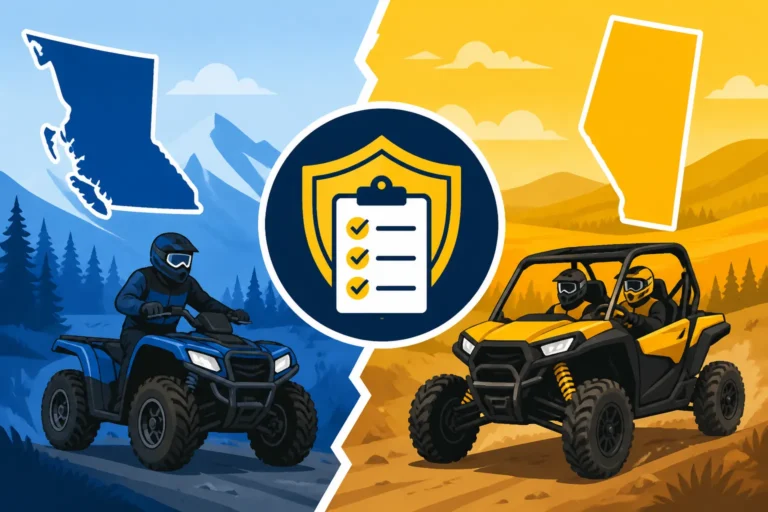
The following table provides a quick comparison of general OHV rules and expectations between Alberta Provincial Parks and Public Land Use Zones (PLUZs):
| Feature / Rule | Alberta Provincial Parks | Alberta Public Land Use Zones (PLUZs) |
|---|---|---|
| OHV Access | Generally prohibited; very rare designated access. | Generally permitted on designated trails/routes. |
| Primary Purpose | Conservation, passive recreation (hiking, camping). | Multi-use: recreation, resource extraction, OHV. |
| Registration Required | N/A (as OHVs usually not permitted). | Yes, for all public land riding. |
| Insurance Required | N/A (as OHVs usually not permitted). | Yes, for all public land riding. |
| Helmet Law | N/A (as OHVs usually not permitted). | Yes, mandatory for all riders/passengers. |
| Spark Arrestor | N/A (as OHVs usually not permitted). | Yes, mandatory on public land. |
| Trail Marking | Trails for non-motorized use, clearly marked. | OHV trails clearly marked as designated for OHVs. |
| Environmental Focus | High protection, minimal impact from motorized use. | Balanced with recreational access, but still protected. |
| Enforcement | Park Rangers, Fish and Wildlife Officers. | Fish and Wildlife Officers, RCMP. |
Penalties and Responsible Riding
Ignoring the rules for OHV use, especially in sensitive areas like provincial parks, can lead to a lot more than just a stern talking-to. Alberta has clear regulations in place to protect its natural resources and ensure public safety, and enforcement officers don't hesitate to act when these rules are violated. Understanding the potential consequences is a strong motivator for riding responsibly and sticking to designated areas.
Beyond the legal ramifications, there's a broader responsibility we all share as outdoor enthusiasts. Our actions on the trails, or where we choose to create new ones, directly impact the environment and the future of OHV recreation in Alberta. Being a good steward of the land means respecting closures, staying on marked trails, and supporting efforts to maintain sustainable riding opportunities.
Ultimately, riding an ATV or UTV is a privilege, not a right. When we act with respect for the land and for other users, we help ensure that these opportunities remain available for everyone to enjoy. It’s about being part of the solution, not contributing to the problem, and helping to shape a positive image for the OHV community.
Consequences of Illegal OHV Use in Parks
Riding an OHV in an undesignated area within an Alberta provincial park can lead to severe penalties. This isn't just a minor infraction; it can be treated as a serious violation of provincial park regulations and the Alberta Provincial Parks Act. You could face significant fines, potentially hundreds of dollars, for illegally operating an OHV in a prohibited zone. [Alberta Penalties for Riding Unregistered] gives you an idea of the costs involved with other OHV infractions.
In some cases, especially if there's damage to the environment or repeated offenses, your vehicle could even be seized. Imagine your quad or side-by-side being impounded, leading to further towing and storage fees on top of any fines. This isn't a scenario any rider wants to experience, and it's a very real possibility if you choose to ignore posted signs and park boundaries. Enforcement officers, including Park Rangers and Fish and Wildlife Officers, are vigilant in these protected areas precisely because of their ecological sensitivity.
Beyond the immediate legal and financial consequences, there's the long-term impact on the reputation of the OHV community. Illegal riding contributes to a negative perception of off-highway vehicles and their operators, making it harder for advocates to secure and maintain legal riding areas. Every instance of environmental damage, whether it's erosion from riding off-trail or disturbance to wildlife, strengthens the argument for further restrictions on OHV access across the province. Responsible riding means respecting the rules, even when it feels inconvenient, to protect both the environment and the future of the sport.
Advocating for Responsible OHV Access
Instead of pushing boundaries where OHVs are clearly not allowed, responsible riders advocate for and support legitimate, designated OHV opportunities. This means actively seeking out areas like Public Land Use Zones (PLUZs) that are managed for motorized recreation and sticking to the trails within them. When you consistently ride where you're supposed to, you become a part of the solution, demonstrating that OHV enthusiasts can be responsible stewards of the land.
Supporting organizations like the Alberta Off-Highway Vehicle Association (AOHVA) is another excellent way to advocate for access. These groups work with government agencies to develop and maintain designated trail systems, educate riders on best practices, and promote responsible land use. They are often instrumental in securing funding for trail development and maintenance, creating the very opportunities that riders enjoy. Participating in volunteer trail maintenance days or simply being a dues-paying member can make a tangible difference in the future of OHV riding in Alberta.
Ultimately, the best way to ensure continued and expanded access for ATVs and UTVs in Alberta is through education, adherence to rules, and active participation in the OHV community. By being responsible, informed riders, we help demonstrate that OHV recreation can coexist with conservation efforts, ensuring that there are plenty of fantastic places to ride for years to come without encroaching on the pristine beauty of our provincial parks. You can find many [Alberta OHV Trail Maps Worth Downloading] to help you plan your next ride in a legal and designated area.
Disclaimer
This article is for general informational purposes only and does not constitute professional advice. Laws, prices and regulations vary by location and change over time. Consult a qualified professional for guidance on your specific situation.