Alberta Private Property Helmet Exemption
It’s a scene many of us have lived: you’re out at the cabin, or on your friend's sprawling acreage, or maybe even just on your own backyard property, and the thought crosses your mind – "Do I really need to put on this helmet just to zip around here?" Alberta's OHV helmet laws can feel pretty restrictive, especially when you're just trying to enjoy your machine in what feels like a perfectly safe, private setting. This guide will walk you through the specific exemption for riding an ATV or UTV on private property in Alberta, helping you understand when you can legally and safely ditch the lid.
Understanding Alberta's General Helmet Law for OHVs
Before we dive into the specifics of private property, it’s crucial to understand the foundational rule in Alberta: helmets are generally mandatory when riding off-highway vehicles. This isn't just a suggestion; it's a legal requirement designed to keep riders safe, and it's a rule that trips up many people who aren't familiar with its nuances. Ignoring it can lead to more than just a stern talking-to.
The Mandate for Helmets on Public Land
The Province of Alberta, specifically through its Traffic Safety Act and the Off-highway Vehicle Regulation (319/2002), states quite clearly that anyone operating or riding as a passenger on an off-highway vehicle (OHV) must wear a helmet that meets an approved safety standard. This applies whenever you are on public land. "Public land" is a much broader term than many folks realize, encompassing not just designated trails and [Alberta's Public Land Use Zones Explained], but also highway ditches, undeveloped road allowances, and even many seemingly remote cutlines and lease roads that are technically accessible to the public. If you're out exploring the backcountry, hitting the trails in places like [McLean Creek: Alberta's Best Known OHV Area], or even just crossing a gravel road, you are almost certainly on public land and a helmet is required.
Think of it this way: if a conservation officer or an RCMP officer can access the area without trespassing on private property to reach you, chances are it's considered public land. This broad interpretation is a common source of frustration for riders who feel like they’re miles from anywhere but are technically still subject to provincial regulations. It’s a good reminder that just because it looks wild doesn't mean it's unregulated.
Why the Helmet Law Was Introduced
The introduction of mandatory helmet laws for OHVs in Alberta, which came into effect on May 15, 2017, wasn't about stifling fun, but about saving lives and reducing severe injuries. Before this date, helmets were only mandatory for riders under 18 years old on public land, and voluntary for adults. However, statistics showed a disturbing trend of head injuries, fatalities, and long-term disabilities resulting from OHV accidents. It’s easy to dismiss a helmet as an inconvenience, but when you consider the speeds these machines can reach, the unpredictable terrain, and the sheer force involved in a rollover or ejection, the protection they offer is undeniable.
The provincial government recognized that many accidents, particularly those involving adults, resulted in preventable head trauma. Mandating helmets was a proactive step to mitigate these risks. While it might feel like an extra burden, especially on a hot day, it's a small trade-off for the potentially life-saving protection it provides. It's about ensuring that riders, and their families, don't have to face the devastating consequences of a head injury that could have been avoided. This background helps explain why the rules are so pervasive, making the private property exemption stand out as a notable carve-out. [Alberta Helmet Law on Public Land] details more about the requirements on public ground.
Defining "Private Property" in the Context of OHVs
This is where the distinction becomes critical for riders in Alberta. The helmet exemption hinges entirely on whether you are truly on "private property." It sounds simple, but the definition can be more nuanced than just "land I own" or "land my buddy owns." Understanding these distinctions is key to riding legally without a helmet.
Your Own Land and Immediate Farm Property
The most straightforward example of private property where the helmet exemption applies is land that you own outright, or land that is clearly and exclusively private, such as a farmer's field or a private acreage. If you're riding your quad around your own backyard, through your pastures, or exploring your own personal woodlot, you are on private property. This also extends to the specific scenario of [Alberta Farmer-Owned Machines on Private Land] where the machine is used strictly for farm operations on that farmer’s own property.
This means if you're working the cattle, checking fences, or just joyriding around your own spread, the helmet law does not apply. The logic here is that landowners have the right to set the rules for their own property, and the province largely respects that for non-commercial, non-public activities. However, it's vital that the property remains genuinely private and inaccessible to the general public, and that you have ownership or a clear right to be there.
Land with Express Permission
Beyond your own land, the private property helmet exemption can also extend to land owned by someone else, provided you have explicit permission to be there. This isn't about implied consent or "I assume it's okay because the gate was open." This means direct, clear permission from the landowner. For example, if your friend owns a large piece of land and invites you to ride there, that would generally fall under the private property exemption.
It's always a good idea to have this permission in writing, or at the very least, be able to confidently state who gave you permission if ever questioned. Verbal permission from a known landowner is usually sufficient in practice, but a quick text or email exchange can provide invaluable proof if a misunderstanding arises. Remember, this permission needs to be for the specific activity you're undertaking. Don't assume permission to hunt extends to helmet-free joyriding on a quad, for instance. Clear communication with the landowner is paramount.
The Grey Areas: Lease Roads and Unmarked Trails
This is where many riders get caught out. What feels like private land often isn't. Many industrial lease roads, oil and gas cutlines, and even some seemingly untouched bush trails are actually on public land, even if they're not explicitly marked as such. The companies that maintain these roads often do so under agreements with the provincial government, and while they might restrict access, the land itself often retains its public status. This is important because if it's public land, the helmet law does apply.
It's common for riders to assume that because a gate is closed or because the road services private industry, it’s de facto private. This is a dangerous assumption to make. Unless you have definitive proof that the land is privately owned and you have specific permission from that landowner, you should always err on the side of caution and wear your helmet. Ignorance of the land's true status is not a defense if you're caught without a helmet on what turns out to be public land. Even if it's used exclusively by industry, if the underlying land is Crown land or public access is not explicitly and legally restricted, it's often considered public for the purposes of the Traffic Safety Act.
The Specifics of the Private Property Helmet Exemption
So, you've established you're on legitimate private property with permission – now what? The exemption allows you to ride without a helmet, but it doesn't mean you should throw caution to the wind. It's about understanding the scope of the exemption and still prioritizing safety.
When the Exemption Applies
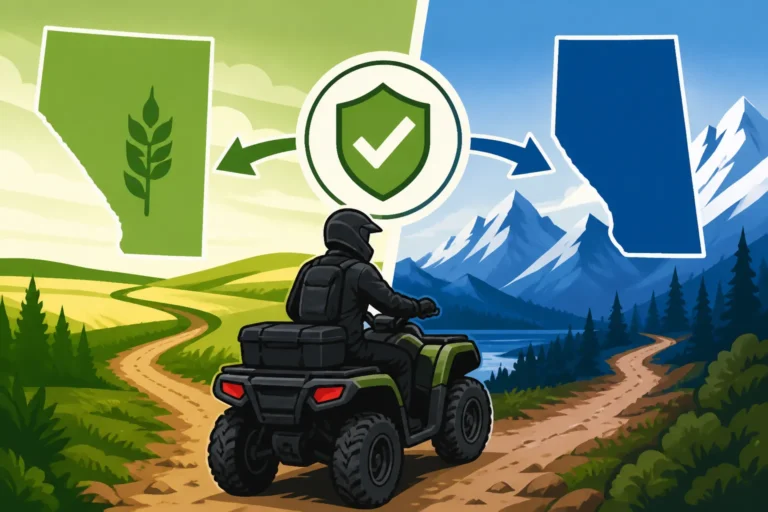
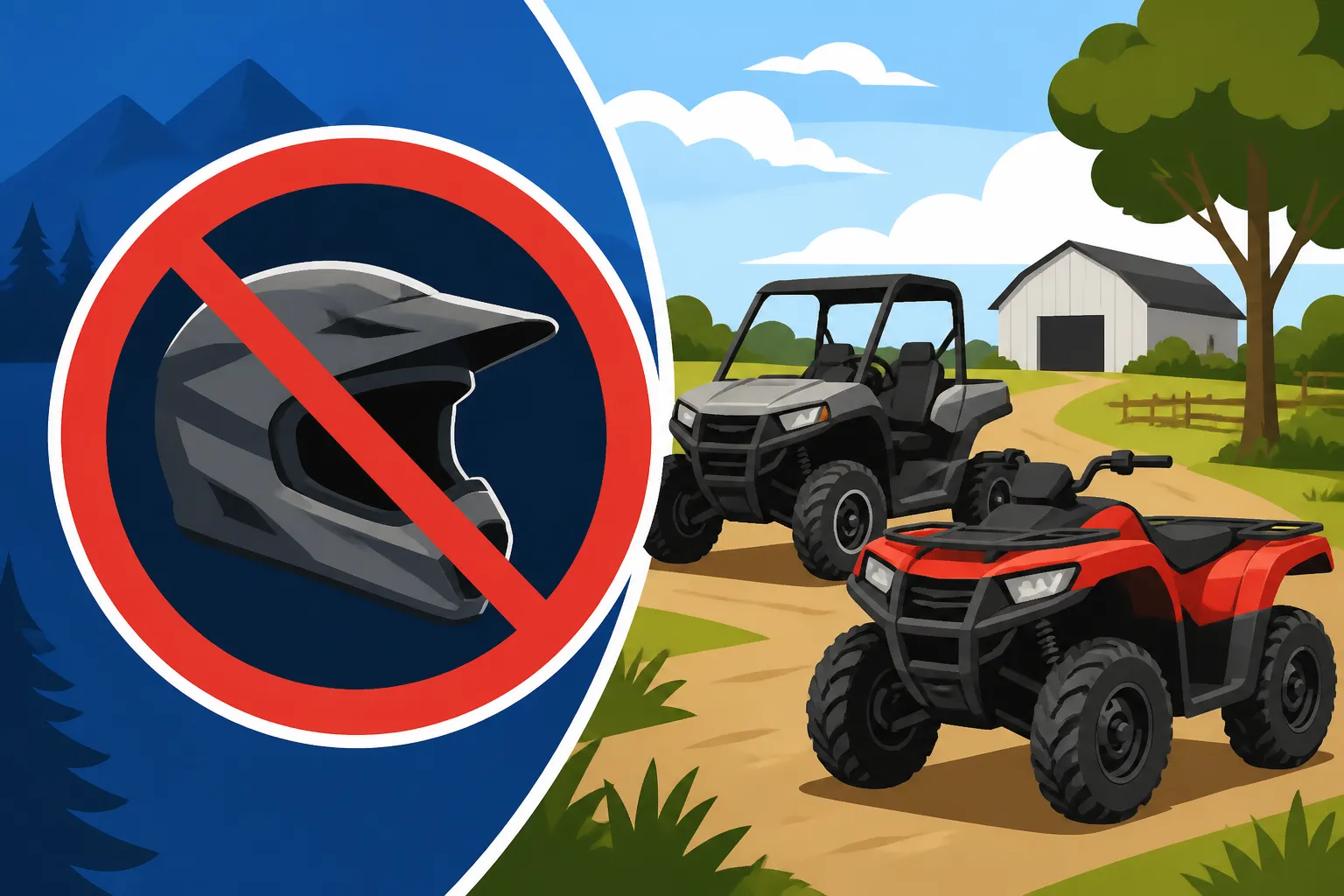
The [Alberta Private Property Helmet Exemption] clearly states that the helmet requirement does not apply to a person operating or riding as a passenger on an OHV on land that is privately owned, and where the operator or passenger has the express or implied consent of the owner or lawful occupier of the land to be there. This is the legal foundation for helmet-free riding on your own, or a friend's, acreage. It means that if you're sticking to your farm fields, your private trails, or your hunting lease (with landowner permission), you don't legally need to wear that approved helmet.
However, the moment you leave that private property boundary – even just to cross a public access road, use a road allowance, or enter Crown land – the helmet mandate immediately kicks back in. This requires riders to be very aware of their surroundings and property lines. It’s easy to drift onto public land without realizing it, especially in areas where property lines aren't clearly marked. Always assume you need a helmet unless you are 100% certain you are on private land with permission.
Common Scenarios for Helmet-Free Riding
Let’s look at some real-world examples where the private property helmet exemption commonly applies:
- Working on the Farm: A farmer driving their ATV or side-by-side to check crops, move equipment, or gather livestock on their own property. This is a classic example of both private property and often falls under the [Alberta Farm and Ranch Work Exemption] as well, making it a double exemption in some cases.
- Acreage Life: Someone riding their quad around their own acreage, maybe to fetch firewood, check fences, or just enjoy a leisurely ride within their property boundaries.
- Private Cabin or Hunting Land: Riding on land owned by a family cabin or a private hunting club, where all riders have explicit permission from the landowner.
- Youth Riders Under Supervision: While Alberta has age restrictions for riders on public land ([Alberta Rules for a 12-Year-Old Rider]), these minimum age rules also don't apply on private property. This means a younger child could ride a youth-appropriate machine on private land without a helmet, provided they have parental supervision and consent.
In all these scenarios, the key is the private nature of the land and the permission to be there. Step off that land, and the rules change instantly.
Safety Considerations Even When Exempt
Just because you're legally exempt from wearing a helmet on private property doesn't mean it's the safest choice. Accidents can happen anywhere, and the impact on private land can be just as severe as on public trails. Many experienced riders still choose to wear a helmet, even when working on their farm or riding around their acreage, simply because the risks of head injury remain the same.
Consider the potential for unexpected obstacles, rollovers, or collisions even at low speeds. A helmet provides crucial protection against these unpredictable events. For side-by-sides, especially if you have a sturdy roll cage (like those often reinforced or accessorized with products from brands like SuperATV), you might feel more secure. However, even with roll-over protection, occupants can still hit their heads on the cage, objects outside the vehicle, or experience whiplash that could be mitigated by a helmet. It's a personal choice, but one that warrants serious thought about your personal safety and that of your passengers. A moment of convenience isn't worth a lifetime of regret.
Distinguishing Private from Public Land: The Critical Difference
This is arguably the most important section for any OHV rider in Alberta. Misunderstanding the line between private and public land is the single biggest reason riders find themselves facing fines or other legal issues, especially concerning helmet requirements. The distinction is not always intuitive.
The Broad Definition of "Highway" in Alberta
Here's the kicker that catches many people off guard: in Alberta, the term "highway" in the Traffic Safety Act is incredibly broad. It doesn't just mean paved roads or busy thoroughfares. [What the Traffic Safety Act Calls a Highway] includes virtually any road, street, trail, avenue, parkway, driveway, or other place or way that the public is ordinarily entitled or permitted to use for the passage or parking of vehicles. This definition also extends to the ditches on either side of these roads, as well as alleys, road allowances, and even unmaintained paths that lead to public access points.
This means that if you're riding your quad down the ditch beside a gravel road, or using an unpaved trail that connects to a provincial highway or municipal road, you are, by definition, on a "highway" and therefore on public land. Even if it feels remote and unused, if the public could access it, the law considers it public. This is why many riders get ticketed for no helmet while doing something as seemingly harmless as moving between two fields across a road allowance. The key takeaway: unless it's unequivocally private land that you or a known landowner control, assume it's public.
Navigating Public Land Use Zones and Designated Trails
Alberta has extensive Public Land Use Zones (PLUZs) and a network of designated OHV trails, such as those found in [Ghost PLUZ Riding in Alberta] or [Castle Park OHV Trails in Alberta]. These areas are undoubtedly public land, managed by the province for various uses, including recreation. When you're in a PLUZ or on a designated trail, the helmet law is in full effect, without exception.
These areas are often clearly marked with signage indicating they are public lands and, in some cases, specific rules for OHV use. It's your responsibility as a rider to know where you are and what regulations apply. Downloading official trail maps, checking provincial websites, or asking local authorities can help you determine the status of the land you plan to ride on. Never assume that an unmarked trail is private; more often than not, it's public Crown land.
Avoiding Accidental Public Land Infractions
Given the broad definition of public land, how do you avoid inadvertently breaking the helmet law?
- Map Your Ride: Before you head out, use satellite imagery or detailed land ownership maps (available from various provincial or municipal sources) to identify property boundaries. Know where private land ends and public land begins.
- Stay Informed: If riding on land you're unfamiliar with, ask the landowner or local authorities about specific property lines. Don't rely on old knowledge or assumptions.
- Err on the Side of Caution: When in doubt, wear your helmet. It's better to be safe and compliant than to risk a ticket or, more importantly, a head injury.
- Avoid Public Connectors: If you’re riding on private land without a helmet, plan your route so you don’t have to cross or even briefly enter any public roads, ditches, or easements. Even a short hop across a municipal road for which [Alberta ATV Road Rules: Bylaws Decide] might not explicitly allow OHVs, can put you in violation.
This vigilance is crucial because officers conducting random checks in OHV areas are well aware of these distinctions, and they enforce them.
Alberta Helmet Exemptions Beyond Private Property
While private property is the most common and broad exemption to the helmet rule, Alberta's OHV regulations acknowledge a few other very specific situations where wearing a helmet isn't legally required. It's important to understand these specific carve-outs, as they are not blanket exemptions and come with their own set of conditions.
Farm and Ranch Work Exemptions
This is a key exemption that often overlaps with private land use. The law provides an exemption for individuals operating or riding as a passenger on an OHV while engaged in bona fide farming or ranching operations. This is particularly relevant for those who use their machines as essential tools for their livelihood. This exemption recognizes that wearing a helmet might, in certain very specific circumstances, impede the work being done, especially if frequent dismounting and mounting is required or if peripheral vision is critical in a tight spot with livestock.
However, this isn't a free pass for recreational riding on a farm. The activity must be directly related to farming or ranching operations. If you're joyriding after chores are done, or using a "farm quad" for purely recreational purposes on public land, the helmet rule still applies. It's about the purpose of the ride, not just the ownership of the machine. An example could be checking fences along a grazing lease, even if the lease land isn't owned outright, if the specific activity is part of the farming operation. More details can be found in [Alberta Farm and Ranch Work Exemption].
Rollover Protection Systems and Seatbelts
For certain types of OHVs, specifically side-by-sides (SxS) or utility terrain vehicles (UTVs), there's another exemption tied to safety equipment. If the OHV is equipped with a rollover protective structure (ROPS) – essentially a factory-installed roll cage – and all occupants are wearing seatbelts (or other occupant restraints) and the vehicle is operating at a speed of 20 km/h or less, then a helmet is not required. This exemption primarily applies to SxS machines, which are designed with features more akin to small cars than traditional ATVs.
This specific exemption acknowledges the enhanced safety features of these vehicles. However, it's critical to note the strict conditions: the ROPS must be factory-installed, seatbelts must be worn, and the speed limit must be adhered to. Many riders modify their UTVs with custom cages or aftermarket parts, but only the original factory ROPS qualifies for this specific exemption. If you remove your original cage and replace it with a SuperATV custom cage, ensure it meets all safety standards, but remember that the exemption specifically refers to the factory ROPS. If you exceed 20 km/h, or if an occupant unbuckles, the helmet rule immediately applies. You can read more on this in [Alberta Rollover Protection Exemption].
Cultural or Religious Exemptions
Alberta also provides a specific exemption for individuals whose religious beliefs prevent them from wearing a helmet. Specifically, a member of the Sikh faith who wears a turban is exempt from the helmet requirement. This is a recognition of cultural and religious freedoms within the province's legal framework. This exemption is highly specific and applies only to turbans worn for religious purposes by members of the Sikh faith. It does not extend to other headwear or to individuals not of the Sikh faith. The purpose of this exemption is to ensure that adherence to religious practices does not unfairly prevent individuals from operating OHVs. [Alberta Turban Exemption for Sikh Riders] provides further clarity on this.
It's crucial to understand that these exemptions are specific and narrow. They are not loopholes but carefully considered allowances for particular situations or beliefs. In all other scenarios on public land, wearing an approved helmet is a legal requirement.
Consequences of Non-Compliance on Public Land
Riding an OHV without a helmet on public land when one is required isn't just a minor oversight; it's a provincial offense with real, tangible consequences. Many riders underestimate the seriousness of these penalties until they're staring at a ticket or, worse, an officer is impounding their machine.
Fines and Penalties for Riding Without a Helmet
If you're caught riding an OHV on public land without a helmet in Alberta (and no valid exemption applies), you can expect to receive a significant fine. While specific amounts can change, these are not typically cheap "slap on the wrist" tickets. You could be looking at a fine that runs into the hundreds of dollars. For instance, [Alberta Helmet Fines and How They Are Issued] often describes fines of $155 for failing to wear an approved helmet. This applies to both the operator and any passengers who are also not wearing a helmet. So, if you're riding two-up with no helmets, both of you could be ticketed, effectively doubling the cost.
Beyond the immediate financial hit, receiving such a ticket can also lead to other complications. It might affect your driving record (though typically not your Class 5 driver's licence directly, as OHV operation is distinct), and repeated offenses could lead to more severe actions. It's a costly lesson to learn, especially when a helmet could have been purchased for a fraction of the fine.
Vehicle Seizure and Insurance Implications
The consequences can escalate beyond just a fine. In more serious instances, particularly if other violations are present (such as impaired riding, or riding without valid registration or insurance), officers have the authority to seize your off-highway vehicle. Losing your machine for a period, even temporarily, can be incredibly disruptive and expensive, involving impound fees and retrieval costs that quickly add up. This is a last resort for enforcement but a very real one, especially for repeat offenders or dangerous operators. This is also a common consequence for other serious infractions like riding without valid [Alberta Requires Insurance on Public Land].
Furthermore, consider the insurance implications. While your OHV insurance might cover damage to your machine or liability in an accident, riding in violation of provincial laws (like not wearing a helmet) could potentially void or reduce your coverage. If you're involved in an accident and weren't wearing a helmet, your insurance provider might argue that you contributed to your injuries or that you were operating outside the terms of your policy, potentially leaving you on the hook for medical bills or damages. This could turn an already unfortunate situation into a financial catastrophe. Always carry your [Alberta Proof of Insurance on Demand] to avoid further issues.
Protecting yourself means not only wearing the right gear but also understanding and adhering to all the rules. It's a small price to pay for peace of mind, both in terms of your safety and your wallet.
Comparative Overview: Public vs. Private Land Riding
To help clarify the distinctions discussed, here's a table summarizing the key differences when it comes to helmet requirements and associated rules for OHV riding in Alberta.
| Feature | Public Land Riding | Private Land Riding (with permission) |
|---|---|---|
| Helmet Requirement | Mandatory (with specific exceptions like ROPS, farm work, religious turban) | Not mandatory (but highly recommended for safety) |
| Approved Helmet Standard | Yes, must meet CSA, DOT, Snell, or ECE standards | Not legally required, but personal choice for safety |
| OHV Registration | Mandatory (e.g., [What Alberta OHV Registration Costs]) | Not required if machine never leaves private property |
| OHV Insurance | Mandatory for liability (e.g., [Alberta Requires Insurance on Public Land]) | Not legally required, but smart for personal liability |
| Age Restrictions | Minimum age 14 for unsupervised operation (e.g., [Alberta's Minimum Age of 14 on Public Land]) | No provincial age restrictions, landowner/parent discretion |
| Driver's Licence | Not required for OHV operation, but must be able to operate safely | Not required |
| Equipment Required | Headlight, tail light, spark arrestor (e.g., [Alberta Requires a Spark Arrestor]) | Not legally required, but smart for safety and machine preservation |
| Fines for Non-Compliance | Significant fines, vehicle seizure possible | No provincial fines (unless local bylaws apply for other infractions) |
| Jurisdiction | Provincial Traffic Safety Act, OHV Regulations, Public Lands Act | Landowner's discretion and general property laws |
This table highlights just how different the regulatory environment becomes once you cross from private to public land. It truly reinforces the need for riders to be aware of their location at all times.
Disclaimer
This article is for general informational purposes only and does not constitute professional advice. Laws, prices and regulations vary by location and change over time. Consult a qualified professional for guidance on your specific situation.