Alberta’s Camping Pass Has Raised $3.6 Million
Alberta’s camping pass has raised $3.6 million, but that headline can leave campers wondering what the money pays for and what the pass actually allows. The key distinction is that it relates to camping on certain public lands, not permission to ride an ATV or UTV. Knowing that difference helps you plan a trip without assuming the pass covers more than it does.
What the $3.6 million figure tells you
The reported $3.6 million is a cumulative amount raised through Alberta’s Public Lands Camping Pass program. It is not an annual fee, an amount charged to each camper, or a price you should expect to pay for one trip. Individual pass costs and options are separate details, and they can change; check the current official information before buying.
The total is useful as a sign that the program has collected substantial revenue. But it does not, by itself, explain how much money was spent in a particular area, what work was completed, or how much was used for any specific purpose. Revenue raised and money spent are different measures. A headline total should not be treated as a project-by-project accounting.
The pass program is intended to support the management of public lands where the camping requirement applies. That can involve the work needed to manage recreation and camping impacts. But the total alone does not guarantee that every campsite, road, trail, or facility will receive maintenance, nor does it tell you what improvements have been made near your destination.
If you want the practical background first, Alberta Public Lands Camping Pass explains the pass program, while Alberta Camping Pass Cost covers the cost question. Confirm current details through the official source before your trip, especially if you are relying on a particular pass option or camping location.
Revenue is not a recreation-area entry ticket
The camping pass is tied to camping on eligible public lands, not to general access to every recreation area in Alberta. It should not be confused with a fee that automatically covers trail use, a reservation, a serviced campground, or access to all public land.
That distinction matters for ATV and UTV trips. A rider may need to think about several separate requirements: where camping is allowed, whether a camping pass is required there, whether the machine can legally be ridden on the intended route, and whether any other access or safety rules apply.
The reported revenue does not mean every person entering a riding area needs the camping pass. It is not a universal charge for using an OHV. Alberta does not have a mandatory province-wide OHV trail pass; Alberta Has No OHV Trail Pass explains that separate issue. A camping pass may still be required if you camp in an area where the camping-pass rules apply.
| Question | What the $3.6 million figure does and does not tell you |
|---|---|
| Is it one camper’s charge? | No. It is a reported cumulative total raised through the program. |
| Does it show the current pass price? | No. Check current official information for prices and options. |
| Does it buy ATV or UTV trail access? | No. The camping pass is not an OHV trail permit. |
| Does it show exactly where the revenue was spent? | No. The total alone does not provide a detailed spending breakdown. |
| Does every camping area require it? | No. Requirements depend on the location and type of camping. |
What the pass does and does not cover
The most useful way to think about the pass is as one requirement that may apply to a camping plan, not as a bundle that settles every access question. Whether you need it depends on where you intend to camp and the rules for that land. A campsite inside a managed recreation area may have different arrangements from random camping on public land, and a pass requirement should not be assumed either way without checking.
The pass also does not replace other responsibilities. It does not grant permission to ride wherever you like, open a closed trail, authorize travel across private land, or override a local restriction. It does not replace vehicle registration, insurance, equipment requirements, or rules that apply to the route. For a trip built around riding, check the destination’s current land-use rules separately from the camping-pass information.
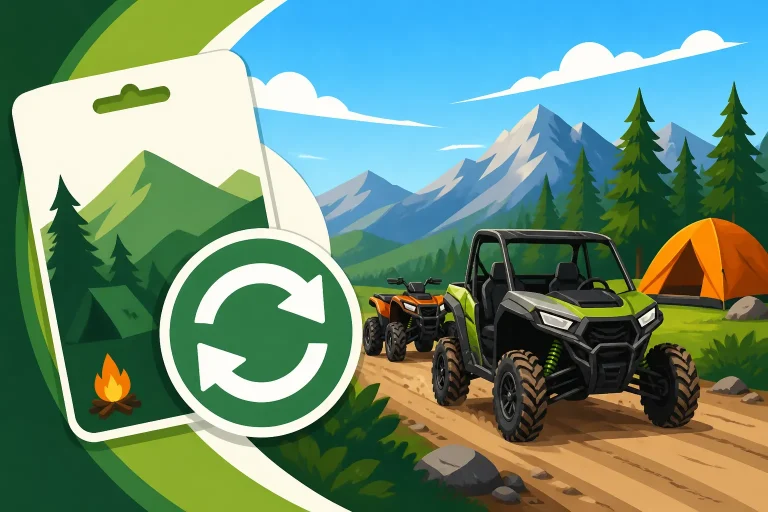
The three-day and annual options are not interchangeable in every planning situation. Review the current terms, including when a pass becomes valid and how its validity period is calculated. Alberta Three-Day Pass vs Annual Pass can help you compare the options, and Renewing an Annual Public Lands Camping Pass is relevant if you already hold an annual pass. Do not rely on an old receipt or an assumption about expiry when planning a later trip.
A pass can also have limits that are easy to miss if you focus only on its name. For example, it may not cover a campground reservation or fees for services and facilities. What the Three-Day Camping Pass Does Not Cover is useful when you are trying to separate the pass requirement from other possible costs.
Camping, riding, and land access are separate questions
For a combined camping and riding trip, ask these questions independently:
- Where are you sleeping? Identify whether you will use a developed campground, an established camping area, or random camping.
- Does the camping-pass rule apply there? Check the official information for the specific place, not just a nearby town or staging area.
- Where will the machine go? Confirm that the route is open to your vehicle type and that riding is permitted under the applicable land-use rules.
- What other requirements apply? Check for closures, local restrictions, registration, insurance, equipment, and any other rules that apply to your plans.
- What proof should you carry? Keep the pass confirmation and any other required documents accessible, including when cell service is unreliable.
This approach avoids a common planning mistake: treating “I bought the pass” as a complete answer to “Can I camp and ride here?” It answers only the requirement it was designed to address.
How to check your trip before you go
Start with the exact camping location. A broad label such as “Eastern Slopes” or “public land” may not be enough to determine which rules apply to a particular site. Use current official maps and information for the area, and check whether there are seasonal closures or other changes. If the rules are unclear, ask the relevant land-management office before setting out.
Next, confirm which pass option is suitable for your dates. The pass’s validity and purchase conditions matter, especially when your trip crosses dates or you are comparing a short visit with repeated outings. How to Buy an Alberta Camping Pass covers the purchase process. The official purchase system is the place to confirm current prices, pass terms, and any instructions about carrying or displaying proof.
If you need a Wildlife Identification Number to use the purchase system, check that requirement before you are at the trailhead. Alberta WIN Card Explained describes the WIN card’s role. A WIN card and a camping pass are different things: one does not automatically stand in for the other.
For an ATV or UTV trip, build a second check around riding access. Look up the exact public land use zone, trail, road, or recreation area you plan to use. Trail access can vary by vehicle type, season, closure, or designated route. A pass purchase does not make an undesignated route legal, and a camping area being open does not necessarily mean every nearby trail is open.
Before departure, save useful details offline. Download the applicable maps, note the official rules and contact information, and keep proof of purchase available in a format you can access without a connection. A phone screenshot can be convenient, but do not assume a screenshot alone meets every requirement; follow the current instructions for the pass. Keep a backup record if possible.
A quick planning checklist
- Confirm that the planned camping spot is on land where camping is permitted.
- Check whether a camping pass is required for that specific location and type of camping.
- Verify the current pass options, price, validity, and proof requirements through the official source.
- Check riding access separately, including vehicle-specific rules and closures.
- Review any additional requirements for your machine and the people riding it.
- Carry the confirmation and maps in a form that remains available outside cell coverage.
Reading the revenue headline in context
The $3.6 million figure is a useful summary of what the camping-pass program has raised, but it is not a complete measure of public-land recreation funding or a promise about conditions at a specific site. It does not establish that every campground or trail is maintained to a particular standard, and it does not tell you whether a specific location has received recent work.
For campers, the practical question is whether a pass is required for the location and dates they have planned. For OHV riders, the additional question is whether their chosen route is open and legal for their machine. Keeping those questions separate makes the pass easier to understand and reduces the chance of arriving with the wrong assumption.
If you are deciding whether to buy a pass, use the official current terms rather than estimating from the revenue headline. If you are deciding where to ride, use the current land-use information for that route. The pass can be part of a responsible trip plan, but it is not a substitute for checking the rules that apply to camping and riding separately.
Disclaimer
This article is for general informational purposes only and does not constitute professional advice. Laws, prices and regulations vary by location and change over time. Consult a qualified professional for guidance on your specific situation.