Alberta Penalties for No Camping Pass
If you ride an ATV or UTV to a public-land campsite in Alberta, a missing camping pass can turn a quiet stop into a ticket. The key is knowing when the pass applies, who in your group needs one, and what it does not authorize. Here’s how to check your plans and reduce the risk of a costly mistake.
When Alberta Requires a Public Lands Camping Pass
The camping pass is tied to camping on public land in designated areas, not simply to owning or riding an ATV or UTV. Whether you need one depends on where you camp and what kind of site you use. A pass is not a universal permit for every campsite in Alberta, and having one does not mean you can camp wherever you find a suitable spot.
The boundaries matter. Before leaving, check the current government information and map for the public land area you plan to use. Don’t assume a familiar trail, staging area or roadside location falls outside the pass area just because it looks different from a campground. For a broader overview of where the pass fits with other camping rules, see Alberta Random Camping Rules Explained.
In the covered area, the pass requirement generally applies to adults camping on public land. Plan for each adult in your group to meet the requirement rather than assuming a single pass covers everyone at camp. Requirements for children, visitors and particular land designations can differ, so confirm the details that apply to your trip. Alberta Passes Needed by Everyone 18 and Older explains the adult requirement, while Alberta Visitors Under 30 Days is useful if you’re riding in from another province or country.
A camping pass is not the same thing as an OHV registration, insurance policy, trail permit or permission to use a specific site. Those requirements address different activities. If you are riding on public land, check the separate rules for your machine as well; Alberta Registration Before Riding Crown Land and Alberta Insurance Requirements on Public Land cover two common requirements for OHV riders.
| Your plan | What to check |
|---|---|
| Camp on public land in a covered area | Whether the pass is required and which adults need one |
| Stay at a developed campground | The campground’s own fees, booking conditions and rules |
| Ride public land but do not camp | OHV registration, insurance and riding rules; don’t assume the camping pass is a riding permit |
| Camp outside the pass area | Other land-use, access and camping rules for that location |
| Ride in from outside Alberta | Whether visitor rules apply to your machine and whether the camping pass is still required |
A pass also does not replace rules about where camping is allowed. Land-use restrictions, closures, fire bans, site limits and access conditions can apply even if you have a valid pass. Check Alberta Camping Limits in One Spot and Alberta Fire Ban Lookups before you set up camp.
What Can Happen If You Camp Without a Pass
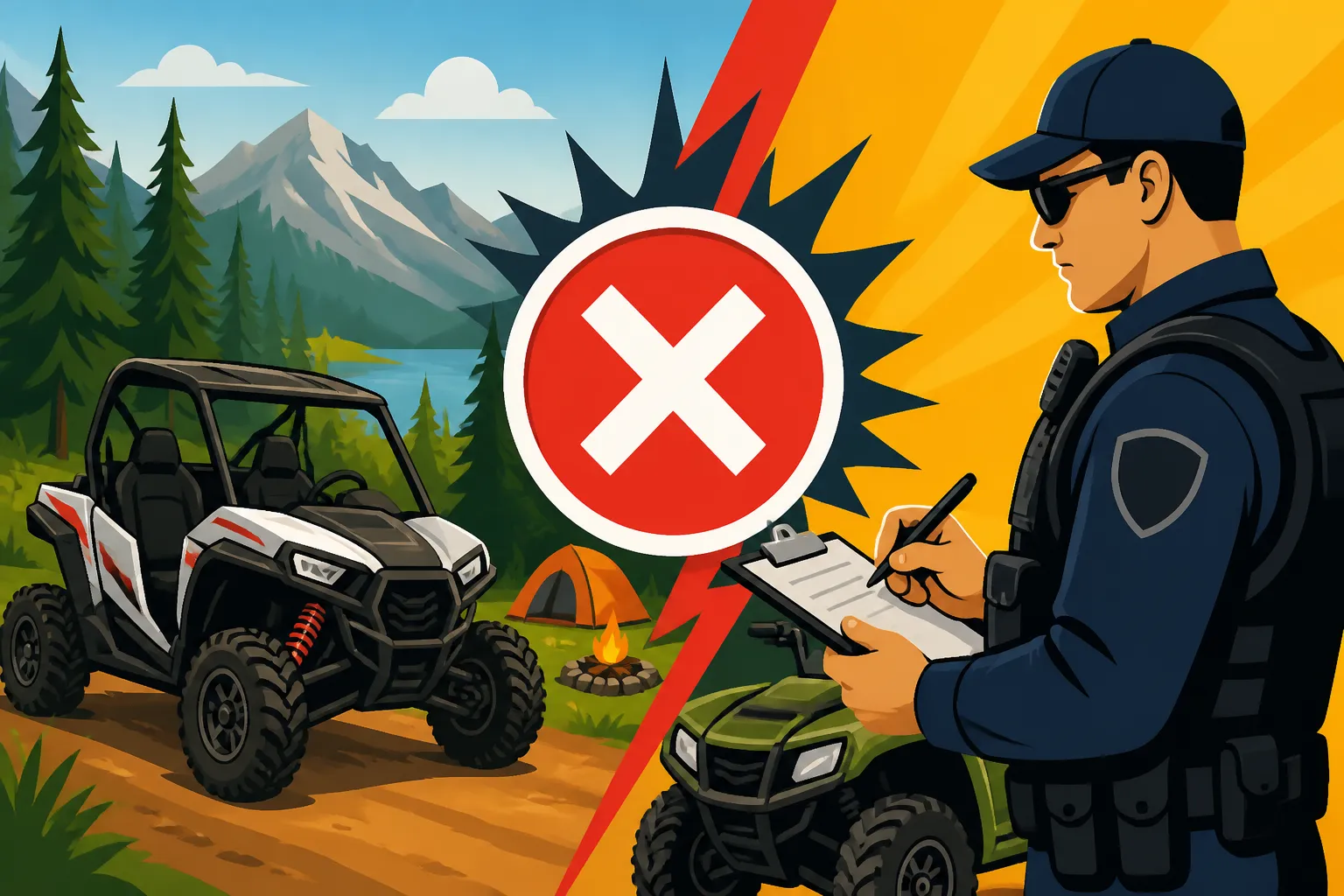
If the pass is required for your campsite and you do not have it, an officer may issue a violation ticket or take other enforcement steps allowed under the applicable rules. The precise penalty can depend on the current law, the circumstances and how the matter is handled. Because fines and enforcement provisions can change, confirm any amount with an official Alberta source rather than relying on an old forum post, trip report or screenshot.
A ticket is not necessarily the only practical consequence. An officer may ask you to show that you have the required pass, clarify where you are camped, or address another issue discovered during the check. If your location is not permitted for camping, buying a pass at that moment will not make the location lawful. You may need to move, and other violations could be considered separately.
It helps to distinguish three situations:
- You are camped in a covered area without the required pass. You could face enforcement for not meeting the pass requirement.
- You have a pass but are camping somewhere you are not allowed to camp. The pass does not grant access or override a closure, restriction or site rule.
- You are only riding through and are not camping. The camping pass may not be the relevant requirement, but your machine and riding activity still have to comply with OHV rules.
A camping pass should not be treated as permission to ride trails, cross private land, enter a closed area or leave designated routes. It also does not excuse failures to carry other required documents. To understand what officials may ask to see during a public-land visit, read What to Show an Officer on Alberta Public Land.
Does a ticket automatically mean you must pay it?
A ticket gives you instructions for responding to the allegation. Read the notice carefully and follow the process and deadline stated on it. Depending on the ticket and the available options, a person may be able to pay it or dispute it through the appropriate process. Ignoring the notice can create additional problems, so don’t leave it in a glove box and assume it will go away.
If you believe you had a valid pass, were outside the area where it was required, or were not camping, keep any useful records. These might include the pass confirmation, proof of purchase, a map showing your location, photographs and notes about the date and circumstances. Use the dispute process on the notice if you decide to challenge it; a verbal disagreement at the campsite is not a substitute for following the formal process.
How to Avoid a No-Pass Ticket on an ATV or UTV Trip
The easiest way to avoid a pass-related problem is to settle the question before you leave home. Identify your actual overnight location, check whether it is public land in a covered area, and confirm the pass rule for that location. “We’ll camp somewhere near the trail” is not specific enough to make that decision.
Use this practical sequence:
- Mark the intended campsite. Check the exact location, not just the nearest town, trailhead or staging area.
- Confirm the land designation and current pass coverage. Use official maps and information because boundaries and access conditions matter.
- Check who needs a pass. Make sure every adult in the group who is subject to the requirement is covered.
- Buy the correct pass before camping. Compare the available options and confirm how their validity period works. For purchase steps, see How to Buy an Alberta Camping Pass.
- Keep proof accessible. Store the confirmation where you can retrieve it without relying on a weak cell signal. If you use a phone, save the relevant information for offline access; a screenshot or saved confirmation can help you locate the details, but follow the official instructions for acceptable proof.
- Check the rest of the trip requirements. Review OHV registration, insurance, fire restrictions, closures and site rules separately.
Buying a pass does not turn an uncertain campsite into an approved one. If a map or sign is unclear, choose a site with clearer status or contact the relevant land-management office before your trip. It is better to resolve the boundary question at home than after your group has unloaded machines and gear.
Visitors should not assume that a home-province plate or a short stay removes Alberta camping requirements. Reciprocity rules for a visiting OHV and the camping pass are separate questions. Check the pass rules for the campsite and the visitor rules for the machine; one does not automatically answer the other.
Keep camping proof separate from riding documents
For an ATV or UTV trip, it is sensible to organize documents by purpose. Keep the camping pass confirmation with your camping information. Keep the machine’s registration and insurance proof available for riding. That makes it easier to respond accurately if an officer asks about a particular requirement.
This matters because a pass check may happen while you are stopped at camp, but a ride can raise separate questions about registration, insurance, equipment or whether the route is open. A valid camping pass does not cure an issue with the machine, and valid OHV paperwork does not replace a camping pass where one is required.
For extra planning help, Alberta Camping Pass Cost explains how to think about pass options and current costs. Check the official provider for current figures and conditions before buying; fees and purchase details can change.
Common Mistakes That Lead to Confusion
The most common mistake is treating the pass as either universal or irrelevant. Neither assumption is safe. It is not a blanket camping permit for all Alberta public land, but it can be required in covered areas even when a rider is only making a short overnight stop. Confirm the land and activity rather than relying on a general impression.
Another frequent mistake is confusing a staging area with a campsite. Parking a trailer or unloading a machine at a staging area does not necessarily mean you are camping there, but the site may have its own rules. Conversely, sleeping near a trail or vehicle does not stop the activity from counting as camping just because you did not pitch a tent. If your plan includes an overnight stay, check the rules for that exact location.
Groups can also assume the organizer’s pass covers all adults. Check the requirement for each person rather than relying on one person’s receipt. If plans change and the group moves to a different public-land area, recheck the pass boundary and local restrictions. The original campsite’s status may not apply to the new one.
Finally, riders sometimes focus only on the pass and miss other restrictions. Public land can be subject to closures, fire rules, access limitations and requirements to camp in particular places. Check the latest official information close to departure, especially after weather events or during a period when fire conditions may change. Alberta Passes Required Year-Round is a useful reminder that seasonal timing alone should not be used to assume a pass is unnecessary.
The practical takeaway is straightforward: a missing pass can lead to enforcement when you camp in an area where it is required, but carrying a pass is not permission to camp anywhere. Verify the location, make sure the right adults are covered, keep proof accessible, and treat camping, riding and land access as separate compliance questions.
Disclaimer
This article is for general informational purposes only and does not constitute professional advice. Laws, prices and regulations vary by location and change over time. Consult a qualified professional for guidance on your specific situation.