Alberta Proof of Residency Documents
If you ride an ATV or UTV in Alberta with an out-of-province plate, you may need to show that you are visiting rather than living in the province. The challenge is that “proof of residency” can mean different things to a registry agent and an officer on a trail. Here’s what documents can help, what they do not prove by themselves, and how to avoid relying on one piece of paperwork.
When proof of residency matters
For a visiting rider, residency documents can help establish where you normally live and whether your machine is still properly registered in its home jurisdiction. Alberta has rules for visitors using an out-of-province machine, and the length of the stay can matter. The visitor period is commonly described as 30 consecutive days, but check the current requirements before relying on it. See Alberta’s 30-Day Rule for Out-of-Province Machines and Alberta Registration for Visiting Riders for the related rules.
Proof of an address is not the same thing as proof that you qualify for every visitor rule. An Alberta address on a document could raise questions about whether you have moved or settled in the province, but it does not settle the issue on its own. Likewise, a mailing address outside Alberta does not necessarily establish that you are only visiting. Your actual circumstances and the current registration requirements matter.
It also helps to separate two situations:
- You are visiting Alberta with a machine registered elsewhere. You may need to show that the machine has valid registration from its home jurisdiction and that you remain eligible to use it as a visitor.
- You have moved to Alberta or are staying beyond the visitor period. You may need to register the machine in Alberta rather than relying on its previous plate. Start with Alberta Visitors Staying Over 30 Days and Alberta ATV Registration for a New Resident.
Proof of residency is not a replacement for the documents that relate directly to the machine. It does not establish ownership, current registration, or insurance. Keep those records available separately. For a broader look at what may be requested at registration, see Alberta Registration and Proof of Address.
A trail or roadside check is also different from a registry transaction. An officer may ask for documents connected to the machine and your ride; a registry agent may need identity and address information to process a registration. Do not assume that the same document list applies in both situations. What an Alberta Officer Can Ask to See explains what to be ready to produce during a check.
Documents that can support your address
There is not one document that works for every purpose. A current government-issued photo ID with your address is often a useful starting point, but an agent may ask for additional evidence or require a particular form of documentation. If your ID is expired, shows an old address, or lists an address in another province, bring current supporting records and ask the registry agent in advance what they will accept.
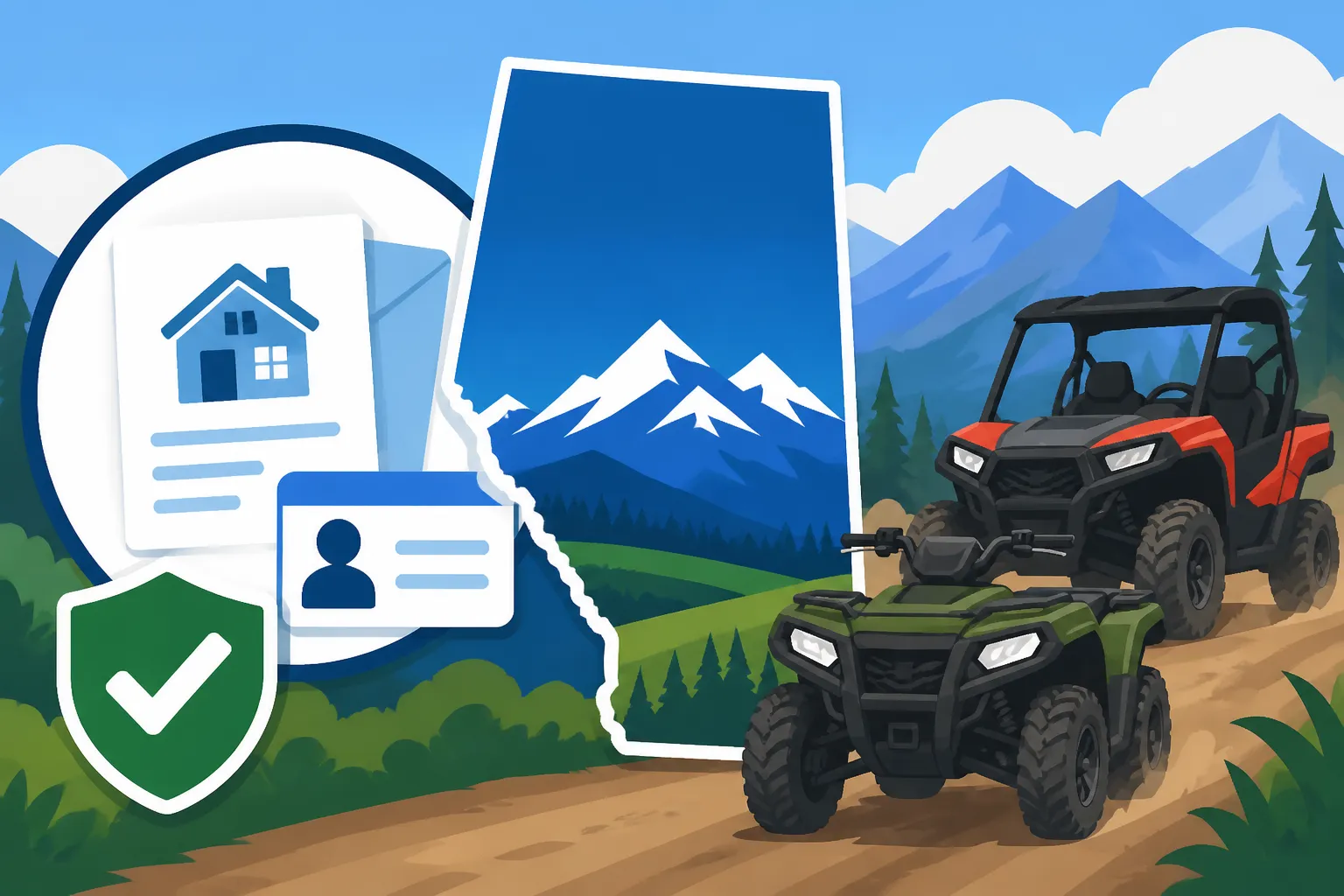
Documents that may help support a residential address include:
- A current provincial driver’s licence or identification card
- A recent utility bill showing your name and service address
- A bank or financial statement showing your current residential address
- A lease or rental agreement
- A mortgage statement or property-tax document
- An official letter or account statement sent to your current address
These are examples of useful supporting records, not a guaranteed list of documents accepted for every transaction. Requirements can depend on the service you are requesting and your circumstances. A registry agent can tell you which documents meet the current requirements for a specific application.
| Document | What it can help show | Possible limitation |
|---|---|---|
| Driver’s licence or government ID | Identity and the address recorded with the issuing authority | It may be expired or show an outdated address |
| Utility or financial statement | A recent connection between your name and an address | It may show a mailing address rather than where you live |
| Lease or rental agreement | A residential arrangement and its stated term | It may not establish when you moved or whether the arrangement is current |
| Mortgage or property-tax record | A connection to a property | Owning property does not, by itself, prove that it is your primary residence |
| Official correspondence | An additional record linking your name with an address | Some correspondence may be unsuitable as formal proof |
The strongest paperwork is usually consistent: the name matches your identification, the address is current, and the dates make sense together. If your driver’s licence shows one province while a recent bill shows another, be ready to explain the difference. A billing address, seasonal cabin, workplace address, and primary residence are not necessarily interchangeable.
If you are registering a machine in Alberta, ask the registry agent about the specific transaction before you go. Requirements for establishing identity or an Alberta address can depend on the service. The article Alberta Proof of Residency for Visitors covers the visitor question more directly, while Alberta Registry Agents and OHV Paperwork can help you prepare for a registry visit.
What to carry as a visiting rider
A visitor’s paperwork should make it straightforward to identify both the rider and the machine. Keep documents together in a secure, accessible place, and make sure the details are current. If you are travelling as a group, each rider should know where their own identification and machine records are.
A practical set of documents to carry may include:
- Photo identification. Carry current identification that matches the person riding.
- The machine’s registration. Bring the current registration issued by the home jurisdiction, with details that match the machine.
- Insurance proof. Carry evidence of valid insurance and make sure the policy applies to the type of riding you plan to do. Alberta has insurance requirements for riding on public land; see Alberta Proof of Insurance on Demand.
- Address support, if your visitor status may be questioned. A current ID plus a recent supporting document can help explain where you live, especially if your identification has an old address or your travel arrangements are unusual.
- Purchase or ownership records when relevant. If the registration is not in your name, or you recently bought the machine, keep the sale and ownership paperwork available as well.
Do not treat a phone photo as a guaranteed substitute for an original document. Digital records can be convenient, but a device can lose power, fail to connect, or display an image that an official cannot accept for the purpose at hand. Keep required originals with you when practical, and use electronic copies as backups. For related advice about organizing visitor documents, see Carrying Proof of Residency.
Before leaving home, compare the names, addresses, plate details, and machine identification across your records. A small mismatch can make a simple check harder. For example, a registration certificate may still show a previous owner, or the mailing address on an insurance document may not match the address on your identification. If a record is wrong, contact the issuer rather than assuming an explanation will be enough.
When your address or plans change
The question becomes more important if you have recently moved, are spending an extended period in Alberta, or keep a machine at a seasonal property. A property, cabin, or job site in Alberta does not automatically answer where you reside for registration purposes. Conversely, continuing to receive mail at an old address does not necessarily mean you still live there.
If you have moved to Alberta, do not rely only on an out-of-province address to keep using visitor rules. Check the current requirements for registering a machine as a new resident and update records where required. Alberta Registration and Proof of Address and Alberta ATV Registration for a New Resident are useful starting points. If you are uncertain whether your stay counts as a move or a visit, ask an Alberta registry agent or the relevant official office and describe your actual situation.
If you are visiting for a longer trip, keep a simple record of when you arrived and when the machine entered Alberta. This can help you track the visitor period, especially if the machine has been in the province before or your trip includes time away and a return. Do not assume that taking the machine across a provincial border automatically resets a time limit; check how the current rule applies. Thirty Consecutive Days and the Clock explains why the timing deserves attention.
A few common assumptions can lead to trouble:
- “I own a home outside Alberta, so I am automatically a visitor.” Property ownership alone may not establish your current residence.
- “My Alberta cabin address proves I live there.” A seasonal or recreational property may not be the same as your primary residence.
- “My licence has my old address, so I can use it as proof.” An outdated document may create more questions than it answers.
- “A bill with my name on it proves everything.” A bill can support an address, but it does not prove the machine’s registration, insurance, or your eligibility to ride as a visitor.
- “A photo on my phone will always be accepted.” Acceptance depends on the document and the purpose of the check.
When in doubt, contact a registry agent before the trip or before applying for registration. Describe whether you are visiting, recently moved, or staying for an extended period; say where the machine is registered and what service you need. Ask what proof is accepted, whether originals are required, and whether any other machine documents are needed. That short check is more reliable than guessing from a generic list.
Disclaimer
This article is for general informational purposes only and does not constitute professional advice. Laws, prices and regulations vary by location and change over time. Consult a qualified professional for guidance on your specific situation.