Does a Printed Registration Certificate Count on the Trail?
You’re all geared up, machine sparkling, fuel tank full, and ready to hit those incredible Alberta trails. But then a thought niggles: you registered your OHV online, and the certificate is an email on your phone. Will that digital proof actually cut it if an enforcement officer asks for your papers deep in the backcountry? This guide will clear up the common confusion around whether a printed registration certificate counts on the trail in Alberta, and why a physical copy often provides the best peace of mind.
The Heart of the Matter: What Counts as Valid Proof of Registration in Alberta?
When you’re out enjoying Alberta’s vast network of OHV trails, the last thing you want is a legal snag to interrupt your adventure. One of the most common questions riders have revolves around proving their machine is registered. It's easy to assume that because so much of our lives are digital now, a quick flash of your phone screen will suffice for official documents. However, when it comes to off-highway vehicle registration in Alberta, the reality can be a little more nuanced, and often, more traditional.
Decoding Alberta's Off-Highway Vehicle Regulation
Alberta’s Traffic Safety Act and its associated Off-Highway Vehicle Regulation are the foundational pieces of legislation that dictate how we operate our quads, side-by-sides, dirt bikes, and snowmobiles. The regulation generally states that you must carry proof of registration for your OHV when operating it on public land. The wording typically refers to a "certificate of registration" or "registration certificate." It doesn't explicitly mandate a paper copy over a digital one in every single scenario, which can be the source of much confusion.
However, the spirit of the law, and the practicalities of enforcement, lean heavily towards having something tangible that can be easily inspected. Think about it: an officer isn't going to scroll through your emails or ask for your phone password to verify a PDF. They need to quickly ascertain that your machine is legally registered, and a clear, printed document streamlines that process significantly. This is why many experienced riders will tell you that while the law may not explicitly say "paper only," it's certainly the safest bet.
The Unspoken Standard: Why Paper Still Reigns Supreme
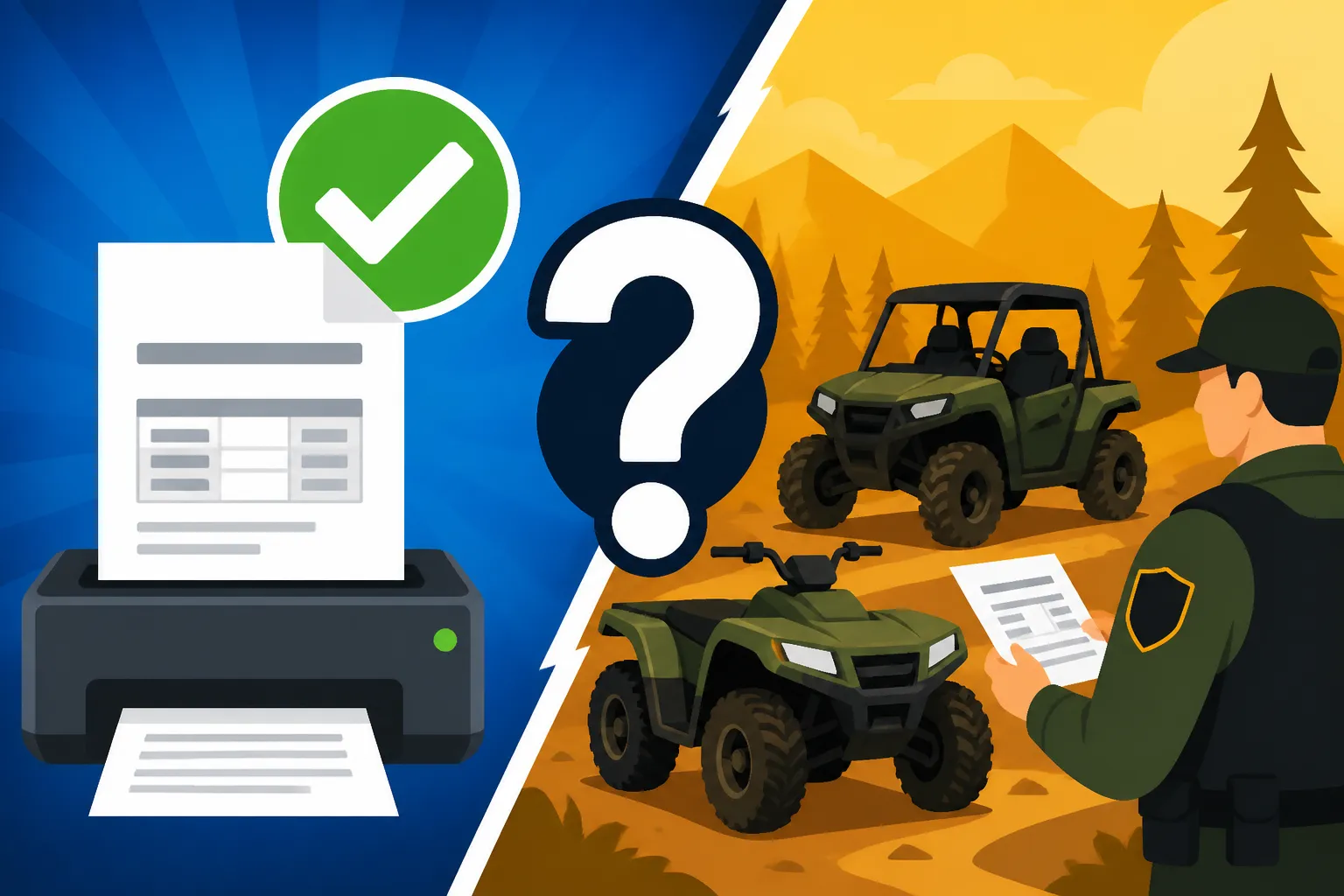
Despite the rise of digital documents, a physical, printed copy of your OHV registration certificate often remains the unspoken standard when dealing with law enforcement on the trails. There are several very practical reasons for this. Firstly, officers are trained to look for certain official markers and formatting that are consistent on a printed certificate issued by a registry agent. A digital image, no matter how clear, can sometimes raise questions about its authenticity or currency, especially if it looks doctored or is difficult to read due to screen glare or damage.
Secondly, and perhaps most importantly, having a paper copy demonstrates a level of preparedness and compliance that can positively influence an interaction with an officer. It shows you've taken the steps to ensure your documentation is readily available and verifiable, even in the most remote areas. It’s about more than just meeting the letter of the law; it’s about making the officer’s job easier and showing that you’re a responsible rider. For further clarity, you might want to review [Printing a Certificate Before You Ride] or even [What an Alberta Officer Can Ask to See] to understand their perspective.
The Perils of Relying Solely on Your Phone
While it might seem convenient to keep your registration certificate as a PDF on your smartphone, this approach comes with several inherent risks that can quickly turn a fun day into a frustrating one. Imagine you’re deep in the Kananaskis, miles from any cell service, and your phone battery suddenly dies. Or, perhaps you take an unexpected spill, and your phone screen shatters, rendering your digital documents unreadable. These aren't far-fetched scenarios; they're very real possibilities in the rugged environment of Alberta's OHV trails.
Furthermore, relying on a digital copy requires your phone to be charged, functional, and easily accessible. Officers often patrol areas with limited or no cell service, which means downloading your certificate on the spot might not even be an option. A physical document, tucked away safely in a waterproof bag, isn’t dependent on battery life, signal strength, or screen integrity. It’s always there, always readable. Don't risk a potential ticket or, worse, a vehicle seizure because technology failed you when it mattered most. For details on potential consequences, look into [Alberta Penalties for Riding Unregistered].
Getting Your Paperwork in Order: From Registry to the Trail
Once you've registered your OHV, whether it’s for a brand-new machine or a used one, the process of obtaining and preparing your certificate for trail use is straightforward. However, overlooking these simple steps can lead to unnecessary complications down the line. It’s all about ensuring you have a verifiable, accessible document when you need it most.
How Your Registration Certificate is Issued
When you register your OHV in Alberta, typically through a local registry agent, you'll receive a certificate of registration. This document will contain vital information about your machine, including the VIN, make, model, and your details as the owner. If you register in person at an Alberta Registry Agent, they will usually print a physical copy for you right there on the spot. This is often the most direct way to get your hands on a paper certificate.
If you register online or renew your registration virtually, you’ll likely receive an email with your certificate as a downloadable PDF. This is where many riders pause, assuming the digital file is sufficient. While the digital file is your official certificate, the crucial next step is to print it out. Always ensure that the printed version is clear, legible, and shows all the details exactly as they appear on the digital file. This simple act closes the loop between your digital record and the practical need for a physical document on the trail. You can learn more about this process in [Alberta Registry Agents and OHV Paperwork] or [Registering an ATV in Alberta Online].
Ensuring Your Printed Certificate is Up-to-Date and Accessible
Having a printed certificate is one thing; ensuring it’s the most current version and readily available is another. Before every riding season, or certainly before any significant trip, take a moment to double-check your registration certificate. Verify that the expiry date is still valid and that all information, such as your address or machine details, is accurate. If you’ve recently renewed your registration, make sure the copy you're carrying reflects that renewal. [When an Alberta OHV Registration Expires] can help you track those dates.
Accessibility is key. Your certificate should be stored in a place on your OHV that is easy to reach, even if you’re still strapped into your machine. Fumbling through a backpack or trying to dig it out of a deep storage compartment while an officer waits isn't ideal. Many riders opt for a small, secure, waterproof compartment on their machine, or a dedicated pocket in their riding jacket. The goal is to present it quickly and efficiently.
The Smart Way to Carry Your Documents
So, you've printed your certificate. Now what? Simply stuffing it into your pocket might seem okay, but the elements on the trail – dust, mud, rain, and sweat – can quickly render it unreadable. The smartest way to carry your printed registration certificate, and any other important documents, is in a waterproof and tear-resistant pouch or bag. Many outdoor supply stores sell small, durable zip-lock style pouches specifically designed for documents.
Consider making a couple of copies as well. Keep one on your person (e.g., in a jacket pocket), and another securely stored on the machine. This way, if one copy gets lost or damaged, you have a backup. It’s a small effort that can save a lot of grief. Remember, the goal isn't just to have the document, but to have it in a condition where it can be easily inspected by an officer.
Beyond Registration: A Full Kit of Essential Trail Documents
While your OHV registration certificate is paramount, it's just one piece of the puzzle for responsible and legal riding in Alberta. There are other documents that are equally, if not more, critical to have on hand. Being fully prepared means having a complete set of papers, not just the registration.
Don't Forget Your Insurance: A Separate, Critical Requirement
This is a big one. In Alberta, operating an OHV on public land requires valid insurance. And just like with your registration, you must be able to produce proof of that insurance on demand. The rules around insurance are explicit and often carry significant penalties if violated, including potential vehicle seizure. Even if your registration is perfect, lacking proof of insurance can quickly derail your ride.
Always carry a current copy of your OHV insurance liability card or certificate. Again, a printed copy, secured in a waterproof pouch, is the best approach. Relying on a digital version of your insurance is just as risky as relying on a digital registration certificate. Many registry agents will issue insurance cards when you get your policy, making it easy to grab a physical copy. For more on this, check out [Alberta Requires Insurance on Public Land] and [Alberta Proof of Insurance on Demand].
Personal Identification and Other Useful Papers
Beyond your OHV-specific documents, you should also carry valid personal identification. Your driver's license, even if you don't need it to operate the OHV (as OHVs don't typically require a specific driver's license on most public land), serves as essential ID. It allows an officer to verify who you are, which is crucial during any interaction.
Additionally, if you plan to ride on any private land, even if it's just crossing a rancher's field to get to public trails, you absolutely need to carry written permission from the landowner. Verbal permission is often insufficient in a legal context, especially if there's a dispute or an incident. A formal letter, stating the landowner's name, your name, the dates of permission, and a description of the land, provides invaluable protection. If you need help drafting such documents, resources like LawDepot offer templates for various legal agreements, including letters of permission or bills of sale, which can be a real lifesaver. This simple piece of paper can prevent charges of trespassing. Consider also [Alberta Private Land Permission].
When Buying or Selling: The Importance of a Solid Bill of Sale
If you've recently purchased your OHV through a private sale, it's incredibly important to carry a copy of the bill of sale, especially if the registration is still in process or newly transferred. This document proves ownership and can answer questions about the machine's origin. A clear, legally sound bill of sale should include the seller's and buyer's full names and contact information, the OHV's VIN, make, model, purchase price, and date of sale.
Don't just rely on a scribbled note. A properly drafted bill of sale protects both parties and makes the registration transfer process smoother. This is another area where services like LawDepot can be incredibly helpful, providing professional templates that ensure all necessary legal details are included. Carrying this ensures you can prove you legitimately own the machine, which is critical if an officer has questions about its provenance. Read [Alberta Private Sale Paperwork] for more tips on this.
Navigating an Enforcement Stop: What to Expect and How to Be Prepared
Enforcement officers are out on the trails for our safety and to ensure compliance with the law. A friendly and prepared interaction is always the best outcome. Knowing what to expect and having your documents in order can make all the difference between a quick chat and a stressful situation.
What an Officer is Looking For
When an enforcement officer stops you on the trail, they are typically looking to verify several key things. First and foremost, they'll want to see your identification. Your driver's license (or other government-issued ID) will suffice for this. Next, they'll ask for proof of your OHV's registration. This is where having that clear, printed certificate, securely stored, becomes vital. They'll check the VIN on your certificate against the VIN on your machine.
Then comes proof of insurance. As mentioned, this is a separate and equally important document. They'll verify the policy is current and covers the OHV you are operating. Beyond paperwork, they might also perform a quick visual inspection of your machine to check for required safety equipment like a working headlight and tail light, a spark arrestor, and that your exhaust isn't illegally modified. They may also check for helmet compliance, particularly with [Alberta Helmet Law on Public Land].
Consequences of Insufficient Documentation
Failing to produce adequate proof of registration or insurance can lead to significant penalties. These can range from a hefty fine to the temporary seizure of your OHV. Imagine having your quad impounded miles from your truck, leaving you stranded and with a long walk back. It's a reality that no rider wants to face. Officers have the discretion to issue warnings, but they also have the power to enforce the law to its fullest extent.
Beyond the immediate financial cost and inconvenience, a violation can also affect your riding privileges or future insurance rates. It’s simply not worth the risk of being caught unprepared. The small effort of printing and properly storing your documents pales in comparison to the hassle and expense of a citation. For more specifics on costs and seizures, refer to [Alberta Penalties for Riding Unregistered] or [Alberta Vehicle Seizure for No Insurance].
Proactive Steps for Peace of Mind
To truly enjoy your Alberta OHV adventures without a looming worry, adopt a proactive approach to your documentation. Before every ride, especially when heading to new or remote areas, run through a quick mental checklist:
- Is my OHV registration certificate printed, current, and in a waterproof pouch?
- Do I have my current proof of insurance, also printed and protected?
- Is my personal ID easily accessible?
- If applicable, do I have written permission for any private land I plan to cross?
Consider putting together a small "document kit" that stays with your machine or in your riding gear. This way, you'll never accidentally leave essential papers behind. A laminated copy of important contact numbers (emergency, family, insurance provider) is also a smart addition. For public land access, a Public Lands Camping Pass might be needed, and you can learn about that in [Alberta's Public Lands Camping Pass]. A little preparation goes a long way in ensuring your focus stays on the incredible experience of riding, not on bureaucratic anxieties.
Here's a quick comparison of printed vs. digital registration certificates:
| Feature | Printed Registration Certificate | Digital Registration Certificate (on phone) |
|---|---|---|
| Legality | Generally accepted as valid proof by enforcement. | May be accepted, but often at officer's discretion; less reliable. |
| Reliability | Not dependent on battery life, signal, or screen function. | Highly dependent on phone battery, cell signal, and screen integrity. |
| Accessibility | Easily presented, no technical issues. | Can be difficult to access in remote areas or if phone is damaged/dead. |
| Durability | Can be stored in a waterproof pouch, resistant to physical elements. | Phone itself is vulnerable to water, drops, dust, and extreme temperatures. |
| Verification | Officers can quickly inspect for authenticity and required details. | May raise questions of authenticity; glare or small screen can hinder inspection. |
| Peace of Mind | High, knowing you have undeniable proof. | Lower, constant worry about phone issues. |
Disclaimer
This article is for general informational purposes only and does not constitute professional advice. Laws, prices and regulations vary by location and change over time. Consult a qualified professional for guidance on your specific situation.