Alberta Campgrounds Near a Staging Area
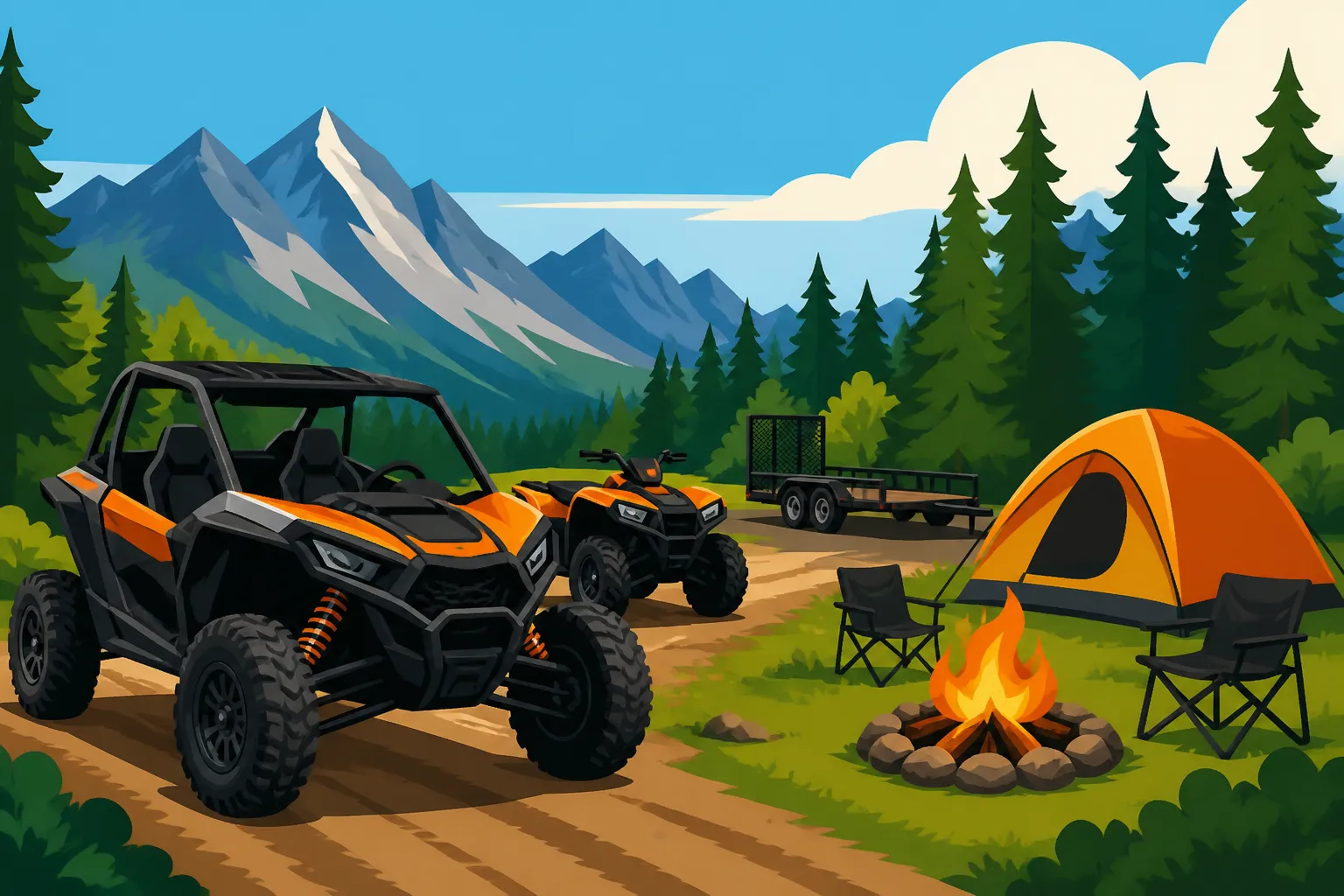
Finding a campground close to an Alberta ATV or side-by-side staging area can save a lot of towing and make early starts easier. The catch is that a staging lot is not automatically a campsite, and nearby public land may have its own rules. This guide explains how to choose a legal, practical base for riding without mistaking trail access for permission to camp.
How to choose a campground near an Alberta staging area
Start with the kind of camping you want
A campground near an OHV staging area can mean several different things: a developed campground with assigned sites, a public-land camping area, a designated camping node, or a place where random camping is allowed under applicable rules. Those options are not interchangeable. A flat gravel lot beside a trailhead may be intended for parking and unloading only, not tents, trailers, campfires, or overnight stays.
Before reserving or driving out, identify the actual camping location and the actual staging location separately. Check whether the campground has trailer-friendly sites, whether your machine can be transported legally from camp to the staging area, and whether the connection between them is a permitted road or trail. A campground can feel close on a map but still require a longer tow if there is no legal route between the two.
This distinction matters in popular riding areas such as McLean Creek and the Ghost Public Land Use Zone. Both are well-known for OHV access, but the rules and facilities vary by specific location. Start with [Alberta OHV Camping and Staging Areas] and the relevant zone information, such as [McLean Creek: Alberta's Best Known OHV Area] or [Ghost PLUZ Riding in Alberta]. Then confirm the camping rules for the precise site you plan to use rather than assuming every nearby clearing is available for overnight use.
Decide how close is close enough
“Near the staging area” does not have to mean right beside it. For some riders, the best arrangement is a campground a short drive away, with a secure place to park a truck and trailer overnight. For others, staying near a designated camping area and towing to the staging point each morning is more comfortable than camping in a busy trailhead lot.
Think through your group’s routine. If you have young children, a large trailer, or several machines to unload, reducing the morning drive can make the trip much less stressful. If you are riding with a small group and can pack efficiently, a quieter campground farther away may be worth the extra travel. Also consider what happens when the weather turns: a site with room to manoeuvre a trailer and a firm access road may be a better choice than the closest site with muddy or narrow access.
Use this quick comparison to narrow your options:
| Camping option | Best for | Questions to check |
|---|---|---|
| Developed campground | Families, groups, and riders who want established facilities | Are reservations needed? Are trailers accommodated? Are there restrictions on parking or unloading machines? |
| Designated public-land camping node | Riders seeking a camp within an approved public-land area | Is camping permitted at that specific node? What pass or other requirements apply? |
| Random camping where allowed | Experienced campers who want a less developed setting | Is the location eligible? Are there distance, duration, fire, or site-impact rules? |
| Staging area parking lot | Day-use parking and unloading, unless overnight use is expressly allowed | Does the site permit overnight stays, or is it only a trailhead? |
The right answer depends on the group, not just the distance. A family that wants toilets and a predictable place to park may prefer a developed campground. A self-contained camper who is comfortable following public-land rules may have other options, but should verify that the specific location allows overnight camping.
Finding riding areas with camping options
Check the area rules before choosing a site
Begin with the land manager’s information for the riding zone and camping location. Look for rules covering designated trails, camping areas, access roads, fire restrictions, seasonal closures, and vehicle types. A trail may be open while a nearby route or camping area is closed, so do not treat a general “area open” notice as confirmation that every activity is allowed.
The Ghost PLUZ is a useful example of why location-level checking matters. Camping opportunities may be limited to marked or designated places, and the rules for where you can camp are separate from the rules for where you can ride. Review [Ghost PLUZ Camping Nodes in Alberta] along with current public-land information before choosing a site. Do not assume an attractive pullout, meadow, or spot beside a trail is an approved camping location.
McLean Creek is another area where riders should plan the camp and ride as two connected but separate parts of the trip. Research the staging and camping details for the location you intend to use, and confirm whether the campground or camping area is open and suitable for your vehicle. [Alberta Trails With Camping] can help you identify the kind of riding-area options to investigate, but you should still confirm site-level details before setting out.
Use maps to plan the route, not to replace permission
Maps are excellent for comparing distances, spotting access roads, and seeing whether a campsite appears close to a staging area. They do not establish that you may camp there, ride a particular track, or drive an OHV on a road. Private land, lease roads, closures, and designated-use restrictions can be hard to interpret from a map alone.
A practical approach is to use an official land or trail map for rules and boundaries, then use a navigation app such as onX Offroad as a planning aid for orientation and route context. Check that the map layer and route information match the area you plan to visit, and download the information you need before leaving reliable service. In the foothills and other remote areas, a phone may lose signal well before you reach the staging area.
Treat app markings as a prompt to verify, not as permission. If a line appears to connect your campground to the trail network, confirm that the route is open to your machine and that riding it is allowed. For additional planning help, consult [Alberta Trail Maps Worth Downloading] and [Checking a Zone Before You Go]. Carry an offline map or a second navigation option, and make sure someone in your group knows the route and the planned return time.
Planning the campground and staging-area logistics
Confirm trailer access, parking, and unloading
A campground that welcomes recreational vehicles may still be awkward for an ATV trip. Before booking, ask whether your site can accommodate the complete setup: truck, trailer, machine, and any extra gear. Look closely at turning room, site length, road width, slope, and the surface of the access road. A site that fits the trailer but leaves nowhere to park the truck can create a frustrating arrival.
Then check the staging area itself. Some lots are busy, have limited room, or are not suitable for leaving a trailer for an extended period. Find out whether parking is allowed overnight, whether the staging area has designated trailer spaces, and whether your group can unload without blocking other users. [Alberta Staging Areas With Trailer Parking] is a useful starting point for this part of your planning.
If the campground is not directly connected to an approved OHV route, plan to haul the machines between camp and the staging area. Do not ride on a public road, ditch, or private access route merely because it looks like the shortest connection. Municipal rules and land permissions can change from one route to the next. If the route is unclear, contact the relevant campground, land manager, or local authority before you ride.
Prepare for a remote or lightly serviced stay
Not every riding-area campground offers the same amenities. Check whether there is potable water, a dump station, garbage disposal, toilets, fire facilities, or reliable cell service. If the site is basic, arrive with enough drinking water, food, fuel, and supplies for your group, and know where the nearest services are before you leave home. Fuel availability can be limited in smaller communities and remote areas, so plan your machine’s range as well as your tow vehicle’s.
For a less developed site, be ready to manage waste and leave the area clean. Keep cooking and camp equipment organized, secure food and scented items, and avoid creating a larger campsite footprint than necessary. Follow local fire restrictions and use only permitted fire locations. If a fire ban is in effect, do not assume that a built fire ring makes a fire acceptable.
Navigation planning matters just as much as packing. With onX Offroad, you can prepare a route view and save map information before the trip, but make a separate plan for emergency communication if your chosen area has dead zones. Tell someone where you are going, where you intend to camp, and when you expect to return. For a group ride, agree on a meeting point at the staging area in case machines or riders become separated.
Rules and final checks before you go
Verify camping passes and local requirements
Public-land camping rules depend on where you are staying. Some areas require a camping pass, while other locations may have different requirements or fall under a separate campground system. Check the applicable land information for your exact destination, including whether a pass is needed, who must have one, and how it must be carried or shown. Start with [Alberta's Public Lands Camping Pass] rather than assuming one pass covers every overnight location in the province.
Also check the camping limit and site-use rules that apply to the area. Restrictions may cover how long you can stay, whether you must use a designated node, how far a camp must be from certain facilities, or how you should manage a fire. The rules are not a minor detail to sort out after arrival: a site that is convenient but not permitted can mean packing up and relocating when the group is tired and the light is fading.
Keep copies of reservations and any required permits accessible, either in paper form or saved for offline use. If you are uncertain whether a site falls within a particular public-land area, ask the land manager or campground operator to confirm the location. Pinning a spot on a phone map is useful for navigation, but it is not proof that camping is allowed there.
Check the machines and the ride plan
Before departure, confirm that each machine is ready for the terrain and the rules that apply where you plan to ride. Check tires, brakes, lights, fuel, and any equipment required for the trip. Review registration and insurance requirements for public-land riding, and carry the documents you may be asked to show. If you are bringing a visiting machine or riding with a mixed group, verify that everyone’s paperwork and equipment are in order.
Make a route plan that suits the least experienced rider and the machine with the least capability. Mark the staging area, camp, fuel stops, turnaround points, and any locations where the group should regroup. Agree on a simple procedure for a breakdown or separation before anyone leaves the lot. A short, clear plan helps avoid the familiar trailhead scramble where everyone is adjusting gear while the group is already moving.
OnX Offroad can help keep the planned route visible, especially when the group is unfamiliar with the area, but pair it with official information and common-sense judgment. Recheck for closures or restrictions before the ride, and turn around if conditions are unsafe or a route is not clearly permitted. The most convenient campground is only a good choice when the camping location, route to the staging area, and ride itself all fit the rules.
A smooth Alberta riding trip starts with three separate confirmations: a legal place to camp, a suitable place to stage, and a permitted route between them. Once those details are settled, you can choose a base that fits your trailer, your group, and the kind of facilities you want. The nearest campsite is not automatically the best one; the best choice is the one that makes the whole trip work.
Disclaimer
This article is for general informational purposes only and does not constitute professional advice. Laws, prices and regulations vary by location and change over time. Consult a qualified professional for guidance on your specific situation.